Blog

  • iCloud thoughts

    On June 6, Apple announced a number of products at a keynote speech to kick off its worldwide developer conference. Mac OS X Lion and iOS 5 were widely anticipated; but the one that got the most attention was a service called iCloud.

    This service has received a fair bit of coverage and its worthwhile reflecting upon, some of this reflection has to do with all the things that we don’t currently know. I am not  going to focus on the iTunes Connect product that gives you a selection of your music across devices as other people have done that much better than I could.

    First of all a bit of a history lesson

    Apple has actually selling online services since about 1985, so Apple’s history with online services is almost as old as The WELL. AppleLink was an online service set up originally to connect Apple employees and dealers, it had a client software application for both Mac and the later models of the Apple II. It provided assess to remote server folders (kind of like FTP, iDisk, Box.net or Dropbox), bulletin boards for discussion and system-wide email (though interoperability with other email systems came in later).

    This system was a way that Apple distributed systems updates and drivers to dealers (you have to remember that at that time operating systems and the associated software that went along with them took up much less memory than they do today). This was all hosted on time-shared mainframes and connected by a global data network by GE Information Services. GE charged too much for the service and didn’t reflect the technological changes coming down the pipe that made these services cheaper to operate. So Apple eventually worked with Quantum Computer Services (now known as Aol) to develop a version of AppleLink suitable for consumers.

    The first email from space was sent on an Apple Portable via an AppleLink account from the Atlantis space shuttle to the Johnson Space Center in 1991. Back in 1988, AppleLink was also the host for a multi-channel story that played out with weekly episodes and included user identities woven into its plot. The storytelling used chat rooms and email was well as a more traditional narrative format echoing Matt Beaumont’s novel e by about 12 years.

    After a while, Apple, had a falling out with GE Information Services and consolidated their own service renamed eWorld and had it run by AOL.
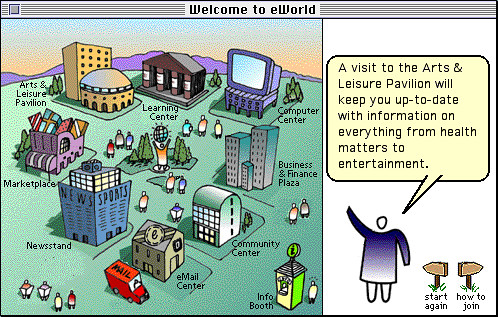
    eWorld main screen
    Eventually eWorld was closed down as Apple realised that it couldn’t compete with AOL and they had bigger things to worry about as Apple was on the downward trajectory that would result in the return of Steve Jobs. By 1997 both AppleLink and eWorld had been closed down. The content eventually ended up on the Apple website under sub-domains like developer.apple.com and support.apple.com.

    In 2000, Apple came back with iTools which included the .mac email accounts, simple web publishing and iDisk. The email account allowed you to have IMAP4 which was rare at the time and iDisk was based on WebDAV standard to syncing. There were other services including web publishing and iCards: an electronic greeting cards service (prior to Facebook were a low impact way to exchange greetings, with a HTML card sent via email. One of the most prominent providers bluemountain.com was bought in a deal apparently worth 780 million dollars by then internet giant Excite@Home).  By 2002, Apple started charging for these services and briefly threw in a subscription to Virex.

    The service got a rebrand as MobileMe to take account of Apple’s expanded computing portfolio to take in the iOS-powered series of devices. Newcomers got a .me.com email address rather than the .mac.com email address. I myself have been signed up to these services through their evolutions for the past ten years or so, so still have a .mac.com ID.

    iCloud is a development repackaging of these offerings; an evolution rather than an innovation, it also means that Apple’s claim in the sub header of its press release that the service: Free Cloud Services Beyond Anything Offered to Date – are economical with the truth. There is also a question in my mind, for reasons I’ll outline below, about whether this next evolution is positive for end users.

    Device philosophy

    One of the things that stuck out to me when I was listening to Steve Jobs introduce iCloud, he described the Mac as ‘just another device’. On one level it makes sense; as the Mac is one of three sets of computing devices that Apple now sells: the Mac, the iPad and the iPod Touch / iPhone.

    • The second thing that marks it out, is a trust that as Sun Microsystems used to say ‘the network is the computer’.
    • Finally there is the question of primacy. Which device is the ultimate arbiter of the correct data?

    The flawed ‘net

    iCloud is based on the assumption that good quality data connectivity is ubiquitous, this is complete fiction for many people. I live in central London, apparently a world city, a hive of connectivity. Wi-fi that I can access safely is only available in certain coffee shops, and the mobile networks are full of holes like Swiss cheese. I am with Vodafone that seems to be better than most, but the only way to have a near-continuous reception is to roam on a foreign SIM; which is outrageously expensive. This situation isn’t . In the UK, the broadband infrastructure simply isn’t available to support existing streaming video services. I live in Central London within the proverbial stones throw from Silicon Roundabout and get barely 3MBs download and 400KBs upload from my ADSL connection. I live 500 metres from my local exchange.

    Data integrity

    One area I am not convinced that Apple will get right with the iCloud is keeping the integrity of address and calendar data intact. If one device doesn’t have primacy there is no control mechanism. It is easy to accidentally alter a record on an iPhone and that could then ripple through the iCloud to all associated devices based on it being the most recent edit. There is no information on how it will handle duplicate entries and failed syncs. Lots of unanswered yet critical questions.

    Household enterprise systems

    My set-up on MobileMe is relatively simple, I have one iTunes account, one address book, one calendar, one set of bookmarks and system preferences. These are synced across two devices (the MacBook Pro that I am writing this post on, and my iPhone). But increasingly, Apple’s eco-system is found at the centre of family’s IT systems. The analogy of the household CEO is often used to describe the housewife as homemaker.

    The family’s IT system needs to look more like the kind of enterprise technology that a CEO would expect. With massive data storage and policy-based systems designed to keep the right data with the right owners. I haven’t seen any evidence that iCloud would do this which is likely to result in lots of poisoned address books and music collections.

    It just works?

    One of Apple’s key selling points since Steve Jobs returned to Apple was that the company’s products just work. This is why the synergy between hardware and software is so important. When you took one of the original iMacs out of the box, you plugged in the keyboard, the modem cable into the telephone socket, the power socket and turned it one; you were ready to start computing.
    Museum of Information
    It promised elegant simple technological choices to early adopters and the late majority alike and is why products like the iPod, the iPad and the iPhone have become commonplace in many developed marketplaces disrupting incumbent players like Creative and Nokia. The complexity and challenges that the iCloud system needs to overcome could undue this unique selling proposition and tear Apple’s market-making leadership position apart.

    Open standards to Apple standards

    One of the things that has helped Apple to do well has been its adherence to open standards: the iMac benefited from being a USB pioneer. Mac laptops became popular with photographers because of FireWire. The Safari web browser and WebKit build upon W3C standards compliance and it is hard to remember now, but the first iPhone used HTML5 web applications for external developers – something that many people lost sight of.

    Apple’s online services were similar. The email service was based on IMAP4 allowing for easy synchronisation and iDisk works on WebDAV. However in the Apple press release announcing iCloud there is no information on what it supports any standards, but it does talk about iCloud storage APIs. And Apple did promise to make thse APIs available to developers. I am concerned that my social graph may be locked into a storage equivalent of the Hotel California; which is especially dangerous when you think at the amount of iterations and service closures that Apple has exhibited in the online space.

    More online related content can be found here.

    More reading

    Apple Introduces iCloud – Free Cloud Services Beyond Anything Offered to Date

    What the iCloud will cause to happen next | FT.com

    Apple details iCloud’s digital storage and syncing, free 5GB of storage

    Fourth time’s a charm? Why Apple has trouble with cloud computing

    Cloud Poll: Does iCloud Actually Have Anything to Do with Cloud Computing? | ReadWriteWeb

  • The wisdom of mobs

    Old media historically took a pride in its ability to spur the public into action, a classic example would be The Sun’s headline from April 11, 1992 which trumpeted ‘It’s The Sun Wot Won It’. In this case claiming that The Sun’s readers had turned the tide of an election. There is also a darker side to this: the wisdom of mobs. 

    I have been interested in how mob behaviour or the shifting of public opinion has been changed by social media and affected consumer behaviour with ‘the wisdom of mobs’.  The recent super injunction debate has again brought it to the fore, as has Anonymous and Wikileaks.

    This has all had another subtle effect, as evidenced by this quote from Jamie East, founder of HolyMoly:

    “There are fewer gobshites who aren’t media-trained and surrounded by PRs, so it’s more difficult to find things to write about. And the ‘pap’ agencies aren’t getting the pictures they used to.”

    East is describing in his own colourful way an awareness and responsibility about their own reputation, or as Singaporean blogger Pat Law put it:

    As long as the information is online, even if you’ve placed it on private mode, your privacy is automatically placed on a pedestal for potential abuse. So never publish anything you don’t want people to know online.

    This is one side to a multi-stranded solution to the wisdom of mobs problem:

    • Behavioural – individuals need to take responsibility for their actions and what they say, reputation isn’t managed: reputation is, as reputation does
    • Social – we have yet to develop an appropriate civic society online. Towns on the American frontier appointed sheriffs and town councils to try and bring a modicum of justice and decorum during the pioneering days. These appointments were symptoms of a wider awaking towards thinking less about the individual and more about the kind of society that they were creating on the frontier. We need a similar awakening for online. Secondly a better civic society, should be able to organise lobbying that is as effective as that currently done by vested interests on behalf of disrupted interests like the ABPI and Warner Music; otherwise these groups will continue to enjoy undue succor – what politicians fail to see is that these groups are the British Leyland or the Northern Rock of the digital age
    • Legislative – this is the one that I am most concerned about for a number of reasons. Politicians of all sides are not good at giving up surplus powers and striking down legislation, instead keeping it to one side for a rainy day. The Labour administration of Tony Blair kept the Criminal Justice and Public Order act of 1994 including its controversial part V dealing with criminalising rave culture. The current conservative government has kept the Digital Economy Act in place, despite the fact that it adversely affects their ability to spur digital innovation and inclusion. The threat of legislation allows politicians to adjust behaviour in industries, for instance: self-censorship by UK ISPs by Ed Vaizey. It is virtually impossible to find a legislative body with the suitably sustained light touch required
    • Governance – effective and transparent governance mechanisms for governance in commercial issues would mean that there would be less of a public interest in gossip. Allegations surrounding Fred Goodwin would have been more appropriately investigated as part of his management of the Royal Bank of Scotland
    • Professionalism – the media has a responsibility to lift its own content out of the gutter of sensationalism. They need to man up and take responsibility for the wisdom of mobs, but they won’t. There simply isn’t a desire to do decent investigative journalism or thought-provoking analysis. It is probably not considered commercially viable to do it (though the audience of documentaries at the cinema seems to suggest otherwise), there aren’t the journalists with the right set of skills and mindset: where are the next Bob Woodward, Carl Bernstein or Seymour Hersh?

    More ethics related content can be found here.

  • Sennheiser HD250 II Linear headphones

    The Sennheiser HD250 II Linear came from a time before Dr Dre and Lady Gaga had their own headphone lines. Quality headphones were dominated by German and Austrian companies. The three companies were AKG, Beyerdynamic and Sennheiser. These companies had a number of things in common: their headphones were very well made, sounded amazing and many of the parts were user serviceable.

    Sennheiser, AKG and Beyerdynamic now

    AKG designs haven’t changed that much (because they don’t need to), but the company has moved production from Austria to China since it is now part of the Harman conglomerate of audio equipment. The main difference that I have noticed is that the plastic mouldings aren’t as good as the Austrians used to do.

    Beyerdynamic is still a German family-owned business that keeps making technological progress. They have still managed to keep on building headphones to the same high standard it always has done. The most recent headphones that I bought were a set of Beyerdynamic DT150s. They look crude, but are robust, well-made and sound great.

    Sennheiser like Beyerdynamic is still family-owned but taken a more fad-centric attitude to it’s headphone design. Its HD25 and HD25-SP models hark back to HD414 which was originally sold back in 1967. Most of the rest of the designs take their cues from the Sony and Technics headphones from the late 1990s onwards.  I have a set of HD25 headphones but they aren’t my favourite Sennheiser set, I tend to wear them when I am traveling as they are pretty space efficient.

    Sennheiser have been on a role since the HD414 in 1967, by the time the early 1979 came around Sennheiser bought out the game changing HD420 with a modernist design. These were noticeable for their great comfortable headband, lightweight, great sound and value for money. The problem was that they were ‘open’ in design. That means that they allowed other people to hear your music and could easily hear ambient noise from your surroundings. Eventually they created a closed version of these headphones and tweaked them to come up with the Sennheiser HD 250 II Linear.
    Sennheiser HD 250 II Linear headphones
    These headphones are big, but don’t look bulky. They are aesthetically pleasing which is more than you can say for their peers back in the day or even now. I have worn them all day without any discomfort or sweatiness. Pretty much every part is user replaceable making them ideal as a long term purchase (and environmentally friendly to boot).

    The rivals

    I’ve worn most of the rival headphones to the Sennheiser HD250 II Linear:

    • Sony’s MDR-7506 are loud and reliable. Which is why they are popular in APAC and amongst many people in video
    • The AKG K270 are comfortable and light, but sound less accurate than Beyerdynamic’s DT150.
    • Beyerdynamic’sDT100 and DT150 are great headsets, but they feel bulky. The sound is pleasant accurate but doesn’t have the space and detail of the Sennheisers
    Sennheiser HD250 II Linear pros and cons

    Sennheiser HD250 II Linear headphones have an open sound more like listening to loudspeakers. They are still insulated enough for DJing and being a good citizen on public transport. They are very accurate allowing you to hear flaws in digital sound sources. For instance iTunes on my Mac and my iPod sound clipped with a slight metallic quality and the bass sounds thin; even when compared to CD. (I use an old HHb CD-Recorder player based on the old Pioneer ‘turntable’ CD mechanism and a Technics SLZ-1200 as my primary CD players). Vinyl sounds warmer and more rounded. It does make me wonder how digital dance music can become without decent bass response but that’s a whole other blog post.

    There are some aspects of the Sennheiser HD250 II Linear that are an acquired taste from a design point-of-view. They have a straight cable rather than a coiled ‘telephone’ style cable. I prefer the coiled cable design but some people find that it pulls so its a matter of personal preference. The cabling design is a simple ‘Y’ design rather than running around inside the headphones like the HD 25. However this means that they are easy to service and there is less to go wrong.

    Sennheiser, if you get to read this article please bring the HD250 II Linear model back, or at the very least keep making spare parts for them and keep the parts readily available to consumers. More related content here.

  • I want to work in PR…

    I’ve had a number of messages on LinkedIn and emails over the past few months as graduates started to look for first jobs and start with ‘I want to work in PR’. So I figured it might be useful sharing the advice here. There are lots of obvious things you can do to make you more employable in terms of highlighting potential useful skills and getting the basics right – spelling and grammar being a major bugbear.

    But beyond all that generic advice here are some things to think about that are PR-specific:

    Don’t lose heart. I want to work in PR means commitment to beat out thousands of other talented smart graduates.

    Let’s start off with the maths, the job market is basically a numbers game, I got my first agency role after sending out over 200 CVs/ job application forms. It is just a matter of being at the right place at the right time

    When I started off, being a mature graduate, coming from an Irish working class household in the North West of England put me at a disadvantage. The clients and colleagues were all bothered about mojitos, wine and six nations rugby. The industry is still as white, middle class and English as it ever was. You have to be the change and that is really lonely. You’ll be on your own. Mentors can help, but you’ll be relying on your own resilience whether you’re:

      • From another country
      • Working class
      • Teetolaller
      • From an ethnic minority
      • Being older than the ‘norm’

    Classism and age are the last acceptable prejudices, but the others will be signalled through micro-aggressions, gaslighting and omission. Your allies won’t always be allies, dragging you down will help them get a leg up.

    So how can you tilt the odds in your favour?

    • You can increase your odds by becoming more visible through social media, just in the same way that you probably wouldn’t buy a brand that you couldn’t find on Google, having your own personal brand that is visible in a positive way online can only be a good thing. I realise that this isn’t necessarily easy however if your name is John Smith
    • Many of applicants have read all the pieces about innovative ways of applying for jobs and every second CV seems to have a QRcode on it. Innovation is great; my former colleague and friend Doug Winfield got himself noticed using Facebook advertising a year or two ago and is now holding down a senior role with with MS&L in New York. All I am going to say about innovation is that whilst it might get you  on to the initial pile of CVs to read; you also need to think about your CV also in terms of usability. When interviewing people you want to get the salient points of the CV prior to meeting them as easily as possible mainly because your working life will be time poor. Many larger HR departments will look to save your data on a database that they can interrogate, that means your information needs to be easy to put in. So there is a balance in your decision: getting noticed versus getting a job in competitive environments
    • Go where there will be less competition. How about applying to agencies working in less popular sectors and by looking to do PR at small-to-medium sized firms or even junior roles in-house.  Whilst people want to work with brands that their friends will know, third sector PR where they can feel good about themselves, or do celebrity PR – that is only a small part of the industry. I focused on the technology sector when I started off mainly because it was (and still is if we’re honest about it) deeply unsexy. The vast majority of the population don’t care about ERP, SCM, BPM and BPO; nor should they
    • Take advantage of disruption in the PR industry. Digital has started progressive change in the PR industry. The media industry is being disrupted; there are less gainfully-employed journalists writing more coverage, and publications  are earning less money from product and recruitment ads. This means that there less opportunities for traditional media relations. So PR has had to look to new influencers like bloggers and having direct dialogue with perspective product / service purchasers. This overlaps with business functions such as sales and customer services and other marketing disciplines. At the moment media buying, search and advertising agencies are staffing up with digital PR expertise and are killing PR agencies in new business pitch situations. Consequently it is worthwhile looking beyond the PR sector for PR roles
  • IBM fellows + more news

    IBM fellows

    New IBM Fellows push computing frontiers – IBM fellows are the company’s most prolific innovators. This batch of IBM fellows is interesting because it is a good indication of technology areas which will be hot: question-and-answer systems, a holistic approach to hardware and software design (like Apple), mathematical modelling for environmental risk management, stream computing, network optimised computer operating systems, cloud services, virtualised data centres and semiconductor design verification tools / processes (presumably to deal with increasing complexity and parallel processing at the silicon level)

    Business

    Helen Wang On China’s Opportunities. She’s Not Dreaming. : China Law Blog – luxury, healthcare, education and green tech are foreign companies opportunities. Basically most of the west is screwed

    Design

    Warm Respect for a Scottish Ruin – NYTimes.com – I love the way you have a house within a house on this design, could think of a few places in Ireland where this would work a treat

    Economics

    Revenge of the Invisible Hand – By Bruce Everett | Foreign Policy – this of course also means that much of the FTSE-related portfolios depending on Shell and BP for its value is screwed

    Big Oil In Turnaround – By Edward C. Chow | Foreign Policy – good write-up on the current state of what were the 7 Sisters of the oil industry. I’d be more worried about energy security than the environment now

    What exactly is made in China? | FT.com – rising wages encouraging clothing to move elsewhere in Southeast Asia

    Luxury

    Chanel’s cruise control | Material World | Vanessa Friedman blogs on the fashion and luxury industry for the Financial Times – FT.com

    Media

    U.S. Bill To Criminalize Illicit Movie / Music Streaming | TorrentFreak

    Leaked “ACTA” Lobby Letter Reveals Hollywood Pressure On EU | TorrentFreak – what is of interest is that they want to bypass the judiciary and push this into law

    Online

    Study Says Spam Can Be Cut by Blocking Card Transactions – NYTimes.com – interesting that law enforcement hasn’t been looking at this

    Security

    Why you can’t really anonymize your data – O’Reilly Radar – the ethics of big data need to be thought out and you have to ask questions about the ethics of how healthcare research is executed in the future

    Software

    Android vaults to smartphone lead as Nokia faces ‘ugly’ future | guardian.co.uk

    Did Microsoft pay for the wrong Skype? | asymco – interesting analysis

    Technology

    Zennstrom: private investors take the profits | FT.com – interesting ethical questions brought up