Blog

  • Aspiration of flight

    Inter-city rail services increasingly define themselves in terms of comparison to airlines. Take for instance the Chinese attendants recruited for the countries new Beijing-Shanghai ‘bullet-train’ route. The 403 women inductees look like classic air stewardess material and have gone through a similar kind of polishing process. The Chinese describe these attendees as ‘high-speed sisters’ 高姐. Find out more at the Shanghaist

    In the UK, you don’t have to look far for the aspiration of flight, rows of seats where you are not facing people are called ‘airline-style seats’ on the online ticket booking service and First Great Western even have gone to the trouble of recreating the airline safety card attached to the seat and a little fold-down drinks table.

    Virgin Trains have provided an integrated points system with other aspects of their business including Virgin Travel and Virgin Atlantic – their airline. Thankfully the airline doesn’t have the kind of odours that its train toilets seem to have, even when spotless. 
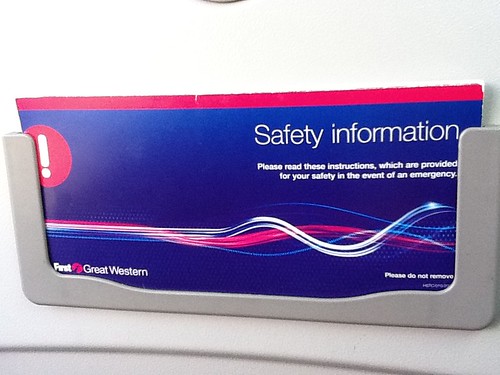
    Aspirations of flight
    The problem is that the actual experience isn’t like an airline in most cases, its bumpy and lurches from side-to-side on older parts of the track. At least Virgin has its Pendolino trains that lean into a turn and smooth out the side to side movement. On occasion Virgin’s tilting trains can make the walk to the buffet car like a simulation of being under the influence. And the overall ambiance of trains in the UK, if it did meet the aspiration of flight standard is generally more Ryanair than Singapore Airlines. 

    Instead of aping airlines with an aspiration of flight, why not emphasis what the trains don’t have like laborious security checks and having to spend hours in the crap department store concessions that now pass for airside lounges in the UK? More related content can be found here

  • Maze restaurant

    In many other countries the best restaurants are often found in a good quality hotel; in London you have a lot of restaurants out of hotels in areas like Mayfair and Soho. Gordon Ramsay’s Maze restaurant is inside the London Marriott Grosvenor Square hotel.

    Grosvenor Square is a bit out of my stomping ground, but would be ideal for shoppers on New Bond Street and the plethora of hedge fund managers based in Mayfair. I went along with my friend Tomoko on a Saturday morning, so your mileage may vary.

    Whilst the hotel is a vintage brick building, the interior design of the restaurant has a modern tip with a nod to 1960s science fiction films. We got there early and so grabbed a drink at the bar. The bartender was friendly and set a high standard of service that was matched later on when we sat down to eat.

    One of the problems with having a successful career is the inevitable spread that comes with too many corporate lunches. maze addresses this by having a menu more akin to a set of tasters rather than full-blown dishes. The food is tasty and aesthetically pleasing modern European in style.

    Whilst you eat the food, you can hold a reasonable conversation with your lunch date, given that the noise levels are lower than most Soho diners because of the acoustic panels lining the walls. In fact, the only thing that would negate me recommending maze as a business restaurant is the fact it only opens as 12h00; so there is no breakfast menu – which nukes half the business meetings I do.

    maze restaurant (in the London Marriott Grosvenor Square hotel)
    10-13 Grosvenor Square
    London W1K 6JP
    020 7495 2211
    Open Daily 12pm-2:30pm, 6pm-10:30pm

  • London through a tourist’s eyes

    My friend Tomoko was in London the other week and it was interesting seeing what excited her about London, as Tomoko’s London is very different from my own.

    Firstly ‘knowing London’ means knowing central and Northwest London rather than central and East London. Shoreditch, Clerkenwell and Soho aren’t attractive; St Johns Wood and Mayfair are – big learning curve for me here, as I have assiduously avoided anything west of Soho during my 13 or so years in London.

    Whilst we may think that London has everything to offer with contemporary clubs like Cargo and the East Village, it was Whisky Mist that Tomoko went to. With a clientele drawn from or aspiring to be in a P.G. Wodehouse adaption styled by Jack Wills; that you would only find me in under duress, but was what she wanted to do. Tradition and the class system trappings is a huge selling point for the UK – in terms of experience it beats Cool Britannia of modern UK life into a cocked hat. We had a drink and a catch-up late one evening in the Rockcliff Bar in The Trafalgar Hotel which I felt was a reasonable compromise.

    One thing that she was surprised at was how early in general London closes its bars and restaurants on a week-day; its not as swinging as the reputation would have others believe and certainly not up to the standard of Tokyo, Seoul, Shanghai or Singapore.

    Fifteen or twenty years ago, the UK had a reputation as the worst cooks in Europe. Tomoko’s trip was as much about being a gastronomic journey. She learned how to prepare a proper English afternoon tea (the rest of the world thinks that we don’t go to Pret-a-Manger and Starbucks apparently) and we had a taster menu lunch at Gordon Ramsay’s Maze restaurant (more on this in another post).

    There was an interesting take on shopping:

    • Mitsukoshi for convenience – not having to fight your way through Mayfair, along Regent Street or up Oxford Street to Selfridges
    • Jermyn Street for male family presents; Covent Garden antiques market for souvenirs and bringing presnts to female family presents
    • Old and New Bond Street were of interest for window shopping

    Which makes me think that a lot of central London retail space is looking seriously over-priced and that high footfall – long the measure of a desirable retail space can be as lethal for a shop as a branch of the Sue Ryder charity opening up next door.

    All of this made think about what what my current home city means to people around the world. I have met people within my industry where having worked in London agency life carried a lot of kudos, the popularity of modern dance music elsewhere in the world was spearheaded by the middle-aged UK DJs who were involved in the late 80s acid house scene. Modern design with a twist of irreverence from James Dyson and Paul Smith to Jonathan Ives at Apple are the product of a forward-looking country. But that doesn’t seem to have translated into a brand identity for London that is less Daniel Craig and more David Niven.

    Asian countries like Korea, Japan and China have managed to forge identities that are modern, yet are complementary to the centuries of culture and history that they have. On the other had, Egypt (at least as a tourist destination) is all about the ancient Egyptian society that flourished and declined 2,000 years ago. I would prefer to see London being able to balance a modern identity with a nod to the history rather than be trapped by it. Perhaps the best place to start would be through the creative destruction of the Central London built environment.

  • Pepsi cola + more news

    Pepsi cola

    PepsiCo Gives Pepsi-Cola a Renewed Marketing Push – WSJ.comYou just can’t go dark on brands and expect them to hold their value (paywall). At a corporate level PepsiCo had tried to focus more on functional / healthy foods and so had under invested in Pepsi cola as a brand. Market share depends on market penetration and relative share of voice so keeping a steady investment in Pepsi cola would have made more sense, even if the ‘social good’ points aren’t earned. By comparison, Pepsi cola main competitor

    Ideas

    Phys Ed: The Science of Toning Shoes – NYTimes.com – is it about whether they work, or encourage people to exercise?

    Innovation

    Did Microsoft steal the Kinect? – Hack a Day – or is it like the light bulb which had about 8 inventors at the same time

    Nice try, Amazon: ‘One-click’ payment too obvious to patent • The Register

    TECHNOLOGY REPORT » Artificial Intelligence Pioneer Marvin Minsky on the current state of AI Research – a high tech research version of the ‘if you have a hammer, every problem looks like a nail’

    Japan

    Japan’s attention to detail is all in the delivery | The Japan Times Online – since security is no longer guaranteed, fun is a key decider in roles

    London

    Afternoon Tea – Japanese tourists love it apparently

    Luxury

    Prada Woos Young Chinese With Sister-Brand Miu Miu – WSJ

    Only In China: Paper Gucci Insert Causes Vogue China Buying Frenzy « Jing Daily – shows the power of the brand, however does this dilute the brand for purchasers?

    Watches Are Rediscovered by the Cellphone Generation – NYTimes.com – an interesting article. Watches aren’t only about what information they convey to the wearer, but also what they say to other people. I remember reading an article about stainless steel Seiko analogue watches being popular with Japanese job hunters who wanted to convey that they were punctual

    Security

    Microsoft admits Patriot Act can access EU-based cloud data | ZDNetCan Microsoft guarantee that EU-stored data, held in EU based datacenters, will not leave the European Economic Area under any circumstances — even under a request by the Patriot Act? – This screws US technology sales in a number of areas

    Software

    Why Microsoft’s ‘single ecosystem’ for PCs and tablets carries huge risks | guardian.co.uk – unified user experience just isn’t going to cut it across the different user contexts

    Judge finds HTC guilty of infringing two Apple patents; could mean trouble for Android

    Amazon’s Appstore problems run deep: a developer speaks out | ExtremeTech – interesting that Amazon has had problems

    Telecoms

    I, Cringely » The enemy of my enemy – Bob Cringely on Google’s next likely move after losing the Nortel patent portfolio to an alliance of its enemies – RIM and Ericsson together put up $1.1 billion with Ericsson getting a fully paid-up license to the portfolio while RIM, as a Canadian company like Nortel, gets a paid-up license plus possibly some carry forward operating losses from Nortel, which has plenty of such losses to spare. For RIM the deal might actually have a net zero cost after tax savings, which the Canadian business press hasn’t yet figured out. Microsoft and Sony put up another $1 billion. There is a reportedly a side deal for about $400 million with EMC that has the storage company walking with sole ownership of an unspecified subset of the Nortel patents. Finally Apple put up $2 billion for outright ownership of Nortel’s Long Term Evolution (4G) patents as well as another package of patents supposedly intended to hobble Android.

  • Idea Man by Paul Allen

    Self-described ‘Idea Man‘ Paul Allen was the technical foil to Bill Gates’ when he founded Microsoft. Much of the Microsoft story is the story of Bill Gates – partly due to the way the company’s PR machine built Gates up as a software superman. The wheels came off the wagon with the Judge Jackson trial video testimonial. Allen dropped out of the story despite being instrumental in many of the key early products; instead he became known as a local billionaire who liked to jam with rock star friends and owned some local sports teams. Now he is trying to reinsert himself carefully in Microsoft’s story with Idea Man.

    Gates is now re-inventing himself has a modern-day Rockerfeller through charitable donations, trying to redefine his place in history as a convicted monopolist. With this change, Allen becomes even less significant. A cynical person may describe this book as Paul Allen’s attempt to write himself back into history, but without the Gates stigma. This view was reinforced by the books launch occurring round about the same time that Allen took legal action against many of the most successful technology companies for alleged patent violations.

    A student of Microsoft’s history would recognised the flawed human portrait of Bill Gates who is portrayed  as argumentative, ruthless, driven determined and petty. So in many respects Allen doesn’t add much to the Gates canon; Allen acts as an apologist for Gates in many respects being exceptionally tolerant of his faults; a co-founder equivalent of Stockholm Syndrome. Ballmer comes across as being a more decent human being, yet Allen’s accurate but unnecessary visceration of Microsoft’s performance feels as if it is aimed more towards liquidating Ballmer’s historic legacy.

    What I didn’t get from the book was the sense of Allen the person, what is he really like? What drives him? What are his demons? In this respect, Allen is absent from his own memoirs and the book comes across as two-dimensional because of it.

    There are sections on his relationships with famous musicians and sportstars, but it didn’t mean that much to me so I can’t comment beyond saying  that I didn’t find it that engaging.

    If you are going to read any book that touches on Microsoft and the PC era; I would instead recommend Robert X. Cringely’s Accidental Empires or Jennifer Edstrom (daughter of Waggener Edstrom’s Pam Edstrom) and Martin Eller’s Barbarians Led By Bill Gates.