I’ve seen a lot written about Yahoo’s downfall.
Most of it lacks insight. And at the most basic level lacks precision. Yahoo is an employee who works at Yahoo! or Y! (the Y-bang). It was the best culture I ever worked in; and the most dysfunctional company that I ever worked for. I got to work with amazing people at a company that managed to fumble the ball on opportunity after opportunity. Most analysis you see comes from outsiders who lack insight.
So when I came across this question on Quora and decided to post my answer. I’ve shared my answer on this blog with additional data points and information on ‘Yahoo’s downfall’.

This is a big question. In the answers that it will receive you are likely to see:
- Difference of opinions about the reasons of the decline
- Differences of opinion about when the decline actually set in. Which begs the question was the downfall that drastic?
Before we get into the why, lets think about the nature of businesses.
Public listed companies generally don’t last forever
The AEI said that 88 per cent of the companies that made up the Fortune 500 in 1954 are gone. Yahoo! is between 21 and 22 years old depending which way you count its age.
Yahoo! has outlasted many of its peers:
- Excite – merged with @Home Network in 1999. It went bankrupt in October 2001. It was sold in December 2001. By 2007, the business was broken up by territory.
- Lycos – was sold three times, each time for a fraction of the purchase price
- Hotbot – bought by Lycos
- AltaVista – minority stake sold to CMGI in 1999. Bought by Overture in February 2003. Yahoo! acquired Overture in July 2003
Only MSN remains of the original brands that it competed against. If MSN wasn’t a Microsoft business, its survival would be questionable. Microsoft’s online services lost money from 2006 through 2010. By comparison, Yahoo! has kept making a profit – despite its issues.
Macro-effects
The technology sector has become a hunting ground for active investors. Back in the 1980s, American publicly listed brands were attacked by investors:
- RJ Nabisco – leveraged buyout by KKR
- Gulf Oil & Unocal – T. Boone Pickens had failed bids for both oil companies but made a large profit on his holdings
- TWA – leveraged buyout by Carl Icahn. Icahn’s business practices were responsible for its bankruptcy in 1992 and 1995
- Revlon – acquired in a hostile takeover by Ron Perelman, much of the business was broken up to pay for the deal
In the 1990s, factors changed:
- Credit lines for deals dried up as some leveraged buyouts proved to be bad for investors
- Businesses developed more effective defences including poison pills, golden parachutes and greater debt
- Overall value of the stock market increased. This reduced the amount of opportunities to get companies on the cheap
Moving forward 20 years, the technology sector became in a similar place
Historic technology businesses have moved from being high growth to value businesses. This changed the nature of investors interest in them.
- Microsoft gave a seat on its board to an activist shareholder ValueAct Capital
- Apple started paying dividends and raising the debt on its balance sheet to fend off Carl Icahn
Google’s unique two-tier shareholding structure has proved to be an effective defence so far.
A business like Yahoo! looks like a classic corporate raid target as its value is less than the sum of its parts. It has a regular cashflow that could service a lot more debt at current interest rates. It has assets that can be quickly sold.
Capital has become much cheaper. This is partly a result of low interest rates set to keep the economy out of trouble in 2008. But there is also a lot of foreign capital and pension fund money looking for a home.
Missed opportunities
Given that we have the perfect vision of hindsight, Yahoo! missed key opportunities. Here are some of them.
Yahoo! failed to buy Google
Yes, Yahoo! did fail to buy Google. And their competitors failed to buy Google as well. Excite rejected the opportunity to buy Google for $750,000 in a deal arranged by Vinod Khosla. By comparison Terry Semel, then CEO of Yahoo! failed to buy Google for $5 billion. At the time Yahoo!’s entire market value was roughly $5 billion.
Yahoo! failed to buy DoubleClick
While Yahoo! was playing catch-up with Google on search. Google outbid the online industry to pay $3.1 billion for DoubleClick. DoubleClick provided advertisers with more opportunities to place banner ads than Yahoo! did.
Yahoo! failed to buy Facebook
Terry Semel offered $1 billion for Facebook in 2006. Semel wouldn’t go to $1.1 billion Facebook’s board wanted.
Yahoo! failed to sell to Microsoft
I don’t think that the Microsoft deal was a serious offer. There are reasons to be suspicious:
- Microsoft couldn’t make its own online business profitable at the time. The deal was unpopular with shareholders
- Yahoo!’s contribution to the open source community would have been an antitrust issue
- It would have to get through approval by Japanese competition authorities
- It would likely have to get through Chinese antitrust authorities
Yahoo! didn’t communicate these risk factors to shareholders. Which then left the door open for the Microsoft-funded Carl Icahn coup later on.
Yahoo!’s board has failed the company
I think that there is a stronger argument for this when you look at their selection of CEOs over the years
- Tim Koogle – led Yahoo! on the upcycle of the dot.com boom. He resigned and replaced by Terry Semel during the bust that followed.
- Terry Semel – was a senior media industry executive who bought the business out of the bust. He never got the product and never used email. He never managed to build a media company despite his Hollywood heritage.
- Jerry Yang – history will look with more favour on Jerry Yang in the future. He did the Yahoo! Japan and Alibaba deals which are the most interesting parts of Yahoo! today. As a CEO, his time was consumed by Microsoft’s hostile bid
- Carol Bartz – Bartz was a Microsoft approved appointee. Her deal on Facebook Connect saw the social network build its business on the back of Yahoo!’s user database. Bartz does the Microsoft search deal badly. She also launched mobile apps that were bad. The one thing she needs respect for is her approach to marketing. Bartz realised that she needed to promote the entire Yahoo! brand. Although there was a buzz marketing team in the US, most marketing was based around products. Unfortunately the execution of the brand campaign was poor. This was partly because it was led from the US with little engagement of regional and national marketing teams.
- Scott Thompson – stayed for five months. Allegations were made about his education, better due diligence on his recruitment required.
- Ross Levinsohn – Ross served as interim CEO after Thompson left. It is hard to know what CEO he would have made. But his successor seems to have borrowed his strategy.
- Marissa Mayer – Despite the goodwill Mayer had going into the job she hasn’t managed to change Yahoo!’s current business. That the company’s strategy is being driven by activist shareholders says a lot.
Problems in execution
Yahoo! had its fortune hitched to brand display advertising. Growth has dropped in this for the past ten years. Yahoo!’s declining advertisng revenues started in Q2 of 2006. Part of the problem was that Yahoo! had been too successful to begin with. Yahoo! sold its display advertising for way more than it was worth.
Yahoo! failed to monetise search as well as Google. And then handed its search business over to Microsoft, who failed to do as good as job as Yahoo! managed on its own.
Yahoo! failed to execute in mobile, despite some smart early efforts. Photo community Flickr was the default photo app on Nokia’s N73 blockbuster smartphone. The N73 launched at the end of April 2006. It was was one of the last things I worked on before leaving. Given that headstart Flickr could have been Instagram. Instead its a more specialist community of ‘proper’ photography enthusiasts. Yahoo! Messenger and Mail both worked on Nokia handsets from the mid-2000s. Yahoo! Go was an app which provided access to services including:
- Flickr
- Address book
- Calendar
- Email
- Maps
- Search
- Content: news, weather, finance, sports, entertainment
It could have provided the same function that Android provides for Google, but Yahoo! considered as ‘beta software’ right up to it’s demise in January 2010. Yahoo! has been providing Apple with weather information and stock data for the iPhone. Yet it hasn’t managed to build a successful iPhone app.
One way of illustrating the decline of Yahoo! in mobile is to look at the user numbers of Yahoo! mail, which seems to have peaked around September 2011.
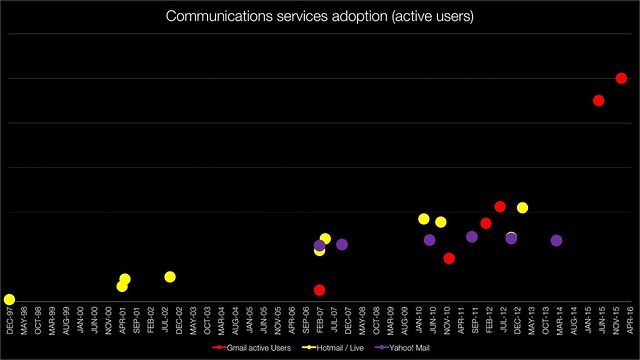
Hotmail shows a linear increase over time, likely due to organisation changes as it has moved to the cloud and Gmail takes off, presumably on the back of Android – though iOS users also have Gmail accounts.
Yahoo!’s acquisition process was broken. Ever since Yahoo! wasted 1 billion dollars buying Mark Cuban’s Broadcast.com the business slowed down. Broadcast.com was a scare on the collective memory. Capital decisions took longer, acqusitions took longer. The cheque book was harder to open. Under Marissa Mayer, it was finally let loose, but the purchases seem to have made little difference.
Yahoo! failed to become a media company. Back when I was at Yahoo! we launched Kevin Sites in the Hot Zone – a sort of proto Vice News in 2005. Despite Semel’s Hollywood background, he and following CEOs never made it work. Despite the fact Yahoo! had joint ventures with TV networks in Australia and Canada. When Marissa Mayer finally managed to get talent in the door, audiences had moved to other sites:
- Gawker Media
- Buzzfeed
- Daily Beast
- Aol’s blog network
- Huffington Post
Yahoo’s downfall in social is spectacular. Yahoo! owned pioneer social brands, any of which could have been the Instagram, Facebook or WhatsApp:
- Yahoo! Chat – chatrooms were the Facebook Groups of yesteryear. Yahoo! was doing social before it was a thing
- Delicious – neglect, internal politics and corporate interference meant that Yahoo! never capitalised on Delicious. Despite its tribulations there are some people who still use it, though I am not sure why
- Flickr – corporate interference and neglect destroyed the potential growth of photo sharing site Flickr. The site is kept going as a photographic enthusiasts community. It could have been Instagram. Thankfully, Yahoo! only spent $30 million on it
- Yahoo! Messenger – Yahoo!’s Messenger had a poor mobile client, but could have been WhatsApp. Facebook dominates the sector along with Tencents WeChat, NHN’s LINE and Daum Kakao’s KakaoTalk
- Tumblr – Yahoo! was forced to writedown the value of Tumblr to nothing. The company failed to monetise the popular blogging and curation platform. Tumblr is one of Yahoo!’s few products that attracts a millennial audience
Yahoo! products had a poor experience. I launched over 14 products at Yahoo! in just over a year. I only ever used 2 of them on a regular ongoing basis – Delicious and Flickr. Other products like Yahoo! 360, Yahoo! Answers or Yahoo! MyWeb 2 – fell into three categories:
- Dogs to use – particularly in the set-up part of the process
- Not particularly useful – Yahoo! Answers, great idea in prinicple but poor cultural fit. That poor fit meant that it filled up with noise, Yahoo! Answers isn’t as useful as Quora
- Strangled soon after birth – so it became frustrating to commit your time to them as a user
Politics paid a part in this process. The Communications group (responsible for Messenger and Mail) had a lot of duplicate products. Yahoo! Photos was a bad version of Flickr. For storing your bookmarks there was:
- Yahoo! Bookmarks
- Yahoo! MyWeb
- Yahoo! MyWeb 2
- Delicious
This all bogs management down and sucks away resources. There were also so many projects that never saw the light, due to constant changes in priority. More Yahoo!-related posts here. What do you think brought about Yahoo’s downfall?
More information
Fortune 500 firms in 1955 vs. 2014; 88% are gone, and we’re all better off because of that dynamic ‘creative destruction’ | AEI Ideas
Microsoft’s Bing/MSN Results Truly Horrifying — Loss Rate Balloons To ~$3 Billion A Year | Business Insider
Stupid Business Decisions: Excite Rejects Google’s Asking Price | Minyanville
A Microsoft First: Activist ValueAct Gets a Board Seat – WSJ
How Yahoo! Blew It | Wired
Yahoo! Could Have Bought Facebook For 2% Of Today’s Valuation | Business Insider
Sorry Microsoft, Yahoo — Google Just Got Bigger | Ad Age