Category: consumer behaviour | 消費者行為 | 소비자 행동

Consumer behaviour is central to my role as an account planner and about how I look at the world.

Being from an Irish household growing up in the North West of England, everything was alien. I felt that I was interloping observer who was eternally curious.

The same traits stand today, I just get paid for them. Consumer behaviour and its interactions with the environment and societal structures are fascinating to me.

The hive mind of Wikipedia defines it as

‘the study of individuals, groups, or organizations and all the activities associated with the purchase, use and disposal of goods and services.’

It is considered to consist of how the consumer’s emotions, attitudes and preferences affect buying behaviour. Consumer behaviour emerged in the 1940–1950s as a distinct sub-discipline of marketing, but has become an interdisciplinary social science that blends elements from psychology, sociology, social anthropology, anthropology, ethnography, marketing and economics (especially behavioural economics or nudge theory as its often known).

I tend to store a mix of third party insights and links to research papers here. If you were to read one thing on this blog about consumer behaviour, I would recommend this post I wrote on generations. This points out different ways that consumer behaviour can be misattributed, missed or misinterpreted.

Often the devil is in the context, which goes back to the wide ranging nature of this blog hinted at by the ‘renaissance’ in renaissance chambara. Back then I knew that I needed to have wide interests but hadn’t worked on defining the ‘why’ of having spread such a wide net in terms of subject matter.

  • Record Store Day 2019

    Record Store Day 2019

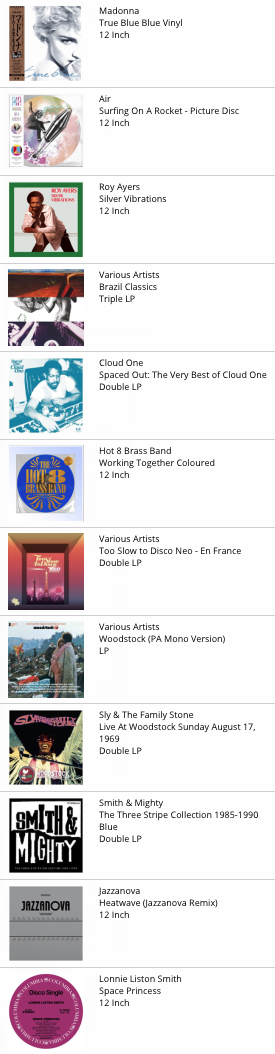
    Record Store Day 2019 redux. Record Store Day has moved away from its origins, to drive music fans into independent record stores and support independent record labels in a time of iTunes and Spotify. For various reasons I didn’t do any any vinyl shopping but used The Vinyl Store to compile a list of what I would have considered buying if I had been in a position to.

    My picks from Record Store Day UK 2019

    A few things:

    • Madonna’s True Blue single was one of her classic 12 inch singles. I am less convinced by the fake ‘obi’
    • Cloud One were a studio-based disco production team
    • Jazzanova’s Heatwave was given a 1980s makeover which sounds amazing
    • Lonnie Liston Smith – Space Princess is a great disco cut from the man that brought you Expansions

    Online consumer behaviour

    danah boyd on the current state of play of participatory media. I first met danah back in 2005 at the Yahoo! Campus in Sunnyvale with Bradley Horowitz. She was working on a project for Yahoo! Research back then and has kept close to youth and ‘social’ media since then.

    Design

    Even if you don’t know eBoy, you’ll recognise their work and its distinctive style. They’re doing a collaboration in customised Swatch watches. The video talks about how they work together, which is an interesting process in and of itself.

    Korea

    Asian Boss have done a collaboration with a documentary maker to bring Crossroads to YouTube. Crossroads is a documentary that shows how the Sewol Ferry disaster shaped modern Korean culture and politics. It was as big as the Poll Tax riots or the Brexit vote in the UK. It pressed the reset button on the Korean public’s relationship with the government captured by chaebol which was business as usual.

    Japan

    And Tomy’s range of mini retro consumer electronics are amazing. I presume that these are all aimed at adults. The level of detail is impressive. More related posts here.

  • RESIST + more things

    RESIST – counter disinformation tool – published by UK government. There needs to be more done beyond this document however. Secondly, much of the disinformation in the UK is from within the country supporting anti-vaccination, Islamic fundementalism, Islamophobia, the far left and the far right. RESIST feels like a start rather than a solution. This brings up a whole range of issues from security to wider societal ethics. (PDF)

    15 Months of Fresh Hell Inside Facebook | WIRED – interesting read on the cultural issues and business decisions inside Facebook as it faced criticism externally. The world has changed, Facebook’s culture hasn’t. The comparison between Facebook and Microsoft under Gates and Ballmer is a valid one. This time the stakes are much higher (paywall). More on Facebook here.

    I was gobsmacked when Leica dropped The Hunt. Chinese netizens are notoriously nationalistic, taking offence at any perceived slight. Chinese consumers are a big market for Leica and this was way beyond what even Dolce & Gabbana did in China. Like the NBA, Leica will still have diehard fans amongst the camera community in China. It also screws their partner Huawei who make a big deal of their top-of-the-range smartphones using ‘Leica’ cameras. But that maybe the idea given how toxic the Huawei brand is becoming.

    More on The Hunt reaction in China from the South China Morning Post.

    YouTube flags Notre-Dame Cathedral fire as 9/11 conspiracy | AdAge – machine learning isn’t the be all and end all yet (paywall)

    Gen Z doesn’t want to buy your brand, they want to join it | AdAge – This group isn’t waiting for brands to lead on issues. Instead, they’re leading. Since movements rarely come with a business case or cost-benefit analysis, marketers must consider how they can partner with Gen Z to become more involved and deliver on the promise of purpose (paywall)

    Mediatel: Newsline: Audi/BBH limbo; P&G puts down a(nother) marker – interesting points on P&G media platform pronouncements

    Apple App Store downloads went into decline, Morgan Stanley says – Business Insider – which indicates a ceiling to services

  • What Happened by Hilary Clinton

    I just had a chance to read What Happened am glad that I didn’t pay good money for this book. I found it both insightful and disappointing in equal measures. Clinton conveys her emotion really well. She also deeply loves power and policy. I don’t mean that in a megalomaniac way; but in a deep love of the job. The emotional release in the writing lacked the kind of intellectual rigour and analysis that she could, but didn’t apply in this book. Clinton is still mystified why she didn’t resonate with Americans.

    The sub-text is that it wasn’t her fault she lost to Trump but ‘them’ for disliking her and winning. It felt as if Clinton was writing for insiders.

    What Happened

    I am sure What Happened would resonate well with:

    • The writing team of The West Wing. If the show got a reboot, this book might be a good choice for tone of voice. I’ve worked with a lot of centre right and progessive public affairs people. They all loved The West Wing. It seems that Clinton does too
    • Political wonks with a centerist stance
    • True Clinton believers

    My guess this is partly why my initial reaction is that What Happened was the equivalent of a commemorative programme. She vigorously name checks everyone involved. (I am sure that they’ll buy a couple of copies, in a similar way to selling a high school year book.) Much of her ‘mistakes’ are turned into sins that her opponents or the media clickbait business model. Clinton tries to justify things in the book a bit like the late Paul Allen’s biography Idea Man. Her justification is sometimes dressed up as introspection.

    The first part of the book is about coping with grief. One gets the sense of how losing the presidential election was like a death in the family for Clinton and her supporters.

    Clinton tries to lead by example to give hope to the middle and right of the Democratic Party that she represented.

    Clinton is right about the fallacy of storytelling which provides easy closure for the media and voters. It doesn’t however provide the colour required for serious stories. This was the reason why Italian spaghetti westerns felt more authentic than Hollywood.

    She is right that fear identity politics and manufactured legislation gridlock favours small government parties over ‘big government’ parties.

    Clinton seems to think that more of the same of her brand of progressive politics is the answer. This seems a world away from the current Democratic Party direction.

    Clinton differentiates her stance of listening, rather than Trump’s grandstanding. What also becomes apparent is that Clinton needed to ‘reconnect’ with the public, whereas Trump had the pulse of the zeitgeist. Clinton seemed to have a lack of awareness on this.

    Her description of her marketing machine being constructed was interesting. Yet there was other curiously analogue examples of insight. Clinton wants to see how a progessive Democratic candidate will do in the Ozarks. They contact a trusted advisor in the area. He recommends reaching out of a country store owner in the middle of the constituency. The man fed back on how identity politics and government inaction will see the seat go Republican.

    Clinton doesn’t seem to take on board how emotion was so important. Secondly, Clinton thought that the togetherness platitudes would not come across as more of the same.

    She wants to make sure that you realise data was an early focus on her campaign, but . Clinton praises her team and throws her 2008 team under the bus.

    To quote an old advertising maxim:

    To sell something surprising, make it familiar; and to sell something familiar, make it surprising

    Raymond Loewy

    Clinton got this in terms of her visual branding (her appearance) she made her gender as a candidate familiar through her consistent trouser suit uniform, but failed to grasp it in terms of the wider policy approach. She was selling the familiar but failed to make it surprising.

    Her description of her daily life tries to imply, ‘I am just like middle-class people you’. But the problem is; middle class people have the time to read four daily papers, or have a residence manager to curate reading materials. Clinton admits that neither her or Bill had nipped to the store for an emergency bottle of milk, since there has always been people helping out since Bill was first appointed Arkansas state governor.

    The team’s diet of hot sauce with everything, protein bars and canned salmon is given a good deal of coverage. Artisanal food fetishised in the copy is again middle class virtue signalling. There was no Red Bull, no pizza.

    Clinton goes deep into each activity explaining what it feels like to go through things like media training and debate preparation.

    It was interesting that the selfie had risen to prominence in Clinton’s election campaigning, compared to her last serious run in 2008. She nails it when she talks about how it limits connection between the politician and the people, eating into brief talk time.

    Clinton also does some interesting thinking about what future policy making should look like and how it should be merchandised – as what creative marketers would call ‘the big idea’. Citizens don’t read policy papers, but they remember big, audacious simple things they can grok.
  • Chinese typing + more things

    The complexity of Chinese typing. Chinese typing relies extensively on predictive text technology. It is even more problematic that Chinese people are forgetting what some characters look like. The idea of memory trade-off is interesting. It is also worthwhile considering when one thinks about Chinese internet behaviour and the popularity of gaming (because chat can be a pain)

    Meet Liam. He has 5000 Instagram followers, but no pulse. | Campaign AsiaNikuro is Japan’s first male virtual influencer. A 3D computer-sculpted head mapped onto to a live-action body, he seeks work “in the fields of music, fashion, and entertainment, where he will be involved in the production of a wide range of content as a multimedia producer”, according to the company, which also mentions using AI to create innovative content – digital influencers won’t misbehave, have a me too moment or be arrested for a criminal offence.

    An amazing looking Mac-based desktop phone. This was an Apple prototype from 1993. Eventually things went the other way and phones were integrated into computers. This was from back when people were starting to think about VoIP services and Novell Networks integrated telephony solutions. And that’s before we even get to smartphones.

    The quaint industrial case design is classic early 1990s Silicon Valley chic. You can also see aspects of the thinking of General Magic’s connected devices in this computer. More design related posts here.

    Kantar Media has done some qualitative research on consumer attitudes to marketing, media and advertising. You’ve got three reports that are free to download: Dimension 2019 | Kantar 

    Finally: TODAYonline | LVMH shares hit record high as China demand boosts luxury group – luxury is still on a bit of a screamer in China. And this is despite economic growth halving year on year since Premier Xi took power, a clampdown on corruption and gift-giving.

  • Netflix DVD service + more things

    Why 2.7 million Americans still get Netflix DVD service in the mail – CNNNetflix also has plenty of DVD customers in urban areas who prefer the service for its convenience and selection of movies, spokeswoman Annie Jung says. “People assume that our customers must either be super seniors or folks that live in the boonies with no internet access,” she says. “Actually, our biggest hot spots are the coasts, like the Bay Area and New York.” – Netflix DVD service in the US covers the long tail like arthouse cinema and cult classics that the streaming service doesn’t address. They are two differentiated offerings rather than substitutes now. It is interesting that Blu-Ray hasn’t displace Netflix DVD service. More on Netflix here.

    Audi’s New Electric Car Factory Goes Green | Wired – Electric vehicles consume more energy than gasoline-powered rides during manufacturing and manufacture is 70% of a gasoline powered car’s carbon footprint. Something to think about when you drive a Tesla rather than a classic vintage Land Rover or diesel Mercedes

    Luxury Daily | Jean-Paul Gaultier is the latest brand to collaborate on streetwear – with Supreme. I think the outsider reputation of JPG fits streetwear really well, in its heyday it really got culture (paywall)

    How Rolex Is Revamping Its Digital Channels: 3 Marketing Innovations Not To Miss | Luxury Society – interesting how they are melding brand purpose and product messages

    How US went from telecoms leader to 5G also-ran without challenger to China’s Huawei | South China Morning Post – Interesting how Qualcomm is implicitly being blamed in this op-ed. There is no consideration of the implosion of new telcos following the dot.com bust for instance which took out fixed line equipment etc – Verizon and Sprint chose the CDMA mobile standard, developed by US firm Qualcomm, which operated on different frequencies than GSM, adopted by Europe. After the initial boom in the mobile industry following deregulation, the US telecommunications industry began to decline from 2001

    The Quietus | News | RBMA And Red Bull Radio To Shut Down“Red Bull will be moving away from a strongly centralized approach, will gradually phase out the existing structure and will implement a new setup which empowers existing Red Bull country teams and utilizes local expertise. Red Bull will continue to explore new ways to support promising and cutting-edge artists wherever they may be.” – major move

    New Huawei phone has a 5x optical zoom, thanks to a periscope lens | Ars Technica – reminds me a lot of Konica Minolta’s pocket digital cameras (the first standalone digital camera that I owned), everything old is new again

    Irish government concludes there is no viable plan B | total telecom“We still don’t have universal 4G coverage so it’s a bit of a pipe dream to suggest we are going to have universal 5G coverage to deliver the national broadband plan,” the country’s communications minister, Richard Bruton, said. – To be fair, London doesn’t have universal mobile coverage, let alone 4G coverage.

    Google’s work in China benefiting China’s military: U.S. general | Reuters“The work that Google is doing in China is indirectly benefiting the Chinese military,” Marine General Joseph Dunford, chairman of the Joint Chiefs of Staff, said during a Senate Armed Services Committee hearing. “We watch with great concern when industry partners work in China knowing that there is that indirect benefit,” he said. “Frankly, ‘indirect’ may be not a full characterization of the way it really is, it is more of a direct benefit to the Chinese military.”

    Increasing The Effectiveness of PR Agency Partnerships in China | Holmes ReportInsight from R3’s China PR Scope Report reveals that though PR agencies are highly regarded in content (23.7%) and media management (17.8%), they are not particularly strong in KOL and celebrity engagement (3.9% and 1.3%) – if I were an international agency I’d be really concerned about this. It shows a failure to adapt that is probably more spectacular than in the west

    U.K. Pub Chain Bans Mobile Phone Use in Bid to Encourage Talking – Bloombergour pubs are for social conversation person to person – actually no they’re for drinking

    BrandZ says Huawei is strongest Chinese brand outside China, but why? | Marketing | Campaign Asiadespite lots of documented geopolitical issues, the year was still very good for Huawei in terms of branding, driven by focus on 5G and R&D leading to chip-level AI capabilities, foldable phones and other innovations, said Doreen Wang, global head of BrandZ at Kantar. – for an index that’s looking at marketing and advertising being converted to brand equity this isn’t good news

    KFC Bought a Time Slot on Ultra Music Festival’s Main Stage | Music News | Consequence of Sound – you can see how this would all happen in a William Gibson book plot about the bankruptcy of culture in the near future. A client hungry of innovation and a desire to resonate with millennials and gen-Z. A jaded creative director who liked DeadMau5 and the agency’s news sponsorship and cultural partnerships team. I’m just surprised that there wasn’t a SnapChat tie in somewhere

    Facebook’s most shared story of 2019 is a 119-word local crime brief from Central Texas. | Slate – interesting insight into how Facebook’s algorithms drove this

    What Finally Killed AirPower | iFixitApple boxed themselves into an electromagnetic corner. What they wanted to do was physically possible—and they surely had it working in the lab—but they couldn’t consistently meet the rigorous transmission requirements that are designed to keep us safe from our gadgets.

    Report: Huawei Riddled With ‘Long Term Security Risks’ – ExtremeTechIn short, Huawei isn’t trying to riddle its software or hardware with secret back doors, but it’s also really, really bad at security. That’s not a conclusion that’s hard to fathom, particularly given how many companies have been hit by security breaches or had their own poor practices exposed – Huawei aren’t Machiavellian, they’re just incompetent and unwilling or unable to fulfil their infosec commitments?

    T-Mobile Introduces Private Phone Booths for Making Calls, Surfing the Web, Taking Selfies | Frequent Business Traveler – so in the same business as WeWork then

    The Apple Card is great (playing devil’s advocate) | Boarding Area – the money quote in this article ‘Here’s the part where I pretend to love the card and argue why it really is cool and revolutionary.’

    Chupa Chups logo, designed by Salvador Dali | Logo Design Love – Salvador Dali designed the logo, just wow

    Appl Still Hasn’t Fixd Its MacBook Kyboad Problm | WSJ – this is quite shocking (paywall)