Category: consumer behaviour | 消費者行為 | 소비자 행동

Consumer behaviour is central to my role as an account planner and about how I look at the world.

Being from an Irish household growing up in the North West of England, everything was alien. I felt that I was interloping observer who was eternally curious.

The same traits stand today, I just get paid for them. Consumer behaviour and its interactions with the environment and societal structures are fascinating to me.

The hive mind of Wikipedia defines it as

‘the study of individuals, groups, or organizations and all the activities associated with the purchase, use and disposal of goods and services.’

It is considered to consist of how the consumer’s emotions, attitudes and preferences affect buying behaviour. Consumer behaviour emerged in the 1940–1950s as a distinct sub-discipline of marketing, but has become an interdisciplinary social science that blends elements from psychology, sociology, social anthropology, anthropology, ethnography, marketing and economics (especially behavioural economics or nudge theory as its often known).

I tend to store a mix of third party insights and links to research papers here. If you were to read one thing on this blog about consumer behaviour, I would recommend this post I wrote on generations. This points out different ways that consumer behaviour can be misattributed, missed or misinterpreted.

Often the devil is in the context, which goes back to the wide ranging nature of this blog hinted at by the ‘renaissance’ in renaissance chambara. Back then I knew that I needed to have wide interests but hadn’t worked on defining the ‘why’ of having spread such a wide net in terms of subject matter.

  • Millennials are people too

    Smart funny video by Adam Conover on the marketing obsession of millennials as a form of segmentation.

    Show this to as many marketers as you can.

    Having been involved in youth marketing and even spoken at conferences about it, many of the challenges and insights that ‘millennials’ as a cohort face aren’t unique insights per se.

    You hear the same things over-and-over again. Being young presents its own set of challenges, these are tweaked accelerated by environmental conditions such as economy and housing. You feel the injustices of the world, adulting is hard. Responsibilities have a weight to them. Education has a cost.

    Getting your first home is hard. Finding the right partner is stressful. Since the baby boomers the concept of youth has become elongated. The whole of society hasn’t been drafted into fighting a war and benefited from the rise of the industrial society.

    But that doesn’t mean that it makes much sense for marketers to talk about millennials in such a broad brush way. At least gen-X whilst been written off as slackers were realised to have various different sub-cultures or tribes.

    That level of nuance seems to have disappeared in ‘our’ collective understanding of millennials and gen-Z.

    While we’re on about nuance, since when do adverts aimed at baby boomers appreciate that they don’t all look like Helen Mirren or Joanna Lumley. Or that they like going to rock concerts and festivals? Or that they might run for health and leisure?

    Marketers are increasingly looking at big data, but lacking granularity in terms of segmentation and factors that might influence brand relevance.

    My hypothesis is that the fetishisation of millennials as a single cohort is down to a deeper seated fear of disruption ambushing the marketers. Millennials aren’t an alien invasion, but people just like we’re used to. This fetishisation will end up as a feedback loop distorting their own view of what they expect to be and how they expect to be seen.

    More on millennial related topics here.
  • What about the work desk phone?

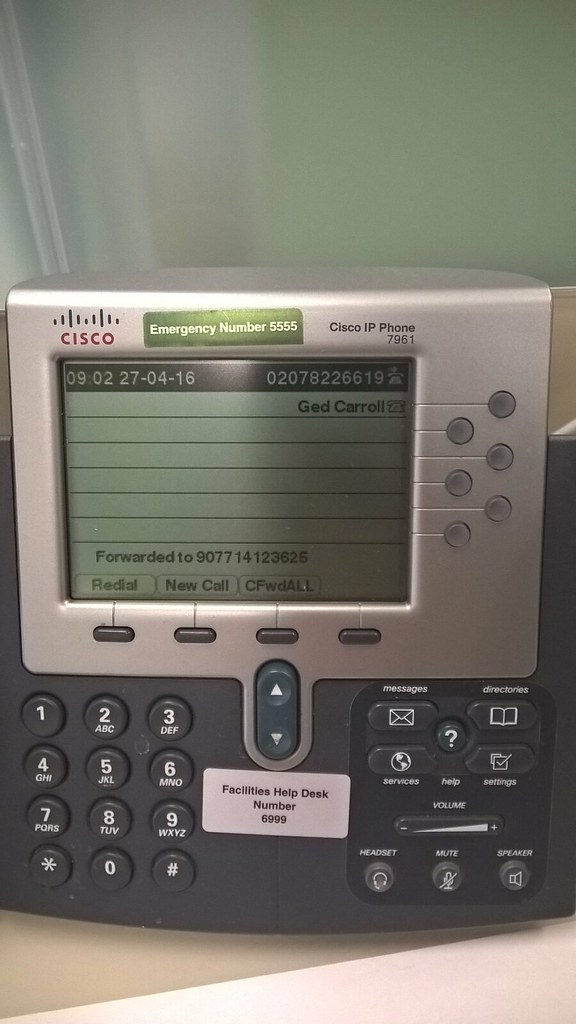
    I was in touch with a former colleague of mine the other day and they sent me a picture of my old work desk phone. It was still logged into my account and with a divert through to my mobile phone.
    Untitled
    The office had hot desking because there wasn’t enough space for everyone to be in at the same time.  We had email account size restrictions and people walked around with secondary hard drives plugged into their laptops as local and network storage wasn’t adequate enough to schlep all the documents on to a file server. There wasn’t a cloud-based equivalent of a file server in use 3either.

    Yet my former work desk phone remained logged in because no one was bothering to use it. So they have a surplus of desk telephones, when there was a shortage of pretty much every other resource the knowledge worker needed.

    Often times, people still used the land line number which followed them due to the Cisco VoIP PBX, but they diverted it to their mobile handset. The culture was very much based around conference calls, international teams would dial into a bridge number and be connected. You would see people pacing the common spaces such as corridors or reception and participating in conference calls on headsets wired into their smartphone.

    At the point of my project finishing they were just starting to roll out Skype for business. I suspect that this wasn’t going to change dramatically the use of mobile handsets, just the nature of how the call got to the recipient.

    Mobile infrastructure manufacturers have been expecting this for years, they rolled out pico-cell products aimed at enterprises to deal with reception dead spots in metal framed office buildings. What really seemed to have spurred things into action is the rise of all-you-can-eat voice tariffs.

  • China tech data slides

    I have been pulling together China tech data slides for me that were useful for some work that I have been doing. I thought it would be worthwhile sharing these slides with a wider audience.

    This month, I have selected a few slides that shed a light on advertising and consumer behaviour in China.
    May online marketing
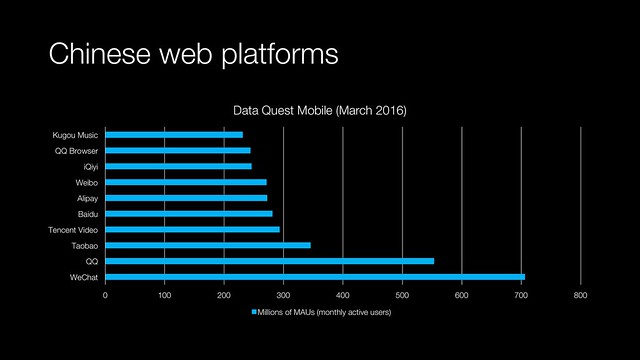
    Looking at platforms it is hard to over play the importance of Tencent in the Chinese internet which is show at the heart of the China tech data I have collated. Looking at mobile behaviour Tencent is responsible for at least four of the top ten properties: WeChat, QQ, QQ Browser and Tencent Video.
    May online marketing
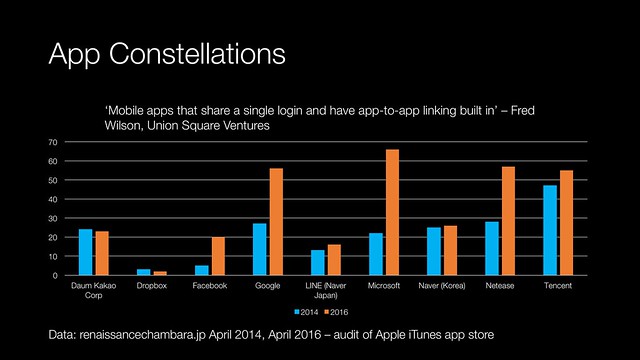
    If we look at two Chinese internet companies Tencent and Netease we can see how the companies have massively increased the number of non-game apps that they provide to keep consumers in their eco-system for their digital lives.
    May online marketing
    (Microsoft’s high number is driven by a number experimental project apps and enterprise apps). What this means is that the mobile OS becomes less important, which is one of the reasons why western brands from Samsung to Apple have been hit in the market. Their platforms give them less leverage.

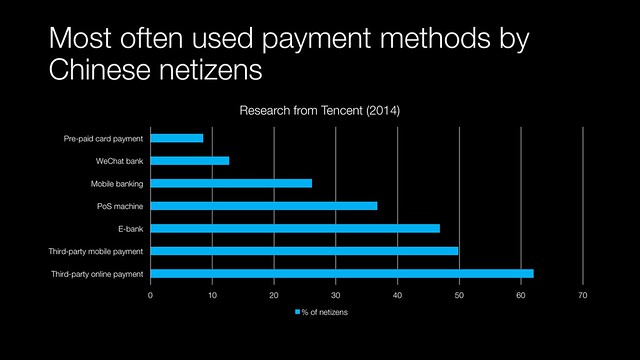
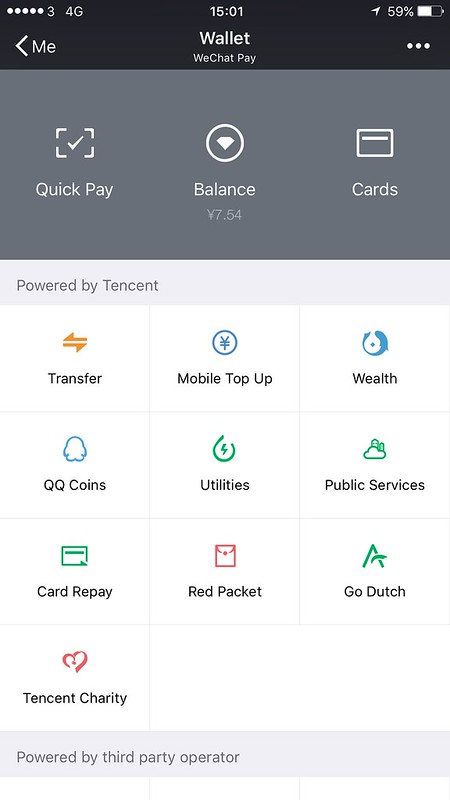
    Tencent’s WeChat is one of the most popular methods of payment in China
    May online marketing

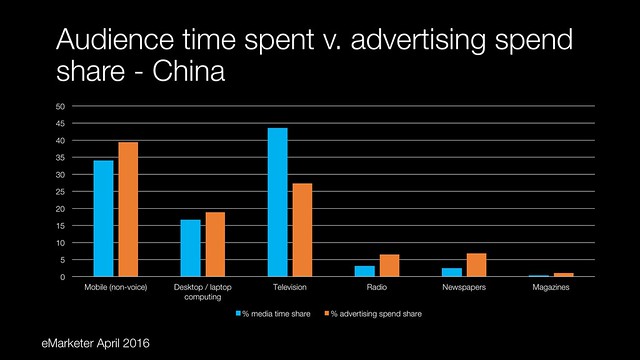
    If we look at advertising spend in the Chinese market we can see that digital and radio advertising spend over-indexes. In some ways this is surprising. Online content is huge and historically the government controlled traditional media much more tightly than online media – to the detriment of watchable content on the television. More recently, government regulation has tightened across platforms.
    May online marketing
    Print advertising only slightly over-indexes in comparison to digital or radio. On the face of it there looks to be a massive opportunity in television advertising.

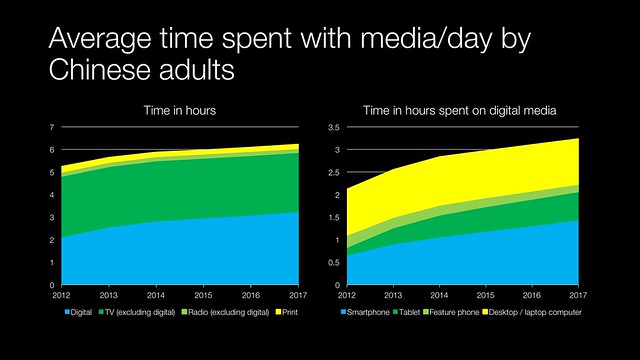
    If we look at the media market consumption habits two things immediately stand out. Television and radio are largely holding their own in the face of rapidly growing digital consumption. The rapid growth in digital consumption is being driven by non-PC devices.
    May online marketing

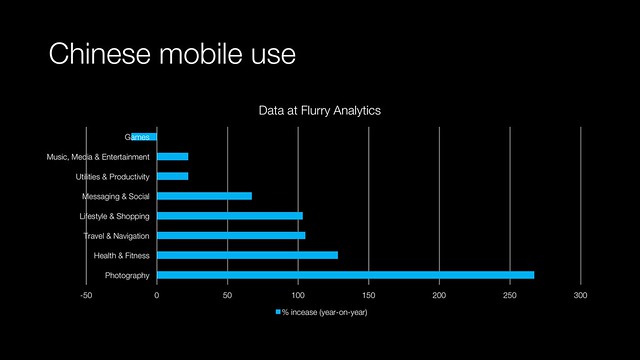
    If you want to know why Huawei has partnered with Leica to boost the perception of its smartphone camera function, one of the factors involved is the massive growth of photography in Chinese mobile behaviour. This is especially interesting when one compares it to messaging and social – WeChat the largest mobile social platform is all encompassing in its functionality and place in modern Chinese life. A second factor is the way manufacturers are trying redefine the premium smartphone sector, at a time when innovation and experiential difference have become incremental.
    May online marketing
    May online marketing


    You can see the full presentation here. More posts on China and technology related subjects.

  • Thin film electronics + more things

    Coal redefined for thin film electronics | Electronics EETimes – sounds like a graphene connection. Thin film electronics is going to be key for wearables

    Web Summit 2016 | Approach to marketing – it does beg the question why should a marketer support this and go to their conference?

    The VR idea maze — Benedict Evans – worthwhile read. I think the point made on content is particularly pertinent. We may have the hardware but it could take decades for the craft of content creation to come to full fruition

    China’s government sounds out international PR agencies about how to polish nation’s image overseas, sources say | South China Morning Post – A spokesman for WPP, which owns Hill+Knowlton declined to comment. Ketchum also declined to comment. Fleishman Hillard Inc, Ogilvy Public Relations and Edelman did not respond to messages requesting comment – Weber Shandwick attracted negative attention working for China during the run up to the 2008 Olympics and Ketchum had a similar experience working for Russia

    Microsoft’s Silver Lining Is Shrinking — The Information – not surprisingly moving a cloud model disrupts Microsoft’s margins in comparison to package software (paywall)

    Off the grid – Official site of Stephen Fry – interesting essay on the perils of social media

    China Unicom bets on turnaround as net profit plunges 85pc | SCMP – 4G network capital costs and increased marketing costs

    “Overpaid and underperforming”: An anonymous investors’ letter lashes out at Nikesh Arora — Quartz – there are other shoes to drop on this. Looking that the shareholders hold ADRs rather than SoftBank shares – this is a US led charge. It is also interesting that this happening right before the Yahoo! shoe drops. SoftBank,  and its Yahoo! Japan joint venture are a key part of Yahoo! Inc’s value

    Korean TV Dramas Are the Best Export Since ‘Gangnam Style’ | Digital – AdAge

    Pirate Bay Founder: Streaming Model Could Ignite New Piracy War – TorrentFreak – really interesting essay. I had a similar experience with Apple’s iBooks. I bought James Michener’s Mexico for a long flight and trip, tried to download it a week later and it was no longer available. I now buy mostly paper books

    Brands rip up media plan in the face of disruption – it decided last September, in consultation with MediaCom, to take more radical action. Tesco slashed its media budget for newspapers to practically zero and shifted most of the money into online and social media. TV and other traditional media have also been heavily cut (reg wall)

    Can audio go viral on Facebook? Here’s what happened when NPR ran an experiment for a month » Nieman Journalism Lab – Sharing audio on social media is hard to do. Stan Alcorn documented many of the struggles two years ago in a widely cited Digg story

    Elisabeth Murdoch’s Vertical Networks creating ‘Brother’ Snapchat Discover channel – Business Insider

    IRIN | Spies Sans Frontières? – the ethical conundrums around this are particularly interesting. More security related posts here.

    Is Programmatic Expertise Moving In-House? – EContent Magazine

  • WeChat payments + more things

    WeChat payments and wallet function brought to the international version of WeChat with its last version update, but I only noticed it this week. Does this mean that WeChat is now putting all the pieces in place before they get serious about an international market push? They are already trying to get foreign credit card merchants on board accepting WeChat payments to  provide extra convenience for Chinese consumers travelling abroad.
    WeChat wallet now for louwai
    TfL brought back its experiment for having people stand on both sides of the escalators. For those of us who live in London this is quite a change to our usual routine. We are used to standing on the right or moving along the escalator on the left. It caught me out the first time that I visited London.

    But TfL research found that you net out moving people more efficiently by encouraging everyone to stand. This allows a ‘denser’ escalator and better times clearing people off platforms.
    Stand on both sides - people living outside London won't realise what a paradigm shift this is
    A comparable shift would be say, New Yorkers suddenly becoming unfailingly polite and accommodating. I do quite like the ‘blue pill’ footprints that TfL use for signage on the escalators.

    Japanese producer TOYOMU reimagined Kanye West’s The Life of Pablo based on reviews and a list of the samples used. Japan hasn’t embraced streaming music unlike western lemmings music buyers. I think what he came up with is far better, see for yourself.

    Forthcoming Russian superhero film Guardians looks even more intense than the Night Watch and Day Watch films. Apparently the bear packs a chain cannon a la Jesse Venture in Predator.

    Luxxury releases Greg Wilson remixes of the their track on yellow vinyl, have a preview of it here. I am a huge fan of Luxxury and the lush nu-disco products that he manages to come up with.  More Luxxury sounds here.