Category: design | 設計 | 예술과 디자인 | デザイン

Design was something that was important to me from the start of this blog, over different incarnations of the blog, I featured interesting design related news. Design is defined as a plan or drawing produced to show the look and function or workings of a building, garment, interfaces or other object before it is made.

But none of the definition really talks about what design really is in the way that Dieter Rams principles of good design do. His principles are:

  1. It is innovative
  2. It makes a product useful
  3. It is aesthetic
  4. It makes a product understandable
  5. It is unobtrusive
  6. It is honest
  7. It is long-lasting
  8. It is thorough down to the last detail
  9. It is environmentally-friendly – it can and must maintain its contribution towards protecting and sustaining the environment.
  10. It is as little design as possible

Bitcoin isn’t long lasting as a network, which is why people found the need to fork the blockchain and build other cryptocurrencies.

Bitcoin uses 91 terawatts of energy annually or about the entire energy consumption of Finland.

The Bitcoin network relies on thousands of miners running energy intensive machines 24/7 to verify and add transactions to the blockchain. This system is known as “proof-of-work.” Bitcoin’s energy usage depends on how many miners are operating on its network at any given time. – So Bitcoin is environmentally unfriendly by design.

On the other hand, Apple products, which are often claimed to be also influenced by Dieter Rams also fail his principles. They aren’t necessarily environmentally friendly as some like AirPods are impossible to repair or recycle.

  • PopSlate failure

    PopSlate

    I’ve go in involved in a few crowdfunded products and some of them have worked out but the majority haven’t. The latest example was the high profile e-ink phone cover PopSlate. PopSlate got over $1 million dollars of funding and was widely covered by the media.

    “popSLATE 2 is E-Ink for your iPhone done right.” – Slashgear

    “It’s an evolution, not merely refinement.” – Wired

    Why crowdsourced projects fail?

    Generally I’ve found that crowdfunded projects like PopSlate tend to fail for three (non-criminal) reasons:

    • They underestimated the cost or complexity for batch manufacture of items. They have problems with getting tooling moulds to work and have to go through iterations that burn up cash
    • They get gazzumped; their product is sufficiently easy to make that Chinese manufacturers who go through Indiegogo and Kickstarter for ideas get the product into market faster
    • The engineering is just too hard. This seems to have been the problem for PopSlate who couldn’t innovate and get their product into market as fast as new phones came out

    On the face of it, the PopSlate is a great idea. Bringing the kind of dual screen technology to the iPhone that had been in the Yota phone for a number of years. Huawei had a similar snap-on e-ink back available for the the P9 handset in limited quantities.

    popSLATE – The smart second screen on the back of your phone

    PopSlate had already launched a mark I version of their product.  With the mark II version of their product PopSlate tried to do too much: they tried to make it a battery case but still ridiculously thin.  The following email was sent out on Saturday morning UK time:

    Critical Company Update

    This update provides serious and unwelcome news.

    Based upon your support, we have spent the last year continuing to develop our vision for “always-on” mobile solutions. Our goal was to solve three fundamental issues with today’s smartphones: we wanted to simplify access to information, increase battery performance, and improve readability. Unfortunately, the significant development hurdles that we have encountered have completely depleted our finances, and we have been unable to raise additional funds in the current market. As a result, popSLATE does not have a viable business path forward.

    This marks the end of a 5-year journey for our team, which started with a seed of an idea in 2012 and led to our quitting our jobs to start the company. Although we are very disappointed by the ultimate outcome and its implications for you as our backers, we are proud of our team, who worked tirelessly over the years to commercialize the first plastic ePaper display, globally ship thousands of popSLATE 1 devices as a first-in-category product, and re-imagine & further extend the platform with the second generation product. Despite a strong vision, high hopes, and very hard work, we find ourselves at the end of the journey.

    We are out of money at this juncture for two key reasons. First, we have spent heavily into extensive development and preparation for manufacturing;  as you are aware, we hit some critical issues that multiplied the required spend, as described in previous updates.

    Most recently, we learned that the fix for the Apple OTA issues would involve more significant redesign. While we initially suspected that the Lightning circuit was the culprit, it turned out that it was a much more fundamental issue.  Namely, our housing material is not compatible with Apple OTA requirements. You may think, “Wait, isn’t it just plastic?  Why would that be a problem?” While the housing is indeed largely plastic, we used a very special custom blend of materials that included glass fibers. The glass fibers were used to solve two issues, both of which were related to making the device super-thin: a) they enabled uniform, non-distortional cooling of the housing mold around our metal stiffener plate (the key component that makes popSLATE 2 thin but very strong) and b) they added tensile strength to the very compact form factor. Unfortunately, we have concluded that these added fibers are attenuating the RF signal and that we would have to spend additional cycles to tune a new blend with required modifications to the tooling. This is an expensive and timely process.

    Second, we have been unsuccessful at raising additional financing, despite having vigorously pursued all available avenues since the close of our March Indiegogo campaign (including angels, VCs, Shark Tank and equity crowdfunding, both in the US and abroad). Many in our network of fellow hardware innovators have encountered this difficult new reality. You may have also seen the very public financial struggles of big-name consumer hardware companies—GoPro, Fitbit, Pebble, Nest and others—as highlighted in this recent New York Times article [link]. The most dramatic example of this phenomenon is the recent and sudden shutting down of Pebble, paragon of past crowdfunding success.

    There is no way to sugarcoat what this all means:

    • popSLATE has entered into the legal process for dissolution of the company
    • Your popSLATE 2 will not be fulfilled
    • There is no money available for refunds
    • This will be our final update

    While this is a very tough moment professionally and emotionally for us, it is obviously extremely disappointing for all of you who had believed in the popSLATE vision. Many of you have been with us since the March campaign, and a smaller set helped found the popSLATE community back in 2012. To you—our family, friends, and other unwavering backers—we are incredibly grateful for your enthusiasm, ideas, and support throughout the years. Just as importantly,  we deeply regret letting you down and not being able to deliver on our promise to you. We truly wish there were a viable path forward for product fulfillment and the broader popSLATE vision, but sadly we have exhausted all available options.

    Sincerely yours,
    Yashar & Greg
    Co-founders, popSLATE

    The problem as a consumer you have for much of these gadget is this:

    • If a product can be easily made in Shenzhen, it will be so you should be able to get it cheaper on lightinthebox or similar sites
    • If it can’t be turned out in a reasonable time, it has a low likelihood of succeeding

    There have been successes of more hobby-based products; I have a replica of Roland’s TB-303 synthesiser. It’s the kind of product that can be assembled whilst not relying a China-based supply chain. It also is based on well understood technology and there weren’t issues of with designing for very tight places or Apple’s requirements (in the case of iPhone’s accessories).

    What about the poster child of Pebble? Pebble managed to go for longer with a sophisticated product but couldn’t withstand the gravity of declining sales in the wearables sector. More related content here.

  • The World as Design: Writings of Design by Otl Aicher

    The World as Design author Aicher was a German designer. He is most famous of his graphic design and typography. His most famous font is Rotis  His impact was far wider. Aicher was a co-founder of the short-lived Ulm School of Design. Over its 15 years it developed a legacy that continues to echo through design education.

    He worked with prominent German brands including Braun, Lufthansa and ERCO the lighting firm.

    Aicher’s design language for the Munich Olympics was ground breaking. He designed the first Olympic mascot: Waldi a dachshund with multicoloured bands on his body. The posters for the Munich Olympics were hyper coloured designs that still had a system wrapped around them and now trade for hundreds of pounds.

    You can blame him for single handedly kicking off the use of stickmen pictograms on public signage in buildings like airports.

    Aicher and his colleagues at Ulm were about more than making things look pretty on their medium of choice, they thought about systems. Aicher’s holistic approach to systems influenced modern brand design.  Mark Holt, a co-founder of 8vo; who worked on everything from Factory Records to billing systems for mobile carrier Orange cited Aicher as a major influence.

    otl aicher

    Aicher’s book The World of Design collects a series of his essays across a wide spectrum of topics. Culture and political essays sit alongside examinations on the process of design and typography. Design and art do not exist in isolation but as part of the wider world. Something that you become keenly aware of as being central to his thinking – alongside his advocacy of reinvigorating modernism.

    Probably most striking is Aicher’s delivery and style of writing. He writes with absolute confidence as each item has been thought about, despite feeling like a stream of consciousness in the way those mulled over thoughts are put down. He also completely dispenses with capital letters, sentences flow into each other from a visual perspective. This gives his work a sense of urgency and authenticity – but doesn’t make it any easier to read.

    Theses essays felt as if they were born on the internet not written sometime before Aicher died in 1991, which says a lot about how fresh and contemporary his work still is.


  • Have we reached peak streetwear?

    At the end of January I wrote a blog post about the landmark luxe streetwear collection by Louis Vuitton and Supreme.

    I delved into the history of streetwear and the deep connection it shared with luxury brands. This linkage came from counterfeit products, brand and design language appropriation.

    This all came from a place of individuality and self expression of the wearer.
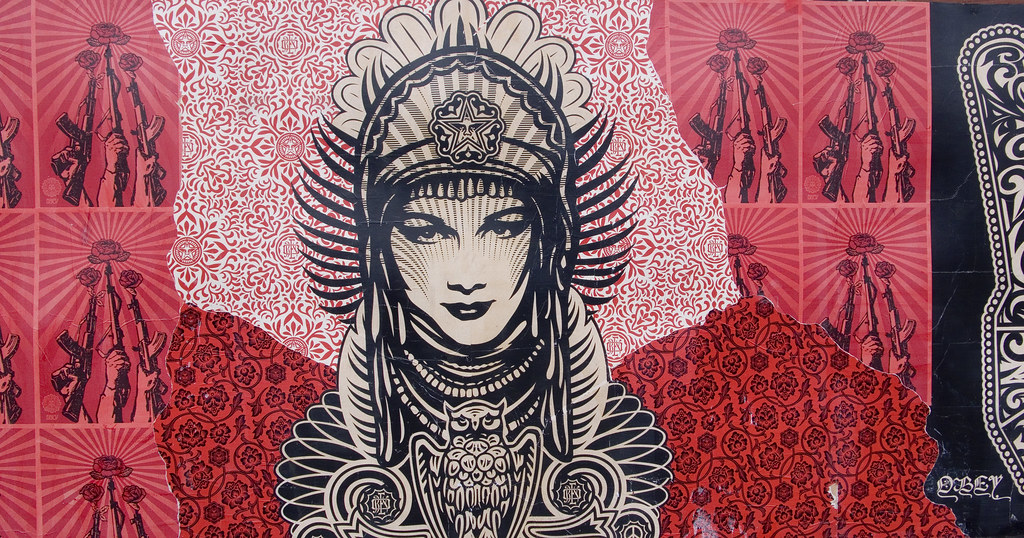
    obey

    I reposted it from my blog on to LinkedIn. I got a comment from a friend of mine which percolated some of the ideas I’d been thinking about. The comment crystalised some of my fears as a long-time streetwear aficionado.

    This is from Andy Jephson who works as a director for consumer brand agency Exposure:

    The roots of street and lux that you point to seem to be all about individuality and self expression and for me this is what many modern collabs are missing. To me they seem to be about ostentatious showmanship. I love a collaboration that sees partners sharing their expertise and craft to create something original. The current obsession with creating hype however is creating a badging culture that produces products that could have been made in one of the knock-off factories that you mention. Some collabs that just produce new colourways and hybrid styles can be amazing, reflecting the interests of their audience. But far too many seem gratuitous and are completely unobtainable for the brand fans on one side of the collaborative partnership.

    The streetwear business is mad money

    From Stüssy in 1980, streetwear has grown into a multi-billion dollar global industry. Streetwear sales are worth more than 75 billion dollars per year.

    By comparison the UK government spent about 44.1 billion on defence in 2016. Streetwear sales are more than three times the estimated market value of Snap Inc. Snap Inc., is the owner of Snapchat.
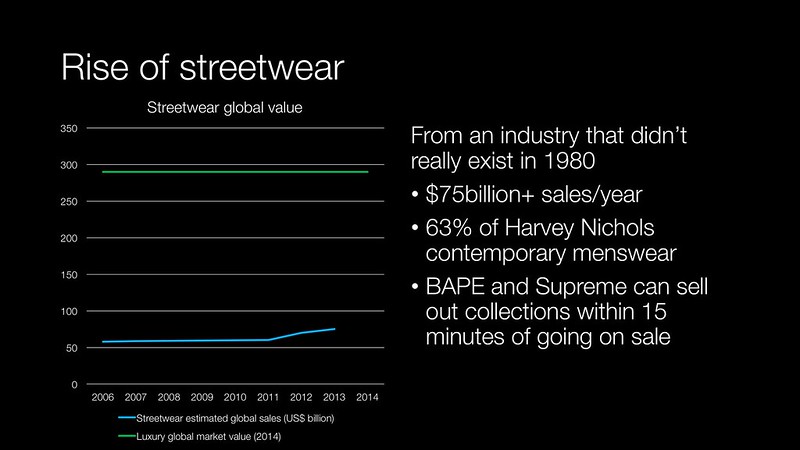
    Rise of Streetwear

    It is still about one third the size of the luxury industry. Streetwear accounts for the majority of menswear stocked in luxury department stores. Harvey Nichols claimed that 63% of the their contemporary menswear was streetwear. Many luxury brands off-the-peg men’s items blur the boundary between luxe and streetwear.

    The industry has spawned some technology start-ups acting as niche secondary markets including:

    • Kixify
    • K’LEKT
    • THRONE
    • StockX
    • SneakerDon
    • GOAT

    Large parts of the streetwear industry has become lazy and mercenary. You can see this in:

    • The attention to detail and quality of product isn’t what it used to be. I have vintage Stüssy pieces that are very well-made. I can’t say the same of many newer streetwear brands
    • Colour-ways just for the sake of it. I think Nike’s Jordan brand is a key offender. Because it has continually expands numbers of derivative designs and combinations. New Balance* have lost much of their mojo. Especially when you look at the product their Super Team 33 in Maine came up with over the years. The fish, fanzine or the element packs were both strong creative offerings. By comparison recent collections felt weak
    • The trivial nature of some of the collaborations. This week Supreme sold branded Metro Cards for the New York subway
    • Streetwear brands that sold out to fast moving consumer products. This diluted their own brand values. While working in Hong Kong, I did a Neighborhood Coke Zero collaboration. The idea which had some tie-in to local cycling culture and nightscape. Aape – the second-brand of BAPE did a deal wrapping Pepsi cans in the iconic camouflage

    Hong Kong brand Chocoolate did three questionable collaborations over the past 18 months:

    • Vitaminwater
    • Nissin (instant noodles)
    • Dreyer’s (ice cream)

    By comparison, Stüssy has a reputation in the industry for careful business management. The idea was to never become too big, too fast. The Sinatra family kept up quality and selective distribution seeing off Mossimo, FUBU and Triple Five Soul. Yes, they’ve done collaborations, but they were canny compared to newer brands:

    “The business has grown in a crazy way the past couple of years,” says Sinatra. “We reluctantly did over $50 million last year.”

    Reluctant because, according to Sinatra, the company is currently trying to cut back and stay small. “It was probably one of our biggest years ever — and it was an accident.”

    Sinatra characterises Stüssy’s third act as having a “brand-first, revenue second” philosophy, in order to avoid becoming “this big monstrosity that doesn’t stand for anything.”

    The Evolution of Streetwear. The newfound reality of Streetwear and its luxury-like management academic study uncovered careful brand custodianship.

    It’s not clothing; it’s an asset class

    Part of the bubble feel within the streetwear industry is due to customer behaviour. For many people, street wear is no longer a wardrobe staple. Instead it becomes an alternative investment instrument. Supreme items and tier zero Nike releases are resold for profit like a day trader on the stock market.

    Many of the start-ups supported by the community play to this ‘day trader’ archetype. It is only a matter of time for the likes of Bonham’s and Sotherby’s get in on the act.

    A key problem with the market is that trainers aren’t like a Swiss watch or a classic car. They become unusable in less than a decade as the soles degrade and adhesive breaks down.

    There is the apocryphal story of a Wall Street stock broker getting out before the great stock market crash. The indicator to pull his money out was a taxi driver or a shoe shine boy giving stock tips.

    Streetwear is at a similar stage with school-age teenagers dealing must-have items as a business. What would a reset look like in the streetwear industry? What would be the knock-on effect for the luxury sector?

    More information
    USA Streetwear Market Research Report 2015 | WeConnectFashion
    Louis Vuitton, Supreme and the tangled relationship between streetwear and luxury brands | renaissance chambara
    New Balance Super Team 33 – Elements Collection | High Snobriety
    New Balance ST33 – The Fanzine Collection | High Snobriety
    1400 Super Team 33 (ST33) trio | New Balance blog – the infamous fish pack
    How Stüssy Became a $50 Million Global Streetwear Brand Without Selling Out | BoF (Business of Fashion)
    The Evolution of Streetwear. The newfound reality of Streetwear and its luxury-like management by de Macedo & Machado, Universidade Católica Portuguesa (2015) – PDF

    * in the interest of full disclosure, New Balance is a former client.

  • Eatmybeat + more things

    Eatmybeat

    This week I was listening to: [Free Download] London Collective, eatmybeat, Drop a Tasty 21 Track Compilation  ‘Bonus Snacks Vol. 2’ Perfect for DJs | Magnetic

    Eatmybeat have put together a create collection in Bonus Snacks Vol. 2. The Eatmybeat compilation is an interesting mix of ambient soundscapes, old school electro and various strands of house music. 

    Ablet lightning audio adapter

    I was upgraded Bose QC25 headphones I use at work with a new audio cable. The Ablet Lightning Audio Adapter for Iphone 7 / 7 Plus is a great replacement cable, microphone and remote that makes doing calls an awful lot easier. Once the call is over, I just unplug and jack in with the original cable that stays in my iPod

    Blade Runner 2046 preview images

    Instagram announced a carousel function that shows up to 10 photos and videos in the one frame. The first one I saw in the wild was to promote the new Blade Runner film due this year

    Safari ready

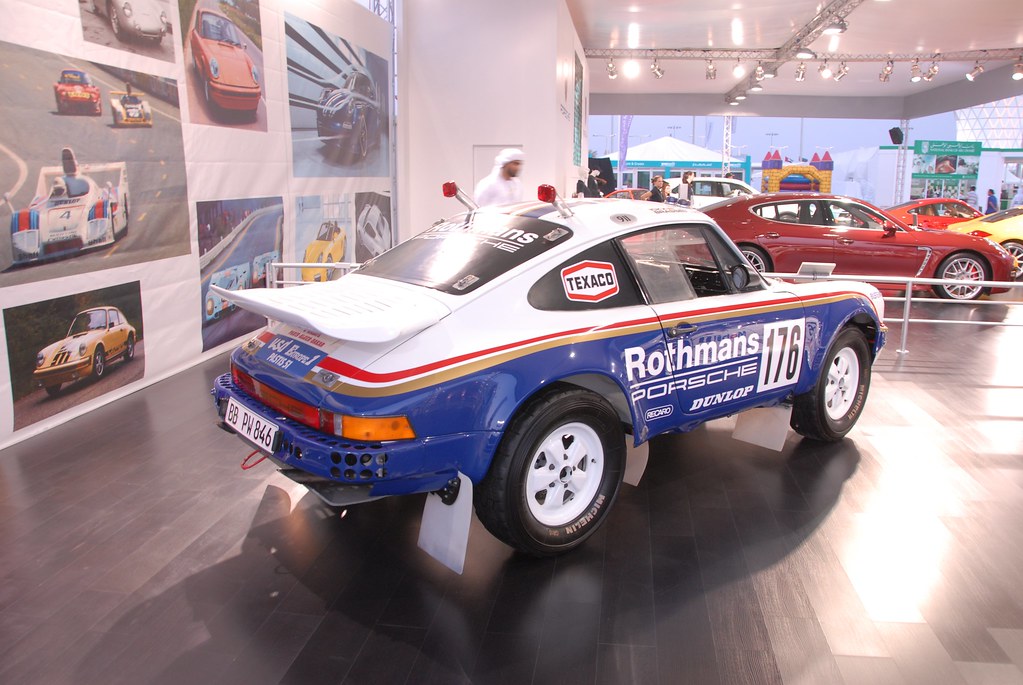
    Kelly Moss Motorsport built a ‘safari ready’ Porsche 911 that evoked the old Rothmans Porsche rally cars of the 1980s, check out their series of pictures here. The original Porsche 911 RS SC prepared by Dave Richards Motorsport were the dream car of my teens, alongside the rally raid ready Porsche 959 that they also prepared.

    Rothmans 176 Porsche

    The grey colour reminds me of post-war vintage tractors from the likes of Nuffield. Porsche made some beautiful looking tractors in the 1950s – a useless fact that I picked up as a child spending much of my time on the family farm in Ireland and having a Dad who used to repair heavy agricultural and construction plant early on in his career

    Porsche Tractor

    Collecting Europe

    Collecting Europe – really interesting game that investigates consumer attitudes to boundaries and identity

  • The end of employees + more

    The end of employees

    The End of Employees – WSJ – temp agencies, zero-hour contracts, outsourcing, asset-light businesses, focusing on core competences etc etc all driven by revenue per employee metrics. The end of employees is about financial engineering, it is an example of late stage capitalism. You can thank McKinsey & Company for the ‘thought leadership’ that brought on this sorry state about the end of employees. I can imagine them ideating over a double finger of The Macallan 40 year old single malt aged in a bourbon cask 

    This Tech Entrepreneur Shares Her Strategy For Managing Remote Workers Globally  – great interview with Tamara Middleton

    Design

    hiroshi fujiwara’s park-ing ginza X SONY collection | Design Boom – great tribute to Sony – now can they just get their mojo back

    Fullstopnewparagraph — Freelance copywriter | London – really nicely designed site

    Economics

    People are quitting gig jobs in the sharing economy — Quartz – not terribly surprising, this is likely to accelerate interest in automation

    Finance

    Apple tells Australian Commission that their Bank’s acting as a Cartel has a Chilling Effect on the Benefits of Competition | Patently Apple

    FMCG

    Is This the World’s Most Expensive Strawberry? | Time.com – interesting how the largely ex-pat Hong Kong Mums group kicked this story off. Gift giving is very important in Asia, is this any more offensive than Cadbury Christmas selection boxes, foil laminate packaging like Capri Sun or brittle plastic blister packs

    Hong Kong

    The Enigma of Hong Kong in the 1950s: Werner Bischof’s Photos at the F11 Photographic Museum – Zolima City Magazine

    Innovation

    Shell begins huge task of decommissioning Brent oil rigs | The Guardian – reduced tax revenue just as the UK goes post-EU with Brexit….

    Emerging Theme Radar – Goldman Sachs – rising importance of lithium and blockchain (PDF)

    Japan

    Nanidato | Free Listening on SoundCloud – this week I have mostly been listening to Japanese pop with a disco feel

    Media

    60% of content created by brands is just clutter | Marketing Week – Havas meaningful brands study

    ‘Planet Earth II’ Snapchat Show Will Promote BBC TV Series | Variety – bit size lean back media for millennials

    Bot Traffic Report 2016 | Incapsula Blog – interesting drill down into bot traffic for web properties

    Thousands of College Kids Are Powering a Clickbait Empire | Backchannel – content marketing using university students

    Software

    Tucows – AVC – interesting how they morphing into an alternative telco infrastructure company

    Style

    Harajuku style bible FRUiTS stops publishing after 20 years | Dazed – Noooooo!

    Wireless

    Apple iPhone loses Chinese market share for first time as Oppo, Huawei, Vivo gain ground | South China Morning Post – and the iPhone 7 didn’t impress