Yōkoso – welcome to the Japan category of this blog. This blog was inspired by my love of Japanese culture and their consumer trends. I was introduced to chambara films thanks to being a fan of Sergio Leone’s dollars trilogy. A Fistful of Dollars was heavily influenced by Akira Kurosawa’s Yojimbo.
Getting to watch Akira and Ghost In The Shell for the first time were seminal moments in my life. I was fortunate to have lived in Liverpool when the 051 was an arthouse cinema and later on going to the BFI in London on a regular basis.
Today this is where I share anything that relates to Japan, business issues, the Japanese people or culture. Often posts that appear in this category will appear in other categories as well. So if Lawson launched a new brand collaboration with Nissan to sell a special edition Nissan Skyline GT-R. And that I thought was particularly interesting or noteworthy, that might appear in branding as well as Japan.
There is a lot of Japan-related content here. Japanese culture was one of odd the original inspirations for this blog hence my reference to chambara films in the blog name.
I don’t tend to comment on local politics because I don’t understand it that well, but I am interested when it intersects with business. An example of this would be legal issues affecting the media sector for instance.
If there are any Japanese related subjects that you think would fit with this blog, feel free to let me know by leaving a comment in the ‘Get in touch’ section of this blog here.
TikTok quacks is a bit of a harsh label for TikTok content. The reality is that similar content to that turned out by various TikTok quacks appear on YouTube, Instagram and other social media channels. Quack and quackery are synonyms for medical false claims or a ‘snake oil salesperson’.
Social media not only spreads misinformation and false hope across a range of medical conditions, it allows the perpetrators to profit directly from their work. The rise of dodgy health businesses with commerce integrated into their social posts by the likes of TikTok (and Instagram) facilitates TikTok quacks.
Below are just some of the content currently exposing this intersection between health, wellness, beauty and dishonestly obtained profits.
Hong Kong’s corporate lawyers test boundaries as Beijing’s influence grows | Financial Times – legal practitioners, including corporate lawyers, are concerned the broadening scope of a sweeping national security law could jeopardise the independence of the city’s legal system, a legacy of British administration, as Beijing tightens its grip. “There is general concern . . . that people are not fully understanding where the boundaries lie,” said a senior corporate lawyer with a global firm who has worked in Hong Kong for more than two decades – not entirely unexpected and a great opportunity for Singapore
Digital materials look to use different geometry of materials to replace other materials with special properties like foams. It does this through 3d printed lattices.
Sweden Is Not Staying Neutral in Russia’s Information War | New York Times – The Psychological Defense Agency also raised political concerns when it was proposed, but its leaders have emphasized that mandate allows it to address only foreign sources of disinformation, not content generated in Sweden. The challenge is one facing all democracies that, as a matter of principle, decline to enforce official ideologies, allowing divergent points of view of what is true or false. “The government can’t control the truth if it’s going to be a democracy,” said Hanna Linderstål, the founder of Earhart Business Protection Agency, a cybersecurity firm in Stockholm, and an adviser to the International Telecommunication Union, part of the United Nations. “The government can’t control the truth if it’s going to be a democracy,” said Hanna Linderstål, the senior cybersecurity adviser of Earhart Business Protection Agency.
ChatGPT In Trouble: OpenAI may go bankrupt by 2024, AI bot costs company $700,000 every day – not terribly surprising, it’s computationally intensive and hard to monetise. Look at how Google and Facebook have looked to squeeze computing power per watt out of their data centres, along with squeezing cost per server right down as well – they did this to reduce operating costs versus income. ChatGPT hadn’t gone there on design and instead uses 10,000 plus servers based around power-hungry top-of-the-range Nvidia graphics processors
The August 2023 newsletter was inspired by LinkedIn’s in-built newsletter function. It’s almost the bank holiday so I thought I would spend some time to try out the newsletter function in LinkedIn.
If you’re reading this, you’re a pioneer! If this goes well I will put one out each month. You can find my regular writings here and more about me here.
LK99 & room temperature superconductors – why it was a big deal, what it would have meant if it were true and the damage likely to have been caused given it’s likely to be false.
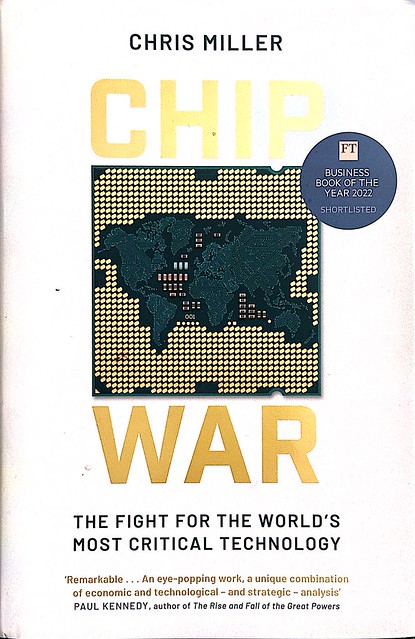
Chip War by Chris Miller. You can read my full review here.
Things I have been inspired by.
How left wing politics inspired Prada’s clothing designs.
Encouraging empathy for people with dementia in Japan with the restaurant of mistaken orders (scoll to the end here to find out more).
Things I have watched.
Three Body Problem. Chinese adaption by Tencent Video and made available for FREE on their YouTube channel. Don’t worry it has English subtitles. This is based on the blockbuster novel The Three Body Problem by Chinese science fiction author du jour Cixin Liu. The three books in the series are all fantastic and there is soon to be a Netflix adaption as well.
The Peripheral on Amazon Prime Video. An ambitious adaption of William Gibson’s novel of the same name. Amazon Studios recently cancelled the next season of this drama, which is a real shame as its one of the stand out series amongst the content on Prime Video.
Un Flic and Le Samourai – the magical formula of French new wave director Jean-Pierre Melville and actor Alain Delon created some iconic crime films that inspired directors in Hollywood, Hong Kong and Japan.
The sales pitch.
Available for strategic engagements in the autumn. Contact me here.
The End.
Congratulations, you’re reached the end of the August 2023 newsletter. Until next month: be excellent to each other. Let me know what you think or if you have any recommendations to be featured in forthcoming issues.
I first heard Kurena Ishikawa on a video that a friend of mine showed me of her performing at the Blue Note Jazz Club in Tokyo. Ishikawa played double bass and played a stripped down version of Michael Jackson’s off the wall.
It completely changed the atmosphere of the original song. In Ms Ishikawa’s hands a dancefloor classic full of life became much more emotive, in particular with her plaintive voice, but still danceable.
Kurena by Kurena Ishikawa
The main reason why I bought Ms Ishikawa’s self titled album on CD was for a studio recording of her Off The Wall performance. I had high expectations as the album has been released on the Japanese arm of the Verve record label. Verve is home to the largest back catalogue of jazz standards.
Kurena as an album doesn’t disappoint. The tracks are sparse and the instruments given room to breathe. At 34 minutes the album can’t be measured by the length of the recording but the quality within.
The album starts off with Sea Wasp which feels like a seamless mix of bossanova type vocals laid over a light jazz backdrop. The percussion evokes the winds and waves of the beach. The harder you listen, the more you get out of the track. I decided to listen to the rest of the album on a pair of AKG K872 headphones, which allowed for an open yet more detailed listening experience.
500 Miles High has Ishikawa’s vocals leading a more free-form experimental track, taking us from crashing surf to the sky. Bird of Beauty brings back a more Brazilian feel to the recordings with the focus again on Kurena Ishikawa’s lilting vocals.
Olea takes the tempo right down and focuses on the interplay of double bass, jazz drums and piano.
The album version of Off The Wall sees Ishikawa play double bass and sing unaccompanied. The performance while really good, feels incongruous with the rest of the album content. Despite this I can wholeheartedly recommend Kurena as a great album. It deserves to be focused on as a listening experience as could easily disappear to the background through a casual listen.
What prompted me to write about Geico advertising was a stream of news from marketing services companies about the state of technology company advertising. At the time of writing Stagwell are just the latest marketing services firm after S4, IPG, Omnicom and WPP have pinned declining profits on a reduction in technology company advertising spend. Then this story broke about Geico advertising: Insurer Geico made more money after benching its famous gecko | Quartz – and my first reaction was that the wrong lessons might be taken away from this.
Geico advertising – a primer
Geico îs an unfamiliar name to most people outside of the US. If you’ve read American magazines chances are there was a print ad or two in there with their iconic Gecko spokesperson. It’s a similar case on American television.
Geico advertising and their Gecko are as familiar to Americans as the meerkats of Comparethemarket.com are to your average Brits.
The truth about technology marketers vs. Geico advertising
Having worked with technology brands on and off for the past three decades, I have enough experience to know that generally, they aren’t great marketing organisations.
Coinbase’s Super Bowl ad drove traffic to a site that fell over.
Geico reinforced brand equity in the insurance space and pointed out their 24-hour claims hotline (I imagine that this isn’t an exclusive feature, but you wouldn’t know it from the advert).
Growth mindset ≠ marketing mindset
As organisations, they have a growth mindset, but not a marketing mindset. Before the internet, this meant a powerful field sales force organisation and marketing meant a bit of branding / design work coupled with case studies for the sales people. With the internet came constant iterative ‘growth hacking’ on digital channels, that mirrors agile software development rather than the best practices of marketing science.
There is a good reason why organisations like the Ehrenberg-Bass Institute for Marketing Science are supported by FMCG manufacturers, luxury goods makers, media companies, marketing services firms and pharmaceutical companies, BUT has no technology company sponsors.
The reasons are cultural in nature:
Engineering – if I haven’t heard of it or invented it then it’s not valid and you’re just a suit. At best great product is the marketing – and that’s great if you have a clearly differentiated great product which is self evident. The engineering mindset is also why they trust adtech and marketing automation services which outsource your marketing communications approach to a black box
Sales – marketing is just support. Which is the reason why my early clients (like old school Silicon Valley royalty LSI Logic) promoted long serving secretaries and administration staff into marketing roles
Even if they had a marketer who knew about Ehrenberg-Bass they wouldn’t be able to get in buy-in from the wider organisation to participate and they’d likely be fighting other dumpster fires elsewhere
Secondly, their laser focus on data affects their outlook. To paraphrase the comedian Bill Hicks: they know the price of everything, but the value of nothing. Because they are only looking at short term data. Great marketing and advertising also has long term effects that both screws with the short term marketing data focus.
Marketing and growth hacking are considered synonymous. It would seem ridiculous for me to to claim in any large marketing orientated organisation that sales and marketing are synonymous. The differences and complementary aspects of both would be well known. Yet in technology companies, this isn’t the case.
By contrast Geico as a brand is an organisation who understood marketing. You make your car or house insurance decision at best once a year (though there is friction in making a change).
The technology sector approach would be for Geico to bid on search ads and aggregators to acquire customers and then do direct mail or email when it comes to renewal times. But Geico advertising does something different. Geico advertising builds mental framework, so that Geico means car insurance and will be one of the brands that you consider.
This achieves a few things:
You are less likely to move away from Geico, you may not love them, but searching for an alternative might be too much of a hassle.
You may be reassured that you have chosen ‘the’ car insurance
It helps new customers get over the ‘which car insurance company to choose’ decision
It helps with upsell on the products due to the reassurance of the brand
Technology companies deal with these problems in a slightly different way:
Certification of engineering staff. If you are Microsoft certified or Cisco certified, you are less likely to use open source software or Juniper Networks products respectively. It would be against your self interest and the investment in terms of time and money that you have made in your self development
Contractual lock-in – self explanatory
Technology lock-in. You can put your data or programming code into a particular system, but its much harder and more expensive to move on to another system
Owning the entire technology stack. This is the approach that Adobe Systems have taken, gradually acquiring over the years the entire marketing, workflow and creative systems used by ad agencies, media agencies and their clients
So why was Geico advertising spend cut?
This is the crux of my point about how the wrong lessons might be taken away from the Geico advertising spend cut, with no ‘apparent’ impact.
There are a number of good reasons why Geico made the cut in advertising spend:
There was a cut in insurance sector advertising overall, so that Geico maintained or even grew its relative share of voice while spending less. This should see it emerge with improved economic performance over time. Procter and Gamble became the behemoth it now is by INCREASING advertising during the great depression of the 1920s. So the idea of relative share of voice and its relationship to market share is older than I am. Further more research by the IPA has found that holding or increasing relative share of voice during a downturn has a positive impact for business performance over a five year period
Geico may have managed to make some efficiency gains, this is most likely to occur in brand activating activities
There is also a bad reason: saving money in the short term. Kraft Heinz cut marketing to the bone under the guise of zero based budgeting (ZBB) – which made a mockery of ZBB as a concept. Kraft Heinz shares massively underperformed and were down 60% in the last 5 years, compared to the S&P 500 having gone up 69%. If Geico is following this route then it bodes ill for the long term performance of the business.
Without us knowing the real reasons and focusing on the short term measure, it reinforces a growth hacking mindset.
Hard times mean no sustainability premium in North America | WARC | The Feed – every single economic recession this comes around and marketers are surprised. Time to pay attention to what the longitudinal research data says. I really like the work that Gallup have done on macro trends and the American consumer, in particular their work on attitudes to the environment.
‘Pokémon Sleep’ Review: Sleep-Tracking Game Made Me Into Snorlax – gamifying sleep. Pokemon Sleep has surged to 3.2M global downloads and an estimated $130k in daily revenue according to SensorTower data. The app ranked in the top 5 in the U.S. Games charts. It’s even more popular in Japan (the home of Pokemon), where it’s number 1 across the App Store categories
Using attention to scale creative excellence at Mars | WARC – Sales, distinctive assets, and attention to advertising are the go-to metrics to guide marketing decisions at Mars. Mars use Attention as a pre-testing tool, to inform creative choices in digital and also proxy in TV. Mars believe that an execution with a better attention score will travel across media channels better and will be a safer bet for you when you need to make a choice. Measuring Attention is a key element in helping us improve the creative hit rate. Advertisers should question how they measure consumer responses and focus on measures of real consumer behavior.
It has taken me far too long to finish Chip War and write this review, so apologies in advance. Chip War was one of the FT’s best business books of 2022. In reality it’s a book about history, that happens to feature businesses.
The lens shaping everything else that I have written here
I am a sucker for books on the history of technology and Chip War was right in my wheelhouse. It complemented, rather than overlapped some of my existing favourite technology history books like Bob Cringely’s Accidental Empires, John Markoff’s What The Dormouse Said or most of Michael Malone and Steven Levy’s output to date.
The author
The author Chris Miller wasn’t a familiar name to me. Unlike Cringely, Markoff, Malone or Levy; Miller is an academic rather than a former journalist. Miller currently teaches international history at Tufts University. Chip War wasn’t his first book, his previous ones have focused on Soviet and Russian history. As a technology sector outsider, Miller’s Chip War has a very different tone my other favourite books from the genre.
It also allowed Miller to view the history of semiconductors in terms of a global perspective, that I hadn’t previously seen done.
On to Chip War itself
Other reviewers have used words like ‘outstanding’ and ‘epic’ to describe the book – which while being a reasonable guide to overall quality and length of read aren’t really all that helpful. It took me six months to read as a casual book. This is partly down to a hectic work schedule and that its a long book. I suspect that some readers when they reviewed the book seem to have thought ‘long’ as difficult to read. It’s actually 351 pages ignoring acknowledgements and the footnotes at the back of the book. Being an academic Miller worked hard to source everything in Chip War.
The book starts in the post-war period as the defence industry moves from being focused on hammering steel to developing smarter systems using semiconductors. That road takes the book past Texas Instruments and the early Silicon Valley of Bob Noyce and other members of the treacherous eight.
The book also zooms out to cover the Soviet Union’s failed efforts to replicate Silicon Valley as well as domestic industrial espionage and the start of globalisation which begat the current industry.
The Japanese challenge is covered in depth as is the rise of Korea including challenges that the industry faced in the early 2000s. The rise of Taiwan and its use of semiconductors as a hedge against invasion from the mainland. European tool maker ASML gets its own section, which is a case study in how to make a virtue of necessity. Finally it covers the technology conflict with China. Bring this up to date circa 2022.
If you are student of Silicon Valley history, then Chip War is unique in the way it puts everything in context. There were some completely new parts to me such as the political role that Sony founder Akio Morita played in advocating for a robust Japanese semiconductor industry as part of reasserting Japanese importance internationally.
You can get hold of Chip War here. More book reviews here.