Yōkoso – welcome to the Japan category of this blog. This blog was inspired by my love of Japanese culture and their consumer trends. I was introduced to chambara films thanks to being a fan of Sergio Leone’s dollars trilogy. A Fistful of Dollars was heavily influenced by Akira Kurosawa’s Yojimbo.
Getting to watch Akira and Ghost In The Shell for the first time were seminal moments in my life. I was fortunate to have lived in Liverpool when the 051 was an arthouse cinema and later on going to the BFI in London on a regular basis.
Today this is where I share anything that relates to Japan, business issues, the Japanese people or culture. Often posts that appear in this category will appear in other categories as well. So if Lawson launched a new brand collaboration with Nissan to sell a special edition Nissan Skyline GT-R. And that I thought was particularly interesting or noteworthy, that might appear in branding as well as Japan.
There is a lot of Japan-related content here. Japanese culture was one of odd the original inspirations for this blog hence my reference to chambara films in the blog name.
I don’t tend to comment on local politics because I don’t understand it that well, but I am interested when it intersects with business. An example of this would be legal issues affecting the media sector for instance.
If there are any Japanese related subjects that you think would fit with this blog, feel free to let me know by leaving a comment in the ‘Get in touch’ section of this blog here.
Horns that seemed to portent the apocalypse and stuttering dialogue: ‘none of them received a heroes welcome, none of them, none of them. None of them received a heroes welcome’. This was the soundtrack of 1985 as part of Vietnam Requiem sampling 19 by Paul Hardcastle. At the time the sampling got me interested in music, production, technology and DJ’ing – which pretty much set the path for the various stages of my career to date.
The best part of four decades later and I finally got the see documentary that was responsible for much of the samples in 19. I can understand how Vietnam Requiem might have profoundly affected Paul Hardcastle at the time.
Scott Galloway on Silicon Valley Bank’s collapse and the rise of Saudi Arabia. More on SVB here.
BMW M1
I am a huge fan of the BMW M1 and have written about it before. So I wanted to share this documentary by Jason Cammisa on the car. The putdown of modern BMW’s current 2-series range as ‘Grand Corollas’ is actually an insult to Toyota.
Driving Japan
Before I moved to London, I had a car and drove everywhere. I even drove for leisure. One of my favourite drives was going past the local oil refinery and associated chemical works late at night for the dystopian cyberpunk vibes of mercury vapour lamps reflected from matt zinc coated lagging.
These videos of driving in Japan gave me a similar sense of enjoyment.
Au campaign
KDDI cellphone service brand Au are looking at metaverse and Web 3.0 value added services, which partly explains this new campaign. I think that it is interesting as it reminded me of CD-ROM era motion comic and how Midjourney and Stable Diffusion can be used to reduce production costs on a campaign.
If this all feels a bit 2021, its because large corporate take time to catch up with where things are. I can also understand the attractiveness of the metaverse and digital assets as a concept in modern Japanese culture. Even if it is out far, far ahead of where technology is actually going.
Huamei Qiu is now an intellectual property lawyer based in Germany. Three years ago she featured in a New York Times documentary about the pressures on Chinese women to marry. She comes across in the film as bright, smart and engaging. She’s pretty in a girl-next-door kind of way with a flattering pixie haircut and definitely someone’s potential partner in a marriage rather than merely a trophy wife.
She has followed the party’s advice to build a good future for herself. As woman in China, she should be a hot commodity relatively speaking in the dating pool. As we see Huamei Qiu face a match maker; you realise that something is very rotten in the Chinese dating market. What Ms Qiu is looking for isn’t that much. Someone who is respectful, educated and ambitious. What I thought would have been hygiene factors? Instead, Huamei Qiu is told, her time is running out and she needs to settle fast.
China has more men than women in the marriage market, which should mean they would have to compete harder if you think about it as an economic model. Instead Huamei Qiu existed in a Kaftaesque world. I know about the government policy about leftover women, but this just left me feeling angry and frustrated on her behalf.
Beauty
The Class Politics of Instagram Face – Tablet Magazine – by approaching universality, Instagram Face actually secured its role as an instrument of class distinction—a mark of a certain kind of woman. The women who don’t mind looking like others, or the conspicuousness of the work they’ve had done. Those who think otherwise just haven’t spent enough time with them in real life. Instagram Face goes with implants, middle-aged dates and nails too long to pick up the check. Batting false eyelashes, there in the restaurant it orders for dinner all the food groups of nouveau riche Dubai: caviar, truffle, fillers, foie gras, Botox, bottle service, bodycon silhouettes. The look, in that restaurant and everywhere, has reached a definite status. It’s the girlfriend, not the wife
What party control means in China | The Economist – The workings of Chinese power are not easy for outsiders to follow. Visitors to some official buildings, for example, are greeted by two vertical signboards, one bearing black characters, the other red. The black-lettered sign denotes a government department. Red characters signal an organ of the Communist Party. In bureaucratic slang this is known as “party and government on one shoulder-pole”. Sometimes the two offices oversee the same policy area, and employ some of the same officials. They are not equally transparent. Especially when meeting foreigners, officials may present name cards bearing government titles but stay quiet about party positions which may or may not outrank their state jobs. Many party branches are not publicly marked at all. It is a good moment to remember this quirk of Chinese governance. The annual session of the National People’s Congress (npc), the country’s largely ceremonial legislature, is under way from March 5th to 13th. This year’s npc meeting comes after a big party congress last October. At that gathering China’s supreme leader, President Xi Jinping, secured a norm-trampling third term
Google – Headless chicken pt. II – Radio Free Mobile – this reminds me of Yahoo! in the mid-2000s, when I worked there. Its size and prior success ensnares it. Projects are likely being started and closed rapidly. It is struggling to meaningfully redefine itself and regain its agility
Studying Ukraine war, China’s military minds fret over US missiles, Starlink | Reuters – the Ukrainian conflict had provided impetus to long-standing efforts by China’s military scientists to develop cyber-warfare models and find ways of better protecting armour from modern Western weapons. “Starlink is really something new for them to worry about; the military application of advanced civilian technology that they can’t easily replicate,” Koh said. Beyond technology, Koh said he was not surprised that Ukrainian special forces operations inside Russia were being studied by China, which, like Russia, moves troops and weapons by rail, making them vulnerable to sabotage.
I was started down the train of thought to think about the idea of a cyborg based on a discussion with my colleague Colleen with regards to the changes we had been seeing in consumer behaviour. With that in mind I thought I would reflect on what my understanding of what cyborgs are.
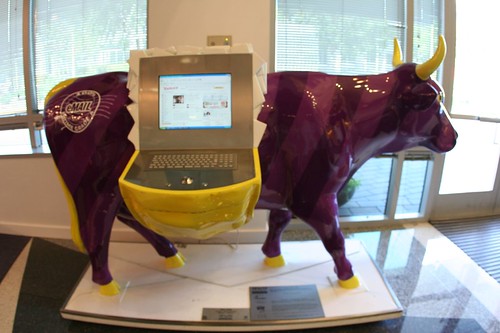
‘Moo-mail’ Yahoo! cow parade cow. The web appliance / cow cyborg hybrid used to stand in the lobby of building D, next to the Yahoo! branded merchandise store on the Yahoo! campus back when I worked there. It was originally created in 2000 as a buzz marketing gimmick to promote Yahoo! Mail – the company’s email product to New Yorkers. More here.
Cyborg in culture
I can just about remember playing with friends bionic man toys and primary school and remember the opening credits of The Six Million Dollar Man. The show ran from 1973 to 1978 and had a corresponding spin-off show called The Bionic Woman.
According to the show a cyborg was:
CY’BORG
A HUMAN BEING WHOSE ORIGINAL HUMAN PARTS HAVE HAD TO BE REPLACED TO ONE EXTENT OR ANOTHER BY MACHINES THAT PERFORM THE SAME FUNCTIONS.
According to the definition, at the time of writing my Dad is a cyborg, having had a pacemaker fitted a year or two ago. So would the character Batou be in Ghost In The Shell.
The cyborg was a feature of cyberpunk culture. The key difference was that people chose to have augmentation, not just as a repair but as a form of enhancement.
Optional enhancement
Johnny Mnemonic had a storage brain interface fitted that allowed him to be a giant walking thumb drive as a profession.
Fellow William Gibson creation Molly Millions has retractable razor sharp blades in her fingers and an augmented metabolic system. She has permanently fitted mirrored lens over her eyes that enhance her vision.
Captain Cyborg
Real life did a rather poor version of this cyberpunk fantasy with academic Kevin Warwick spoofed by IT paper The Register using the moniker Captain Cyborg for him. He did foolish things like implant himself with an RFID chip usually used for pet identification. And yes of course Warwick did a TED talk. I can’t tell whether the audience is laughing with him; or at him.
So what has an office conversation got to do with a cyborg?
Digital drugs
Which brings me to how an office conversation spurred me to reflect on how a conversation on compulsive behaviour got me to start thinking about cyborgs. Culture did envisage some form of device addiction. The premise of Neal Stephenson’s novel Snow Crash revolves around a file that crashes a person’s computer and leaves a hacker called Raven with real-world brain damage in the process.
Long live the new flesh
Ten years earlier Videodrome featured a TV executive called Max Renn investigating a satellite TV show called Videodrome. It is described a socio-political battleground in which a war is being fought to control the minds of the North American population. Built into it is a signal that produces a malignant brain tumour. Renn’s reality dissolves over the rest of the film as he finds out more and then kills himself.
There is a clear analogy with the heroin and crack cocaine epidemics that ravaged the cities of the western world through 1980s and 1990s as drugs of desperation in the face of globalisation. Science fiction is as much about the past and the present rather than the future. Heroin and crack both cost large amounts of money, so children tended to be secondary and tertiary victims rather than addicts in their own right. It would also be problematic for the authors to contemplate gratuitous harm to children in their works back then, let alone now in more anxious times.
In both Snow Crash and Videodrome users suffer damage from technology that they are unwilling to put aside.
Back to now
Addiction is ‘real’
My colleague put forward the following points:
Screens now dominate our lives, and their presence is only getting stronger and more powerful
(Some) adults can control to a certain extent how often and when they use screens. But there is a commonplace screen addiction.
Smartphone addiction and drug addiction share some similarities including a neglected personal life, a pre-occupation with the subject of the addiction, social media as a mood modifier or for escapism. The implication is that smartphones are an unwilling appendage which add capabilities (some of which are of a questionable value) and can’t be put down. All of which reminded me of my childhood (and adult relationship with music). But it is why I started to thinking about the nature of a cyborg
Smartphone addiction
Smartphone addiction goes by many names including screen addiction, online or internet addiction. Japan identified the phenomenon of hikikomori. The term was coined by social scientist Tomaki Saito in a 1998 book. While the term itself meant socially withdrawn, it hinged around the person staying home and playing video games or living a virtual life.
By 2015, academic research indicated that somewhere between 1.9 – 2.5 percent of Hong Kongers aged from 12 to 29 might fall into the hikikomori category, compared to the 1.5 percent of Japanese believed to in the category.
Meanwhile in the early 2000s BlackBerry email devices were nicknamed Crackberry, often by users who admitted overusing them in anti-social contexts. There was a corresponding term ‘BlackBerry orphans‘ for children who were ignored by parents wrapped up in their BlackBerry writing and reading emails instead of engaging at home.
China was the first country to push for action to clamp down on children’s online time, in particular the use of online games. As far back as autumn 2005, China’s General Administration of Press and Publication had started trialling a fatigue system to limit screen time.
By 2007, the local government of Shanghai had a camp set up to help cure teens of internet addiction working with a pilot bunch of inmate aged between 14 and 22. And just a year later the FT was documenting how the Chinese government was struggling to combat the addiction throughout the country. This addiction implies a cyborg-like relationship with their internet access device.
In 2017, the substitute phone is launched as a kind of fidget tool. This provides the tactile experience of swiping and button pressing, but without any of the compelling addictive software.
By 2018, smartphone manufacturers were worried about smartphone addiction and came up with different ways to try and give their customers better information and control over their smartphone usage.
What about the children?
My colleague asked the following question: given the impact on adults, who haven’t grown up with screens, what does this all mean for children?
Remember the BlackBerry orphans earlier? My colleague proposed that now children are being taught once they are born that screens and smartphones are at the centre of life, rather than people. Parents use their smartphone as a substitute to toys, parent-child playtime or conversation or even reading to the child.
This is claimed to manifest in impacted social and emotional development. Expert opinion is that children below 2 years old shouldn’t have any ‘technology in their life‘.
There is a belief amongst experts that screen time can result in permanent damage to developing child’s brains impacting concentration, social kills and vocabulary. Some even believe that there might be a link between ADHD and TikTok.
But the Royal College of Paediatrics and Child Health (RCPCH), the UK’s professional body most concerned with a child’s health, doesn’t publish any recommendations. There isn’t any research to indicate the ‘safe’ level and arguably commissioning this research would likely pose ethical questions.
By the time children enter secondary education, they are likely to own a smartphone of some sort. They maybe exhibiting a number of physiological effects:
‘Text neck’
Premature eye ageing
Sleepless nights
Admittedly, as a child I was told that reading after lights out and listening to the radio or watching TV in the dark would result in ‘going blind’ or a lack of much needed sleep.
Like television before it, online screen time adversely affects academic performance. My own exam grades were empirical evidence of this. China, South Korea and Taiwan both have different ways of limiting screen time. China has enabled technology with online games platforms. Taiwan has held the parents directly responsible and even fines them.
Questions
All of this prompted a number of questions with me:
Is it the device or is it the media?
Is it different to other waves of technology?
Moral panics – or what can we learn from the past & our cyborg future
Media
Rock music – academic research indicated that listening to rock music was linked to an increase of reckless behaviour including drug use, unprotected sex, casual sex, drunk driving, speeding and vandalism
Violent content – while violent content was considered to trigger a response in children, the overall risk associated with it was difficult to prove conclusively despite decades of research. Studies as far back as the mid 1990s indicated that there a lot of other factors to consider in addition to the exposure including mental health and cognitive ability.
Sexual content – the US Center for Media Literacy pulled together views on sexual violence in content. There wasn’t a lot of clarity in the plurality of views beyond the challenge of defining content to be of an overly sexual nature. What views were expressed were not backed by scientific research
Video gaming – because of the strategies used by players in video games. Academic research in 2015 indicated that video games might have a negative impact on brain development over time.
Devices
Personal stereos – the use of a Sony Walkman and later on the iPod was considered to a negative effect on hearing. They were also considered to have a social effect, depending who you ask it considered to be empowering or dislocating from society with increased narcissism. The positive autonomy based interpretation was called the ‘Walkman effect‘. The implication from this research is that not giving a child a smartphone at a certain point could have a detrimental effect on them – at some point the child has to become a smartphone | human cyborg.
Televisions – when I was a child I was constantly told to not sit too close to the television and that doing so would cause me to go blind. According to Scientific American, it isn’t the distance from the television that affects the child, but a long enough amount can cause eye strain.
The implication in past concerns about media and devices is that its the content that tends to do the damage rather than the device. This tends to indicate where action should be taken on ‘screen addiction’. As for our great cyborg future – it can’t be stopped.
Japanese soft power didn’t start with anime, manga or even Sonny Chiba. Asianometry posted a video covering how Japanese soft power was manifested in the 19th century through a mix of planning and happy accident.
Japan benefited from a sophisticated artisan culture for everything from food and drink to metal working.
Wikileaks
Talking about soft power. Task and Purpose goes back and looks at Wikileaks. This is interesting as it reflects on the US viewpoint of pro-Russian bias with the work Wikileaks did disclosing both Chinese and Russian secrets. The biggest legacy was likely reinvigorating investigative journalism at mainstream media outlets that had been cut back over the previous decade or so.
VFDs
Dutch YouTuber posts a love letter to VFDs or vacuum fluorescent displays. They were featured on stereos, VCRs, Blu Ray players and my Bose Wave (you can get your own one here). They feel nicer than LCD displays, don’t look cheap and don’t affect your sleep.
Streaming culture in China
While most people think about streaming is China’s e-commerce. But the offering of the streamer featured in this documentary is more ambiguous. Her audience feel some sort of romantic attachment to her. ‘Inside the Daily Life of a Live Streaming Star in China’ is as much about the imbalance in male and females in China due to the one-child policy.
It reminded me of Japanese and Korean ‘idol‘ culture, but designed for the mobile addicted COVID traumatised young adults. Buffeted by societal expectations and the economic issues by the government pivot away from economic growth to internal and external control.
Men
Scott Galloway has an interesting prognosis on the current crisis in the male population which seems to be in a socio-economic death spiral. I am not convinced by his solution. It’s very male-centred and assumes that parenting isn’t broken.
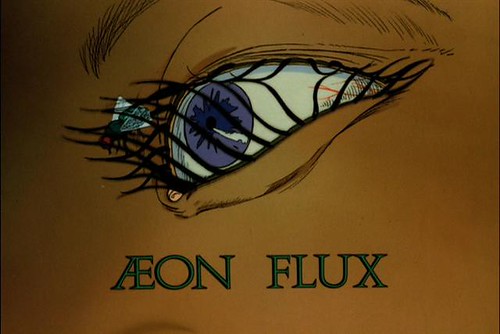
Æon Flux’s surprisingly modern take on privacy and surveillance. | Slate – Æon Flux was a name that I hadn’t heard in at least a decade. I remember when it came out as I enjoyed cable TV in our student house. It fitted in with the wider cyber culture. The big beats and brash gravity defying visuals were everywhere from WipeOut to anime. The media was tech artefacts from a future counter-culture.
Macromedia Director and Flash produced animated video hardwired straight into our cortex. It was psychedelia but not as it had been experienced before. Asian animated and real world films weren’t mainstream but serious culture.
Æon Flux & The Matrix
The series came out in the early 1990s as part of a series of experimental animation on MTV called Liquid Television. It came out before The Matrix, yet drew from many similar influences:
Cyberpunk
Biopunk
Anime
Asian ‘gun fu’ action films
European comics in particular the space opera works of Möbius, Mézières & Christin. You can also see the influence that Chung had working with Ralph Bakshi on his fantasy animation
Gnostic beliefs
In another Matrix link; Æon Flux creator Peter Chung (피터 정) went on to create a segment for the Wachowskis’ The Animatrix which told part of the back story of The Matrix quadrology.
Privacy and the surveillance state
Each episode saw a conflict play out between an anarchic city and its authoritarian rival. Flux was an assassin from the anarchic city on undercover missions.
The animated series had been released on VHS, DVD and UMD – the Sony Playstation Portable (PSP) disk media that was the ultimate manifestation of cyberpunk storage. For some reason, it hasn’t been released on Blu-Ray yet.
It was truly transmedia with computer games and graphic novels to complement the animated series. Eventually Hollywood did a live action version that was vaguely related to the original Æon Flux. The original was too difficult and avant garde to be a Hollywood franchise, which is probably why the animated version has slipped back out of view.
Given that Æon Flux was influenced by cyberpunk was inevitably seen as a prescient take on privacy and the surveillance state.
Consumer behaviour
Taking Affection Back | No Mercy / No Malice – some interesting and intractable problems in society revolving around how men are set up for failure. Contrast the diagnosis with this article: The Great Feminization of the American University | City Journal – Female students and administrators often exist in a co-dependent relationship, united by the concepts of victim identity and of trauma. For university females, there is not, apparently, strength in numbers. The more females’ ranks increase, the more we hear about a mass nervous breakdown on campus. Female students disproportionately patronize the burgeoning university wellness centers, massage therapies, relaxation oases, calming corners, and healing circles. Another newly installed female college president, Dartmouth’s Sian Leah Beilock, claims that the two “most pressing challenges of our time” are the “mental crisis among young people” and climate change. College institutions “really have a part to play in how we support students” suffering from that mental health crisis – correlation and causality aren’t the same thing
Why social class is advertising’s biggest diversity blind spot | Advertising | Campaign Asia – Social class might bring up antiquated ideas of British snobbery, but it exists everywhere. In Asia, social class is very pronounced. From obscenely wealthy ‘Crazy Rich Asian’ types, to a much reported on ‘rising middle class’, and a majority who are working class or live in poverty. The pandemic certainly brought class differences in Asia into sharp focus. Yet, despite making up the majority in society, advertising often fails to represent working class people. And when adverts do feature working class people, they usually perpetuate class-based stereotypes. Instead, the advertising industry is obsessed with targeting middle-class 18 to 34-year-olds, resulting in advertisements that seem to overlook the genuine diversity of society and instead mirror adland’s own demographic.
話題のChatGPTをLINEで使える「AIチャットくん」リリースから3日で20万登録突破 | みんなの便利な使用例を紹介 #AIチャットくん|株式会社piconのプレスリリース – LINE adds ChatGPT gains 200,000 users in 3 days. ChatGPT speaks and understands Japanese, but uptake in Japan has been hampered, apparently, because you need to speak English to sign up. Line is the dominant messaging platform in Japan, and last week they added ChatGPT. You just add “AI Chat-kun” as a friend and start chatting. Up to five messages per day are free, and you can upgrade to unlimited messages for ¥680/month (about $5).
The Daring Ruse That Exposed China’s Campaign to Steal American Secrets – The New York Times – China publicly denies engaging in economic espionage, Chinese officials will indirectly acknowledge behind closed doors that the theft of intellectual property from overseas is state policy. James Lewis, a former diplomat now at the Center for Strategic and International Studies in Washington, recalls participating in a meeting in 2014 or so at which Chinese and American government representatives, including an officer from the People’s Liberation Army, discussed the subject. “An assistant secretary from the U.S. Department of Defense was explaining: Look, spying is OK — we spy, you spy, everybody spies, but it’s for political and military purposes,” Lewis recounted for me. “It’s for national security. What we object to is your economic espionage. And a senior P.L.A. colonel said: Well, wait. We don’t draw the line between national security and economic espionage the way you do. Anything that builds our economy is good for our national security.” The U.S. government’s response increasingly appears to be a mirror image of the Chinese perspective: In the view of U.S. officials, the threat posed to America’s economic interests by Chinese espionage is a threat to American national security.