Over the space of 20 years, luxury changed enormously. The Japanese had been a set of new consumers for luxury, but in terms of numbers they hadn’t eclipsed the US as the biggest market for luxury.
China’s ascent into the WTO (World Trade Organisation) made a lot of business people and politicians a lot richer. China challenged the US in terms of luxury market size. On their rise, Chinese consumers changed a lot in their sophistication as they educated themselves on luxury consumption.
These new consumers picked up new traits such as wine drinking. This also meant that luxury goods became new asset classes as Chinese money looked to acquire only the best. Chinese culture in turn impacted luxury design. Chinese new year became more important than Christmas.
Then there was the second generation money. Young rather than old consumers. Consumers who were looking for something less formal, either because they didn’t wear anything but streetwear or they worked in the creative classes rather than the traditional professions and high finance.
The industry had traditionally avoided rap artists and R&B singers, now Jay Z and Beyonce are the face of Tiffanys and Fendi had collaborated with Rihanna.
They no longer wanted to have to wear a jacket and tie to have afternoon tea at the Mandarin. They took an eclectic look more attuned to the Buffalo Collective than Vogue Italia.
You had hybridisation with the street to create a new category of luxe streetwear in a way that also owes a debt to football casual terrace wear and the pain.
Now you have Zegna badge engineering approach shoes from alpine brand La Sportiva and Prada has done a similar thing with adidas’ iconic Stan Smith tennis shoes. Balenciaga with their Speed Sock looks like a mix between Nike’s flyknit football boots and the Nike Footscape sole.
Luxury has traditionally reflected status. Goods of a superior nature that the ‘wrong sort’ of people would never be able to afford. Luxury then became a symbol that you’d made it. In Asian markets, particularly China, luxury became a tool. People gifted luxury products to make relationships work better. It also signified that you are the kind of successful business person that partners could trust. You started to see factory managers with Gucci man bags and premium golfwear to signal their success. Then when the scions of these business people and figures in authority were adults, luxury has become about premium self expression.
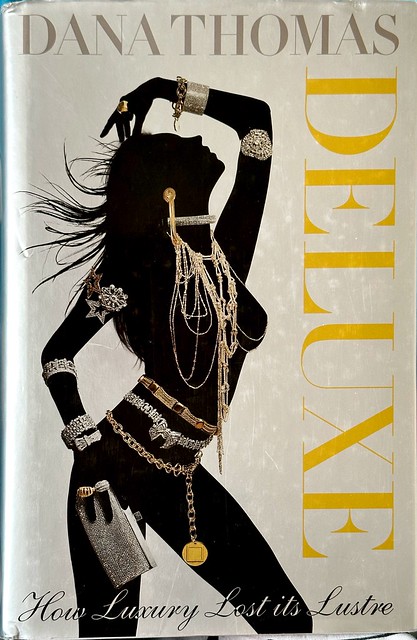
I had this copy of Deluxe on my shelf for a while and finally managed got round to reading it. Deluxe – how luxury lost its lustre was written by Dana Thomas. Dana knows the subject that she’s talking about.
Dana Thomas
Dana Thomas is a Paris-based journalist who covered the fashion industry. Thomas started her journalistic career writing for the ‘style’ section of The Washington Post. For a decade and a half Thomas was a cultural and fashion correspondent for Newsweek in Paris. She has contributed to The New York Times, The New Yorker, The Wall Street Journal, the Financial Times, Vogue, Harper’s Bazaar and Architectural Digest. Deluxe is one of three books that she has written, the other is Fashionopolis, which focuses on the fast fashion industry and Gods and Kings covered the career of fashion designers Alexander McQueen and John Galliano.
Deluxe – How Luxury Lost its Lustre
In the introduction starts with a scatter gun approach. She bemoans Gucci and Burberry factory seconds on sale in China, revealing the global supply chain used by luxury brands now. She also criticises that luxury goods are used as currency by some sex workers from compensated dating to ‘returning gifts’ and pocketing the difference minus a restocking fee.
I get the sense that Thomas would like to see these companies remain small ‘secrets’ only known by a cosmopolitan cognoscenti, obviously including herself. What my younger peers would call ‘gatekeeping’ in a derogatory way.
Parasite singles
Most of Thomas’ ire focuses on Louis Vuitton early on. She describes Bernard Arnaud in unflattering terms and makes the globalisation of the brand sound like a mix of a happy accident and opportunity. Along the way she critiques the weakness of Japanese society’s love for luxury goods down to subtle social signalling and ‘parasite singles’ – young women living at home with their parents who spend their disposable income on luxury goods.
(The reality is that could be young people with a job in Spain or Italy either as east Asians and Southern Europeans tend to only move out of home to marry or to follow work or education.)
Japanese tourists took their luxury shopping abroad, taking advantage of duty-free shopping. It’s no coincidence that LVMH owns DFS (Duty Free Shopping) outlets across America and the Pacific rim. Some of the lessons that DFS and LVMH learned selling to Japanese luxury buyers, such last late closing, you can still see in showrooms across the Asia Pacific region.
Jumping from Japanese duty free shoppers in Hawaii, Thomas moves on to the connection between a generation of Italian designers and Hollywood. Richard Gere’s star power was as much down to his styling making him look the part by Giorgio Armani as it was to his considerable acting prowess.
From Hollywood, the book delves into the perfume operations of the design houses. It highlights how perfume formulation moved from being an in-house activity for design houses to being outsourced to a few specialists companies who work with a ‘creative brief’.
Quality issues
The area where I can agree most with Thomas is around the decline in quality of luxury goods. Deluxe approaches this from the different tactics that luxury companies have used to conceal their use of Chinese factories. However as Apple has shown, made in China doesn’t necessarily mean cheap or poorly made. Indeed, a decade and a half after Deluxe was written, we’re seeing local luxury brands displacing international luxury brands in the Chinese market for several reasons, usually explained using the term ‘guo chao‘.
Thomas estimates that there at least four factories in China who manufacture most of the luxury industry’s handbags and leather goods – alongside private label brands for department stores and supermarkets. I was surprised that even back in 2004, manufacturing in China only saved 30 percent of the bill of materials.
The book goes on to cover the cost cutting that has gone into luxury products, from clothes with cheap stitching, skipped tailoring such as no lining in jackets and dresses. Thomas highlights that these changes happened to allow luxury to go mass market. Luxury then followed customers out of the office or the salon into all aspects of their life including sportswear and ‘streetwear’. What my friend Jeremy calls the ‘Supremification’ of luxury.
The reliance on the mass market bought about two challenges in Thomas’ eyes:
Counterfeit products that are almost indistinguishable from the real thing by experts
Rockier finances for the large luxury corporates who are no longer sheltered from economic cycles by the continued spending of ultra high net worth individuals.
The future
Thomas left us with two parts to what we saw the future of luxury looking like:
The continued pursuit of emerging markets with India replacing China due to demographics.
The new luxury of industry specialists spinning off and creating new houses, because they were jaded with the existing business practices and structures. The book highlights Tom Ford; who recently gave up his label and sold it on in November 2022 to cosmetics business Estée Lauder and fellow fashion house Ermenegildo Zegna.
In summary
Dana Thomas’ Deluxe is a book of its time in the early to mid 2000s. Thomas clearly has some bias’ due to history with some of the protagonists, which is worthwhile bearing in mind. The historical part of the book is useful; but the luxury industry has moved on and in some ways the problems are now much worse. With those provisos in mind, I can recommend the book as a background read on the luxury sector.
The luxury sector was surprised by the acquisition of Bucherer AG by Rolex. Bucherer was founded in 1888 by Carl F. Bucherer. Over time, it grew to be a 100 store international network of watch and jewellery shops. In addition, the company owns a watch brand called Carl F. Bucherer. The chairman Jeorg Bucherer is the last of Bucherer family. His lack of a successor and the family’s close connection to the Rolex Foundation were given as a reasons for the sale.
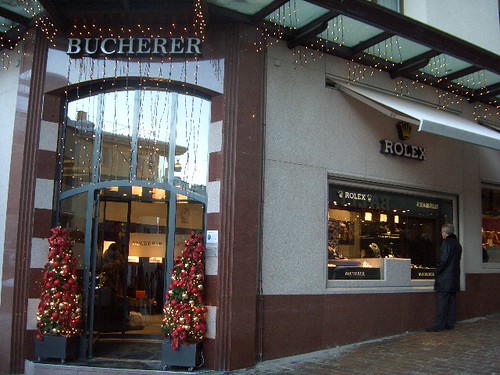
Bucherer in Lausanne
Why should Bucherer sell?
Bucherer pivoting to a sale was surprising. Part of this is down both companies being private. Neither publicly disclose finances or appear regularly in the media. We don’t know if the offer came from Rolex or if Bucherer approached Rolex with a view to sell.
If Rolex made the first move
If it was Rolex that made the move, then saying no would put the 100+ strong Bucherer retail showroom network at risk. While Bucherer represents 5 percent of Rolex’ global sales. Rolex means much more to Bucherer; 53 of their stores are Rolex authorised dealerships and 48 are Tudor authorised dealers. Having a Rolex franchise increases footfall and likely boosted sales of other brands in Bucherer stores.
If Rolex were invited to make an offer
If, like it was claimed that Bucherer’s decision was down to the lack of succession, why did Bucherer conduct a lot of activity to grow its business internationally?
Bucherer has continued to expand its retail and service network. It reputedly spent up to $350 million buying US luxury watch retailer Tourneau five years ago.
The Carl F. Bucherer (CFB) watch brand has put a lot of effort in terms of expanding its watch line-up, which are made in its own factory in Lengnau, Switzerland. This watch range uses some movements that are based on La Joux-Perret or ETA movements and some which seem to be complete in-house designs that look to mirror the kind of horology that the likes of Patek Philippe are better known for. A good example of this is the minute repeater below.
Watch featuring their inhouse M3000 movement.
The watch making side of the business has continued to design innovative movements including novel technology designs.
The brand has worked on marketing its watches globally from a roster of Chinese and western actors as brand ambassadors, movie product placement including Deadpool 2 and the John Wick series. In 2018, they worked with JD.com to establish a watch brand-specific online storefront for the China market. Marketing activity continued through the COVID pandemic.
At the beginning of July this year they launched a new watch model: the Heritage Chronometer Celebration in rose gold.
This doesn’t sound like the brand was preparing for a sale due to a lack of family members to take over the reins. So why the sudden change?
Why should Rolex buy Bucherer?
Vertical integration?
Bucherer apparently counted for five percent of Rolex’ global sales, but had showrooms in strategically important markets like Geneva, London, New York and Paris.
Bucherer was the pioneer retail partner for Rolex’ CPO (certified pre-owned) programme; so their relationship was already very close. The programme was suspected to be rolled out for a number of reasons:
To try and deal with authorised dealers shortage of new Rolex stock, that had driven ‘watch flipping’ and allegations of corrupt sales practices at Rolex authorised dealers. If customers leave the authorised dealer network, Rolex loses control of the customer experience.
To allow Rolex additional profits from the inflated pre-owned watch market driven by pre-owned watch dealers catering to massively increased consumer demand.
More on the allegations of corrupt sales practices
While the CPO programme arrived just as the pre-owned watch market peaked (and at the time of writing its now at a two year low), it hints at the benefits to Rolex of having both circular and vertical integration.
Buying Bucherer potentially gives Rolex 100+ owned outlets. Why would Rolex want to own its retail outlets? Let’s go back to 1977 and a seminal event in the current luxury industry history. Madame Renée Vuitton asked her son-in-law to take over the family business. Henry Racamier got under the hood of the business and found that franchisees were making the bulk of the profits. So, slowly but surely Racamier set the business on the path to vertical integration. Racamier’s only business mistake was getting involved with Bernard Arnault, who took the Racamier formula and built LVMH into the giant that it is today.
Racamier, set a path that Audemars Piguet would eventually follow. Vertical integration would mean control and increased income for the Rolex Foundation.
For Rolex, owning its showrooms is not without risk. The reactive statements by Rolex that the brand shops would maintain their brand and management seems to be designed to placate Swiss competition authorities. What the subsequent integration into Rolex Group operations would look like may depend on regulatory concerns.
Swiss competition authority COMCO confirmed that was was analysing the deal. It accesses impact based on size and its possible effect to eliminate effective competition.
Bucherer is a sales agent for much of the luxury Swiss watch industry
Baum & Mercier
Bell & Ross
Blancpain
Bregeut
Bulgari
Cartier
Chopard
Frederique Constant
Girard-Perregeaux
Hublot
IWC
Jaeger LeCoultre
Longines
Maurice Lacroix
Montblanc
Omega
Oris
Panerai
Piaget
Rado
Roger Dubuis
TAG Heuer
Tissot
Ulysse Nardin
Vacheron Constantin
Zenith
Secondly, being a retailer and being a manufacturer is a very different business. If Rolex is going to learn about retail, it needs to spend years understanding Bucherer’s current business. Even then, there is no guarantee that it will follow the owned single brand showroom network model.
CPO and circular economy
The idea of the circular economy is now a big idea in the luxury sector and fits into the ‘Perpetual Planet’ tenet of the Rolex Foundation and at least part of the thinking behind the CPO programme. The idea is that a product can be serviced and or resold from its first owner to successive owners. This would require less new materials to be mined and less energy expended on the manufacturing process. The customer would end up with a product that is long-lasting and better for the planet.
Rolex watches like the 1960s era 5513 Submariner are still worn as everyday watches and will likely outlast you and I, if they are serviced once every five years and parts replaced on an as-needed basis. Secondly, there is a premium set on authenticity – vintage items that may have already lived an interesting life. You see this desire for authenticity from fashionistas thrifting to Rolex collectors prizing COMEX and military-issued models.
Finally, there is precedent for watchmaker participation in the circular economy; Richemont are already in the pre-owned market with their ownership of WatchFinder.
Avoiding a retail power shift?
Bucherer is the largest of independent privately owned Rolex authorised dealer networks. Rolex has about 2,000 outlets worldwide. If a rival or a private equity company bought Bucherer on its own, it wouldn’t be a big deal. But if the private equity buyer used Bucherer as a hub and bought up:
Wempe – which has a multi-country footprint (Austria, France, Germany, Spain, USA and the UK). Like Bucherer, Wempe is also a watch brand.
David Rosas that has a network of seven stores in Portugal.
Emperor Watch and Jewellery that has a footprint in Hong Kong, Macau, the Chinese mainland, Malaysia and Singapore.
You then have a private equity run authorised dealership network that would be a substantial part of Rolex Group sales and more likely to try and dictate terms to the watch maker. Often this doesn’t work, a classic example of this is how Phones4U went under after trying to dictate terms to the mobile networks. Regardless of whether Rolex fended this off or were enthralled by the dealer network, it would be damaging for the Rolex brand, its global reach and customer experience.
Realistically, Rolex dealers whilst profitable miss out on some of the things that private equity firms look for:
Huge cost-cutting potential – this might happen if you can scale to a dominant position in the Rolex dealership network and leverage it to get costs reduced. Stores tended to be staffed pretty lean already with Bucherer using one sales manager for three London showrooms. There would be limited scaling benefits for business functions.
Huge growth potential – maybe, but you’re still constrained by the nature of the luxury market and the complex eco-system of grey market and pre-owned specialists.
All of this would take time, likely longer than the 4 to 6 years that private equity investors typically look for their return. But that doesn’t rule out sovereign funds from the likes of the Gulf states.
Taking Bucherer off the table means that the notional private equity firm would likely need to buy a larger publicly listed partner like Watches of Switzerland. This would likely cost more on a store-for-store basis and be less attractive to private equity.
Watch servicing
Bucherer has provided Rolex with watch servicing capability through its retail network, which gives you the high level of trust that Rolex had in the brand. Having greater service capacity would be beneficial as waiting times can take as long as six months for a Rolex service. At best this is a secondary benefit for the Rolex organisation. Purchasing it would be beneficial to prevent it falling into the hands of LVMH who have increasing ambitions in watchmaking.
Manufacturing
Rolex is building three temporary manufacturing units, for use until its new factory comes online in Bulle, Switzerland some six years from now. This will be the fifth Rolex-owned factory in Switzerland. The Lengnau factory would their add to the existing manufacturing capacity or offer additional capability. Lengnau manufactures a range of movements and complications with COSC chronometer certification. The question would then be, what would Rolex do with the additional manufacturing capacity and how would it fit into the Rolex system?
In addition to manufacturing capacity, the brand brings innovation in movement design to the table from a novel balance wheel driving an automatic movement to a minute repeater movement.
if Carl F. Bucherer were kept as a separate brand it would likely benefit from being part of Rolex’ larger materials purchases from suppliers and transfer of process technologies to further improve its own manufacturing line. Scale has its advantages.
Rolex multi-brand strategy
Rolex has more demand than it’s prepared to supply for its own brand watches and the brand has been moved upmarket into the luxury space by management since the 2000s. Its second brand Tudor has been reinvigorated through the use of innovative watch materials and playing on both the Rolex and Tudor brands heritage. Tudor seems to be moving into Rolex’s classic brand positioning, while Rolex moves its price and positioning even further upmarket. But both of these brands sit firmly in the tool watch space, despite Rolex being available in precious metals.
Having a third brand would allow Rolex to move in a number of directions:
Have a brand that could slot in below Tudor, which the CFB Pratavi models could do.
Allow Tudor to go exclusively heritage in their design language. The CFB Pratavi models would represent a more contemporary looking alternative.
Go after the non-Rolex space of horological designs from the likes of Audemars Piguet, Blancpain, H Moser, Patek Philippe or Vacheron Constantin. Rolex hasn’t committed to going after this part of the market previously because of its Lexus-like reputation for reliability, even in their most expensive models. This could be done with the CFB Manero and Heritage ranges which have similar complications.
Rolex has shown for decades with the Tudor brand that it was prepared to take its time, so reinventing and repositioning another watch brand isn’t out of the question.
Watches of Switzerland
The long squeeze?
As news of the acquisition got out Watches of Switzerland (WoS) shares plummeted almost 30 percent. Rolex represents about 50 percent of WoS sales. So investors were concerned about the impact that this might have in the watch market.
What if Bucherer represented, just a first move by Rolex? What if Rolex wanted to get a readymade wholly owned global footprint. Buying WoS at a depressed price would provide the ideal footprint. Porsche very nearly succeeded in a buy out of Volkswagen in 2008 that riffed on this approach.
Like the Bucherer deal, it may receive competition scrutiny. However such an approach would likely face action from the Swiss regulator COMCO, even if the UK’s CMA didn’t step in.
A second reason not to do an intentional long squeeze on WoS is that it might attract institutional investment from deep pocketed hedge funds and private equity firms who previously wouldn’t have looked at WoS as a target, to build a dealer network and in turn squeeze Rolex.
Preference
Rolex wouldn’t need to get rid of Watches of Switzerland in order to do damage to the brand. Just the perception that Bucherer had a more favoured status for Rolex availability would be enough to adversely affect footfall to its showrooms.
This is something that could happen even if Bucherer remained an independently operated multi-brand watch retailer.
What prompted me to write about Geico advertising was a stream of news from marketing services companies about the state of technology company advertising. At the time of writing Stagwell are just the latest marketing services firm after S4, IPG, Omnicom and WPP have pinned declining profits on a reduction in technology company advertising spend. Then this story broke about Geico advertising: Insurer Geico made more money after benching its famous gecko | Quartz – and my first reaction was that the wrong lessons might be taken away from this.
Geico advertising – a primer
Geico îs an unfamiliar name to most people outside of the US. If you’ve read American magazines chances are there was a print ad or two in there with their iconic Gecko spokesperson. It’s a similar case on American television.
Geico advertising and their Gecko are as familiar to Americans as the meerkats of Comparethemarket.com are to your average Brits.
The truth about technology marketers vs. Geico advertising
Having worked with technology brands on and off for the past three decades, I have enough experience to know that generally, they aren’t great marketing organisations.
Coinbase’s Super Bowl ad drove traffic to a site that fell over.
Geico reinforced brand equity in the insurance space and pointed out their 24-hour claims hotline (I imagine that this isn’t an exclusive feature, but you wouldn’t know it from the advert).
Growth mindset ≠ marketing mindset
As organisations, they have a growth mindset, but not a marketing mindset. Before the internet, this meant a powerful field sales force organisation and marketing meant a bit of branding / design work coupled with case studies for the sales people. With the internet came constant iterative ‘growth hacking’ on digital channels, that mirrors agile software development rather than the best practices of marketing science.
There is a good reason why organisations like the Ehrenberg-Bass Institute for Marketing Science are supported by FMCG manufacturers, luxury goods makers, media companies, marketing services firms and pharmaceutical companies, BUT has no technology company sponsors.
The reasons are cultural in nature:
Engineering – if I haven’t heard of it or invented it then it’s not valid and you’re just a suit. At best great product is the marketing – and that’s great if you have a clearly differentiated great product which is self evident. The engineering mindset is also why they trust adtech and marketing automation services which outsource your marketing communications approach to a black box
Sales – marketing is just support. Which is the reason why my early clients (like old school Silicon Valley royalty LSI Logic) promoted long serving secretaries and administration staff into marketing roles
Even if they had a marketer who knew about Ehrenberg-Bass they wouldn’t be able to get in buy-in from the wider organisation to participate and they’d likely be fighting other dumpster fires elsewhere
Secondly, their laser focus on data affects their outlook. To paraphrase the comedian Bill Hicks: they know the price of everything, but the value of nothing. Because they are only looking at short term data. Great marketing and advertising also has long term effects that both screws with the short term marketing data focus.
Marketing and growth hacking are considered synonymous. It would seem ridiculous for me to to claim in any large marketing orientated organisation that sales and marketing are synonymous. The differences and complementary aspects of both would be well known. Yet in technology companies, this isn’t the case.
By contrast Geico as a brand is an organisation who understood marketing. You make your car or house insurance decision at best once a year (though there is friction in making a change).
The technology sector approach would be for Geico to bid on search ads and aggregators to acquire customers and then do direct mail or email when it comes to renewal times. But Geico advertising does something different. Geico advertising builds mental framework, so that Geico means car insurance and will be one of the brands that you consider.
This achieves a few things:
You are less likely to move away from Geico, you may not love them, but searching for an alternative might be too much of a hassle.
You may be reassured that you have chosen ‘the’ car insurance
It helps new customers get over the ‘which car insurance company to choose’ decision
It helps with upsell on the products due to the reassurance of the brand
Technology companies deal with these problems in a slightly different way:
Certification of engineering staff. If you are Microsoft certified or Cisco certified, you are less likely to use open source software or Juniper Networks products respectively. It would be against your self interest and the investment in terms of time and money that you have made in your self development
Contractual lock-in – self explanatory
Technology lock-in. You can put your data or programming code into a particular system, but its much harder and more expensive to move on to another system
Owning the entire technology stack. This is the approach that Adobe Systems have taken, gradually acquiring over the years the entire marketing, workflow and creative systems used by ad agencies, media agencies and their clients
So why was Geico advertising spend cut?
This is the crux of my point about how the wrong lessons might be taken away from the Geico advertising spend cut, with no ‘apparent’ impact.
There are a number of good reasons why Geico made the cut in advertising spend:
There was a cut in insurance sector advertising overall, so that Geico maintained or even grew its relative share of voice while spending less. This should see it emerge with improved economic performance over time. Procter and Gamble became the behemoth it now is by INCREASING advertising during the great depression of the 1920s. So the idea of relative share of voice and its relationship to market share is older than I am. Further more research by the IPA has found that holding or increasing relative share of voice during a downturn has a positive impact for business performance over a five year period
Geico may have managed to make some efficiency gains, this is most likely to occur in brand activating activities
There is also a bad reason: saving money in the short term. Kraft Heinz cut marketing to the bone under the guise of zero based budgeting (ZBB) – which made a mockery of ZBB as a concept. Kraft Heinz shares massively underperformed and were down 60% in the last 5 years, compared to the S&P 500 having gone up 69%. If Geico is following this route then it bodes ill for the long term performance of the business.
Without us knowing the real reasons and focusing on the short term measure, it reinforces a growth hacking mindset.
Hard times mean no sustainability premium in North America | WARC | The Feed – every single economic recession this comes around and marketers are surprised. Time to pay attention to what the longitudinal research data says. I really like the work that Gallup have done on macro trends and the American consumer, in particular their work on attitudes to the environment.
‘Pokémon Sleep’ Review: Sleep-Tracking Game Made Me Into Snorlax – gamifying sleep. Pokemon Sleep has surged to 3.2M global downloads and an estimated $130k in daily revenue according to SensorTower data. The app ranked in the top 5 in the U.S. Games charts. It’s even more popular in Japan (the home of Pokemon), where it’s number 1 across the App Store categories
Using attention to scale creative excellence at Mars | WARC – Sales, distinctive assets, and attention to advertising are the go-to metrics to guide marketing decisions at Mars. Mars use Attention as a pre-testing tool, to inform creative choices in digital and also proxy in TV. Mars believe that an execution with a better attention score will travel across media channels better and will be a safer bet for you when you need to make a choice. Measuring Attention is a key element in helping us improve the creative hit rate. Advertisers should question how they measure consumer responses and focus on measures of real consumer behavior.
The politics of Prada challenged what I knew about the luxury brand. I knew that Prada started off as a handbag company that then pivoted into apparel. I also realised that some Prada items probably borrowed from military clothing design and fabric technology, such as Prada’s iconic black Pocono fabric backpacks.
This is pretty common across Italian design with Stone Island CP Company being prime examples. If you would have asked me about the politics of Prada, I would have expected it to be part of the wider anarcho-far left hatred of all prestige brands.
I didn’t realise that Miuccia Prada’s clothing designs reflected her own left wing, pro-feminist politics. The connections of Prada with yachting has less to do with the politics of Prada and more to do with the passion of her husband and business partner Patrizio Bertelli.
One forgets how politics in Italy, had elements of the far left with the Communist Party and the Red Brigades pitted against reactionary right including the Propaganda Due (P2) masonic lodge and the Bologna central station bombing on August 2, 1980. The politics of Prada is by its nature Italian. More related content here.
Aimé Leon Dore x DJ Stretch Armstrong
Aimé Leon Dore got Stretch Armstrong in for a set playing sublime vintage soul 45s.
Scott Galloway on the intersection of economics and technology
Professor Scott Galloway on the intersection of economics, social trends, consumer trends and technology.
Iran-Contra affair
The Iran-Contra affair was how the president Reagan administration, specifically ‘rogue’ elements within it like Oliver North and John Poindexter, came to swap heavy weaponry with the terrorist sponsoring government of Iran in exchange for the release of American hostages, and how money from these deals came to be diverted to a secret and illegal war in Central America.
Sean Munger provided one of the best accounts of it that I have seen outside of the Congressional report.
The most Hong Kong thing I saw all week
HKIB News – a cable and online TV news channel featured a news story about the first trip of local bus company KMB’s electric double decker bus. At the bus stop was a mix of young and middle aged (mostly) male business enthusiasts. In Hong Kong, bus enthusiasts is much more mainstream in the UK. There are shops that sell die-cast scale models of buses in different liveries, so you can get an exact period-correct bus. Bus enthusiasm and the continued popularity of radio controlled car builds as mainstream hobbies were two distinctive aspects of Hong Kong culture for me.
Much of this is down to the limited size of Hong Kong and the public transport infrastructure. Generations of small children have enjoyed some of their happiest memories starting and ending with a bus trip. Buses are the first line of public transport. Hong Kong, (and Singapore) have a good number of young men and women for which it is the dream career. Which is remarkable given that these are part of the developed world and have a good education system.
Instead in the UK, you have a job that pays minimum wage that no one dreams doing.
An interesting documentary from 1971 that explores the idea of ‘The Irish Race’ – it is one episode in a 10-part documentary series ‘We The Irish’. It features some of Ireland’s leading public thinkers at the time including Conor Cruise O’Brien and Seán Ó Faoláin. ‘Race’ as a term is more problematic now than back then as there were so few Irish people who weren’t white European looking as Ireland was a next exporter of people rather than welcoming inbound migrants until recent decades. Secondly, the Irish people were constantly having to establish their identity, culture, language and accomplishments in the shadow of their former colonial rulers.
Ó Faoláin an internationally famous short-story writer, a key part of the Irish arts establishment and a leading commentator and critic – a role played by the likes of Fintan O’Toole today.
The discussion about the Irish race was an essential part of decolonising the Irish identity; by emphasising Irish distinctiveness and salience rather than reinforcing racial superiority. A process that countries like Singapore and Malaysia would wrestle with in subsequent decades too.
Tracing The Irish Race
Ó Faoláin starts his discussion with the book Facts About Ireland that was published for over three decades by the Irish Government. The book itself is like a more in-depth version of the CIA World Fact Book profile on Ireland. It was available in souvenir shops up and down the country, my parents probably have my copy of the 1979 edition that I purchased from Salmon’s newsagent and post office in Portumna
O’Brien was part of the Irish elite. His father was a journalist for a Republican newspaper pre-independence and he married into the political establishment of the Irish Republic. But that shouldn’t take away from his achievements in the various facets of his career by turns was an Irish diplomat, politician, writer, historian and academic.
The series also marks a different kind of high brow factual television than we are used to seeing now.
The Case for a Hard Break With China | Foreign Affairs – U.S. theorists and policymakers ignored the potential risks of integration with an authoritarian peer. Globalization was predicated on liberal economic standards, democratic values, and U.S. cultural norms, all of which were taken for granted by economists and the foreign policy establishment – the arguments in the article are not new, what’s interesting is that they are being run in Foreign Affairs magazine and that should worry China
Tesla’s secret team to suppress thousands of driving range complaints | Reuters – Tesla years ago began exaggerating its vehicles’ potential driving distance – by rigging their range-estimating software. The company decided about a decade ago, for marketing purposes, to write algorithms for its range meter that would show drivers “rosy” projections for the distance it could travel on a full battery, according to a person familiar with an early design of the software for its in-dash readouts. Then, when the battery fell below 50% of its maximum charge, the algorithm would show drivers more realistic projections for their remaining driving range, this person said. To prevent drivers from getting stranded as their predicted range started declining more quickly, Teslas were designed with a “safety buffer,” allowing about 15 miles (24 km) of additional range even after the dash readout showed an empty battery, the source said – fundamentally dishonest
Six Bubble Tea Chains Plan IPOs in Bet on China Consumer Revival – Bloomberg – Firms with fast franchise growth not allowed to list onshore. Mixue, ChaBaiDao, GoodMe among firms weighing listings. Who is to say that these businesses won’t be like Luckin Coffee? If the Chinese government won’t allow them to list at home and they don’t want to list in Hong Kong, one has to wonder about the state of these businesses
A couple of things about this video. Major Australian TV network asked YouTuber ColdFusion to make this documentary. YouTubers are now competing against TV production houses for production briefs. Secondly, the video offers a positive take on how machine learning may impact healthcare.
JustoffJunction.co.uk – genius app for planning British motorway travel, the reason why you would care would be the inflated prices at motorway services stops