According to the AMA – Marketing is the activity, set of institutions, and processes for creating, communicating, delivering, and exchanging offerings that have value for customers, clients, partners, and society at large. This has contained a wide range of content as a section over the years including
Super Bowl advertising
Spanx
Content marketing
Fake product reviews on Amazon
Fear of finding out
Genesis the Korean luxury car brand
Guo chao – Chinese national pride
Harmony Korine’s creative work for 7-Eleven
Advertising legend Bill Bernbach
Japanese consumer insights
Chinese New Year adverts from China, Hong Kong, Malaysia and Singapore
Doughnutism
Consumer Electronics Show (CES)
Influencer promotions
A media diary
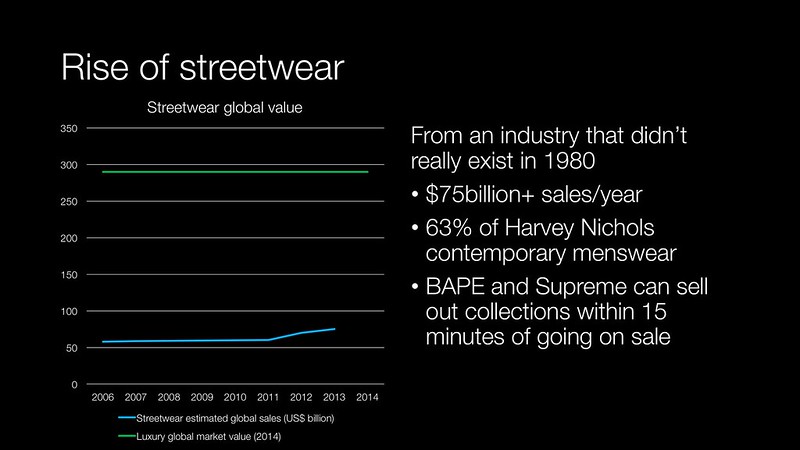
Luxe streetwear
Consumerology by marketing behaviour expert Phil Graves
Payola
Dettol’s back to work advertising campaign
Eat Your Greens edited by Wiemer Snijders
Dove #washtocare advertising campaign
The fallacy of generations such as gen-z
Cultural marketing with Stüssy
How Brands Grow Part 2 by Jenni Romaniuk and Byron Sharp
Facebook’s misleading ad metrics
The role of salience in advertising
SAS – What is truly Scandinavian? advertising campaign
Brand winter
Treasure hunt as defined by NPD is the process of consumers bargain hunting
Lovemarks
How Louis Vuitton has re-engineered its business to handle the modern luxury consumer’s needs and tastes
UK Snoopers Charter gagging order drafted for London Internet Exchange directors • The Register – the original snoopers charter aka the Interception Modernisation Programme was proposed by the last Labour administration and was opposed vociferously by the Conservatives and the other opposition parties. Now you have the Conservatives who pushed through the near identical snoopers charter Communications Capabilities Development Programme, and then legislated the Investigatory Powers Act 2016 – which was also nicknamed the snoopers charger. When you combine this snoopers charter gag order with the new espionage act going through the UK government system and things look exceptionally dark
Global Restructuring at TBWAMedia Arts Lab as Apple Shifts Toward Digital, Regional Work | Ad Week – interesting move with their evolving relationship with Apple. I can’t say that I feel impressed by anything l’ve seen out of Apple in a while – given more creative was driven out of in-house. This move will see things going more digital, rather than just digital expressions of TV-orientated creative
The recent collaboration between New York’s Supreme and Louis Vuitton seems like a natural fit. The reality is that luxury and streetwear have been dancing around each other for a good while.
Snide started it all
Snide was slang in the 1980s for fake or counterfeit. Hip Hop and the Caribbean-influenced Buffalo movement in the UK each used counterfeit and real luxury in their own way.
Daniel Day, better known as Dapper Dan was a was a Harlem-based craftsman and business man who dressed a lot of New York based artists from the golden age of hip hop. Dan’s first hip hop client was LL Cool J back in 1985. Dan’s style was luxe, the finest silks and furs were standard issue – think Puff Daddy before Puff Daddy. They went for customised outfits with their branding on which Dan provided. As the scene took off Dan incorporated suit lining material (which replicated the likes of the Fendi, Bally or MCM brands) and Gucci or Louis Vuitton branded vinyl to make one-off products.
He customised trainers, clothing and even car interiors. Dan’s own Jeep Wrangler had an interior retrimmed in MCM branded vinyl.
Much of the luxury branding Dan used was coming in from Korean factories which at that time supplied the fake trade. Now similar products would have come out of China. I took a trip to the South China City complex in 2010 where fabric suppliers would offer Louis Vuitton labels and Supreme tags side-by-side. I can only imagine that the Korean suppliers of the 1980s had similar markets in textile industry centres like Deagu. Outside of hip hop, Dan was the go-to tailor for all the hustlers in Harlem – so you can see how he could have got the hook-up into the counterfeit suppliers.
At the time hip hop culture was not in a relationship with brands who where concerned about how it might affect them. LL Cool J was the first artist to get a deal with Le Coq Sportif. Run DMC got a long term deal with Adidas after their single ‘My Adidas’ became successful. But these were the exceptions to the rule. So with Dan’s help they co-opted the brands to try and demonstrate success.
Over in the UK, the Buffalo collective of stylists, artists and photographers including Ray Petri, Jamie Morgan, Barry Kamen (who modelled for Petri), Mark Lebon and Cameron McVey. Buffalo was known as an attitude, which threw contrasting styles together and filtered into fashion shoots and influenced the collections of major designers including Yohji Yamamoto, Jean Paul Gaultier and Comme des Garçons. Even if you didn’t know what Buffalo was, you would have recognised the aesthetic from the likes of i-D, Blitz, New Musical Express and Arena.
Buffalo mixed Armani jackets with Doctor Martens work boots, or a Puma bobble hat. Petri used music to sound track his process and this was pretty similar to the kind of stuff that influenced street wear pioneer Shawn Stussy over in California. Motown and hip-hop to dub reggae was the sound which explains the Feeling Irie t-shirts created by the white surfboard maker.
If you thought Bros looked cool in their MA-1 bomber jackets and stone washed Levi’s 501 jeans – there was a direct stylistic line back to Buffalo – rehabilitating the items from their link to skinhead culture.
Buffalo permeated into the street style of the decade; influencing the likes of Soul II Soul. Meanwhile over in Bristol The Wild Bunch were yet to morph into Massive Attack. Two members headed to London; producer Nelle Hooper and Miles Johnson (aka DJ Milo who went on to work in New York and Japan). A shoot was organised by i-D magazine and they turned up wearing their street clothes alongside DJ Dave Dorrell and model / stylist Barnsley. At the time, it was considered to be ‘very Buffalo’ in feel, but Dave Dorrell admitted in an interview that they had just came as they were. Dorrell wore his t-shirt as ‘advertising’ for it.
The Hermes t-shirt and belt were snide, the Chanel Number 5 t-shirt sported by Dave Dorrell were being knocked out by a group of friends. Young people in London co-opted brands just like the hip-hop artists heading to Dapper Dan’s in Harlem.
Homage
From 1980, surfer Shawn Stussy had been growing an clothing empire of what we would now recognise as streetwear. Stussy had originally came up with the t-shirts as an adjunct and advertisement of his main business – selling surfboards. But the clothing hit emerging culture: skating, punk, hip-hop and took on a life of its own. It went global through Stussy’s ‘tribe’ of friends that he made along the way.
Stussy is known for his eclectic influences and mixing media: old photographs alongside his own typography. In a way that was unheard of in brand circles at the time, Stussy manifested his brands in lots of different ways. The back to back SS logo inside a circle was a straight rip from Chanel; the repeating logo motif that appeared in other designs was a nod to MCM and Louis Vuitton.
All of this went into the cultural melting pot of world cities like Tokyo, New York, London and Los Angeles. Stussy went on to do collaborations from a specially designed party t-shirt for i-D magazine’s birthday party to the cover art of Malcolm Maclaren records. Collaboration with mundane and high-end brands is baked into streetwear’s DNA.
(Neighborhood x Coke Zero was something I was involved with during my time in Hong Kong.)
Japan with its engrained sense of quality and wabisabi took the Buffalo mix-and-match approach to the next level. Japan’s own streetwear labels like Visivim, Neighborhood, W-Taps, The Real McCoy and A Bathing Ape (BAPE) took streetwear product quality, exclusivity and price points into luxury brand territory. That didn’t stop BAPE from making a snide versions of various Rolex models under the ‘Bapex’ brand.
Some two decades later Supreme came up in New York. The brand takes design appropriation and homage to a new level. Every piece Supreme seems to do is a reference to something else. The famous box logo rips from Barbara Kruger’s piece ‘I shop therefore I am’. From taking a snide swipe at consumerism to ending up in the belly of the beast took Supreme a relatively short time. This heritage of appropriation didn’t stop Supreme from using legal means against people it felt had appropriated its ‘look’.
In an ironic twist of fate, Supreme was sued by Louis Vuitton in 2000 and yet the 2017 collaboration looks exceptionally similar to the offending items…
North East Asia’s fast growing economies had been borne out of learning from developed market expertise, state directed focus on exports and ruthless weeding out of weaker businesses. Intellectual property was cast aside at various points. Korea, Hong Kong, Japan and China went from making knock-off products to displacing Europe and the US as the leading luxury markets.
Asian luxury consumers, particularly those second generation rich in China were younger than the typical customer luxury brands cater too. These consumers bought product as they travelled taking in style influences as they went. First from nearby markets like Japan, Hong Kong and Singapore and then Korea. This drew from a melange of hip hop, streetwear, Buffalo styling and contemporary western designers like Vivienne Westwood – as well as the more matronly styles of the traditional European luxury houses.
The luxury brands had to adapt. They brought in new designers who themselves were drawing from similar influences. These designers also collaborated with sportswear brands like Alexander McQueen and Puma or Jeremy Scott and Raf Simons for Adidas.
Luxury brands got seriously into new product categories making luxe versions of training shoes that could be charitably called a homage to the like of Nike’s Air Force 1.
Bringing things full circle
As the supreme_copies Instagram account notes the collaboration with Supreme and Louis Vuitton brings things full circle with the pieces having a nod to Dapper Dan’s custom work as well as Supreme’s own ‘homage’. Luxury brand MCM (Michael Cromer München), which Dan borrowed from extensively in the 1980s was restructured in 1997 with shops and brand being sold separately. The brand was eventually acquired eight years later by the Korean Sungjoo Group. Korea now has its own fast developing luxury fashion and cosmetics brand industry. Textile city Deagu which was the likely source of Dapper Dan’s fabric is now a fashion and luxury business hub in its own right. The Korean entertainment industry is a trend setter throughout Asia. For instance, Hallyu drama My Love From A Star drove breakout sales for the Jimmy Choo ‘Abel’ shoe.
The only question I still have is why did a move like Louis Vuitton’s collaboration with Supreme take so long? The luxury brands spend a lot on customer insight, they were using social listening far longer than they had been on social media. They know that a customer wearing their jacket could have a Visivim backpack slung over the shoulder and a pair of Adidas Stan Smiths on their feet. Customers mix-and-match Buffalo style for all but the most formal occasions. For streetwear brands, collaboration is in their DNA and they get an additional leg-up in the quality stakes. More luxury related posts here.
Not Just A Crock: The Viral Word-Of-Mouth Success Of Instant Pot : The Salt : NPR – The instant pot of the title is what was called a slow cooker back when my parents bought one in the mid-1980s. It was a ceramic dish with a lid in a metal holder with a heating plate. They used to use the instant pot to make porridge for breakfast and lentil soup. I am expecting to see the instant pot as a case study in ‘value of earned media’ decks moving forward
WSJ City – CPI Hits Two-Year High – UK price inflation due to currency devaluation is going to put a pre-Brexit squeeze on the economy prior to the post-Brexit tumble
Qualcomm: FTC Alleges Special Deal with Apple – Tech Trader Daily – Barrons.com – Extracted exclusivity from Apple in exchange for reduced patent royalties. Qualcomm precluded Apple from sourcing baseband processors from Qualcomm’s competitors from 2011 to 2016. Qualcomm recognized that any competitor that won Apple’s business would become stronger, and used exclusivity to prevent Apple from working with and improving the effectiveness of Qualcomm’s competitors.
Shareware -back before the internet became ubiquitous, software was distributed by bulletin boards. It was expensive to dial into a board, so magazines uses to have storage media pre-loaded with applications on the front of them.
For much of the late 1990s and early 2000s my parents used to use MacFormat magazine CDs and floppy disks as coffee coasters. One disk may come with bloatware such as the installation software for AOL, Demon or Claranet. The other disk would be full of free or paid for software.
The paid for software was often written by a single developer. It was a labour of love / cottage industry hybrid. Often the developers wrote the software to deal with a real need that they had, it was then passed on as they thought others would benefit as well.
Open source software the way we understand it now was only in its infancy in terms of public awareness. Packaged software was big money. As recent as 2000, Microsoft Office for the Mac would have cost you £235. Quark Xpress – the Adobe Indesign of its day would have cost in the region of £700+ VAT.
Into the gap sprung two types of software: freeware and shareware.
Freeware was usually provided as is, there was little expectation of application support. It would become orphaned when the developer moved on to other things
Shareware usually had different mechanisms to allow you to try it, if you could see the benefit then you paid a fee. This unlocked new features, or got rid of nag screens (like the one from image editing app Chocoflop).
In return you also got support if there was any problems with the app. Shareware hasn’t died out, but has become less visible in the world of app stores. One that I have been using on and off for over 20 years is GraphicConvertor by Lemke Software. It handles any kind of arcane graphic file you can throw at it and converts it into something useable.
Kagi Software were one of the first people to provide programmers with a way of handling payments and software activation. Kagi provided an onscreen form to fill out, print, and mail along with their payment. it was pre-internet e-commerce.
I can’t remember exactly what utility programme I first bought for my college PowerBook, but I do remember that I sent the printed form and cheque to a developer in Glasgow. I got a letter back with an activation code and a postcard (I’ve now lost) from the Kelvingrove Art Gallery and Museum.
Later on, Kagi were one of the first online payment processors.
From the late 1990s FTP sites and the likes of download.com began to replace the magazine disk mount covers. Last year Kagi died, making life a little more difficult for the worldwide cottage industry of small software developers. it was inconvenient, but now with PayPal developers have an easy way to process payments and there are various key management options.