Category: marketing | 營銷 | 마케팅 | マーケティング

According to the AMA – Marketing is the activity, set of institutions, and processes for creating, communicating, delivering, and exchanging offerings that have value for customers, clients, partners, and society at large. This has contained a wide range of content as a section over the years including

  • Super Bowl advertising
  • Spanx
  • Content marketing
  • Fake product reviews on Amazon
  • Fear of finding out
  • Genesis the Korean luxury car brand
  • Guo chao – Chinese national pride
  • Harmony Korine’s creative work for 7-Eleven
  • Advertising legend Bill Bernbach
  • Japanese consumer insights
  • Chinese New Year adverts from China, Hong Kong, Malaysia and Singapore
  • Doughnutism
  • Consumer Electronics Show (CES)
  • Influencer promotions
  • A media diary
  • Luxe streetwear
  • Consumerology by marketing behaviour expert Phil Graves
  • Payola
  • Dettol’s back to work advertising campaign
  • Eat Your Greens edited by Wiemer Snijders
  • Dove #washtocare advertising campaign
  • The fallacy of generations such as gen-z
  • Cultural marketing with Stüssy
  • How Brands Grow Part 2 by Jenni Romaniuk and Byron Sharp
  • Facebook’s misleading ad metrics
  • The role of salience in advertising
  • SAS – What is truly Scandinavian? advertising campaign
  • Brand winter
  • Treasure hunt as defined by NPD is the process of consumers bargain hunting
  • Lovemarks
  • How Louis Vuitton has re-engineered its business to handle the modern luxury consumer’s needs and tastes
  • Korean TV shopping celebrity Choi Hyun woo
  • qCPM
  • Planning and communications
  • The Jeremy Renner store
  • Cashierless stores
  • BMW NEXTGen
  • Creativity in data event that I spoke at
  • Beauty marketing trends
  • Kraft Mothers Day marketing
  • RESIST – counter disinformation tool
  • Facebook pivots to WeChat’s business model
  • Smartphone launches
  • The New Nokia

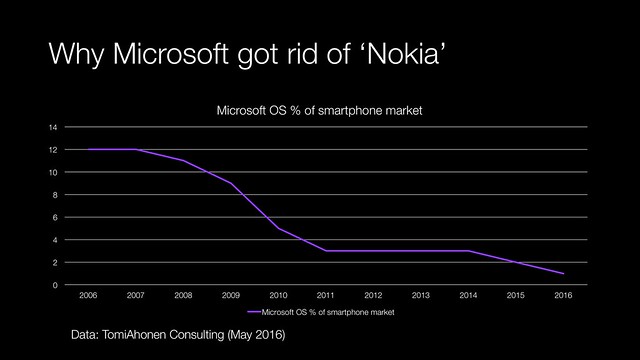
    The New Nokia can rise from the ashes of the old. Microsoft finally let go of its licence for the Nokia brand license on May 19, 2016.
    Slide03
    There is a lot of logic to this move:

    • Microsoft has already written down the full value of the business acquisition
    • It has got the most valuable technical savvy out of the team and moved it into the Surface business
    • It removes problematic factories and legacy products

    For the businesses that have acquired the rights to use the Nokia name and the factories the upsides are harder to see.

    The factories may be of use, however there is over supply in the Shenzhen eco-system and bottlenecks aren’t usually at final manufacture, but in the component supply chain.

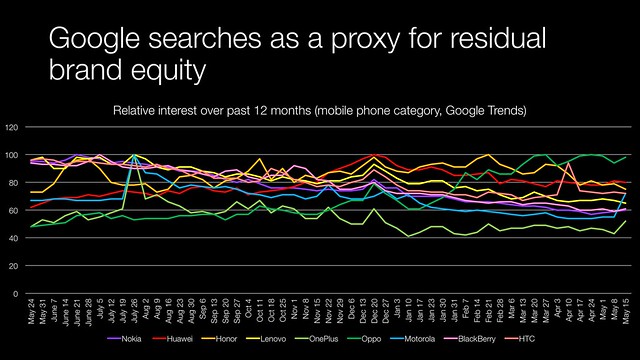
    There is still some brand equity left in the Nokia phone brand. I analysed Nokia along with a number of other international Greater China smartphone eco-system brands using Google Trend data.
    Slide06
    There has been a decline in brand interest over the past 12 months for Nokia of 37%
    Slide07
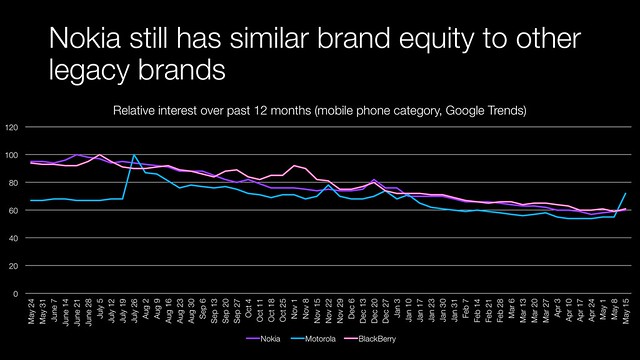
    Nokia still has comparable brand equity to other legacy mobile brands such as BlackBerry and Motorola
    Slide08
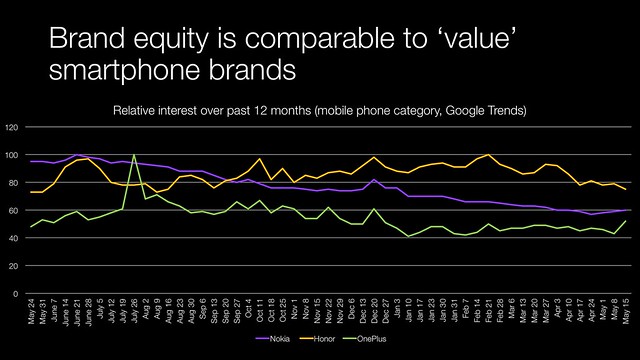
    The brand equity is comparable to other value mobile brands. Honor; Huawei’s value brand has had a lot of money and effort pumped into it to achieve its current position.
    Slide09
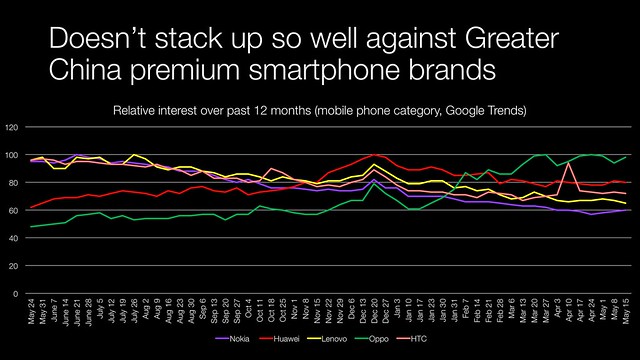
    But it’s brand equity doesn’t stack up well against premium handset brands from Greater China. The reason for this is that smartphone marketing and fast moving consumer goods marketing now have similar dynamics – both are in mature little differentiated markets. Brands need to have deep pockets  and invest in regular advertising to remain top-of-mind across as large an audience as possible. Reach and frequency are more important than social media metrics like engagement.

    In addition to advertising spend needs to be put into training and incentivising channel partners including carriers.

    They are entering a hyper-competitive market and it isn’t clear what their point of advantage will be. Given the lock down that Google puts on Android and commoditised version of handset manufacture, the best option would be to look for manufacturing and supply chain efficiencies  – like Dell did in the PC industry. But that’s easier said than done.

    Garnering the kind of investment required to seriously support an international phone brand is a hard sell to the finance director or potential external investors.

    Slide13
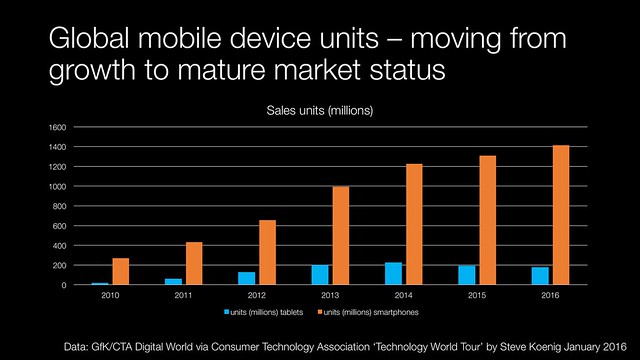
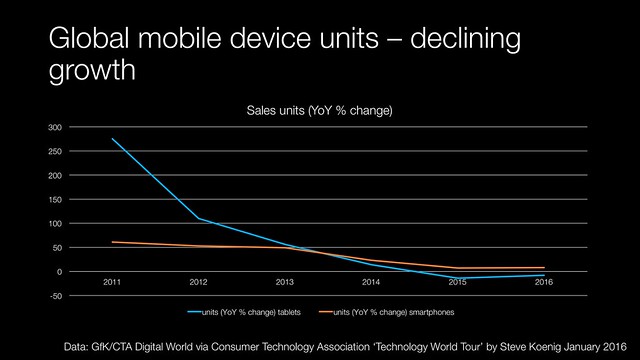
    Growth is tapering out.
    Slide14
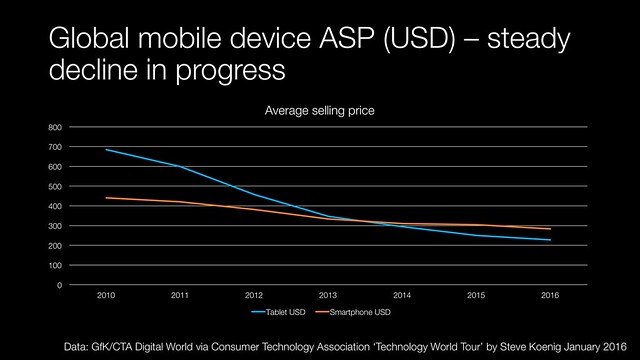
    The average selling price is in steady decline
    Slide16
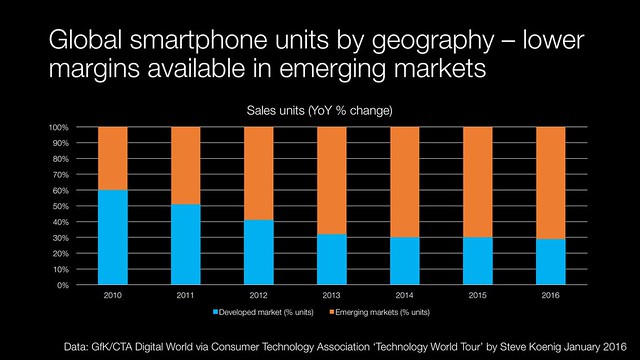
    This is partly because the emerging markets are making the majority new phone purchases.
    Slide15
    Consumers in developed markets are likely holding on to the their phones for longer due to a mix economic conditions and a lack of compelling reason to upgrade.
    Slide12
    All of the consumers that likely want and can afford a phone in developed markets have one. Sales are likely to be on a replacement cycle as they wear out. Manufacturers have done a lot to improve quality and reliability of devices.

    Even the old household insurance fraud standby of dropping a phone that the consumer was bored with down the toilet doesn’t work on the latest premium Android handsets due to water-proofing.
    Slide20

    More information

    The answer to the question you’ve all been asking | Nokia – Nokia’s official announcement
    Gartner highlights a more challenging smartphone sector for Nokia than when it “quit” in 2013 | TelecomTV
    Nokia is coming back to phones and tablets | The Verge
    So the Nokia brand returns.. with a Vengeance | Communities Dominate Brands

    Supporting data slides in full

  • Monster internet surveillance + more

    Britain to pay billions for monster internet surveillance network | DuncanCampbell.org – lets park the moral dilemma this represents for a moment, would other countries come to the UK for expertise in terms of how to implement this locally? What countries would they be? What would the optics be on it? Who are the contractors that are likely to benefit from this work in the UK? More on security related issues here.

    I think it will be pretty hard to make lemonade out of these lemons. The business opportunity probably won’t scale to get a ‘space race’ type benefit, the likely client countries may pose problems in terms of optics. After Snowden, you can count out the EU territories. An obvious contractor to benefit would likely be Huawei (mix of telecoms and enterprise tech, fast growing player in enterprise storage) – who wouldn’t need British expertise to sell this monster internet surveillance solution abroad

    Let’s Talk About Amazon Reviews: How We Spot the Fakes | The Wirecutter – Although many reviews on Amazon are legitimate, more and more sketchy companies are turning to compensated Amazon reviews to inflate star ratings and to drum up purchases

    jenny odell • living a designed life – interesting essay on the rendered spaces used by developers in their sales pitches

    Samsung 837 – JWT Intelligence – really interesting retail space

    Italian Crime Series Gomorrah Kills Pornhub Traffic – Pornhub Insights – the power of mainstream media played out online, I am sure there would be a similar dip for something like Game of Thrones or the FA Cup Final in the US and UK respectively

    WPP Mobile New technology service from Maxus makes marketing as easy as Pie – gives WPP a bigger arbitrage opportunity but if you were a large client wouldn’t you be demanding similar implementation times?

    MSN Ceases Chinese Operations | ChnaTechNews – and that’s the last of the western portals when went there leaving the market

    CK Hutchison mulls legal challenge as EC thwarts its UK ambitions | TotalTele.com – not terribly surprising. UK Government’s big mistake was allowing BT to acquire a cellular operator again

    Misused English Words and Expressions in EU Publications – European Court of Auditors – Secretariat General Translation Directorate – fascinating document that explains why English speakers may feel exasperated at times with their EU counterparts

    Xiaomi faces existential crisis | Techinasia – if it loses the Chinese middle classes, it loses the opportunity to sell its eco-system of smart home products to them

  • Google design

    Google design has had a transformative effect on the world. It reminds me of Dieter Rams on the concept of design had said something to the effect of good design being invisible – once you see the product you couldn’t imagine things exist any other way.

    That’s a really good description of the web with Google design. In the markets where it operates (with the exceptions of Czech Republic, South Korea, Japan and Russia) it’s a monopoly. Different regulatory authorities are investigating them for leveraging their monopoly into market domination in other categories.
    urban dictionary on Google SERP
    With SERP (Search Engine Results Page) like this one above, I am not surprised that antitrust authorities are gaining an upper hand. This Urban Dictionary integration seems to cross the boundary from being useful to feature bundling. It deprives Urban Dictionary of an opportunity to put ad inventory in front of its audience. Urban Dictionary makes it’s money from retargeted banner ads and its own customisable merchandise. You can get any phrase in Urban Dictionary with its definition on a coffee mug, coaster set or tote bag.
    urban dictionary SERP
    It would be interesting to see if Google got into some sort of content agreement with Urban Dictionary. However I suspect that they have just gone ahead and done this? More about Google here.

  • Millennials are people too

    Smart funny video by Adam Conover on the marketing obsession of millennials as a form of segmentation.

    Show this to as many marketers as you can.

    Having been involved in youth marketing and even spoken at conferences about it, many of the challenges and insights that ‘millennials’ as a cohort face aren’t unique insights per se.

    You hear the same things over-and-over again. Being young presents its own set of challenges, these are tweaked accelerated by environmental conditions such as economy and housing. You feel the injustices of the world, adulting is hard. Responsibilities have a weight to them. Education has a cost.

    Getting your first home is hard. Finding the right partner is stressful. Since the baby boomers the concept of youth has become elongated. The whole of society hasn’t been drafted into fighting a war and benefited from the rise of the industrial society.

    But that doesn’t mean that it makes much sense for marketers to talk about millennials in such a broad brush way. At least gen-X whilst been written off as slackers were realised to have various different sub-cultures or tribes.

    That level of nuance seems to have disappeared in ‘our’ collective understanding of millennials and gen-Z.

    While we’re on about nuance, since when do adverts aimed at baby boomers appreciate that they don’t all look like Helen Mirren or Joanna Lumley. Or that they like going to rock concerts and festivals? Or that they might run for health and leisure?

    Marketers are increasingly looking at big data, but lacking granularity in terms of segmentation and factors that might influence brand relevance.

    My hypothesis is that the fetishisation of millennials as a single cohort is down to a deeper seated fear of disruption ambushing the marketers. Millennials aren’t an alien invasion, but people just like we’re used to. This fetishisation will end up as a feedback loop distorting their own view of what they expect to be and how they expect to be seen.

    More on millennial related topics here.

  • Chinese industrial decline + more

    Chinese industrial decline – It is hard to explain to people the diversity of China. If you’ve followed China as a subject area you’re used to discussions around tier one to six cities. We tend to buy into ‘Blade Runner’ China because its the tier one and two cities that you end up visiting. Its pretty much the same with the media. I really like this New York Times documentary that deals with the slowdown of heavy industry in Northern China and apparel manufacturing in Guangzhou province in the South.

    Chinese industrial decline in this documentary shows off it’s rust belt and left behind areas. This city’s mayor and is project is a microcosm of the efforts going on.

    China has been in a constant state of reinvention. I worked out of old electronics factories in Shenzhen that had been turned into offices and creative studios, with Shoreditch style retail attached. Whilst, Shenzhen is famous for manufacturing, the reality now is more complex. It has a thriving finance sector that China hopes will eclipse Hong Kong.

    Further up the Pearl river delta cities like Dongguan were industrialised by Hong Kong entrepreneurs and became crucial parts of the global fashion supply chain. Here too changes is happening, areas of Dongguan are being repurposed as tech campuses. Huawei built their ‘European theme park’ campus there. Of course, the unskilled workers get replaced. They move further inland along with some of the industry.

    Some of the industry, has moved abroad. China has become too expensive and onerous to deal with. In the North, heavy industry was built at break neck speed relatively close to coal fields, rather like the UK during the industrial revolution. During this go-go time China could use or export all the steel old. After the 2008 Olympics China started aiming for more sustainable growth and heroic efforts became surplus production.

    A Brazilian flavoured tune as a free download Oya’ Indebure feat. Laudir de Oliveira | DJ Nu-Mark. However, don’t mistake free, for low quality, this is an amazing tune. More on DJ Nu-Mark here.

    Maybe a team up with Scanner would have been more appropriate but liking Jean-Michel Jarre + Edward Snowden – ‘Exit’

    May the 4th aka Star Wars day saw geeks dominate the web, I did really like Japanese airline ANA’s rendition of the Star Wars theme purely from aircraft related found sounds

    TBWA in Amsterdam pulled together these clever DJ controller place mats for McDonalds. It shows how much is now possible with printed circuits. I love the combination of material smarts and  creativity.