According to the AMA – Marketing is the activity, set of institutions, and processes for creating, communicating, delivering, and exchanging offerings that have value for customers, clients, partners, and society at large. This has contained a wide range of content as a section over the years including
Super Bowl advertising
Spanx
Content marketing
Fake product reviews on Amazon
Fear of finding out
Genesis the Korean luxury car brand
Guo chao – Chinese national pride
Harmony Korine’s creative work for 7-Eleven
Advertising legend Bill Bernbach
Japanese consumer insights
Chinese New Year adverts from China, Hong Kong, Malaysia and Singapore
Doughnutism
Consumer Electronics Show (CES)
Influencer promotions
A media diary
Luxe streetwear
Consumerology by marketing behaviour expert Phil Graves
Payola
Dettol’s back to work advertising campaign
Eat Your Greens edited by Wiemer Snijders
Dove #washtocare advertising campaign
The fallacy of generations such as gen-z
Cultural marketing with Stüssy
How Brands Grow Part 2 by Jenni Romaniuk and Byron Sharp
Facebook’s misleading ad metrics
The role of salience in advertising
SAS – What is truly Scandinavian? advertising campaign
Brand winter
Treasure hunt as defined by NPD is the process of consumers bargain hunting
Lovemarks
How Louis Vuitton has re-engineered its business to handle the modern luxury consumer’s needs and tastes
Ketchum’s David Gallagher wanted to know whether he should have his own website as part of managing his personal online brand? He initially felt that publishing on Facebook and LinkedIn was enough. There was also discussion around platforms like Medium. None of which give you real control over your content. Wadds like me felt that owning your own platform was important.
Why have a website as part of your personal online brand?
LinkedIn and Facebook don’t have the same agenda as you. Your content becomes a hostage to their business whims
It is hard for users to discover your content, Facebook and Google make it so
Even on Medium you no longer really own your content. It can’t be easily exported like content on the Blogger platform
Even in the world of Facebook, Google is still a reputation engine
So show do you manage the process?
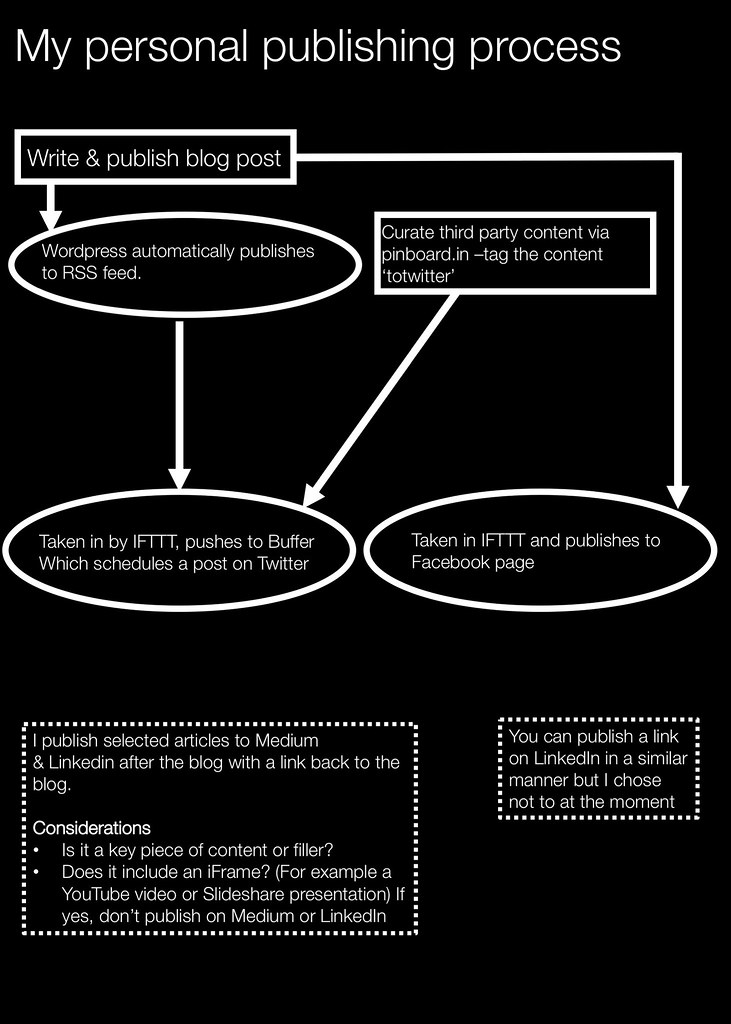
You need to find a system that works for you. Here is what mine looks like for social syndication.
IFTTT – if then, then that. A service that allows you to trigger actions based on pre-created inputs. It allows rules to be built up based around different inputs:
A photograph tagged with a particular label or hashtag
It supports numerous services including Flickr photography and pinboard.in
Buffer – buffer is a social publishing tool. I have pre-scheduled slots. It is also compatible with publishing posts sent via IFTTT.
Pinboard.in – pinboard is a way of storing your bookmarks with notes and tags online rather than on your computer. Your bookmarks then become accessible wherever you are. It is handy to be able to search things that you have found previously. Google seems to have moved away from organising all the world’s information to mainly focus on ‘now’ content. Pinboard helps you get around this.
One of the key issues of concern for the financial services sector has been the lack progress in passporting. This is where the EU says UK regulations and processes are equivalent to theirs and consequently allow market access. More related content here.
China Smartphone Market 2017: Top 10 Best-selling Models – Counterpoint Research – interesting read, basically Apple is the premium smartphone seller. Huawei’s Honor brand makes the top ten along with Xiaomi. It also explains why Huawei wants to get its main brand into the US as that is the main way it can increase the razor thin profit margins of its smartphone business. The real winner is BBK-related brands OPPO and vivo
ongoing by Tim Bray · Google Memory Loss – the whole Web is crushingly expensive, and getting more so every day. Things like 10+-year-old music reviews that are never updated, no longer accept comments, are lightly if at all linked-to outside their own site, and rarely if ever visited… well, let’s face it, Google’s not going to be selling many ads next to search results that turn them up. So from a business point of view, it’s hard to make a case for Google indexing everything, no matter how old and how obscure – the problem for Google would only be if you started to see search promiscuity
Knock and the door shall be opened unto you | FT Alphaville – in China, the data linked to technology companies is already central to the notion of credit provision. It also plays into the country’s planned social credit system. This has come alongside the rapid development of online payments, especially on WePay, part of WeChat. It would be no exaggeration to say that this is perhaps the most important technological development of the present moment, although, in part because of the impenetrability of the Chinese internet, it currently resonates less than it should
Unilever under fire over Gaytime ice cream in Indonesia | PR | Campaign Asia – no idea where they got that idea, I imagine it could become a cult brand if launched elsewhere. Gaytime ice cream makes me think of a more innocent time in my life when, if I was home from school, I would be sat down with Marie biscuits and a cup of Barry’s tea by my Mum. This was a thinly veiled bribe to be quiet, which wasn’t really needed.
The reason for this ritual would be a soap opera called Harbour Hotel and a chat show called The Gay Byrne Show. Both where on RTÉ Radio 1. Back then gay could mean happy; or in the case of Gay Byrne it was short for Gabriel. The radio meant that voices from home where beamed into our house around the clock via medium wave and long wave.
https://youtu.be/hByFDVwiQq8
Of course, I wouldn’t have mentioned it at my English school as there would have been an ocean of sniggers. The Muslim outrage at Gaytime also mirrors the PC revisionist view of The Flintstones ‘we’ll have a gay old time’ lyric in their theme tune. Apparently its original meaning of happy or fun, was interpreted as being intolerant of the LGBTQ community.
The problems that the Labour Party faces with Corbyn and the general distrust of politicians in what should be ‘heartland’ seats
The continued credibility of Nigel Farage
The anti-German sentiment. The EU was seen as a German vehicle to win the war again by stealth – this has almost a Basil Fawlty quality to it. But at least some of the panelists believed it was true
How the political divisions around the societal change driven by Margaret Thatcher’s government reverberated into the Brexit vote
Poundland’s naughty elf campaign which riffed on British smut and the ‘Elf On A Shelf’ franchise affected consumer attitudes to the brand according to YouGov. The research is at odds with the overall positive response it got from Twitter (outside the London media-advertising industrial complex) – YouGov | Poundland’s X-rated ads generated publicity, but consumer perception has dropped
Three Thoughts on Day One at CES 2018 – not surprised that computing is moving to the edge as the network represents latency and potential unreliability – think about how cloud failure when it hit Nest devices and IoT obselescence
Casio AL-1000 – the nixie tube display and ferrite core memory make it a thing of beauty to behold
Huawei’s US market dreams ‘harmed again’ after AT&T walks away from smartphone pact | South China Morning Post – “We have been harmed again,” Huawei’s consumer business unit chief executive officer Richard Yu said in a text message to the South China Morning Post – you can see from later articles how Huawei progressively got their act together in terms of media response though much of the coverage added a thin veneer of analysis whilst repeating the original WSJ article – China’s Huawei hit by last minute collapse of AT&T phone distribution deal | Reuters – the collapse of the deal with AT&T, first reported by the Wall Street Journal, will mean that Huawei will likely struggle to make a hit of its smartphones there as a U.S. mobile carrier would typically promote the products as well as provide subsidies and special package deals
Reuse, reedit, remix and recycle a minimum viable campaign
I have been working on a couple of briefs over time that have suddenly seen budgets cut quite dramatically. It’s often a struggle to pare the list of requirements back to a minimum viable campaign.
One thing that tends not to happen too often is seeing the reuse, reedit, remix and recycle of assets effectively.
Reuse, reedit, remix and recycle for international campaigns
I saw the principles of reuse, reedit, remix and recycle being used more often in international campaigns. Some brands like Mars have looked to do reuse, by spending a lot of time aligning their brands across markets. In the UK and Ireland, consumers of a certain age will remember the migration of Marathon bars to become Snickers and Opal Fruits to become Starburst a decade later. The principles of reuse, reedit, remix and recycle was incorporated into thinking at Unilever making TV ae lssets more easily localised in different countries including adapting end slides and one shot for culturally appropriate product uses.
Mexico
Germany
But perhaps the best example I can recall was one that used to show repeatedly on cable TV when I was in the final year of my degree. I would have the TV on in the background, whilst I slowly but steadily cranked out my final year series of assignments and essays.
BreathAsure seemed to have given their London advertising agency very little to work with, but this cheeky voiceover turned the ad around and was an insiders nod to how awful the original American creative was. I am guessing that this probably would not have passed muster if it needed sign off by an American global marketing supremo.
In case you’re wondering what ever happened to BreathAsure, it seems that soon after this ad campaign originally ran Warner-Lambert took them to court in the US regarding their product claims. More marketing related content here.
And we return to Munich migration back to Windows – it’s going to cost what now?! €100m! • The Register – interesting to see this war over Munich public sector computing still being fought in the background by Microsoft two decades later. I remember working at Edelman when its open source competitive de-positioning work was just taking off. I had to write a two page document explaining what open source was. Munich was seen as one of the key battle grounds back then
BBC StoryWorks unveils new tool which measures impact of branded content | Marketing Interactive – “In addition, the product showed that the creative execution succeeded in driving a clear uplift in subconscious association between Huawei and key brand attributes such as being innovative, inspiring, environmentally responsible, and high quality. Following exposure, audiences also had a high desire to engage with the Huawei brand; brand awareness rose by 216%, brand association went up by 23% and purchase intent increased by 19%”
Online
How the Chinese vs Western battle of internet giants will unfold | Analysis | Campaign Asia – over the next 12 months the Western big three will find themselves head to head with the Chinese internet giants, across ecommerce, brand partnerships and most notably AI. What’s not certain is who will come out on top and whether BAT can adapt to succeed in a different environment- at least in non-Chinese Asian markets