It makes sense to start this category with warning. Marshall McLuhan was most famous for his insight – The medium is the message: it isn’t just the content of a media which matters, but the medium itself which most meaningfully changes the ways humans operate.
But McLuhan wasn’t an advocate of it, he saw dangers beneath the surface as this quote from his participation in the 1976 Canadian Forum shows.
“The violence that all electric media inflict in their users is that they are instantly invaded and deprived of their physical bodies and are merged in a network of extensions of their own nervous systems. As if this were not sufficient violence or invasion of individual rights, the elimination of the physical bodies of the electric media users also deprives them of the means of relating the program experience of their private, individual selves, even as instant involvement suppresses private identity. The loss of individual and personal meaning via the electronic media ensures a corresponding and reciprocal violence from those so deprived of their identities; for violence, whether spiritual or physical, is a quest for identity and the meaningful. The less identity, the more violence.”
McLuhan was concerned with the mass media, in particular the effect of television on society. Yet the content is atemporal. I am sure the warning would have fitted in with rock and roll singles during the 1950s or social media platforms today.
I am concerned not only changes in platforms and consumer behaviour but the interaction of those platforms with societal structures.
My consumer internet usage goes back 25 years as a celebratory email reminded me in my Yahoo! account earlier this year.
25th Yahooversary
I had started using the internet back in early 1994. I had access to email whilst working as a research technician for Corning in their optical fibre manufacturing business. The account was for solely for professional reasons (for the most part).
After Corning, I went to college and had access to the web for the first time. At that time, people in my year and the year above me mostly didn’t bother with the internet. I had found it useful for getting Mac software and researching material for college essays.
I set up an Excite.com webmail account before leaving college, but it wasn’t that reliable. In the immediate aftermath of leaving college I worked long hours for the first few months in the call centre at MBNA the credit card company. So a rare day off was spent catching up on sleep or catching a video from the local Blockbuster store.
Coffee, cake and email
Over time, I got a temporary role in their marketing department. I was writing sales scripts for payment protection insurance and keeping a tally on salesperson performance. This meant that I moved to a role that was more 9 to 5 and I could start looking for my first career role. I even got to go shopping for sports cars that we were given away to the top performing sales person.
(Aside: The Lotus Espirit Turbo and TVR Griffith were unpleasant driving experiences; the Toyota Celica GT-Four ST205 and fourth generation Toyota Supra were great cars to drive.)
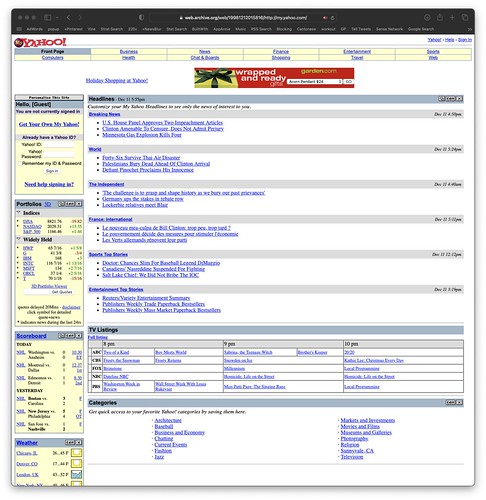
What Yahoo! looked like in early 1998, about the time when I set up my email account.
So one wet Saturday morning in March I set up a Yahoo! account in a cyber cafe around the corner from James Street station in Liverpool. I had found the address for Café Internet on North John Street in the Yellow Pages directory – there were only a couple of cyber cafes at the time in the Merseyside area and this one was the easiest to get to. Of course that would all change a year later with the launch of the easy group’s easyInternetCafe chain.
(Aside: in the process of writing this article I found out that Café Internet was the first cybercafe in the North West of England, originally opened in 1995.)
The connection that I enjoyed at Cafe Internet was slow and expensive.
I had a weekly ritual of working during the week and then heading over to Liverpool on Saturday morning to do a bit of record shopping, check my email and apply to jobs with some of the best coffee and carrot cake available at the time. I used to bring my emails that I needed to send, pre-written up a floppy disk as plain text files, along with a copy of CV to send as an attachment for jobs.
Eventually, I got my friend Andy online with his first email account and showed him the basics of web browsing. I don’t drink and we got accustomed to doing a spot of web surfing with good coffee and carrot cake prior to going window shopping in Liverpool city centre while chatting about everything and nothing. While we were online this was 25 years ago, so there was no UK e-commerce beyond shareware software on Tucows, so going shopping was not ironic.
My front door to the web
Yahoo! and other web portals like Lycos and Excite borrowed design cues from a newspaper page with their multiple columns of news snippets, horoscopes and weather forecasts. But it lacked the salacious content and gaslighting of the modern web.
My job search weekly cycle
Week day evening: Monday looking at The Guardian for marketing jobs. At the time The Guardian was a good source of entry level agency roles. Thursday meant going through Campaign and PRWeek. By going through, I mean looking at their print copies.
The library had a network that allowed PCs to do printing to a laser printer. In addition there were terminals that the librarians used to arrange inter-library deliveries. This ran on a command line interface connecting to a common database shared by all Wirral libraries. So my job search was analogue.
Saturday morning: over to Liverpool to check for email responses and send new applications in.
Given that most people applying for the jobs would be sending applications through via post, using email even on a weekly basis provided me with an advantage as a job seeker.
The internet in print
Given that it was expensive to get online. I spent more time reading MacWorld, Byte magazine and Wired magazine talking about online life than I spent online at the time. I noted down websites to check out next time I visited the cyber cafe, after I had sent my emails.
My internet consumption mirrored a wider consumer patten 25 years ago, many people were excited by the idea of the internet before they had managed to get online. Getting online would follow a year or two later, partly due to the heavy direct mail campaign by early ISPs including AOL and CompuServe who sent CD-ROM discs to my parents every six weeks.
Even by pre-internet standards that was a direct mail campaign of unprecedented scale.
MLM or multi-level marketing is where people who need to make money buy product from a company like Avon, Amway, Herbalife, Nu-Skin or Tupperware. Usually the franchisee doesn’t buy directly but through a contact. They may be a long way down in a chain of sellers, which means you end up with a pyramid scheme. Some have described the onboarding and seller communications as a cult. (Disclosure, I did a bit of agency work on Nu-Skin when I worked in Hong Kong, I got to see products, but not how they were sold).
Financial freedom
The real product of MLM seems to be hope. Discussing the downside of MLM at this time is important. Financial freedom is going to sound particularly appealing to struggling middle class households wrestling with the cost of living crisis and rising mortgage interest rates.
These videos by Sean Munger give a really good insight into Amway.
Ponzinomics
Robert Fitzpatrick’s self-published Ponzinomics seems to be the most cited book talking about the underbelly of MLM. Here’s an interview with him.
Soviet space programme
Enough time has gone buy for us to know how innovative the Soviet space programme was. Some of the innovations were dictated to them by limitations in production campacity. I came across these films about it.
And how Russian closed cycle rocket engines surprised NASA after the cold war.
I, Claudius
Robert Graves period drama novels I, Claudius and Claudius the God were remade in 1976 as a 13 part TV series. (The first two episodes are called 1a and 1b, presumably to avoid an episode 13, given that theatre as a whole is superstitious). In 1965, the BBC had done a documentary about the unfinished 1937 film version and had found bringing their version to television difficult due to production rights still tied into the 1937 production.
I, Claudius was considered to be a high water mark from point of view of audience viewership of more high brow material and latterly critics consider it to be one of the best TV programmes ever on British TV.
Hello Hong Kong
I received post from friends in Hong Kong and the package had a large sticker highlighting the Hello Hong Kong campaign which the government has been using to paper over the cracks left by its authoritarian pivot.
Hello Hong Kong mandatory sticker.
One part of me thought that ambient media such as the sticker might be a good side hustle for mail services everywhere. As I dug into it, I found out that the staff ‘had to’ put these stickers on the packaging and at least some of them were doing so reluctantly. At least some customers were reluctant for their packages to be ‘propaganda banners’ for the Beijing backed regime. Meanwhile 7/21 alleged government backed triad actions are still fresh in the mind of locals.
YKK
You don’t think about how YKK clothes zips work effortlessly, but this Asianometry documentary gives you insight into the Japanese zip manufacturer.
Starbucks Rewards as massive bank
I used to use the Starbucks pre-payment system back when I could use it in both the UK and Hong Kong, but a rupture came in when Starbucks removed its rewards scheme from stored value cards to an app. So I found this video by ColdFusion reframing the Rewards scheme as a large bank like pool of money more akin to PayPal’s float than Avios loyalty points.
Apollo project astronauts off the record
On everything from the context of Project Apollo through to their views on climate change.
Restaurant of mistaken orders
A Japanese pop-up retail project with restaurant servers who are suffering from dementia. I was sent the link by a friend of mine from Japan – the Restaurant of Mistaken Orders really brings the impact home.
One of the biggest things that have impacted many British people has been overseas money that has resulted in soccer team acquisitions. There is a certain irony in someone like myself who isn’t that emotionally invested in sport writing about the impact of soccer team acquisions – but maybe my view from the outside in may get somewhere closer to the truth.
I worked on lacrosse brand Warrior’s foray into soccer and helped relaunch the New Balance offering in football. (It had previously made football boots in the 1980s and had English football team captain Bryan Robson as their spokesperson.)
I have visited major football stadiums in Ireland, the UK and Spain – but still don’t have an emotional connection to the game.
Changing landscape
Over my life I have seen football change as a pass time. Football was a decidedly working class sport with concrete floors on terraced stands with railings to lean on, clubs could pack in their fan base to watch a game standing up.
Roy of the Rovers
The sport was lionised in comics, notably football player Roy Race aka Roy of The Rovers, which ran from 1954 – 1993. It has been rebooted a couple of times, most recently by Rebellion, publisher of 2000AD and Judge Dredd.
https://flic.kr/p/2oHEYiX
Roy of the Rovers from 1977
It is no coincidence that most of the UK’s most prestigious clubs were in historic large working class population centres: Liverpool, Manchester, Nottingham, Leeds and Leicester.
John Moores to Delia Smith
For working class entrepreneurs, soccer team acquisitions and team ownership were a way of demonstrating their position at the acme of their community. John Moores – the scion of the Moores family who founded the Littlewoods empire based on the working class love of betting on football match outcomes. Moores then went on to set up a mail order retail company also called Littlewoods, which mixed a wide product range with payment by instalments.
From mail order Moores rolled out a network of value orientated department stores that catered to working class communities. To give you an idea of how ubiquitous Littlewoods was, everyone I knew at school had school shirts, trousers, jumpers and blazers from Littlewoods.
In 1960, Moores become a director and then sealed his place in Liverpool society by becoming chairman of Everton Football Club. From this achievement he became a freeman of the city of Liverpool in 1980 and received a knighthood ten years later.
via Wendy House
Delia Smith is as famous in the UK for her cookery as she is for her ownership of Norwich City Football Club. A school leaver without qualifications, Smith built up a reputation for cooking after the austerity of the post-war years when cooking had no longer been passed down from mother to daughter due to food rationing. This eventually garnered being published in newspapers and magazines, her own TV series, books, a sponsorship deal with Sainsbury’s and an online cooking portal.
Smith and her husband were not from Norwich, but had chosen to make their home there. They cemented their place in the community when Smith bought into the club in 1996, where she has a reputation as an impassioned owner.
“This is a message for possibly the best supporters in the world. We need a 12th man. Where are you? Where are you?”
Delia Smith broadcast on BBC Radio Norfolk during a match against Manchester City
Smith like Moores was never going to make a fortune from football.
Football is our religion
In their push for viewer subscriptions, British satellite pay TV provider Sky Sports ran an anthem advert that got to the core of the British relationships with their football team.
In the advert, actor Sean Bean reads a manifesto written by Leeds United fan, who also wrote, directed and produced the film.
Life
It can be difficult
You know that
We all need someone to rely on
Someone who’s going to be there
Someone who’s going to make you feel like you belong
Someone constant
It’s ectasy, anguish, joy and despair Part of our history Part of our country And it will be part of our future It’s theatre, art, war and love It should be predictable … but never is It’s a feeling that can’t be explained but we spend our lives explaining it It’s our religion We do not apologise for it We do not deny it They’re our team, our family and our life.
Barry Skolnick
If the football match is their service, then the football stadium is their church and their bible is the history of teams and and their gospel chapters individual player biographies. In Britain weddings, funerals and baptisms may happen in a church – but that’s about the limit of religious activities for many people.
Catalysts
Catalysts were in place for new types of soccer team acquisitions.
How to become a millionaire?
The perceived wisdom about owning a football team was encapsulated in a British joke:
How to become a millionaire? Be a billionaire and then buy yourself a football team
But that isn’t always the case. In America there was a class of investors who realised that owning sports teams with substantial media rights didn’t give regular dividends but did offer the opportunity of a big payout when exiting and selling the business on. People like the Glaser family and their experience with the Tampa Bay Buccaneers took their expertise to English Premier League football. Acquiring undervalued teams, maximising the value and selling them on. This hasn’t been without controversy with fans being openly hostile to the owners.
A new type of British entrepreneur tried the same thing, the exemplar being Mike Ashley at Newcastle United.
Hot media property
Remember when I said about owning substantial media rights? The media rights themselves were a catalyst to changing the business and driving soccer team acquisitions. 1991 was a seminal year in English football with the founding of the Premier League. It was a break top flight football needed. At the time stadiums were in need of refurbishment and fans facilities were in a poor state. There were security issues at matches due to organised crowd violence. The English were only recently allowed back into European inter-league competitions after bans due to hooliganism.
The Premier League allowed clubs to tap into funds to help rebuild stadiums and make nicer facilities. Knock on effects of this included a pivot towards middle class customers and corporate entertainment which affected the atmosphere in the stadiums, but made the matches more media friendly. This meant football clubs became more brand friendly and opened new commercial doors for sponsorships.
The world is watching
The rise of the Premier League also saw the rise of international media rights. Matches were broadcast around the world. Clubs suddenly found that they had a fan base half way around the world. English football tended to be more exciting to watch due to its playing style versus European clubs. It also attracted sports betting. One of the things that most surprised me travelling in Asia was running into fans not only of Liverpool or Manchester United but also lower profile clubs like Blackburn.
The renovation of stadiums meant that clubs were ready for tourism and their merchandise sold around the world. A Manchester United football shirt appeared in even more cities than an ‘Irish’ pub. The clubs became global brands, which attracted the interest of American investors who realised the opportunity that English soccer clubs offered.
Second wave buyers
Skilful investors in English clubs don’t make money in soccer team acquisitions and running the clubs, but in selling their team. The next tranche of investors to shake up English football were foreigners resident in the UK and looking to enmesh themselves in British society some of them like Alexander Lebedev managed to buy the Evening Standard newspaper, which instantly gave him influence. However there are more opportunities to own a top flight football team due to media consolidation, AND, you probably have more chance of making more money on exiting the investment.
Roman Abramovich
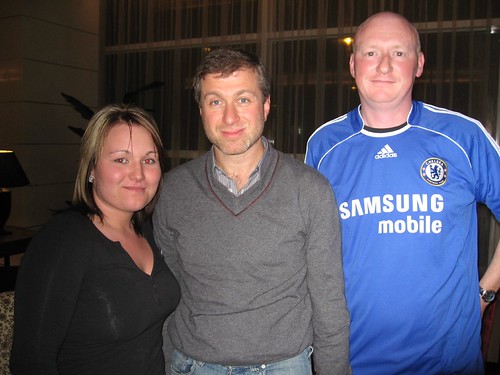
The exemplar for this second wave would be Russian business man Roman Abramovich who had made is money in the post-Soviet era from energy and aluminium processing. He went on to buy Chelsea Football Club, one of the most high profile soccer team acquisitions of the early 2000s, if not the past quarter century. Under his ownership the club went under the kind of development that American owners had looked to achieve, but on a world stage. His ability to spend also distorted the transfer market for football players.
By the end of the decade, a Europe wide set of regulations were brought into effect to try and reduce the distortion that second wave buyers and their soccer team acquisitions could bring to club competition called the UEFA Financial Fair Play Regulations.
Even as a high profile member of British society, Chelsea couldn’t provide the shield that Mr Abramovich needed to stave off suspension of his tier one visa allowing entry at will to the UK in 2018. It also didn’t stop the sanctions deployed against him, amongst other Kremlin-connected business people after the 2022 invasion of Ukraine.
Third wave of soccer team acquisitions
The third wave of soccer team acquisitions are from Gulf Cooperation Council member states:
Bahrain – Bahrain is unlikely to be doing any large soccer team acquisitions, though it has bought into second tier side Paris FC. It is a regional tourist destination for people in the Middle East and has built up a finance services sector that has a regional footprint. However it has relied on financial help from the Kingdom of Saudi Arabia
Kingdom of Saudi Arabia
Kuwait
Oman
Qatar
Their motivations are multi-pronged in nature:
Diversification of national wealth out of extracting oil and gas into assets that will continue to deliver returns after the oil runs out. In this respect they are no different to the sovereign funds of countries like Norway or Singapore
Media ambitions, Qatar already hosts the main service provider showing life professional football across the Middle East. Soccer team acquisitions could be thought of as vertical integration. For other countries, it could be seen as hedging against Qatar’s sports media hegemony
Increasing their soft power to improve their security status. This is also why Qatar hosted FIFA World Cup in 2022
Societal influence. The House of Saud have been the guardians of some of Islam’s holiest sites for about a century. Now they are the guardians of St James’ Park through their majority ownership via the Saudi government Public Investment Fund. This may give them a contingent to draw upon during difficult times in their relationship with the UK, particularly as Saudi oil becomes less important as an energy source. (Saudi oil will still be important as a chemical feedstock for every aspect of modern life including Tesla batteries, but hydrogen and electric power via alternative energy sources will reduce the impact of an oil embargo considerably.)
The outlier
Ryan Reynolds purchase of Wrexham is an anomaly. Soccer team acquisitions to build a media juggernaut are hard to do and Reynolds has shown he is uniquely creative with Aviation Vodka and Mint Mobile. He has managed to create a media property out of a lower league football team and bring pride back to a small North Wales town that hasn’t had much going for it since I was a child.
The club was community owned and has had a modest 2 million pounds invested in it since 2011. But it made great reality television in a healthy way. How long the halo of Hollywood lasts is a bigger question, but any attention given to the former steel making and coal mining town has got to be welcome.
The two stand out films of the summer are Barbie and Oppenheimer . Oppenheimer is a biopic of scientist and Manhattan Project lead J. Robert Oppenheimer, based on the book American Prometheus: The Triumph and Tragedy of J. Robert Oppenheimer. Oppenheimer went on to lead the projects Los Alamos lab. Los Alamos National Laboratory has gone on to do scientific research on defence projects as well as health related projects. Casting of Cillian Murphy provides a good physical resemblance of Robert Oppenheimer.
J. Robert Oppenheimer biopic
Oppenheimer is a complex film with the story told in the form of flashbacks. It also tries to reinterpret Oppenheimer for the present day, with a sense of guilt that Oppenheimer never personally expressed. But Oppenheimer had been concerned about the nuclear arms race and weapons proliferation. He opposed the subsequent development of the hydrogen bomb. These positions along with his friendships with communist party members in the US, led to him losing his security clearance in 1954.
J. Robert Oppenheimer via the US Department of Energy
Barbie
Barbie looks to bring to life Mattel’s toy characters Barbie and Ken. Barbie was introduced in 1959 as a copy of a German fashion doll line. The fashion doll line came out of a cartoon strip in the Bild tabloid newspaper. Mattel went on to buy the German originator and shut it down. But by this time the German doll moulds were bought or copied by manufacturers in Hong Kong and Spain.
1990s vintage Barbie
The Barbie movie addresses head on the cultural and design legacy of Barbie alongside present-day culture wars
Barbie starts off in a matriarchal fantasy world; Ken is represented as a boy toy
Eventually Barbie and Ken end up in the real world. Barbie meet her owner who accuses her of setting unrealistic beauty standards
Ken learns about the male patriarchy, which means a battle of the sexes ensues when they both return to toyland
Barbeheimer
Both Barbie and Oppenheimer were released in the cinema at the same time going head-to-head with Mission Impossible: Dead Reckoning Part One. This led to cinema goers taking advantage and buying a ticket to see each film one after the other. The practice of watching Barbie and Oppenheimer as a double-bill became so common it was given its own name Barbenheimer, when then became a thing in the news, on podcasts and social media. It has been credited with listing the business performance of cinemas, while sit on the edge of a recession. In fact in the UK, for some of the weekend, both Picturehouse cinemas and Vue cinemas websites were having trouble handling customer traffic.
Google Tests A.I. Tool That Is Able to Write News Articles – The New York Times – One of the three people familiar with the product said that Google believed it could serve as a kind of personal assistant for journalists, automating some tasks to free up time for others, and that the company saw it as responsible technology that could help steer the publishing industry away from the pitfalls of generative A.I.
I was taken back to to memories of Skeleton Records in Birkenhead during the early 1990s due to a Taylor Swift album mispress. As a young record buyer I used frequent secondhand record shops to pick up promo copies of records. A rock orientated shop would often not realise what they had, this was before widespread internet access.
The gaunt middle-aged shop assistant was sat behind the counter looking at a picture disc of Fish – State of Mind on picture disc. Fish had recently left then popular rock band Marillion and State of Mind was a single from his first solo album Vigil in a Wilderness of Mirrors.
Apparently one of his customers worked as an assistant shop manager, realised what they had and ‘lost’ the record before the distributor came to collect all the copies of the mispress. The reason why the distributor would want to collect the records? Because they played Madonna’s Cherish instead. The shop assistant said to no one in particular, that will be worth something one day. He wasn’t wrong, I have seen prices quoted as high as 650 dollars paid – if the right Madonna or Marillion completist collector actually finds a copy for sale.
Taylor Swift Speak Now Concert at Heinz Field by Ronald Woan
A similar thing happened to Taylor Swift fans this week, who ordered her latest album and ended up with Taylor Swift artwork, but songs from the early 1990s electronica compilation Happy Lands volume 1 playing instead.
This mispress became know as the ‘cursed version’ presumably because of its dark electronic sounds featuring Cabaret Voltaire and others. They might be able to take heart when they realise the such mispresses have become collectors items in the past with an appreciating value.
Back when I was a child, the oil refinery was a cathedral to industry rather than a climate crime scene and working in the oil industry was a cut above working in other industries.
3D printing industry gripped by intrigue, litigation and churn | Financial Times – 3D printing or additive manufacturing is currently used for small batch manufacturing by the likes of GE, Rheinmetall, Airbus and Lockheed Martin. You had a similar set up with CNC milling (including multi-axis machines) and multitasking machines which were confined to manufacturing ‘cells’ until Apple went out and bought thousands of them and had them running in parallel on Foxconn lines manufacturing iPhone chassis’. Additive manufacturing needs its ‘iPhone moment’ to cross the chasm to mainstream use. That is reliant on an innovative client rather than supplier innovation and the current players like Stratasys aren’t in a position to drive this next stage of innovation, but their customers might be.
Letter Statement March2023 | DAIR – Tl;dr: The harms from so-called AI are real and present and follow from the acts of people and corporations deploying automated systems. Regulatory efforts should focus on transparency, accountability and preventing exploitative labor practices.