The online field has been one of the mainstays since I started writing online in 2003. My act of writing online was partly to understand online as a medium.
Online has changed in nature. It was first a destination and plane of travel. Early netizens saw it as virgin frontier territory, rather like the early American pioneers viewed the open vistas of the western United States. Or later travellers moving west into the newly developing cities and towns from San Francisco to Los Angeles.
America might now be fenced in and the land claimed, but there was a new boundless electronic frontier out there. As the frontier grew more people dialled up to log into it. Then there was the metaphor of web surfing. Surfing the internet as a phrase was popularised by computer programmer Mark McCahill. He saw it as a clear analogue to ‘channel surfing’ changing from station to station on a television set because nothing grabs your attention.
Web surfing tapped into the line of travel and 1990s cool. Surfing like all extreme sport at the time was cool. And the internet grabbed your attention.
Broadband access, wi-fi and mobile data changed the nature of things. It altered what was consumed and where it was consumed. The sitting room TV was connected to the internet to receive content from download and streaming services. Online radio, podcasts and playlists supplanted the transistor radio in the kitchen.
Multi-screening became a thing, tweeting along real time opinions to reality TV and live current affairs programmes. Online became a wrapper that at its worst envelopes us in a media miasma of shrill voices, vacuous content and disinformation.
The August 2023 newsletter was inspired by LinkedIn’s in-built newsletter function. It’s almost the bank holiday so I thought I would spend some time to try out the newsletter function in LinkedIn.
If you’re reading this, you’re a pioneer! If this goes well I will put one out each month. You can find my regular writings here and more about me here.
LK99 & room temperature superconductors – why it was a big deal, what it would have meant if it were true and the damage likely to have been caused given it’s likely to be false.
Chip War by Chris Miller. You can read my full review here.
Things I have been inspired by.
How left wing politics inspired Prada’s clothing designs.
Encouraging empathy for people with dementia in Japan with the restaurant of mistaken orders (scoll to the end here to find out more).
Things I have watched.
Three Body Problem. Chinese adaption by Tencent Video and made available for FREE on their YouTube channel. Don’t worry it has English subtitles. This is based on the blockbuster novel The Three Body Problem by Chinese science fiction author du jour Cixin Liu. The three books in the series are all fantastic and there is soon to be a Netflix adaption as well.
The Peripheral on Amazon Prime Video. An ambitious adaption of William Gibson’s novel of the same name. Amazon Studios recently cancelled the next season of this drama, which is a real shame as its one of the stand out series amongst the content on Prime Video.
Un Flic and Le Samourai – the magical formula of French new wave director Jean-Pierre Melville and actor Alain Delon created some iconic crime films that inspired directors in Hollywood, Hong Kong and Japan.
The sales pitch.
Available for strategic engagements in the autumn. Contact me here.
The End.
Congratulations, you’re reached the end of the August 2023 newsletter. Until next month: be excellent to each other. Let me know what you think or if you have any recommendations to be featured in forthcoming issues.
What prompted me to write about Geico advertising was a stream of news from marketing services companies about the state of technology company advertising. At the time of writing Stagwell are just the latest marketing services firm after S4, IPG, Omnicom and WPP have pinned declining profits on a reduction in technology company advertising spend. Then this story broke about Geico advertising: Insurer Geico made more money after benching its famous gecko | Quartz – and my first reaction was that the wrong lessons might be taken away from this.
Geico advertising – a primer
Geico îs an unfamiliar name to most people outside of the US. If you’ve read American magazines chances are there was a print ad or two in there with their iconic Gecko spokesperson. It’s a similar case on American television.
Geico advertising and their Gecko are as familiar to Americans as the meerkats of Comparethemarket.com are to your average Brits.
The truth about technology marketers vs. Geico advertising
Having worked with technology brands on and off for the past three decades, I have enough experience to know that generally, they aren’t great marketing organisations.
Coinbase’s Super Bowl ad drove traffic to a site that fell over.
Geico reinforced brand equity in the insurance space and pointed out their 24-hour claims hotline (I imagine that this isn’t an exclusive feature, but you wouldn’t know it from the advert).
Growth mindset ≠ marketing mindset
As organisations, they have a growth mindset, but not a marketing mindset. Before the internet, this meant a powerful field sales force organisation and marketing meant a bit of branding / design work coupled with case studies for the sales people. With the internet came constant iterative ‘growth hacking’ on digital channels, that mirrors agile software development rather than the best practices of marketing science.
There is a good reason why organisations like the Ehrenberg-Bass Institute for Marketing Science are supported by FMCG manufacturers, luxury goods makers, media companies, marketing services firms and pharmaceutical companies, BUT has no technology company sponsors.
The reasons are cultural in nature:
Engineering – if I haven’t heard of it or invented it then it’s not valid and you’re just a suit. At best great product is the marketing – and that’s great if you have a clearly differentiated great product which is self evident. The engineering mindset is also why they trust adtech and marketing automation services which outsource your marketing communications approach to a black box
Sales – marketing is just support. Which is the reason why my early clients (like old school Silicon Valley royalty LSI Logic) promoted long serving secretaries and administration staff into marketing roles
Even if they had a marketer who knew about Ehrenberg-Bass they wouldn’t be able to get in buy-in from the wider organisation to participate and they’d likely be fighting other dumpster fires elsewhere
Secondly, their laser focus on data affects their outlook. To paraphrase the comedian Bill Hicks: they know the price of everything, but the value of nothing. Because they are only looking at short term data. Great marketing and advertising also has long term effects that both screws with the short term marketing data focus.
Marketing and growth hacking are considered synonymous. It would seem ridiculous for me to to claim in any large marketing orientated organisation that sales and marketing are synonymous. The differences and complementary aspects of both would be well known. Yet in technology companies, this isn’t the case.
By contrast Geico as a brand is an organisation who understood marketing. You make your car or house insurance decision at best once a year (though there is friction in making a change).
The technology sector approach would be for Geico to bid on search ads and aggregators to acquire customers and then do direct mail or email when it comes to renewal times. But Geico advertising does something different. Geico advertising builds mental framework, so that Geico means car insurance and will be one of the brands that you consider.
This achieves a few things:
You are less likely to move away from Geico, you may not love them, but searching for an alternative might be too much of a hassle.
You may be reassured that you have chosen ‘the’ car insurance
It helps new customers get over the ‘which car insurance company to choose’ decision
It helps with upsell on the products due to the reassurance of the brand
Technology companies deal with these problems in a slightly different way:
Certification of engineering staff. If you are Microsoft certified or Cisco certified, you are less likely to use open source software or Juniper Networks products respectively. It would be against your self interest and the investment in terms of time and money that you have made in your self development
Contractual lock-in – self explanatory
Technology lock-in. You can put your data or programming code into a particular system, but its much harder and more expensive to move on to another system
Owning the entire technology stack. This is the approach that Adobe Systems have taken, gradually acquiring over the years the entire marketing, workflow and creative systems used by ad agencies, media agencies and their clients
So why was Geico advertising spend cut?
This is the crux of my point about how the wrong lessons might be taken away from the Geico advertising spend cut, with no ‘apparent’ impact.
There are a number of good reasons why Geico made the cut in advertising spend:
There was a cut in insurance sector advertising overall, so that Geico maintained or even grew its relative share of voice while spending less. This should see it emerge with improved economic performance over time. Procter and Gamble became the behemoth it now is by INCREASING advertising during the great depression of the 1920s. So the idea of relative share of voice and its relationship to market share is older than I am. Further more research by the IPA has found that holding or increasing relative share of voice during a downturn has a positive impact for business performance over a five year period
Geico may have managed to make some efficiency gains, this is most likely to occur in brand activating activities
There is also a bad reason: saving money in the short term. Kraft Heinz cut marketing to the bone under the guise of zero based budgeting (ZBB) – which made a mockery of ZBB as a concept. Kraft Heinz shares massively underperformed and were down 60% in the last 5 years, compared to the S&P 500 having gone up 69%. If Geico is following this route then it bodes ill for the long term performance of the business.
Without us knowing the real reasons and focusing on the short term measure, it reinforces a growth hacking mindset.
Hard times mean no sustainability premium in North America | WARC | The Feed – every single economic recession this comes around and marketers are surprised. Time to pay attention to what the longitudinal research data says. I really like the work that Gallup have done on macro trends and the American consumer, in particular their work on attitudes to the environment.
‘Pokémon Sleep’ Review: Sleep-Tracking Game Made Me Into Snorlax – gamifying sleep. Pokemon Sleep has surged to 3.2M global downloads and an estimated $130k in daily revenue according to SensorTower data. The app ranked in the top 5 in the U.S. Games charts. It’s even more popular in Japan (the home of Pokemon), where it’s number 1 across the App Store categories
Using attention to scale creative excellence at Mars | WARC – Sales, distinctive assets, and attention to advertising are the go-to metrics to guide marketing decisions at Mars. Mars use Attention as a pre-testing tool, to inform creative choices in digital and also proxy in TV. Mars believe that an execution with a better attention score will travel across media channels better and will be a safer bet for you when you need to make a choice. Measuring Attention is a key element in helping us improve the creative hit rate. Advertisers should question how they measure consumer responses and focus on measures of real consumer behavior.
My consumer internet usage goes back 25 years as a celebratory email reminded me in my Yahoo! account earlier this year.
25th Yahooversary
I had started using the internet back in early 1994. I had access to email whilst working as a research technician for Corning in their optical fibre manufacturing business. The account was for solely for professional reasons (for the most part).
After Corning, I went to college and had access to the web for the first time. At that time, people in my year and the year above me mostly didn’t bother with the internet. I had found it useful for getting Mac software and researching material for college essays.
I set up an Excite.com webmail account before leaving college, but it wasn’t that reliable. In the immediate aftermath of leaving college I worked long hours for the first few months in the call centre at MBNA the credit card company. So a rare day off was spent catching up on sleep or catching a video from the local Blockbuster store.
Coffee, cake and email
Over time, I got a temporary role in their marketing department. I was writing sales scripts for payment protection insurance and keeping a tally on salesperson performance. This meant that I moved to a role that was more 9 to 5 and I could start looking for my first career role. I even got to go shopping for sports cars that we were given away to the top performing sales person.
(Aside: The Lotus Espirit Turbo and TVR Griffith were unpleasant driving experiences; the Toyota Celica GT-Four ST205 and fourth generation Toyota Supra were great cars to drive.)
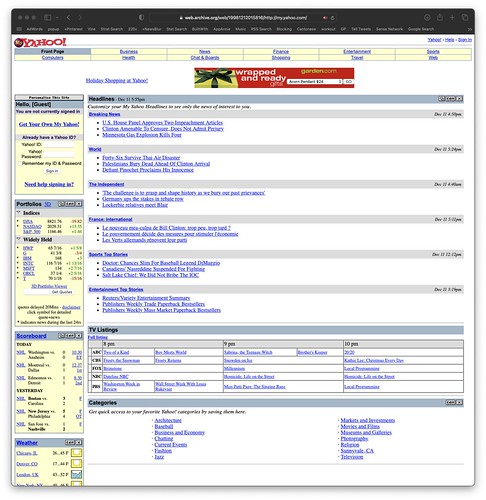
What Yahoo! looked like in early 1998, about the time when I set up my email account.
So one wet Saturday morning in March I set up a Yahoo! account in a cyber cafe around the corner from James Street station in Liverpool. I had found the address for Café Internet on North John Street in the Yellow Pages directory – there were only a couple of cyber cafes at the time in the Merseyside area and this one was the easiest to get to. Of course that would all change a year later with the launch of the easy group’s easyInternetCafe chain.
(Aside: in the process of writing this article I found out that Café Internet was the first cybercafe in the North West of England, originally opened in 1995.)
The connection that I enjoyed at Cafe Internet was slow and expensive.
I had a weekly ritual of working during the week and then heading over to Liverpool on Saturday morning to do a bit of record shopping, check my email and apply to jobs with some of the best coffee and carrot cake available at the time. I used to bring my emails that I needed to send, pre-written up a floppy disk as plain text files, along with a copy of CV to send as an attachment for jobs.
Eventually, I got my friend Andy online with his first email account and showed him the basics of web browsing. I don’t drink and we got accustomed to doing a spot of web surfing with good coffee and carrot cake prior to going window shopping in Liverpool city centre while chatting about everything and nothing. While we were online this was 25 years ago, so there was no UK e-commerce beyond shareware software on Tucows, so going shopping was not ironic.
My front door to the web
Yahoo! and other web portals like Lycos and Excite borrowed design cues from a newspaper page with their multiple columns of news snippets, horoscopes and weather forecasts. But it lacked the salacious content and gaslighting of the modern web.
My job search weekly cycle
Week day evening: Monday looking at The Guardian for marketing jobs. At the time The Guardian was a good source of entry level agency roles. Thursday meant going through Campaign and PRWeek. By going through, I mean looking at their print copies.
The library had a network that allowed PCs to do printing to a laser printer. In addition there were terminals that the librarians used to arrange inter-library deliveries. This ran on a command line interface connecting to a common database shared by all Wirral libraries. So my job search was analogue.
Saturday morning: over to Liverpool to check for email responses and send new applications in.
Given that most people applying for the jobs would be sending applications through via post, using email even on a weekly basis provided me with an advantage as a job seeker.
The internet in print
Given that it was expensive to get online. I spent more time reading MacWorld, Byte magazine and Wired magazine talking about online life than I spent online at the time. I noted down websites to check out next time I visited the cyber cafe, after I had sent my emails.
My internet consumption mirrored a wider consumer patten 25 years ago, many people were excited by the idea of the internet before they had managed to get online. Getting online would follow a year or two later, partly due to the heavy direct mail campaign by early ISPs including AOL and CompuServe who sent CD-ROM discs to my parents every six weeks.
Even by pre-internet standards that was a direct mail campaign of unprecedented scale.
Switching off as a choice is a relatively new phenomenon. A few blogposts ago I talked about how consumer internet usage started for me 25 years ago. Back then going online was an active choice. In my case I would have to travel to an internet café. Later I would have to dial-in to an ISP or log into a wi-fi network.
Confluence of always-on elements
Wireless home broadband allowed seamless connectivity around the house or the workplace. The next thing that changed was laptop battery battery life improved to the point that one could realistically work for a 8 hours on writing or emailing at a conference or coffee shop without a power cable. Social media became a thing, first it was a positive influence, but gradually it had a more complex social impact.
Finally there was smartphones. Nokia, BlackBerry, Palm and Microsoft smartphone attempts gave way to a duopoly of Apple and Alphabet’s respective eco-systems. I went back to an old presentation that I did a number of years ago. Here’s a chart from it, that I pulled together of publicly available active user numbers by time from December 1997 to April 2016.
The dramatic take off in Gmail email accounts in 2011 and beyond is down to the rise of the Android operating system. By 2013, smartphone users were engaged by a series of compelling always-on applications to counter switching off.
Ged Carroll for IMM Conference, Hong Kong (August 2013)
Switching off became important. ‘Crackberry‘ – a light hearted take on smartphone addiction and an ability to turn off peaked as a thing as far back as September 2009 according to Google Trends. 12 months later the Crackberry book advised us on how to put down our smartphones. Four years later, the self-help books became more strident in their exhortations: Put Down Your Damn Phone Already: A (loving) rant about your obnoxious cellphone use being a case in point.
The biggest concerns now, seems to be about two things where correlation if not causality supports beliefs about:
From a professional perspective and increasingly a personal perspective, consumers have become smartphone human cyborgs.
Class as a determinant of switching off
Switching off is also about culture and behaviour. A discussion that I had with a friend about phones being turned off and put in a box before a night at the opera, reminded me of how ‘class’ in its widest sense can be one of the biggest determinants of switching off. You see it in homes that put phones away before a family dinner, or cinema-goers who are happy to turn their phone off before the main feature starts.
The bulk of people may have the devices as always-on pacifiers. This quietens children and is seen as a continued source of confidence and validation rather than switching off.
Secondly, we’re also seeing a small proportion of people choosing to use feature phones as a way of disconnecting. This might happen all the time or at the weekend, when they don’t want to be bothered by Microsoft Teams and WhatsApp messages.
The world’s last internet cafes – Rest of World – Internet cafes were more than just places to log on. They emerged in the waning years of the 20th century — a post-Cold War moment full of techno-optimism. Sharing a global resource like the internet “was going to bring different people in different cultures together in mutual understanding,” historian and author Margaret O’Mara told Rest of World. It was an era in which, both physically and digitally, “people were moving across borders that before were very difficult, if not impossible, to cross.”
I was taken back to to memories of Skeleton Records in Birkenhead during the early 1990s due to a Taylor Swift album mispress. As a young record buyer I used frequent secondhand record shops to pick up promo copies of records. A rock orientated shop would often not realise what they had, this was before widespread internet access.
The gaunt middle-aged shop assistant was sat behind the counter looking at a picture disc of Fish – State of Mind on picture disc. Fish had recently left then popular rock band Marillion and State of Mind was a single from his first solo album Vigil in a Wilderness of Mirrors.
Apparently one of his customers worked as an assistant shop manager, realised what they had and ‘lost’ the record before the distributor came to collect all the copies of the mispress. The reason why the distributor would want to collect the records? Because they played Madonna’s Cherish instead. The shop assistant said to no one in particular, that will be worth something one day. He wasn’t wrong, I have seen prices quoted as high as 650 dollars paid – if the right Madonna or Marillion completist collector actually finds a copy for sale.
Taylor Swift Speak Now Concert at Heinz Field by Ronald Woan
A similar thing happened to Taylor Swift fans this week, who ordered her latest album and ended up with Taylor Swift artwork, but songs from the early 1990s electronica compilation Happy Lands volume 1 playing instead.
This mispress became know as the ‘cursed version’ presumably because of its dark electronic sounds featuring Cabaret Voltaire and others. They might be able to take heart when they realise the such mispresses have become collectors items in the past with an appreciating value.
Back when I was a child, the oil refinery was a cathedral to industry rather than a climate crime scene and working in the oil industry was a cut above working in other industries.
3D printing industry gripped by intrigue, litigation and churn | Financial Times – 3D printing or additive manufacturing is currently used for small batch manufacturing by the likes of GE, Rheinmetall, Airbus and Lockheed Martin. You had a similar set up with CNC milling (including multi-axis machines) and multitasking machines which were confined to manufacturing ‘cells’ until Apple went out and bought thousands of them and had them running in parallel on Foxconn lines manufacturing iPhone chassis’. Additive manufacturing needs its ‘iPhone moment’ to cross the chasm to mainstream use. That is reliant on an innovative client rather than supplier innovation and the current players like Stratasys aren’t in a position to drive this next stage of innovation, but their customers might be.
Letter Statement March2023 | DAIR – Tl;dr: The harms from so-called AI are real and present and follow from the acts of people and corporations deploying automated systems. Regulatory efforts should focus on transparency, accountability and preventing exploitative labor practices.