Category: software | 軟件 | 소프트웨어 | ソフトウェア

Soon after I started writing this blog, web services came up as a serious challenger to software. The thing that swung the tide in software’s favour was the rise of the mobile app ecosystems.

Originally mobile apps solved a gnarly problem for smartphone companies. Web services took time to download and were awkward compared to native software.

Now we tend to have a hybrid model where the web holds authentication functionality and the underlying database for many applications to work. If you pick up a Nokia N900 today, while you can appreciate its beautiful design, the device is little more than a glowing brick. Such is the current symbiosis between between software apps and the web services that support them.

That symbiosis is very important, while on the one hand it makes my Yahoo! Finance and Accuweather apps very useful, it also presents security risks. Some of the trouble that dating app Grindr had with regards security was down to the programmers building on third party APIs and not understanding every part of the functionality.

This means that sometimes things that I have categorised as online services might fall into software and vice versa. In that respect what I put in this category takes on a largely arbitrary view of what is software.

The second thing about software is the individual choices as a decision making user, say a lot about us. I love to use Newsblur as an RSS reader as it fits my personal workflow. I know a lot of other people who prefer other readers that do largely the same job in a different way.

  • A Diamond is Forever + more things

    A Diamond is Forever

    DeBeers have resurrected their tagline A Diamond is Forever. What’s interesting is that DeBeers is focusing the campaign only in China and the United States. Whilst the heritage of A Diamond is Forever may resonate with the American audience. I am less sure about how it might resonate for Chinese consumers.

    While diamonds are a good store of value, the move towards guo chao – Chinese things for Chinese people is another dynamic that may affect receptivity.

    DeBeers

    Beauty

    Gen X men prefer gently-scented bodycare products over heavily-scented ones | MintelDespite having body odour concerns, Gen X doesn’t go for heavily scented products as they have dry, sensitive and acne-prone body skin. Among Gen X, itchiness, excessive sweat and rashes concerns stood out from those of other consumers. They are also concerned with the odour associated with the result of sweat.

    Japan’s Fukushima wastewater release sparks Chinese hesitation in J-beauty | Cosmetics Design Asia – much of this is down to how Chinese rhetoric has affected Japanese country brand perceptions around the purity aspect of quality.

    China

    EU to launch anti-subsidy probe into Chinese electric vehicles | Financial Times

    China’s business confidence problem | Financial Times 

    Chinese state media censors itself after highlighting poem about corrupt leaders | China | The Guardian

    Intelligence services set to unmask China spies | Daily Telegraph 

    Jeep Parts Prices Soar Over 10 Times in China After Local Producer Went Bust

    Economics

    The Pursued Economics of advanced economies.

    https://www.youtube.com/live/dYR8sF12TW4?si=Nq6ZFAGDcRHKbStT

    Future Horizons drops bearish stance, lifts chip market forecast | EE News Europe – still negative, but not as a large drop predicted, which indicates less precipitous economic decline.

    FMCG

    Welcome to the Anti-Woke Economy | The New RepublicA fledgling parallel economy has emerged on the right, hawking everything from coffee to vitamin supplements to anti-abortion protein bars. But can a business movement born of political and cultural grievance be viable over the long term?

    Health

    Breaking Through Depression; The Balanced Brain – reviews | The Guardian 

    An inconvenient truth: Difficult problems rarely have easy solutions | Behavioral and Brain Sciences | Cambridge CoreIndividual-level interventions are often interesting and easy to implement, but are unfortunately ill-equipped to solve most major global problems (e.g., climate change, financial insecurity, unhealthy eating). Resources spent developing, pursuing, and touting relatively ineffective i-frame interventions draw resources away from the development and implementation of more effective s-frame solutions. Behavioral scientists who want to develop solutions to the world’s biggest problems should focus their efforts on s-frame (system level) solutions

    Ideas

    The AI and Leviathan series examining what it means if AI did actually change everything including extreme techopolarity.

    • Part 1 – institutional economics of an intelligence explosion
    • Part 2 – preparing for regime change
    • Part 3 – techno-feudalism

    My friend Gerd Leonhard has a more techno-utopian view, but acknowledges his vision is a best case scenario.

    Innovation

    Sony harvests electromagnetic ‘noise’ and offers milliwatts EE News Europe 

    How to Depolarize American Democracy – by Dexter Roberts 

    Luxury

    How the metaverse downturn is benefitting digital designers | Vogue Business 

    Marketing

    Dentsu launches paid search tool that uses AI to speed up creativity and optimization – Digidayd.Scriptor — a new proprietary offering it’s developed to supercharge paid search, mainly in the area of ad copy development but also as a means to optimize and adapt execution. Dentsu is announcing the tool today, after pilot testing over the last several weeks. It’s meant to help with boosting the volume of creative messaging with an eye toward improved engagement rates, as well as to speed up the process of creative experimentation, and cut down on the time required to perform optimization tasks – the more variants that you cram into a Google Adwords programme the better a job it can do on optimising display based on what works. I spent a lot of time coming up with variants in spreadsheets to do this when I was freelancing

    Media

    Nobody Will Tell You the Ugly Reason Apple Acquired a Classical Music Label

    Exclusive: The Economist adds podcast subscription tier

    In Its First Monopoly Trial of Modern Internet Era, U.S. Sets Sights on Google – The New York Times – about two decades too late. The EU gatekeeper move is very interesting: Digital Markets Act: Commission designates six gatekeepers | European Commission

    CAA Sold to French Billionaire François-Henri Pinault – The Hollywood Reporter 

    Online

    We’re Updating our Community Standards – Linktree – changes on conditions, particularly focused on sex work, presumably to cover themselves from US legislation. There are also restrictions on regulated sectors like vaping and alcohol

    Can Yahoo Be Saved? How Apollo Is Rebuilding an Internet Icon — The Information

    Retail

    Levi’s chief digital officer on the strategy to triple e-commerce sales | Modern Retail

    Security

    New vehicles a “privacy nightmare” where you consent to carmakers collecting data on behavioral, biological, even sexual activity | Boing Boing 

    Afghanistan is the fastest-growing maker of methamphetamine, UN drug agency says | MACAU DAILY TIMES 澳門每日時報 

    Software

    LLMs have serious problems

    Apple Boosts Spending to Develop Conversational AI — The Information 

    When AI Begins to Replace Humans – by Rex Woodbury – how CAPTCHAs are improving machine learning

    China’s Horizon Robotics to Transfer Hundreds of Employees to Its JV With Volkswagen Unit

    Technology

    Groq Demonstrates Fast LLMs on 4-Year-Old Silicon – EE Times 

    Generative AI exists because of the transformer | FT

    Apple & Qualcomm – Gritted teeth – Radio Free Mobile

    TSMC to invest in Arm and Intel subsidiary IMS Nanofabrication | DigiTimes – the ARM investment will get the headlines but the more interesting technology is in the IMS Nanofabrication aspect of the deal

    Telecoms

    Network quality is still very important for German telco customers—but that’s only half the story – Kearney

  • General Magic

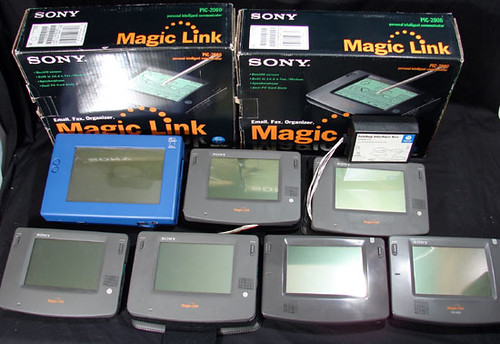
    General Magic has a reputation of being the technology equivalent of the Jordan-era Chicago Bulls, but it ended up going nowhere. I never got to see the device in person, it was only available in Japan and the US. It’s as famous much for its alumni, as it is for its commercial failure.

    Apple "Paradigm" project/General Magic/Sony "Magic Link" PDA

    This is captured in a documentary of the same name. For students of Silicon Valley history and Apple fan boys – the team at General Magic sounds like a who’s who of the great and the good in software development and engineering.

    General Magic started within Apple with a brief that sounds eerily like what I would have expected for the iPhone decades later.

    “A tiny computer, a phone, a very personal object . . . It must be beautiful. It must offer the kind of personal satisfaction that a fine piece of jewelry brings. It will have a perceived value even when it’s not being used… Once you use it you won’t be able to live without it.”

    Sullivan M. (July 26, 2018) “General Magic” captures the legendary Apple offshoot that foresaw the mobile revolution. (United States) Fast Company magazine

    The opening sequence tells you what the documentary is going to lay out. Over carefully curate images of Silicon Valley campuses, Segway riders and the cute bug like Google autonomous vehicle a voice talks about success and failure. That failure is part of the process of development. That General Magic has a legendary status due to its status as precursor to our always-on modern world and while the company failed, the ideas didn’t.

    Autonomous cars aren't nearly as clever as you think, says Toyota exec - Computerworld

    The genesis of the spirit of General Magic goes back to the development and launch of the Macintosh with its vision of making computers accessible. The team looked around the next thing that would have a similar vision and impact of a product. The Mac had got some of these developers on the front cover of Rolling Stone – they were literally rockstars.

    You get a tale of dedication and excitement that revolved around a pied piper type project lead Marc Porat, who managed to come to the table with a pretty complete vision and concept of where General Magic (and the world) would be heading. The archive of footage of the offices with its cool early to mid 1990s Apple Office products still amazes now. The look of the people in the archive footage, make my Yahoo! colleagues a decade later seem corporate and uptight by comparison.

    Veteran journalist Kara Swisher said that she started following the company because it was ‘the start of mobile computing, this is where it leads’.

    What sets the documentary apart is that it tapped into footage shot by film maker David Hoffman who was hired to capture the product development process. The protagonists then provide a voice over of their younger selves. Their idealism reaches back to the spirit of the 1960s. You can see how touch screen screens and the skeuomorphic metaphors were created and even animate emoticons.

    I’ve never known a development process with so much documentary footage. Having been in this process on the inside, the General Magic documentary portrays a process and dynamics that haven’t changed that much.

    The ecosystem that the startup assembled including AT&T, Apple, Motorola and Sony made sense given the ecosystem and power that Microsoft had behind it. It’s hard to explain how dominant and aggressive Microsoft was in the technology space. Newton came out as a complete betrayal and John Sculley, who is interviewed in the documentary comes across worse than he would have liked.

    The documentary also has access to the 1994 promotional film where General Magic publicly discussed the concept of ‘The Cloud’ i.e. the modern web infrastructure – but the documentary doesn’t dwell on this provable claim.

    Goldman Sachs was a key enabler, the idea of the concept IPO set the precedent for Netscape, Uber, WeWork and the 2020s SPAC fever.

    In a time when there is barely one thing changing the technology environment, General Magic were pursuing their walled garden of their private cloud and missed the web for a while. Part of this is down to their relationship with AT&T.

    The documentary covers how project management dogged the project. Part of the problem was perfectionism was winning over the art of the possible and not focusing on the critical items that needed to be done. The panic of having to ship.

    It’s about getting the balance between ‘move fast and break things’ versus crafting a jewel of a product.

    But shipping wasn’t enough, the execution of shopper marketing and sales training was a disaster. The defeat was hard given the grand vision. But the ultimate lesson is that YOU are not representative of the mainstream market.

    The documentary post-mortem featuring thinkers like Kara Swisher and Paul Saffo points out the lack of supporting infrastructure, that would take years to catch up to where General Magic’s Magic Link had gone. Paul Saffo uses a surfing analogy that I had previously read in Bob Cringely’s Accidental Empires about catching the right wave at the right time.

    John Sculley over at Apple made similar mistakes to the General Magic team which resulted in him being fired from Apple. Sculley makes the very human admission that being fired from Apple took him about 15 years to recover from personally.

    IBM Simon

    The documentary gives a lot of the credit (maybe too much of it) to General Magic as the progenitor of what we now think of as smartphones. The reality as with other inventions is that innovation has its time and several possible ‘inventors’; or what author Kevin Kelly would call ‘the technium’. This is the idea that technological progression is inevitable and that it stands on the layers of what has gone before, like fossils found inside rocks several foot deep. For instance, IBM created a device called Simon which was ‘smartphone’ which sold about 50,000 units to BellSouth customers in the six months it was on the market. Motorola – who were a General Magic partner also launched a smartphone version of the Apple Newton called the Motorola Marco in January 1995 and there are more devices around the same time.

    Reality is messy and certainly not like the clean direct line that the General Magic documentary portrays, even the Newton was only part of the story.

    The Wonder Years

    I was thinking about what I liked so much about the General Magic documentary. I immediately thought about it reminding me of my falling in love with the nascent internet and technology, which then bought me to the start of my agency career working with Palm (the company that eventually helped kill off General Magic’s product ambitions) and the Franklin REX which came out of sychronisation pioneers Starfish Software.

    But it was deeper than that. The Silicon Valley portrayed in the General Magic documentary wasn’t the dystopian hellscape of platform firms, generation rent, toxic tech bro culture and ‘churn and burn’ HR culture. Instead the General Magic documentary story represented a halcyon past of Silicon Valley portrayed in books like Where Wizards Stay Up Late, Fire In The Valley and Insanely Great. Where talented people motivated by a fantastic vision thing, with a user centred mission worked miracles. The darkness of fatigue and god knows what else is largely hidden by a Wonder Years TV show feel good nostalgia. Maybe it gives us hope again in the tech sector, despite Peter Thiel, Mark Zuckerberg, Tim Cook and Elon Musk? Maybe that hope might inspire something great again?

    Marc Porat’s personal tragedy and Tony Fadell’s business failure brings a hint of the real world through the door. The documentary uses Fadell’s link with the iPod and iPhone as a point of redemption, resilience, perseverance and vindication for General Magic.

    There’s also a cautionary tale full of lessons learned for new entrepreneurs, who often get the vision thing but forget about the details. More on General Magic here.

    More reviews here.

  • Enquire Within + more things

    Enquire Within Upon Everything

    Enquire Within tends to appear in book collections for people of a certain age, or, where the book collector has inherited part of their collection. Spending time on the family farm in Ireland during my childhood, I used to see a copy of an early 20th century vintage sit next to a dog-eared copy of Old Moore’s Almanac (not to be mistaken for a separate UK publication: Old Moore’s Almanack), Old Moore’s was used for deciding what to plant in the garden besides potatoes.

    During the bank holiday weekend, staying with my parents, emergency works on a water main managed to take out the broadband and electricity along their road. I went back though my Dad’s boxes of books and leafed through my parents copy of Enquire Within. My Dad thinks he had received the copy as a gift from a the owner of a second hand book store in Birkenhead market right after he had moved into the first house that my parents had bought. But he can’t be certain. Given that the outer gloss paper wrap around the hardback inner cover uses a font that looks similar to Eurostile and the price is in decimal – I guess it’s from the early to mid-1970s.

    Enquire Within could be thought of as a primer for everyday life. Topics included how to play a variety of card games, basic first aid, the basics on taxation and education with the addresses of the UK government departments responsible. There was a travel section with a few paragraphs on every western European country, which had been written by the Financial Times travel correspondent. The gardening section went into much more depth explaining what a hardy annual and hardy perennial were, alongside the correct way to build a compost heap, how to dig drills and prune roses.

    At the back there is an exhaustive list of children’s names together with their meanings.

    Enquire within

    Enquire Within and the origins of the web

    What I didn’t find out until later on was that Tim Berners-Lee was partly inspired to create a predecessor to what would become the world wide web by a Victorian vintage copy of Enquire Within that was in his parents house when he was growing up. The system was called ENQUIRE and seemed to be similar conceptually to HyperCard or a Wiki. The World Wide Web came out of Berners-Lee’s efforts to integrate disparate systems including ENQUIRE together to facilitate better collaboration between CERN research projects.

    Beauty

    Digital culture is changing our face: How South Korea is inspiring new cosmetic trends | Culture | EL PAÍS English 

    Economics

    MIT Economist Daron Acemoglu Takes on Big Tech: “Our Future Will Be Very Dystopian” – DER SPIEGELThe rich and powerful have hijacked progress throughout history, says Daron Acemoglu. They did so back in the Middle Ages and also now in the age of artificial intelligence.

    Decoupling isn’t phoney – by Noah Smith – Noahpinion

    Energy

    The Japanese Companies Pursuing a Hydrogen Economy – The Diplomat 

    Bosch starts production of 800V EV technology | EE News Europe 

    Finance

    This video on money laundering is as much of interest for the phenomenon of quality documentaries on YouTube as it is for recycling known truths about HSBC.

    Gadgets

    Global Smartphone Shipments Will Hit Lowest Point in a Decade, IDC Says – CNET – likely to be a mix of market maturity and indicative of inelastic pricing in the premium sector

    Hong Kong

    Language Log » Language and politics in Hong Kong: National Security and the promotion of topolect and Hong Kong national security police target Cantonese language | Quartz 

    Bigger, better, smoother? Hong Kong, Shenzhen border zone blueprint hopes to offer best of both worlds, as Beijing ‘exerts pressure’ to spur cooperation | South China Morning PostLeonard Chan Tik-yuen, chairman of the Hong Kong Innovative Technology Development Association, said the blueprint amounted to directives from Beijing that told both cities to become more integrated.

    Innovation

    Startup uses MEMS ultrasound to improve audio speaker | EE News Europe 

    Japan

    The Japanese student dorm that governs itself – The Face 

    Marketing

    First-Party Data Is Retail’s Next Growth Engine | BCG and CPGs may have embraced data collaboration, but they need to take it further | LiveRamp | Open Mic | The Drum. Yet more from The Media Leader: Retail media: were we right to get so excited? – The Media Leader  

    Media

    Podcast: Why OOH audiences have not hit a ‘new normal’ yet – with Route’s Denise Turner – The Media Leader

    Changes in the nature of the music industry

    Goldman Sachs Exchange

    Online

    Yahoo, taken private by Apollo Global, finds a new renaissance 

    Retailing

    The Forrester Wave™: Commerce Search And Product Discovery, Q3 2023, Surfaces The Challenges Of AI UncheckedDon’t let buzzwords distract you from what your customers — and your business — need. Vendors often use their own terminology, especially in a market that hasn’t had a Forrester Wave evaluation in place already. One will talk about how extremely relevant their results are, while another will scoff at “relevancy” as outdated methodology. You’ll hear semantic, vector, hybrid, ML, AI, and all sorts of branded names for products and functions

    Security

    The Cheap Radio Hack That Disrupted Poland’s Railway System | WIREDthe ability to send the command has been described in Polish radio and train forums and on YouTube for years. “Everybody could do this. Even teenagers trolling. The frequencies are known. The tones are known. The equipment is cheap. – This reminds me of the blue boxes used for phone phreaking decades ago.

    I Tracked an NYC Subway Rider’s Movements with an MTA ‘Feature’

    Software

    Adobe’s AI diversity auditor | Patent Dropis seeking to patent a system for “diversity auditing” using computer vision. Essentially, this system uses facial detection and image classification to break down photos of employees and slot them into categories based on certain physical traits and characteristics. Adobe’s system looks through several images and detects faces in each one, then classifies each face based on a predicted “sensitive attribute” relating to “protected classes of individuals,” such as race, age or gender. For example, Adobe noted, this system may classify images from a company’s website, then compare its predictions to a “comparison population.”

    Technology

    Mexico’s Microchip Advantage | Foreign Affairsthere are significant hurdles to making Mexico a bigger player in supply chains for chips and advanced technologies. The country lacks its Asian rivals’ existing networks of high-technology firms. Until now, investments in the sphere have been sparse. To change this situation, Mexican political and business leaders need a clearer strategy for attracting semiconductor investment. The dividends, both for Mexican industry and for U.S. supply chain security, could be significant. Today’s large-scale shift away from China-focused assembly operations offers a once-in-a-generation opportunity to create a more fully integrated North American semiconductor and electronics supply chain. Despite the United States’ major involvement in many segments of the chip industry, there is at present hardly any semiconductor packaging or assembly in the country and very little anywhere else in the Western Hemisphere. The United States maintains a leading role in R&D-intensive segments of the semiconductor industry, including chip design and manufacturing equipment. The CHIPS Act is intended to increase the amount of chip fabrication in the United States. Yet neither the United States nor any country in the Western Hemisphere plays a major role in the final stages of the chip manufacturing process—assembly, testing, and packaging (ATP)—in which semiconductors are tested and assembled into sophisticated packages. The Western Hemisphere also does relatively little assembly of advanced electronic systems that require a lot of chips, such as consumer electronics.

    Web of no web

    Surfings equivalent of a dive computer: Search GPS Test User Signup

  • The Code – Silicon Valley and the Remaking of America

    The Code

    The Code – Silicon Valley and the Remaking of America by Margaret O’Mara is the second book I have read recently about Silicon Valley, this review follows my review of Chip War by Chris Miller. The Code covers the history of Silicon Valley from the post-war to the present.

    Margaret O’Mara

    In terms of her background, O’Mara is a Clinton administration era policy wonk. When O’Mara left policy circles, she became an academic and is now a history professor at the University of Washington in Seattle – at the other end of the country. Her area of focus is on the history of the modern technology industry. She spent five years researching the book in the mid-2010s, just as Silicon Valley was going under a technological and social change.

    The lens shaping everything else that I have written here

    I am a sucker for books on the history of technology and like Chip War, The Code was right in my wheelhouse. It complemented, rather than overlapped some of my existing favourite technology history books like Bob Cringely’s Accidental Empires, John Markoff’s What The Dormouse Said or most of Michael Malone and Steven Levy’s output to date.

    Like Miller’s Chip War, O’Mara brought a degree of distance from her material to her writing. She has done a lot of research and surfaced lesser known characters like community computing pioneer Liza Loop in her work, she doesn’t have the inside track.

    Bob Cringely with his work on InfoWorld‘s Notes From the Field column got an inside track from the Valley’s engineers before he went on to write is magnus opus Accidental Empires. Like Cringely, Michael Malone was brought up in the Silicon Valley area and then worked the business section beat as a reporter for the local newspapers. Cringely and Malone lived and breathed the valley. If you are are fan of Cringely and Malone’s works, expect something that is interesting but stylistically very different.

    On to The Code itself

    Other reviewers have used words like ‘masterful’ and ‘majestic history’ to describe the book – which while being a reasonable guide to overall quality aren’t really all that helpful. In contrast to Chip War which took me six months, I managed to storm through The Code in a week. This is partly down my familiarity to the material covered and the airplane view that O’Mara takes when writing about her subject. I enjoyed O’Mara’s writing, but could also see someone coming to it with a good grasp of American political history and current affairs, but no knowledge of Silicon Valley history enjoying it just as much.

    Being an academic O’Mara worked hard to source everything in The Code, she also provides a recommended reading list that goes into different aspects of the story that she laid out in more depth including John Markoff’s What the Dormouse Said and Theodore Roszak’s From Satori to Silicon Valley.

    HP's first product, sitting outside of Bill and Dave's office (in HP's headquarters)
    H-P’s first product taken by Robert Scoble

    The book starts in the post-war period as Stanford and Silicon Valley peaked as an area for military contractors. O’Mara references the political lives of the H-P founders alongside the growth of cold war technologies and the space race.

    O’Mara leans hard into Stanford’s defence industry connections that started pre world war II. The book then veers to the decline of the military industrial complex in the area due to a number of factors. The Vietnam war demolished the defence budget. The space programme started to wind down after NASA met Kennedy’s challenge to put man on the moon. Johnson’s social programmes took spend away from scientific developments. Finally the social climate in the US changed.

    The next stage of computing was shaped by counter cultural values which O’Mara covered the libertarian instincts of Silicon Valley pioneers alongside the more community orientated views of the counterculture folks. Unlike other writers, O’Mara also covers the Boston area technology corridor that Silicon Valley eventually overshadows.

    O’Mara focuses more on the finance of Silicon Valley covering some of the highlights featured in Sebastian Mallaby’s The Power Law. But O’Mara also delves into the public markets and the role of lobbying in the Silicon Valley finance machine.

    O’Mara tells how immigration affected the nature of Silicon Valley through the story of Jerry Yang, co-founder of Yahoo!. As is the case with policy wonks she puts a lot of emphasis on Al Gore, the information superhighway and the Clipper chip. The Clipper chip resurrected like Godzilla the libertarian Republican party arm of Silicon Valley elites and paved the way for the likes of Peter Thiel later on.

    The Code finishes on the future hopes for autonomous driving by university research teams and Google’s Waymo business.

    You can get hold of Chip War here. More book reviews here.

  • Gatekeeping + more things

    Gatekeeping

    I wish gatekeeping was a thing back in 2005 and 2006 when I was working on the international launch of Yahoo! Answers. The problem that we had was getting people to contribute answers to questions. Gatekeeping and the exhortation to not gate keep is about sharing knowledge and opinions freely – an in real life version of what we saw in early social publishing. Ironically gatekeeping stands in sharp contrast to oversharing as a social faux pas. The kind of knowledge that concerns about gatekeeping is particularly opposed to is opinion based knowledge or NORA.

    Now ‘your jam’ is no longer your jam, but instead offered up to be other people’s jam instead. Your individuality ready to be cloned at a moments notice. Will everything descend to being ‘basic’ or mainstream? Does it disincentivise possessing good taste?

    gatekeeper

    What the Internet’s Use of ‘Gatekeeping’ Says About PowerThe rise of “Don’t gatekeep” has reframed keeping things to yourself as a selfish act. But not everything is for everyone! And sometimes the act of sharing does more harm than good. I’m thinking of how Anthony Bourdain felt conflicted about sending droves of tourists to mom-and-pop restaurants. I’m thinking of gentrification and what happens when certain neighborhoods are positioned as hidden gems.

    Beauty

    Why Groupe L’Occitane may delist from the Hong Kong stock exchange | Vogue Business

    Consumer behaviour

    My Generation, by Justin E. H. Smith – captures a sense of now rather than a generation

    Economics

    Study Times op-ed shoots down new policy options | Pekingologytranslation from an article from the Study Times. Comments on infrastructure are particularly instructive in terms of the view point that they reflect: To debunk views such as “infrastructure overcapacity is wasteful,” “promoting infrastructure equates to taking the old path that’s inconsistent with high-quality development,” and “limited space,” it’s crucial to fully understand the role of infrastructure investment from a holistic perspective of national economic development. Infrastructure investment doesn’t only interact with the expansion of aggregate demand to stabilize economic operations, but also enhances macroeconomic efficiency, improves people’s living standards, and robustly supports high-quality development. Overall, there’s no issue of excessive infrastructure. On the contrary, there are areas that hinder the efficiency of the national economy and the improvement of people’s living standards. China’s per capita infrastructure capital stock only accounts for 20% to 30% of the developed countries, and public facility investments per rural resident are only about a fifth of an urban dweller, indicating potential for investment

    New analysis reveals how Porsche-VW ‘short squeeze’ distorted the stock market | The University of Kansas 

    Energy

    US airlines ally with farmers to seek subsidies for corn as jet fuel | Financial Times 

    FMCG

    Reckitt Benckiser: too many sterile quarters leave share price flat | Financial Times 

    McDonald’s Hong Kong and Kevin Poon “Coach McNugget Art World” Exhibition | Hypebeast – via Ian at Deft. This was to celebrate 40 years of the McNugget. McDonald’s have always done some smart cultural marketing work in Hong Kong (such as an McDonalds Big Mac themed issue of Milk magazine). Hong Kong seems like a natural home for these things, I remember activating a Coke Zero x Neighborhood collab while there.) But it isn’t only a Hong Kong thing, McDonalds has done some strong cultural marketing internationally as well: from the Cactus Jack happy meal to a bounty programme for rappers that namedropped McDonalds on their mixtape over the years. As my friend Ian observed this is at odds with their current UK positioning ‘ McDonalds is the perfect place for estranged parents to meet their kids for awkward conversations’. The implication in that McDonalds restaurants are a lower rent third space (than Starbucks or Costa) positioning. I have welcomed their value-priced coffee and breakfasts at the end of an all-nighter on a pitch or a long drive. But the UK’s the third space aspect loses all the joy that McDonalds manages to imbue in their children experiences – the treat, the birthday party, the expectation of picking up a much wanted toy in a happy meal. The child to adult disconnect in the experience is something cultural marketing like this can help bridge if done in the UK.

    Gadgets

    US Feature Phone Market Stages Comeback as Gen Z, Millennials Advocate Digital Detox | Counterpoint Research – the reasons are more diffuse than this article is letting on. People like my parents are being forced to get new feature phones by network upgrades. Some people can’t use a smartphone and then there is the digital detox brigade which spans generations, people who need tough phones AND people still needing second phones

    Germany

    TSMC’s New Fab in Germany – by Jon Y – focus around automotive just has Germany has been caught on the wrong side of the move to electric cars

    Chinese responses to Germany’s China strategy: Attack abroad, assuage at home | Merics

    Health

    Unravelling the Link Between Socioeconomic Status and Obesity | INSEAD Knowledge

    Hong Kong

    Hong Kong’s corporate lawyers test boundaries as Beijing’s influence grows | Financial Times – legal practitioners, including corporate lawyers, are concerned the broadening scope of a sweeping national security law could jeopardise the independence of the city’s legal system, a legacy of British administration, as Beijing tightens its grip. “There is general concern . . . that people are not fully understanding where the boundaries lie,” said a senior corporate lawyer with a global firm who has worked in Hong Kong for more than two decades

    The Great Dilution: Hong Kong’s Changing Population Mix | Asian Sentinel

    Hong Kong delays Jimmy Lai trial as police question woman linked to exiled lawmaker | Radio Free Asia

    Innovation

    FDA Largely to Blame for Physicians’ Misperceptions on Nicotine | RealClearPolicy

    Materials

    DARPA looks to monetise the Moon | EE Times 

    Media

    Artificial Intelligence Lawsuit: AI-Generated Art Not Copyrightable – The Hollywood Reporter

    Online

    What is dark social and why does it matter for your brand? – New Digital Age 

    ICANN warns UN may sideline techies from internet governace • The Register – move towards China’s vision of cyber-sovereignty

    Retailing

    Small retailers and fans step in as Nike refuses to make replica Mary Earps shirt | England women’s football team | The Guardian 

    Security

    US nuclear submarine weak spot in bubble trail: Chinese scientists | South China Morning Post

    New Supply Chain Attack Hit Close to 100 Victims—and Clues Point to China | WIRED and Dark Reading’s take: Chinese APT Targets Hong Kong in Supply Chain Attack 

    Daring Fireball: ‘Changes to U.K. Surveillance Regime May Violate International Law’As I see it, the most likely outcome is that the U.K. passes the law, thinking that the grave concerns conveyed to them by the messaging services are overblown. That the platform providers are saying they can’t comply but they really just mean they don’t want to comply because it’s just difficult, not impossible. And when it becomes law, the platforms will hand it off to the nerds, the nerds will nerd harder, and boom, the platforms will fall into compliance with this law. That’s what they think will happen. What will actually happen, I believe, is that E2EE messaging platforms like WhatsApp (overwhelmingly popular in the U.K.), Signal, and iMessage will stop working and be pulled from app stores in the U.K., full stop. The U.K. seems to think it’s a bluff; I don’t

    Singapore

    Money Laundering Bust Puts Foreign Wealth in Singapore on Notice | Asia Sentinel – if that occurred at the behest of the China then we’re likely to see flight overseas from Singapore. It’s also interesting that these raids have come soon after China arrested a Shanghai immigration consultant to get hold of their database of UHNWI overseas (predominantly in the US). They second question I had would be why Singapore would cooperate with China on this?

    Software

    Now is the time for grimoires – by Ethan MollickWith the rise of a new form of AI, the Large Language Model, organizations continue to think that whoever controls the data is going to win. But at least in the near future, I not only think they are wrong, but also that this approach blinds them to the most useful thing that they (and all of us), can be doing in this AI-haunted moment: creating grimoires, spellbooks full of prompts that encode expertise. The largest Large Language Models, like GPT-4, already have trained on tons of data. They “know” many things, which is why they beat Stanford Medical School students when evaluating new medical cases and Harvard students at essay writing, despite their tendency to hallucinate wrong answers. It may well be that more data is indeed widely useful — companies are training their own LLMs, and going through substantial effort to fine-tune existing models on their data based on this assumption — but we don’t actually know that, yet. In the meantime, there is something that is clearly important, and that is the prompts of experts.

    Style

    Where Streetwear and Tech Cross Paths: ASUS Vivobook X BAPE® – one of the more cynical collaborations that I have seen with streetwear brands

    Technology

    Deal to develop generative AI on quantum computer | EE Times – how will quantum computing affect a GPT type Bayesian model?

    Web of no web

    Trybals is a YouTube channel that features people from the less developed parts of Pakistan and asks their reactions about different aspects of the modern world. It’s an interesting bit of anthropology. In this episode the panel gets to try a VR experience.