Soon after I started writing this blog, web services came up as a serious challenger to software. The thing that swung the tide in software’s favour was the rise of the mobile app ecosystems.
Originally mobile apps solved a gnarly problem for smartphone companies. Web services took time to download and were awkward compared to native software.
Now we tend to have a hybrid model where the web holds authentication functionality and the underlying database for many applications to work. If you pick up a Nokia N900 today, while you can appreciate its beautiful design, the device is little more than a glowing brick. Such is the current symbiosis between between software apps and the web services that support them.
That symbiosis is very important, while on the one hand it makes my Yahoo! Finance and Accuweather apps very useful, it also presents security risks. Some of the trouble that dating app Grindr had with regards security was down to the programmers building on third party APIs and not understanding every part of the functionality.
This means that sometimes things that I have categorised as online services might fall into software and vice versa. In that respect what I put in this category takes on a largely arbitrary view of what is software.
The second thing about software is the individual choices as a decision making user, say a lot about us. I love to use Newsblur as an RSS reader as it fits my personal workflow. I know a lot of other people who prefer other readers that do largely the same job in a different way.
China is no longer a good thing on your CV, part of this is down to ‘Brand China’. You are likely to be viewed negatively by peers and even family members at home. From the Chinese perspective, foreigners are now viewed with more suspicion and distaste as the government has fermented fear of foreign spies and nationalistic populism. I am sure that the Chinese government would see it as advantageous if locals had these jobs instead. A position in China might be a rear-guard action now while the future of the corporation that you work for will now be elsewhere in Southeast Asia
There are better opportunities elsewhere in South East Asia such as Singapore, Vietnam or even Indonesia. A lack of travel to China opened up the eyes of foreign c-suite members who have spent a good deal of time looking elsewhere. Even businesses like Apple are looking at their supply chain options
China is more expensive to live in. Costs had been shooting up in the years running up to COVID-19 and haven’t got any cheaper
Accessing timely, good quality healthcare is an issue
Effective tax has risen a lot. You will have to pay into local pensions that you will never be able to use. So you are paying more tax and living in a much more expensive country
The Chinese visa system is much more hassle filled
China’s preference for hostage diplomacy
International schools have to follow a Chinese curriculum due to changes in regulations. If you value your child’s education, you will no longer want them to go to school there
The businesses that made life more tolerable in China have been disappearing. I won’t list off the range of bars in restaurants, but also access to English language books, formerly through stores like The Book Worm in Beijing. The eco-system of businesses that supported expats living in China is rapidly disappearing even before COVID-19 hit
A progressively stricter and harder to crack version of the ‘Great Firewall’
Is nepotism really that bad? | LinkedIn – Jed Hallam wrote an essay on nepotism and the effects that he perceives it as having on inequality. Jed tries to steer a line on nepotism somewhere between recognising that the people may have an interest and talent, whilst pointing out inequality related issues derived from nepotism. Nepotism itself is widespread, whether its impact is small or large.
Jed is concerned that nepotism can actively remove opportunities for less conventional candidates that may do better if assessed solely in merit.
Social, cultural and economic barriers
Even if nepotism disappeared, our unconscious desire to hire people more like us, can mean that candidates face challenges in social, cultural and economic realms. I don’t drink, don’t have an interest in rugby union or football. I knew no one down here and sold my car to pay my first month’s rent when I moved to London. The analogy of a viking burning his boat behind him would be apt. I didn’t, and couldn’t if I wanted to, move to London earlier than my late 20s. I had to put myself through university and build up a modest amount of money to back myself as my parents didn’t have any.
One aspect of Jed’s essay on nepotism particularly surprised me:
“the proportion of people from working-class backgrounds operating in the creative industries has more than halved since the 1970s–falling from 16.4 percent to just 7.9 percent”
The problem with nepotism is that its hard to define and work out the difference between good and bad nepotism. For instance:
I line managed some one who had gone to Harrow and had found it harder to get into a creative agency because he was considered to be too posh by interviewees. He since went on to work successfully for other agencies, inhouse at a well loved brand and now runs his own shop
Would someone following on into the family profession be a case of nepotism? A classic example from the creative industry would be Thomas Bangalter of Daft Punk, whose father is disco producer ‘Daniel Vangarde’ aka Daniel Bangalter. One could imagine how being exposed to music and a studio environment from an early age made Thomas the kind of producer he was.
Or the Arnault children taking roles in LVMH? European business often rely on intergenerational family ownership and management
Nepotism is more obvious when you have events like the recent US college scandal. The problem with debate about any hot subject like nepotism is the lack of room for nuance and good judgement. A second aspect to it is making people feel like victims of nepotism and inequality, rather than encouraging striving. Admittedly that is even made harder to do when inequality that underpins nepotism has become much more extreme.
People look for easy solves and clear lines for issues like nepotism, when what we really need are better decision making and good judgement.
Nepotism unresolved
There will always be people who feel hard done by, it wasn’t them it was X external factor. Sometimes it isn’t your time, or you didn’t make clear how good you were. Equal opportunity doesn’t equate to equal outcomes, the case in point that nepotism can learn from is currently going through the US Supreme Court. In an age of algorithmically filtered CVs I can see nepotism become attenuated rather than resolved.
V Shanshan, “Why are you Forcing me to Embrace Solidarity?” – Reading the China Dream – Weibo post from someone whose uncle had died from complications from covid the previous day, writing to express his anger and bitterness at the hectoring calls in China’s official media to “come together” and “look to the future” as China decides to live—and die—with covid. That such calls ring hollow for many Chinese makes perfect sense, since China’s mighty messaging machine seems to have turned on a dime, suddenly arguing that Omicron is no big deal and that “everyone is responsible for their own health” after insisting for years that the virus is deadly and that collective behavior was the only way to control it
A Place for Fire – The Paris Review – the primal draw of fire in the home. This reminded me of the central role of the turf and wood fuelled range in the Irish farmhouse where I spent a good deal of my childhood
Project MUSE – The Surge of Nationalist Sentiment among Chinese Youth during the COVID-19 Pandemic – Since 2012, Beijing has been promoting a strain of populist nationalism which underscores both the institutional superiority of the ruling party and the cultural superiority of being Chinese. At the international level, however, the image of both the regime and the Chinese has been marred due to the coronavirus (COVID-19) outbreak in Wuhan (December 2019–January 2020). This study examines the extent and the form that the surge in nationalist sentiment of Chinese young people has taken during the COVID-19 pandemic. Based on a questionnaire survey of 1,200 students from a sample of 20 colleges/universities in China (June–July 2020), this study shows that the respondents express high satisfaction with the state’s performance in tackling the pandemic, and that there is a substantial surge of nationalist sentiment with a high level of hostility towards other nations (e.g. the United States). Such nationalist sentiment, however, is found to express a bifurcated pattern in that young Chinese also tend to embrace the opportunity to work and study in the Western societies they ostensibly dislike – yeah, is it smart to let them in though, given Chinese laws obligating them to cooperate with the MSS if requested?
Project MUSE – Living with the State-Led Order: Practical Acceptance and Unawareness of the Chinese Middle Class – China’s expanding middle class is often found to support the regime and lack democratic aspirations. We find that one section of the middle class depends upon the state for jobs and other material benefits, and the other works for the private and foreign sectors of the country’s economy. Once separated as such, we found that the non-state middle class clearly shows lower support for the regime. Furthermore, unlike the state middle class, which registers lower democratic support, the non-state middle class shows a similar level of democratic support as other social classes. In general, however, while only pragmatically accepting the current order, both middle class groups nonetheless appear lacking practical knowledge and understanding of liberal democratic institutions such as free media and multiparty elections. The unforthcoming attitudes toward democracy might also derive from a general sense of fearing the loss of order and the other related uncertainties
Economics
The true priorities of the global elite – by Judd Legum – The New York Times’ Peter Goodman, author of “Davos Man” — a blistering criticism of the WEF and its neoliberal ideology — recently offered this brief description: The World Economic Forum is not a secret government or organized conspiracy. It is a giant business meeting, a chance for the heads of multinational oil giants to sit opposite Persian Gulf potentates — fronted by the performance art of earnest panel discussions aimed at solving the problems of the day. More than anything, Davos is a prophylactic against change, an elaborate reinforcement of the status quo served up as the pursuit of human progress. Tuesday’s WEF program included a panel with Senators Kyrsten Sinema (I-AZ) and Joe Manchin (D-WV). The pair shared an on-stage high-five in celebration of the filibuster, which has been used to block increases in the minimum wage, protections for voting rights, and efforts to maintain access to reproductive health care.
German tank manufacturer’s warning puts pressure on Ukraine’s allies | Ukraine | The Guardian – Battle tanks from German industrial reserves wanted by Ukraine will not be ready to be delivered until 2024, the arms manufacturer Rheinmetall has warned, increasing pressure on Nato allies to support Ukraine with armoured vehicles in active service instead, ahead of a key meeting this week.“Even if the decision to send our Leopard tanks to Kyiv came tomorrow, the delivery would take until the start of next year,” Rheinmetall’s chief executive, Armin Papperger, told the Bild am Sonntag newspaper. Rheinmetall, which manufactures the battle vehicle’s gun, has 22 Leopard 2 and 88 older Leopard 1 tanks in its stocks. Getting the Leopard tanks ready for battle, however, would take several months and cost hundreds of millions of euros the company could not put up until the order was confirmed
Macau gaming: Chau’s jail term warns punters and investors alike | Financial Times – It is worthwhile considering this in part of the wider picture of how China is trying deal with capital flight. It also chimes with efforts to move Hong Kong from being about ‘wealth management’ i.e. schemes to allow capital flight out of the mainland to the west to trying to pull in western money to invest in Chinese businesses. Macau was part of that process too.
Expect a clampdown on insurance policy sales people. At the moment a lot of them sell these things via WeChat with a view to providing financial services to mainlanders in a similar way to what daigou do with luxury goods from abroad. I know work at home mums that do this for Prudential as a side hustle
Auction houses have expanded like crazy in Hong Kong during the pandemic and I would expect the authorities to look at how they can shut this off or use to only import items into China rather than having them leave again. I wouldn’t be surprised if they are strongly encouraged to shutdown in Hong Kong and up up in Sanya on Hainan island instead so they stay inside the yuan firewall
Expect pressure on foreign banks on wealth management / capital flight vehicles. There maybe some latitude through mainland banks where the government can monitor the flow through back-end access into their systems
Ultimately, Singapore will be the new Hong Kong – which is happening already due to ‘run culture’ and a plethora of wealth management and family office services being provided.
Hong Kong’s financial hub is at a crossroads | Financial Times – Look for a senior job in Hong Kong these days on LinkedIn and you’re unlikely to find any openings unless you’re a speaker of Cantonese or Mandarin, or both. “That’s a big change,” confides a longtime British expat in the territory. “It’s understandable. But it’s a big change.” The evolving jobs market is just one of the visible signs of the tilt to mainland China that promises to redefine Hong Kong’s role as a global financial centre. Beijing’s growing influence on the former British colony — evident in four years of security crackdowns and tough Covid lockdowns — has raised existential questions about the sustainability of the territory’s role as Asia’s unparalleled bridgehead to global finance – yeah soon even the finance bros will go
Japan was the future but it’s stuck in the past – BBC News – Japan had emerged from the destruction of World War Two and conquered global manufacturing. The money poured back into the country, driving a property boom where people bought anything they could get their hands on, even chunks of forest. By the mid-1980s, the joke was that the grounds of the imperial palace in Tokyo were worth the same as all of California. The Japanese call it the “Baburu Jidai” or the bubble era. Then in 1991 the bubble burst. The Tokyo stock market collapsed. Property prices fell off a cliff. They are yet to recover. A friend was recently negotiating to buy several hectares of forest. The owner wanted $20 per square metre. “I told him forest land is only worth $2 a square metre,” my friend said. “But he insisted he needed $20 a square metre, because that’s what he’d paid for it in the 1970s.” Think of Japan’s sleek bullet trains, or Toyota’s “just-in-time” marvel of assembly-line manufacturing – and you could be forgiven for thinking Japan is a poster child for efficiency. It is not. Rather the bureaucracy can be terrifying, while huge amounts of public money are spent on activities of dubious utility – this says more about the persons values than about Japan. Also coming from Britain’s public broadcast service, it is ironic that Japan is at the centre of many critical global supply chains and Britain is being stripped out of them. A bit of introspection is required
Luxury Brands Beware: Angered Chinese Tourists Are Avoiding Japan And South Korea | Jing Daily – South Korea issued yellow tags for China’s inbound travelers to wear at its airports, and Japan followed suit, giving red tags to passengers coming from the country. The initiative has elicited outrage online. On Weibo, the hashtag “Japan issues red tags to mark Chinese travelers” has gathered 200 million views, becoming the fourth most trending topic at one point. Many Chinese travelers complained that they not only had to pay for COVID tests and potential quarantines in subpar conditions upon entering South Korea but also had to wear a yellow tag on their necks to identify themselves as coming from China for special inspection at airports. The tags, along with South Korean reporters snapping photos at them, made them feel like they were criminals being transferred
Good to see that we’re finally beyond the 3D printing hype bubble and its true benefits can be appreciated. This article is a good run down of the pros and cons of 3D printing in an industrial setting. In some ways it reminds me of the ‘manufacturing cells’ concept were a computer controlled machine tool with switchable tool faces would do multiple jobs and process multiple types of products in small batches.
Not all manufacturing is true Fordian production lines. Just in the same way that digital printing has been good for small run books and catalogues or printing on demand; yet ‘traditional printing’ is still used for bigger print runs – additive manufacturing will be alongside traditional manufacturing processes.
Chinese Celebrities’ Political Signalling on Sina Weibo | The China Quarterly | Cambridge Core – Recent studies have revealed how the state disciplines and co-opts celebrities to promote patriotism, foster traditional values and spread political propaganda. However, how do celebrities adapt to the changing political environment? Focusing on political signalling on the social media platform Sina Weibo, we analyse a novel dataset and find that the vast majority of top celebrities repost from official accounts of government agencies and state media outlets, though there are variations. Younger celebrities with more followers tend to repost from official accounts more often. Celebrities from Taiwan tend to repost less than those from the mainland and Hong Kong, despite being subject to the same rules. However, the frequent political signalling by the most influential celebrities among younger generations suggests that the state has co-opted celebrity influence on social media to broadly promote its political objectives
Macs In the Enterprise: A Cisco Case Study – Creative Strategies – Despite extremely high desire from employees to use Macs (66% according to a study we did last year), most IT organizations keep the Mac users in their organization at arm’s length. Offering true platform of choice matters when it comes to employee experience and employee satisfaction with their workplace, tools, and IT departments. This is exactly what Cisco found when they studied internal employees. A Cisco report on IT satisfaction of employees found satisfaction to be significantly lower when employees were not offered their platform of choice in a laptop – this bullshit has been going on my entire career, HR departments are a major issue as well
I subscribe to all kinds of weird and wonderful newsletters to get content for these posts, the idea of a Ukraine beta test was inspired by this post on SOFREP: Combat Sandbox: Ukraine’s ‘MacGyver Army’Tests Western Weaponry | SOFREP. SOFREP is written a self-described team of a team of former military, intelligence and special operations professionals. While some of their stories are repeats of tabloid fantasies: UK Apache helicopter gunships for Ukraine, they also provide some smart editorial thinking.
Western military ideas were designed to run against Russian and Chinese campaigns. The Ukraine beta test seems to have failed for Russia’s hybrid warfare concept, when it was executed on a large scale basis. Russia were trying to execute on an idea first outlined by an American theorist Frank Hoffman in his work Conflict in the 21st century: the rise of hybrid wars for a think tank. The Russians themselves call it ‘non-linear warfare‘. After careful preparation, Russia used non-linear warfare to capture Crimea and parts of eastern Ukraine in 2014. On the surface of it, a successful Ukraine beta test for Russia. Yet 7 years later on a larger scale approach Russia failed and is having to go back to older ways of doing things.
Part of the Ukraine beta test works because of the Ukrainians and everything that they have on the line. Part of it was down to better tactics by Ukraine compared to Russia and at least some of which was down to the use of western weapons systems used in an innovative way.
There has since been a Ukraine beta test of western military ideas:
Delta is a system for collecting, processing and displaying information about enemy forces, coordinating defense forces, and providing situational awareness according to NATO standards, developed by the Center for Innovation and Development of Defense Technologies of the Ministry of Defense of Ukraine, founded in 2021 at the base of the A2724 military unit, which, in turn, was created in 2015 from the volunteer group Aerorozvidka.
Delta is used for planning operations and combat missions, coordination with other units, secure exchange of information on the location of enemy forces, etc. In particular, Delta has integrated chatbots developed by the Ministry of Digital Affairs – “eVorog” and the Security Service of Ukraine – “STOP Russian War”.
The system is equipped with modern means of monitoring suspicious activity. From 2021, allied cyber units are constantly scanning the system for vulnerabilities, intrusion attempts, data leaks, and more.
According to the developers, Delta provides a comprehensive understanding of the battle space in real time, integrates information about the enemy from various sensors and sources, including – intelligence, on a digital map, does not require additional settings, and can work on any device – laptop, tablet or even on a mobile phone. Roughly speaking, Delta is such a modern real-time command map and troop control center
It has taken years for western powers to build comparable systems. Delta is powered by a mix of human intelligence, Ukrainian open source intelligence and also includes NATO electronic intelligence and satellite imagery. Integration of NATO for Delta is a Ukraine beta test in itself. NATO will learn from the successes and challenges of Delta. At a tactical level the idea of a Ukraine beta test shows how well weapons systems work under real-world ‘near peer’ war conditions, giving them valuable understanding of what systems are most effective against Russian systems.
The Ukraine beta test shows where the gaps are in NATO systems. For instance the Gepard tank is a short range anti-aircraft system phased out by Germany a decade ago, that has shown the value of similar gun based systems against drones and low flying aircraft as a cost effective method to engage.
All of which makes me wonder why the arms industry aren’t taking the obvious step and ‘donating’ trial systems to the Ukrainian military for a Ukraine beta test to show their mettle and value to western clients? The closest that we’ve seen to this is the GLSDB. The GLSDB is an existing Boeing bomb mated to recycled rocket motors. But the arms industry could do so much more as part of a Ukraine beta test.
China
The politics of China’s Belt and Road workers in Africa – Asia Times – strong empirical evidence that democracies host significantly fewer Chinese workers than autocracies, all other things being equal. The results hold up using a variety of different statistical modeling techniques. In Ghana, a vibrant democracy, we found that both the country’s main political parties faced pressure to ensure that Chinese-built projects delivered local jobs. For example, in the construction of the Bui Dam, the agreement between Sinohydro, the Chinese state-owned behemoth contracted to complete the project, and the Ghanaian government stipulated that a certain proportion of the workforce would be local. In Algeria, on the other hand, Chinese labor has been used to quickly complete projects seen as politically expedient. Algeria is a “hybrid” regime that was ruled by a single man, Abdelaziz Bouteflika, from 1999 to 2019. Even when domestic discontent over Chinese workers prompted measures to limit their presence, the measures were not implemented. Our findings have several important implications. First, host country agency is important. Host governments have the ability to ensure Chinese companies hire locally. Second, projects that hire locally may bring more long-term economic benefits to host countries. This can happen both directly through the jobs that they create, and via knowledge and technology transfers into the wider economy. Our analysis, therefore, suggests that the wider developmental benefits of Chinese-built infrastructure may actually be stronger in democracies than in autocracies
China is flashing red on the skewed consensus indicator | Financial Times – The only strong standout finding is on China, around which a strength of current optimism has no offset. Morgan Stanley didn’t think to even offer one. It’s a Goldilocks scenario with no bears – this doesn’t make sense. Wall Street seems to have an irrational belief in China as a market. For example: China moves to take ‘golden shares’ in Alibaba and Tencent units | Financial Times – expect this is to be about more than censorship. More like military – civil fusion – also likely to have big implications for media engagement on social platforms
Ryanair unsure if softening in UK demand here to stay – “There’s no doubt that the UK economy by any stretch of the imagination, in terms of going into recession or whatever, is different than the other European economies,” – interesting that they are concerned about travel overall rather than thinking about a pivot to them from BA etc
Is this the end of the bachelor pad? – The Face – the bachelor pad has been gobbled up by the economy. Nearly a third of 20 – 34-year-olds in the UK are living at home with their parents. I did feel a bit triggered by the author’s dismissal of stainless steel as a material and good quality furniture like an Eames lounge chair as being emblematic of toxic masculinity. But the economic points are very valid
Mainland rush to return to Hong Kong, Macau post zero-Covid nears 1 million | South China Morning Post – travel demand has been growing since China relaxed its border restrictions in December, with around 998,000 mainland residents applying for travel documents to Hong Kong or Macau, and 353,000 people applying for a new passport – expect Hong Kong fatalities to surge. Hong Kong has an even older population than mainland China. There is a corresponding low vaccination rate amongst them, partly down to vaccine distrust due to often Chinese orchestrated misinformation
Wokeness as prairie fire – by Noah Smith – Noahpinion – Anyway, with all that said, the point of this post is that wokeness’ role in American society is evolving as we move into the early 2020s. In particular, I see three simultaneous trends:
An increasing anti-woke pushback from conservatives
Increasing entrenchment of woke ideas and practices within liberal institutions
A general exhaustion with wokeness among thought leaders and young people
Who Are You Calling a Great Power? – Lawfare – trying to define great power status is difficult in ways that are evident from the mismatched assortment of candidates that emerge in the recent literature. Power varies across issues and domains in ways that are glossed over when international politics is reduced to great power competition. It can be a convenient shorthand, but policymakers should not lose track of the nuances: Who counts as a great power may vary from issue to issue
Saudi Aramco bets on being the last oil major standing | Financial Times – What is often forgotten is how oil is also needed as a feedstock for materials. You want electric batteries they need a plastic based insulator and cables need plastic insulation. Mercedes et al tried soy plastic based cable insulation in the late 1990s and the wiring looms of these cars have had to be remade. All of which will be needed if you want a LiON or hydrogen economy. Then there are seals, bushings, coatings, medicines etc all of which rely on hydrocarbon feedstocks. Oil isn’t just about carbon emissions. Aramco is being prescient about this, Companies like Shell etc are increasingly looking at plastics manufacturing for exactly the same reasons
Lidl, Zara’s owner, H&M and Next ‘paid Bangladesh suppliers less than production cost’ | Retail industry | The Guardian – Lidl, Zara’s owner Inditex, H&M and Next have been accused of paying garment suppliers in Bangladesh during the pandemic less than the cost of production, leaving factories struggling to pay the country’s legal minimum wage. In a survey of 1,000 factories in the country producing clothes for UK retailers, 19% of Lidl’s suppliers made the claim, as did 11% of Inditex’s, 9% of H&M’s and 8% of Next’s. A majority of suppliers of those four brands, and also of Tesco and Aldi, told researchers that almost two years after Covid-19 was declared a global pandemic they were still being paid at the same rate – despite soaring raw material and production costs in the interim
EU draws up plans to stockpile scarce medicines | Financial Times – “a systemic challenge with numerous vulnerabilities”, including overreliance on a few countries for certain products, and the way drugs are regulated and bought. The EU’s Health Emergency and Response Authority (Hera), established in response to the Covid-19 pandemic, could organise joint procurements for several countries to improve supply. Health commissioner Stella Kyriakides outlined the plan in a reply to Greek health minister Thanos Plevris, who had demanded action in a letter to her last week. “There is a shortage in certain branded drugs containing paracetamol, antibiotics and inhalers . . . particularly for children,” Plevris said at a news conference last week where he announced a series of measures that would tackle the shortages. – because China
UK supermarket uses facial recognition tech to track shoppers – Coda Story – In July, civil liberties group Big Brother Watch filed a complaint to the U.K.’s Information Commissioner’s Office against Southern Co-op and Facewatch — the company providing the surveillance system. Joshua Shadbolt, a duty manager at the Copnor Road supermarket, told me that high levels of theft have forced him and his colleagues to hide, for instance, all the cleaning products behind the till. Without the technology, he fears customers would be given free range to steal. Since Covid restrictions were lifted in the U.K. in early 2021 following a third national lockdown, shoplifting has been on the rise. This is likely to have been compounded by a cost-of-living crisis. Still, even if theft has not reached pre-pandemic levels, for Shadbolt, the biometric camera has been an effective and necessary tool in tackling crime. For Big Brother Watch, the camera is a breach of data rights and individual privacy. Every time a customer walks into a shop or business that uses Facewatch’s system, a biometric profile is created. If staff have reasonable grounds to suspect a customer of committing a crime, whether it’s shoplifting or disorderly conduct, they can add the customer to a Facewatch list of “subjects of interest.” Facewatch’s policy notice says that the police also have the power to upload images and data to Facewatch’s system. Anyone uploading the data, which includes a picture of the suspected person’s face, their name and a short summary of what happened, must confirm that they either witnessed the incident or have CCTV footage of it. But the policy does not indicate what the bar for “reasonably suspecting” someone is.
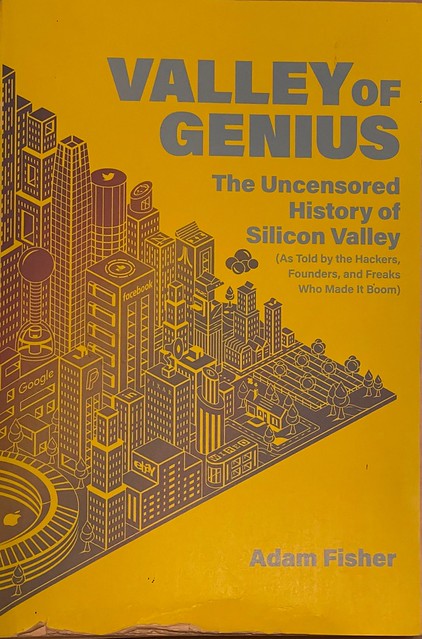
Valley of Genius by Adam Fisher promises to be ‘the uncensored history of Silicon Valley’ based on stories that founders and programmers told to each other. All of which begs the question how much is myth making and how much is true?
Valley of Genius front cover
Getting to the truth
Having worked for Silicon Valley clients and in-house at Yahoo!; I recognise that the truth doesn’t get out there and the myth making is largely self-serving. There is also a big question about how far the collective memory actually goes back.
Finally, there is the challenge of how big tech companies have got so good at controlling their story in the wider world. Whether it was keeping close tabs on journalists like Fred Vogelstein found out while working at Wired magazine, through Frank X Shaw’s reputation for robust rebuttal, funded their own media outlets like Pando Daily and eventually disintermediated the media altogether.
Adam Fisher
Adam Fisher grew up in the Bay Area and became a journalist and later editor at Wired. He left there and freelanced for a number of publications, branching out from technology writing to other areas like travel and tourism.
Style
The most noticeable thing about Valley of Genius when you get into it is that there is no prose. It is all dialogue. Fisher has cut together segments of interviews to tell a story. Sometimes it feels like people around a table, other times it feels more disjointed.
The book is described as an oral history and Fisher in his interviews describes the process as being like putting together documentary interviews.
Fisher went out and interviewed many of the great and the good of Silicon Valley to get this material, however given some of the soundbites were things I had heard before such as Steve Jobs talking about a computer as a ‘bicycle of the mind’; I was not sure if these people like to self reference or if Fisher has interspersed his interviews with archival material. Right at the end of the book, Fisher comes a list of people by chapter and where he had to source secondhand quotes from.
I’ve read a number of books on Silicon Valley over the years, so had a frame of reference and I had context, so I found Valley of Genius enjoyable to read. But for someone who is coming to the subject with just a cursory knowledge of Silicon Valley, there is benefits to having a guide. Reading the quotes without understanding the context, or having been to Silicon Valley still leaves you outside.
I honestly don’t know if Fisher would have been a good guide, so him removing his voice from the book maybe less of a loss than we might think. But a new reader to the subject matter would benefit from a guide like Michael S. Malone or the insider snark of Robert X. Cringely (aka Mark Stephens). Fisher’s book Valley of Genius is a book for insiders and future academics who might be looking at the history of Silicon Valley in the future. According to Fisher, he managed to secure the last interview that Bob Taylor ever gave. Bob Taylor played key roles in moving Silicon Valley forward while in managerial positions at NASA, ARPA and XEROX PARC. In those interview quotes are more granular aspects of things, like Nolan Bushnell having a champagne party on the grass outside the offices of a recently bankrupt competitor, or that the video card to power the monitor used in Doug Engelbart measured about 3 foot by 4 foot in size.
It’s also a very one dimensional view of Silicon Valley. It largely misses out hardware and hard innovation; which is problematic for a technology hub that is competing against China and India for that matter. There is no 3Com, Cisco or Juniper Networks. The hardware story is very much lacking, there is no Intel, AMD or Nvidia, Sun Microsystems or SGI. It is largely a consumer technology vision that writes out businesses like Oracle and Salesforce together with the characters that lead them.
Plot line
Valley of Genius ignores a good deal of early Silicon Valley, such as the the pre-war nature of Stanford, Varian, Bill Hewlett and David Packard’s garage start-up, Shockley Labs, the treacherous eight, defence contracting and the missile age.
Mother of all demos
Instead Valley of Genius history starts at 1968, when Dough Engelbart of Stanford Research Institute provides the Mother of all Demos to a mix of academics, government people from the likes of the department of defense and technologists.
Engelbart talks about his developments in 1986
He the talked about his career on the Google campus in 2007.
Atari
The story moves on to Atari and Nolan Bushnell. Bushnell was responsible for popularising computer games and arcade consoles. Bushnell was a bridge between the counter culture and Silicon Valley hustle. A few chapters later Valley of Genius also covers the acquisition and eventual (first) failure of Atari.
Here’s Bushnell being interviewed for the 50th anniversary of Atari by IGN.
Bushnell did a Google Talk a number of years ago as well.
Xerox PARC
PARC (Palo Alto Research Center) was a west coast R&D facility put together by Xerox to understand what the future of work would look like. They had already realised that it would be computerised. From PARC came modern computers, local area networks, file servers, laser printers and productivity software.
Apple
In separate chapters Valley of Genius covers Steve Jobs and Steve Wozniak’s commercialisation of phone hacking tools, and the evolution of the Apple computer line up from the Apple II to the Macintosh.
Retailer High Technology did the first adverts featuring the Apple II computer
Which was a far more budget affair than Apple’s own launch of the Machintosh.
The book goes on to cover the return of CEO Steve Jobs and the rejuvenation of Apple as a business including the iPod, iPhone and iPad through to the death of Jobs.
The hacker ethic, or hacker culture
The hacker ethic or culture, a digital equivalent of the person who tinkers away with things in a shed or garage has their own section. The section is atemporal in nature, which I can understand to a certain extent. Steve Wozniak came out of hacker culture, as have many software developers over time.
Fisher focuses on what hacker culture is, rather than what it means (both good and bad). I would recommend Steven Levy’s Hackers: Heroes of the computer revolution as a companion to this chapter in Valley of Genius. The copy I read years ago was published by Penguin, but O’Reilly have re-published it as the book this is part of myth-making and cultural norming in software development teams.
The WeLL
The WeLL was the proto-online community that is still going and features first generation digerati such as journalist Wendy Grossman, the founders of Wired magazine and cyberpunk author Bruce Sterling.
Stewart Brand talked about the founding of The WeLL during a Google hosted talk
The WeLL never scaled in the same way that we think about social networks now but it has quality discussions and is much kinder than Twitter or Reddit.
VPL
VPL was a failed start-up in the mid-1990s that set much of the expectations and tempo on VR to this day. You will most likely know it from the VR suit featured in The Lawnmower Man movie. I covered it in more depth in my metaverse discussion paper.
General Magic
Take a series of burnt out Apple employees and have them invent a predecessor of the net appliance or smartphone. That was General Magic and it was a glorious failure. Sarah Kerruish’s documentary on General Magic tells the story much better.
Wired magazine
Wired magazine gets its own chapter. it represented a way of melding culture and technology. I had read Wired before I had used the web, but it gave me a good idea of what to expect. But I don’t know if it is more important than ZDnet or other technology publishing houses. Valley of Genius goes on to celebrate Wired’s online endeavours including HotWired, Suck – a sarcastic version of Wired and Webmonkey – which taught a lot of people web development skills and probably doesn’t get the love it deserves in Valley of Genius. Mondo 2000, a rival to Wired in terms of setting the cultural zeitgeist for technologists also gets a chapter.
Pixar
Pixar as a Silicon Valley story is an accident due to two things
George Lucas’ Industrial Light & Magic being based in North California rather than in Los Angeles
Steve Jobs looking for a project post-Apple
But it didn’t necessarily move Silicon Valley forward.
Netscape
The jump to Netscape as the first commercial browser makes sense. AOL, AT&T True Experience, CompuServe and Prodigy services were all driven by businesses outside the traditional Silicon Valley space.
At the time Netscape seemed as much about the crazy public valuation of the business which was emblematic of the dot com boom, as it was about the software that would kick off the open web. These kind of valuations re-emerged with businesses like Uber and WeWork.
eBay
eBay was the standout e-commerce play for Silicon Valley. Amazon was a Seattle company and so was an outsider in a similar way that Microsoft always had been. eBay was also founded by an ex-General Magic employee and so was part of Silicon Valley’s version of ‘Rock family trees‘. We see this even now with the ‘PayPal mafia’.
Google
Google changed the web experience that Silicon Valley had pioneered via Yahoo! and Excite. Brin and Page became a key point of focus in Valley of Genius. However, this ignores the complexity both around search and the development of foundational web technologies that other companies produced. If you are interested about the nature and history of Google, Steven Levy’s In The Plex is probably a better option to read.
Google’s move to pay per click advertising gets its own chapter that greatly reduces the complexity of the real story.
Napster
Napster was the poster child of market value destruction and disruption that predated Uber and its ilk.
Dot bomb
The dot com boom can be charted from the last quarter of 1995 and reached its nadir in the last quarter of 2002.
Eric Steiner tells his tale as the CEO of Inktomi through the dot com boom and bust
Valley of Genius covers it in terms of its sociological impact on the Bay Area, as much as its economic impact. The reality is more complex, even the dot.com label attached to it is a misnomer. It encompassed telecoms, networking hardware, datacenters and more in terms of its impact rather than just e-businesses.
Facebook
While Facebook was an east coast invention, the movement of the company and its CEO Mark Zuckerberg west saw a cultural change in Silicon Valley that took it down a much darker patch. By comparison Twitter in its start-up phase looked more like Atari in terms of its counterculture influence.
Future gazing
At the end of the book there is a section on future gazing, which became what made Silicon Valley great. The business model was prioritised over innovation. Veteran journalist John Markoff even talked about how Salesforce had moved to a ‘vertical campus’ model with Salesforce tower. Which is how every other business in places like Singapore, Hong Kong and even Wall Street work anyway.
There was a singular lack of reflection on challenges ahead or areas of introspection by the people telling these stories. If anything, that was what concerned me the most about the book. Innovation is at a technological, scientific and socio-cultural cross-roads and the inhabitants of the Valley of Genius apparently doesn’t have a clue. More on the book here. You can find more of my book reviews here.
Extra content – Valley of Genius promotional tour interviews
Panel hosted by Adam Fisher to promote the Valley of Genius book
Leo LePort interviews Fisher on Valley of Genius at the time of its launch.
As cybercrime has become more common there has been a move towards the incidents becoming uninsurable hacks in nature. 2022 looks like a watershed moment in the move to uninsurable hacks.
Lloyd’s of London defends cyber insurance exclusion for state-backed attacks | Financial Times – Lloyds of London were looking at state backed exclusions. The parallel between a state backed cyber attack and and an act of war have clear parallels from an insurance point of view. An act of war would be exempt from most insurance policy cover. A state backed cyber attack then becomes an uninsurable attack. However, while a business could expect government retribution and likely support in an act of war, the uninsurable hack exists in a grey zone just below the threshold of government response.
The closest thing that has happened was criminal charges filed against Park Jin Hyok for the Wannacry ransomware that affected the NHS, Bangladesh Central Bank theft and the Sony Pictures hack. Russia has attempted attacks against at an oil refinery in at least one NATO country likely due to the material support that Ukraine has been receiving. NATO isn’t in a state of war with Russia and there are likely to be few repercussions and deterrents. Chinese backed hackers dismantled Nortel and helped drive the business into bankruptcy. These would all be uninsurable hacks as the risk is unmanageable in nature.
North Korea presents a particular type of risk for uninsurable hacks, using cyber crime to finance its sanction hit economy.
Companies like NSO and service companies based in India have democratised sophisticated intrusions for legal firms and business purposes. Widening the risk even further and creating a shadow economy of such scale that it creates uninsurable hacks by his own nature. Some of these law firms may even work with insurance companies in other areas; indicating the kind of perverse business incentives that drive these uninsurable hacks.
The final aspect ushering in uninsurable hacks is one of scale. Due to the economics of digital business – criminal or otherwise; they scale in a non-linear fashion. Insurance insiders see these as uninsurable attacks as they are ‘civilisation level’ attacks. Uninsurable hacks also come from an inability of the insurance industry to absorb pay-outs on a massive scale. But what can be done about uninsurable hacks since Pandora’s box has been opened?
Business
This story how Balkan organised crime groups completely compromised MSC is stunning for its audacity and impact.
Mao and markets – great talk on the permeable membrane between communist thought and capitalism.
China Makes Moves in Middle East After Biden’s Frosty Reception – An eagerness to offer “Chinese wisdom” to the Middle East’s problems is symbolic of Xi’s decade in power, during which time he has thrown off the humble shackles of his predecessors to raise his country’s stature on the international stage. Welcome or not, his offer signals to China’s domestic audience Beijing’s growing influence abroad and its capacity to advise others on successful governance. However, China’s exact role in realizing its peacekeeping recipe remains unclear. A frequent critic of U.S. military intervention in the Middle East and elsewhere, Beijing knows all too well the political, economic and military costs of becoming involved. Its willingness to do so is also a matter of constant debate. “China is cautiously increasing its presence in the Middle East, driven more by Middle Eastern states than its own ambitions,” said Jon Alterman, director of the Middle East Program at the Center for Strategic and International Studies. “China sees the Middle East as volatile and an area still dominated by the United States. They are cautious about getting sucked into the region’s conflicts.”
Mr Tape used custom modified reel-to-reel tape recorders. The reason why he can handle the reels is that its actually the tape capstans rather than the reels that are powered on a tape machine. So very different to how a cassette tape recorder works.
Henry Cavill on his love for Warhammer 40K. He is seriously invested in the universe.
Making Products in America Means Stuff Will Be More Expensive | Business Insider – cost is less clear when one takes into account carbon tax. It is also worthwhile thinking about how this could drive an improvement in product quality as well as production moves away from China. Improved quality could help reduce consumption and improve environmental impact
Ethics
The Camp Fix: Infrastructural Power and the “Re-education Labour Regime” in Turkic Muslim Industrial Parks in North-west China | The China Quarterly | Cambridge Core – Drawing on worker interviews, government documents, industry materials and images this article shows that for-profit public-private industrial parks have been built as part of a “camp fix” mechanism centred on detaining and “re-educating” Uyghurs and Kazakhs at the periphery of the nation. It argues that these industrial parks concentrate forms of repressive assistance and “dormitory labour regimes” that operate at other frontiers of Chinese state power and point these strategies of disempowerment towards a seemingly permanent, ethno-racialized underclass, producing a “re-education labour regime.” It further argues that the material infrastructures of these surveiled and policed spaces themselves are productive in enforcing the goals of the “camp fix”: the creation of high-quality, underpaid, docile and non-religious Muslim workers who are controlled through the built environment – this is the environment that large corporates have used in their supply chain. Companies such as VW Group and Anta (aka Salomon, Arc’teryx etc)
Finance
Scott Galloway breaks down a number of financial stories from 2022.
Visual Framing: The Use of COVID-19 in the Mobilization of Hong Kong Protest | The China Quarterly | Cambridge Core – messages and images posted on Lennon Walls between January and April 2020 have used COVID-19 to extend public expression of sentiment on the debates around the Hong Kong government and to further mobilize a sense of Hong Kong identity against China. The findings contribute to the understandings of how the cultural politics surrounding the pandemic became a collective action frame in the mobilization of a localized Hong Kong political identity against the Hong Kong and Chinese governments – this linking of COVID-19 to political discourse makes public health communications much more complex
Hong Kong property: developers mourn demise of ‘coffin homes’ boom | Financial Times – Analysts, including Goldman Sachs, expect Hong Kong home prices to drop by 30 per cent by the end of next year. Shares of CK Asset and Henderson Land have fallen about a tenth in the past six months. The latter trades at 10 times forward earnings, which is more than 40 per cent lower than even 2014 levels — during the last property market decline — reflecting the dire outlook. – add into this also the amount of Hong Kongers leaving the city as well
In Indonesia, ‘all-gendered’ priests are fighting to keep their traditions alive | South China Morning Post – With fewer than 40 Bissu remaining in areas across South Sulawesi, a community which once held divine status is now fighting against extinction. Many Bissu were accused of violating Islamic principles and faced persecution, but some are trying to preserve their heritage by performing cultural, shaman-like roles – the implicit influence of gulf Arab style muslim beliefs is not only about extremism but presenting a dead orthodoxy that will make Indonesia as unattractive as Malaysia has become
Read Zuckerberg’s 2019 Deposition on Facebook User Data | Business Insider – A 2017 report in The New York Times had said Cambridge Analytica previously claimed it could use data to glean voters’ inclinations. Zuckerberg appeared to address those types of news reports in his testimony to SEC regulators, saying it piqued his interest about how the company might have been using Facebook at the time. “I kind of remember having this reaction to this, which is, if they are using our systems for advertising, then I’m curious to understand if they’re actually doing anything novel that matches the rhetoric that they have, or if they’re just kind of puffing up rhetoric around what would be a relatively standard use of our ad systems,” he told the SEC in 2019, according to the newly released testimony. – to be fair Zuckerberg’s reaction reminds me of a lot of discussions that I was having with peers about Cambridge Analytica at the time
How SpaceX’s Starlink terminals first arrived in Ukraine | Quartz – Weeks before Russia invaded Ukraine, the US began scrambling to find satellite communications equipment that could keep the Ukrainian government connected to the rest of the world, new documents reveal. Those efforts resulted in thousands of satellite-antenna terminals that connect to SpaceX’s Starlink broadband internet network being sent to Ukraine. They have proven vital to Ukraine’s war effort, but became a source of controversy for both SpaceX and the US over the service’s cost, and who is paying for it. Government contractor DAI began searching for the right equipment as early as Feb. 11, according to documents Quartz obtained through a Freedom of Information Act request. Russia invaded Ukraine on Feb. 24, shocking many, but not the US government, which sounded the alarm ahead of the invasion
TikTok admits tracking FT journalist in leaks investigation | Financial Times – ByteDance, the Chinese owner of viral social media platform TikTok, has admitted it inappropriately obtained the data of users, including a Financial Times journalist, in order to analyse their location as part of an internal leaks investigation. Over the summer, four employees on the ByteDance internal audit team looked into the sharing of internal information to journalists. Two members of staff in the US and two in China gained access to the IP addresses and other personal data of FT journalist Cristina Criddle, to work out if she was in the proximity of any ByteDance employees
Software
How Amazon Uses AI To Automate Work In Its Corporate Headquarters – I was struck by how deeply artificial intelligence was already ingrained in their cultures. With in-house AI research labs that rank among the globe’s best, the tech giants were automating wide swaths of their operations and changing the nature of work within their companies. This commitment to AI in the workplace is newly relevant as powerful tools like Dall-E, ChatGPT, and their ilk make their way into the public’s hands. As access to this powerful technology spreads, nearly all companies will soon have tools like those I saw inside Amazon, Apple, Facebook, Google, and Microsoft. So work inside our companies will change as well
Asianometry does a run down of Sun Microsystems history. A few things. When I started working agency side, this was what our client websites were hosted on. Sun had a partnership with Netscape to have a great software stack. Oracle’s hardware business is the old Sun Microsystems business. Cisco routers and other manufacturers as well were basically a Sun motherboard and a raft of ethernet ports together with a look-up database that handled the routing.
Vietnam loses 25 ancient books related to culture and sovereign territory — Radio Free Asia – one of which is “relevant to Vietnam’s sovereign territory,” according to the deputy head of the literature department, Nguyen Xuan Dien. Posting on his Facebook page on Tuesday, a day after the institute’s annual meeting, Dien said the books were “extremely important for national culture.”The institute said Wednesday the books were among 35,000 volumes it had cataloged and preserved at the request of the Vietnam Academy of Social Sciences When it inspected the inventory in April 2020, for the first time in over 10 years, it discovered that 29 books were missing. Four of the books were later found on the wrong shelves. Among the books still unaccounted for are four written by scientist Le Quy Don and two books which record the precise geography, boundaries and borders related to Vietnam’s sovereign territory, according to Dien. Those two volumes could help substantiate Vietnam’s territorial claims in the South China Sea – I would guess that these books have been incinerated in China, as it helps China’s territorial claims in the South China Sea and debilitates Vietnam’s rival claims