Category: technology | 技術 | 기술 | テクノロジー

It’s hard to explain to someone who didn’t live through it how transformation technology has been. When I was a child a computer was something mysterious. My Dad has managed to work his way up from the shop floor of the shipyard where he worked and into the planning office.

One evening he broad home some computer paper. I was fascinated by the the way the paper hinged on perforations and had tear off side edges that allowed it to be pulled through the printer with plastic sprockets connecting through holes in the paper.

My Dad used to compile and print off work orders using an ICL mainframe computer that was timeshared by all the shipyards that were part of British Shipbuilders.

I used the paper for years for notes and my childhood drawings. It didn’t make me a computer whiz. I never had a computer when I was at school. My school didn’t have a computer lab. I got to use Windows machines a few times in a regional computer labs. I still use what I learned in Excel spreadsheets now.

My experience with computers started with work and eventually bought my own secondhand Mac. Cut and paste completely changed the way I wrote. I got to use internal email working for Corning and internet connectivity when I went to university. One of my friends had a CompuServe account and I was there when he first met his Mexican wife on an online chatroom, years before Tinder.

Leaving college I set up a Yahoo! email address. I only needed to check my email address once a week, which was fortunate as internet access was expensive. I used to go to Liverpool’s cyber cafe with a friend every Saturday and showed him how to use the internet. I would bring any messages that I needed to send pre-written on a floppy disk that also held my CV.

That is a world away from the technology we enjoy now, where we are enveloped by smartphones and constant connectivity. In some ways the rate of change feels as if it has slowed down compared to the last few decades.

  • Habbo + more things

    Growing up Habbo: My so-called life in the first social network for teens | The Kernel – gen-y journeys in computing. Memories of Habbo Hotel as an online experience and social network. Habbo Hotel gets forgotten in its role as a social network.

    Chinese luxury shoppers increasingly turning online: KPMG | Shanghai Daily – interesting move to online purchases for luxury products

    NTT Docomo planning to increase handset prices – so it can provide discounts to users who use less data. Which begs the question is there a ‘peak data’ point’, a limit at which phone services reach in terms of consumer desire for mobile computing versus phone services? More Japan related content here

    Intel Raises Tech Worries About Sales in China and the Cloud | WSJ – (paywall)

    Jawbone Raises $165 Million at Half Its Last Valuation – The New York Times – Jawbone, the once-hot wearable technology start-up, said on Friday that it had raised $165 million in funding at a valuation of $1.5 billion, or roughly half the amount that the company was valued at as recently as 2014, continuing a burgeoning trend of start-ups raising money at lower values than before. (Paywall)

    Apple To Start Charging For iTunes Radio – BuzzFeed News – Apple would have to pay me to listen to Zane Lowe, not the other way around

    Japan business leaders urge real globalisation – FT.com – Central to a globalised psychology, he says, is an acceptance that you are in business for the customers, something missing when Japan first started spreading its sales forces across the globe

    Tackling the Tiers in China – Anyone who has any interest in China will already know that hundreds of millions of Chinese people are entering the middle classes and that hitherto unknown cities in the lower tiers

    Nest Thermostat Glitch Leaves Users in the Cold – The New York Times – dumb is good. Trying to buy a dumb TV at the moment
  • Cellular network surveillance + more

    The Dragnet | The Verge – or how cellular network surveillance was unmasked. A US criminal case into online returns fraud provides the reader with information about law enforcement usage of cellular network surveillance.  More wireless related content here.

    New Technologies and Mixed Use Convergence by Applin & Fischer (University of Kent) – interesting paper on how technology forces an alteration of consumer behaviours called ‘covert agencies’ in this paper (PDF)

    Worldwide smart home device shipments to nearly double in 2016, says ABI Research | Digitises – (paywall)

    Chinese citizens are boycotting search engine Baidu—and praying for Google to come back – Quartz – Baidu quickly announced Tuesday (Jan. 12) (link in Chinese) it had replaced the owner of the “hemophilia” post bar with a representative from an NGO working on the disease, but also seemed to confirm it has been selling these positions for profit, saying it would “stop commercialized operation” of all illness-related post bars, and invite non-profit organizations to run them. A Baidu spokesman told Quartz he couldn’t say what percentage of Baidu’s 19 million post bar groups were run by a commercial partner. – Native social advertising risks have been particularly challenging in healthcare. Baidu’s service is more than search the way we understand it and includes ‘expert’ Q&A as well. Imagine Quora if its was trusted and reliable in nature.

    Detect and Disable an Airbnb’s Hidden Wi-Fi Cameras With This Script – Lifehacker – waiting until someone builds this into a gadget; I think that there is a market for privacy related gadgetry.

    How Could The Winds of Winter Be Published In Only Three Months? | Tor.com – interesting breakdown of book publishing work flow

    Shell of a mystery new Huawei leaked, rumoured to run SD616 – Gizchina.com – interesting focus on product design to try and achieve a premium position versus similar hardware. There needs to be a corresponding focus on software and experience to make it work

  • Cool tools & things that made last week

    Kevin Kelly’s Cool Tools website has a podcast series, this episode on great tips

    Cool Tools is a direct descendant of The Whole Earth catalogue. Kelly started his career helping Stewart Brand edit the last few editions of the Whole Earth catalogue. He was then an editor for follow on projects including the Whole Earth Review and The WELL (Whole Earth eLectronic Link). More Kevin Kelly related stuff here.

    For the right content Chinese audiences will watch longer form branded content, Pepsi’s Bring Happiness Home campaigns are designed to tap into Lunar New Year celebrations and this February ushers in the year of the monkey. This is a beautifully made short film about the different portrayals of the Monkey King over time.

    There is a new Monkey King film due out with an awesome looking trailer

    The X-Files has a new teaser out for the six-part TV series reboot, more over at a microsite which seems to be strangely appropriate. I enjoyed the original series just at the start of my internet usage at college and watched series one of The X Files on a Casio TV with a postage stamp sized LCD screen.

    The campaign: Zwitsal is a well-known baby brand in the Netherlands. For many parents and carers, it has associations with the first formative years of a baby’s life.

    The aim was to use Zwitsal’s famous fragrance and team it with Robijn laundry (both cleaners and conditioners) to produce a unique highly-emotive new product that would extend the reach of both brands.

    Nostalgia and the power of smell was the focus of the brand campaign which used bloggers and Facebook to engage and harness the sharing power of socially engaged mothers.

    The results: The campaign, which ran over ten months, saw over 3.5 million people engage with it on Facebook (average engagement rate 8.4%), 137,752 YouTube video views, 23,861 online views and an 11% uplift in sales.

  • Cinema building obligations

    Hong Kong Looking at Cinema Building Obligations | Variety – When the British colonial government was building new towns in Kowloon and the New Territories it operated policies that specified the minimum number of cinema screens that should be built per head of population. The Hong Kong government are looking to revisit cinema building obligations because retail rental prices for cinemas in Hong Kong have become cripplingly expensive

    Tangible Media Group | Biologic project – really interesting project, the question is how to keep the functionality if the garment is washed

    Ryanair and easyJet eye work with rivals – FT.com – working as feeder airlines for long haul flights. The big issue would be fares once baggage charges had been incorporated; the discount will be negligible compared to legacy airlines like BA or Swiss(paywall)

    PGP-encrypted Blackberrys aren’t immune to being cracked | TheNextWeb – not really terribly surprising. It is remarkable that PGP has been so robust for so long

    Snapchat’s Daily Mobile Video Views Said to Rival Facebook’s – Bloomberg Business – so 7 Billion clips delivered for up to 100 million users per day. That’s a lot of video, but a clip delivery doesn’t necessarily mean a view by a human

    Qualcomm Asks U.S. Court for Documents in Korean Probe – WSJ – Qualcomm must be crapping themselves

    Japan’s Newest Adults Pessimistic About Nation’s Future – The Macromill study found that Line continues to be the most popular social network service among 20-year-olds, with about 90% of them using it. Twitter followed a distant second with a little more than 70% of them saying they use it. The study found the overall percentage of people using social media was dropping, with Facebook and Mixi seeing sharp declines. – more Japan related content here.

    Official Grindr.com Blog | Exciting announcement: Grindr takes investment from Beijing Kunlun – the irony is that Grindr has a better chance of tapping the Chinese market than Facebook does

  • PrivaTegrity: the flawed model of distributed keys

    Dave Chaum’s PrivaTegrity – an idea to to try and balance between state actors demand for internet sovereignty and the defacto end of citizen privacy. Whilst also addressing the need to deal with emotive causes such as terrorism, paedophile rings and organised crime got a lot of attention from Wired magazine.

    Backdoors are considered problematic by privacy advocates and seem to be a panacea for governments who all want unrestricted access.
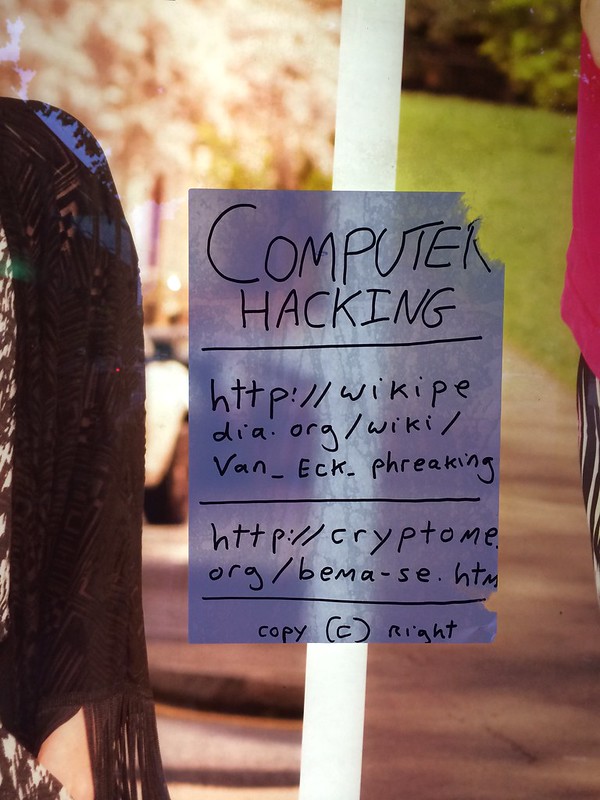
    Yesterday evening on a bus stop in Bow
    The principle behind PrivaTegrity is that there would be a backdoor, but the back door could only be opened with a nine-part key. The parts would be distributed internationally to try and reduce the ability of a single state actor to force access.

    However it has a number of flaws to it:

    • It assumes that bad people will use a  cryptographic system with a known backdoor. They won’t they will look elsewhere for the technology
    • It has a known backdoor, there is no guarantee that it can’t be opened in a way that the developers hadn’t thought of
    • Nine people will decide what’s evil
    • If you’re a state actor or a coalition of state actors, you know that you have nine targets to go after in order to obtain access by hook-or-by-crook. It was only Edward Snowden who showed us how extraordinarily powerful companies where bent to the will of the US government. The UK government is about to grant itself extra-territorial legal powers to compel access. There is no reason why a form of extra-ordinary rendition couldn’t be used to compel access, rather like Sauron in The Lord of the Rings bending the ring bearers to his will. Think of it as Operation Neptune Spear meets a Dungeons & Dragon quest held at a black site. Even if the US wouldn’t consider it a viable option, who is to say that other countries with capability wouldn’t do it. That group of countries with sufficient capability would likely include: UK, Kingdom of Saudi Arabia, United Arab Emirates, People’s Republic of China, Russian Federation, France, India, Pakistan, Turkey, Israel. All that these countries would need is intent

    More information
    The Father of Online Anonymity Has a Plan to End the Crypto War | WIRED
    Privategrity

    More privacy related content here.