Category: wireless | 無線 |무선 네트워크 | 無線

This blog came out of the crater of the dot com bust and wireless growth. Wi-Fi was transforming the way we used the internet at home. I used to have my Mac next to my router on top of a cupboard that contained the house fuse panel and the telephone line. Many people had an internet room and used a desktop computer like a Mac Mini or an all-in-one computer like an iMac. Often this would be in the ‘den’ or the ‘man cave’. Going on the internet to email, send instant messages or surf the internet was something you did with intent.

Wi-Fi arrived alongside broadband connections and the dot com boom. Wi-Fi capable computers came in at a relatively low price point with the first Apple iBook. I had the second generation design at the end of 2001 and using the internet changed. Free Wi-Fi became a way to attract people to use a coffee shop, as a freelancer it affected where I did meetings and how I worked.

I was travelling more for work at the time. While I preferred the reliability of an ethernet connection, Wi-Fi would meet my needs just as well. UMTS or 3G wireless data plans were still relatively expensive and slow. I would eventually send low resolution pictures to Flickr and even write a blog post or two. But most of the time I used it to clear my email box, or use Google Maps if I was desperate.

4G wireless services, started to make mobile data a bit more useful, even if the telephony wasn’t great


  • LINE tries to crack US + more things

    LINE Tries to Crack US Messaging… With a Times Square Store for Plush Toys? – this isn’t about LINE trying to crack the US market its about reaching an international audience for Brown and Co. Think of LINE as a ‘Sanrio’ analogue with a technology company attached when it comes to markets like the US. LINE is unique in this regard, combining both media assets and technology and that why LINE tries to crack US isn’t as crazy  Think about the amount of Asian tourist footfall…

    China’s newest trend: mini karaoke booths at shopping malls | South China Morning Post – Li said that at traditional karaoke bars, users have to reserve rooms in advance and there were usually extra charges such as service charge and for beverages and fruit served. – interesting because it moves KTV into a more family orientated area with no room for the ‘added services’ including drink and company at the shadier end of the sector

    Ad Tech Firm Criteo to Launch Data Cooperative to Help Retailers Take On Amazon – WSJ – a combination of actors here. Criteo’s business is threatened by the all encompassing ad tech stacks of Google and Facebook – who between account for 85% of online advertising growth. The main insurgent online adverting provider is Amazon… E-tailers in many product categories are now dealing with Amazon as the number one product search engine and e-tailer. This won’t address the challenge of breaking consumer habit of ‘let’s hit Amazon and eBay first to see if I can get it’

    Under Armour’s sneaker business has cratered | Quartz – not terribly surprised – when you think about how their basketball business relied on Curry, their football boots have entered a hyper competitive market and the brands historic relationships with college sports

    WeChat Vs. LINE Battle Of the Merchadise Stores | China Channel – really interesting battle LINE sometimes looks as much like Sanrio as a technology firm, its character Brown is popular merchandise

    The UK home secretary is wrong: ‘real people’ need end-to-end encryption | TheNextWeb – probably won’t help digital start-ups either

    UK home secretary Amber Rudd says ‘real people’ don’t need end-to-end encryption | BusinessInsider – what would Amber Rudd know about ‘real’ people

    Shanghai to build ‘brand economy’ | Shanghai Daily – really interesting. In general China isn’t the most marketing orientated business culture so having them talk about brand rejuvenation and brand building is a step change. Shanghai makes the most sense as historically it was the commercial centre of China. In the longer term this is a big move against global brands currently there. There has already been a move towards local FMCG despite past security scares, this seems to consolidate that move further

    Fox Will Bring 6-Second Ads To TV During Teen Choice Awards | Media – AdAge – it will be interesting to see the efficacy of these ads as will have implications for online brand advertising moving forwards (paywall)

    Google’s Push for Dominance Brings Big Change to YouTube | Digital – AdAge – working on media partnerships (paywall)

    Tesla Model 3 Buzz Belies Tiny Electric Vehicle Market | CMO Strategy – AdAge – (paywall)

    Fendi taps Hong Kong millennial consumers by featuring Taeyang and Asian hip-hop acts | Style Magazine | South China Morning Post – interesting that Fendi is further blurring the lines between streetwear and luxury

    LVMH Tests the Notion That Brand Trumps Traffic in China – Bloomberg – going it alone in e-commerce in China rather than being on Jd.com or Alibaba
  • Vic Gundotra + more things

    Vic Gundotra – The end of the DSLR for most people has already… – ex Googler Vic Gundotra endorses the iPhone as a camera phone for structural reasons in the Android community, of course you could always use a third party camera software instead. What’s more interesting is the implications around system-level innovation and hardware support

    Summer of Samsung: A Corruption Scandal, a Political Firestorm—and a Record Profit – Bloomberg – interesting profile of Samsung. Interesting that they don’t realise Huawei is the big bad wolf yet

    The myths of the digital native and the multitasker – ScienceDirect – fits in with what I’ve seen in terms of empirical evidence, millennials are just as bad at technology as the rest of us (paywall)

    Russia Bans’Uncensored’ VPNs, Proxies and TOR | Torrent Freak – interesting implications for China. I wonder how they would achieve all this?

    Announcing Ghost 1.0 – possible WordPress replacement or niche player?

    The ‘real’ reasons manufacturing returning to US – Yahoo! Finance – it depends how you measure costs. Automation requires more capital, upfront costs and benefits big production runs in certain industries. Automation more limited in batch contract manufacturing. Still barriers: ecosystems of suppliers, expertise, skills and access to critical raw materials (rare earth metals, cobalt and coltran). A crisis in shipping (such as the collapse of Hanjin Shipping) will hit both international long supply chains and Chinese finished products equally hard

    Chinese Fintechs Use Big Data To Give Credit Scores To The ‘Unscorable’ – I wonder how this intersects with the PRC govt social scores?

    Turn Off, Drop Out: Why Young Chinese Are Abandoning Ambition – interesting for the subtle differences between this and gen-x style slackers

    Google Adds Autoplay Video to Search Results Page | The SEM Post – this will be terribly annoying

    eBay Powers Searching and Shopping with Images on Mobile Devices – eBay Inc – interesting move turning every shop into a potential showroom for the eBay marketplace

    P&G cuts more than $100 million in largely ineffective digital advertising | WSJ – (paywall)

    Trending posts — Steemit – paid social network. Apparently digital payments of some sort are given per post. They are held in a blockchain database. I won’t lie, I’m sceptical to say the least

    Hong Kong’s Lee Kum Kee Group to buy London’s ‘Walkie Talkie’ building in historic £1.3b deal | South China Morning Post – interesting that Hong Kong investors think that central London office property is cheap enough to make big deals like this. I think they might be disappointed at least from the short to medium term. It could be a play to gain a UK foothold well in advance of Hong Kong’s final assimilation by the motherland

    Inside LeEco’s spectacular fall from grace | Engadget – I was reminded of an old client Enron, when I started reading about LeEco. Like Enron, LeEco started off in one business (video streaming) and then exploded into several other sectors at once before collapsing under the weight of its ambition. Like Enron, I was left feeling that LeEco just didn’t make sense, except in the mind of a megalomaniac with wicked Excel skills

  • Of time and networks

    Time and networks are intertwined and have been forever. Communities have marked time in different ways. It used to be marked by the bells of a church or the clock on a local factory. At that time, it didn’t matter that the clock told the precise time, but that it was consistent. This meant that different ‘time zones’ existed in areas separated by little distance.

    The amount of reference time pieces expanded as mechanical clocks were installed in churches, farm estates and early factories. In the case of factories the change of shift was often punctuated by the blast of a fog horn or a steam powered whistle.

    I can remember this being the case even during my early childhood at the nearby Unilever factory. The change of shift signal marked my walk to infant school.

    Over the centuries canals sprang up throughout the country as the first mass transport link, facilitating the movement of heavy goods such as coal and iron ore in a more efficient manner. Canals were transformative, but the boats still only moved at the speed of the horse. Railways broke the ‘horse speed’ barrier.

    This was transformative because it suddenly shone a light on inconsistent time keeping across the country. Railway timetables couldn’t incorporate all the variations in time zones between stations, so it became the arbiter of accurate time.

    Over time radio and television played their part, audiences could set their watch by the start of key news programmes, for instance the time pips in the run into BBC Radio 4’s today programme or the Angelus chimes on RTE Radio  1.

    The telephone came into play when looking for an exact time (to reset a watch or alarm clock) outside the broadcast schedule.

    The popularity of mobile phone networks didn’t have as much of an impact as one would have thought. NITZ (Network Identity and Time Zone) was an optional standard for GSM networks. It has an accuracy in the order of minutes. A competing standard on CDMA 2000 networks used GPS enabled time codes that were far more accurate.

    Modern timekeeping for the smartphone toting average person goes back to NTP; one of the earliest protocols in for the early internet that was created some time before 1985.

    1

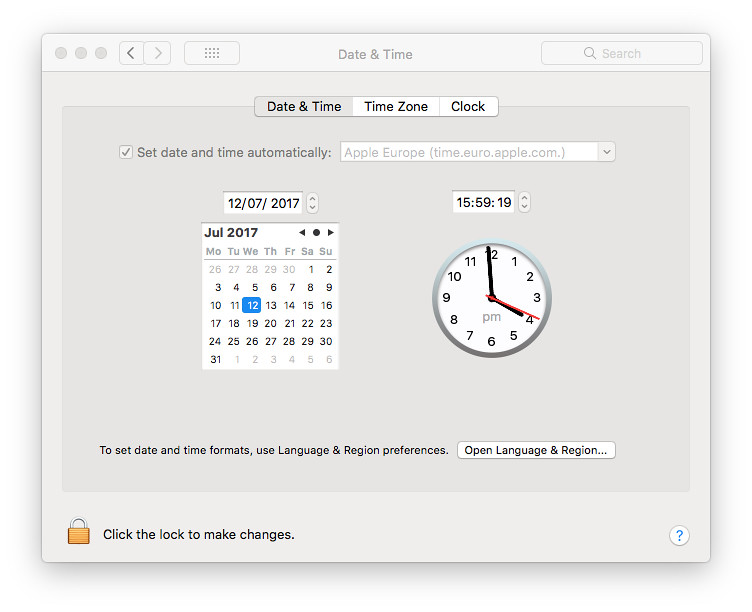
    Back in 2001 when I installed the earliest version of macOS (then known as OSX 10.0 ‘Cheetah’) the date and time settings made reference to Apple owned NTP servers that were used to calibrate time on the computer. This infrastructure has since provided time to Apple’s other computing devices such as the iPhone and the and the iPad.

    We are are now living on the same time. Time synchronisation happens seamlessly. We tend to only realise it when there is a problem.

    SaveSave

  • My decade of the iPhone

    A decade of the iPhone – last week has seen people looking back at the original launch. At the time, I was working an agency that looked after the Microsoft business. I used a Mac, a Nokia smartphone and a Samsung dual SIM feature phone.  At the time I had an Apple hosted email address for six years by then, so I was secure within the Apple eco-system. I accessed my email via IMAP on both my first generation MacBook Pro and the Nokia smartphone.

    Nokia had supported IMAP email for a few years by then. There were instant messaging clients available to download. Nokia did have cryptographic signatures on app downloads, but you found them on the web rather than within an app store.

    At the time BlackBerry was mostly a business device, though BlackBerry messaging seemed to take off in tandem with the rise of the iPhone.  The Palm Treo didn’t support IMAP in its native email application, instead it was reliant on a New Zealand based software developer and their paid for app SnapperMail.

    Microsoft had managed to make inroads with some business users, both Motorola and Samsung made reasonable looking devices based on Windows.

    The iPhone launch went off with the characteristic flair you would expect from Steve Jobs. It was a nice looking handset. It reminded me of Palm Vx that I used to have, but with built in wireless. Whilst the Vx had a stylus, I had used my fingers to press icons and write Graffiti to input text. It looked good, but it wasn’t the bolt from the blue in the way that others had experienced it.

    But in order to do work on the Palm, I had a foldable keyboard that sat in my pocket.

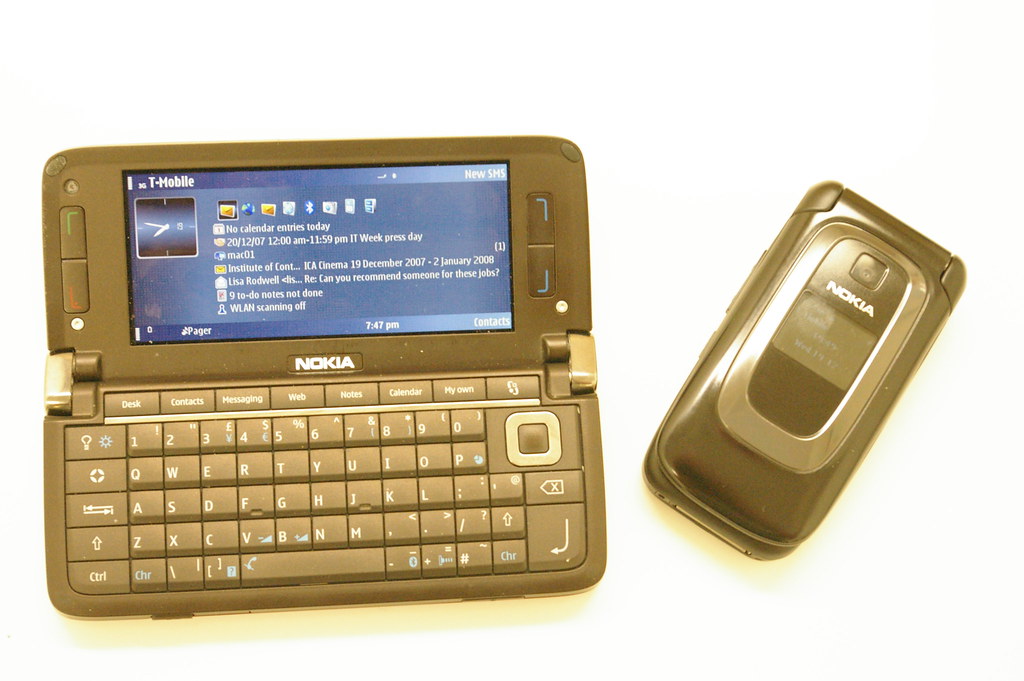
    By the time that the iPhone launched, I was using a developer version of the Nokia E90 which had an 800 pixel wide screen and a full keyboard in a compact package.

    Nokia e90 and 6085

    I had Wi-Fi, 3 and 3.5G cellular wireless. I could exchange files quickly with others over Bluetooth – at the time cellular data was expensive so being able to exchange things over Bluetooth was valuable. QuickOffice software allowed me to review work documents, a calendar that worked with my Mac and a contacts app.  There was GPS and Nokia Maps. I had a couple of days usage on a battery.

    By comparison when the iPhone launched it had:

    • GSM and GPRS only – which meant that wireless connectivity was slower
    • Wi-Fi
    • Bluetooth (but only for headphone support)
    • No battery hatch – which was unheard of in phones (but was common place in PDAs
    • No room for a SD, miniSD or microSD card – a step away from the norm. I knew people who migrated photos, message history and contacts from one phone to another via an SD card of some type

    I wasn’t Apple’s core target market at the time, Steve Jobs used to have a RAZR handset.

    As the software was demoed some things became apparent:

    • One of the key features at the time was visual voicemail. This allowed you to access your voicemails in a non-linear order. This required deep integration with the carrier. In the end this feature hasn’t been adopted by all carriers that support the iPhone. I still don’t enjoy that feature. I was atypical at the time as I had a SIM only contact with T-Mobile (now EE), but it was seemed obvious that Apple would pick carrier partners carefully
    • There was no software developer kit, instead Apple encouraged developers to build web services for the iPhone’s diminutive screen. Even on today’s networks that approach is hit-and-miss
    • The iPhone didn’t support Flash or Flash Lite. It is hard to explain how much web functionality and content was made in Adobe Flash format at the time. By comparison Nokia did support Flash, so you could enjoy a fuller web experience
    • The virtual keyboard was a poor substitute for Palm’s Graffiti or a hardware keyboard – which was the primary reason that BlackBerry users held out for such a long time
    • The device was expensive. I was used to paying for my device but wasn’t used to paying for one AND being tied into an expensive two year contract
    • Once iPhones hit the street, I was shocked at the battery life of the device. It wouldn’t last a work day, which was far inferior to Nokia

    I eventually moved to the Apple iPhone with the 3GS. Nokia’s achilles’ heel had been its address book which would brick when you synched over a 1,000 contacts into it.

    By comparison Apple’s contacts application just as well as Palm’s had before it. Despite the app store, many apps that I relied upon like CityTime, MetrO and the Opera browser took their time to get on the iPhone platform. Palm already was obviously in trouble, BlackBerry had never impressed me and Windows phone still wasn’t a serious option. Android would have required me to move my contacts, email and calendar over to Google – which wasn’t going to happen.

    SaveSave

  • North Korea + more news

    North Korea

    North Korean Restaurants in China Close Amid Regional Tensions | Radio Free Asia – quality of food or China – North Korea politics? While both North Korea and China claim a close political kinship

    Business

    Nestle Targeted by Dan Loeb in Activist’s Biggest-Ever Bet – Bloomberg – Third Point up to its usual tricks, or something more?

    Consumer behaviour

    We Analyzed 100 Million Headlines. Here’s What We Learned (New Research) | Buzzsumo – probably the most depressing post on data driven content strategy in a while. (Rocks with head in hands whilst having no respect for audience)

    Culture

    The Vault Of The Atomic Space Age – amazing 20th century tech photography

    Design

    The Beautiful, Impossible Dream of a Simpler Smartphone | WIREDThe Apple Watch’s purpose (at least at first) was to quieten the demands of the iPhone

    FMCG

    Coffee Ripples – Home of the Ripple Maker – there is something soul destroying about this product

    Hong Kong

    Activist investor calls Hong Kong market rout | Reuters – network of mainland business people running a ‘pump and dump’ scheme on Hong Kong small caps market

    Ideas

    The iPhone Was Inevitable – The Atlantic – interesting how much testing of concepts went into the iPhone. It also emphasises the idea of the technium

    Legal

    Ends, Means, and Antitrust – Stratechery by Ben Thompson – worthwhile reading with regards Google’s EU antitrust trouble

    Luxury

    London Luxury Home Values Fall 6.8% in Year Since Brexit Vote – Bloomberg – by the looks of this the luxury home market is splitting. The track funded by banking and related professions is in decline. But luxury homes funded by inward foreign property investment seems to have suffered less, if at all

    Media

    Facebook video ad viewability rates are as low as 20 percent, agencies say | Digiday

    Security

    Internal Memo: Sir Martin Assures WPP Staff That Everything Is Fine in Wake of Cyberattack | AdWeek – WPP’s love of Windows left so many people exposed. Insistance on proprietary encrypted USB sticks would make working from home harder

    The global ransomware attack weaponized software updates – The Verge – this is epic

    China’s New Cybersecurity Law: The 101 | China Law Blog – interesting requirements laid down for data protection including use of encryption

    Software

    WeChat Developer Error Codes | Grata – so handy for English-speaking  developers

    Twist is Slack without the annoying distractions | TechCrunch – more of a feature that Slack can replicate rather than an alternative app?

    Tencent OS Ceases Services This Week | ChinaTechNews – Tencent finally wrapping up its distribution of Android. With WeChat’s dominance the OS has become a burden rather than an asset

    Where Technology Meets Culture: Week 1 of Living in Beijing – not news to readers of this blog, but a great summary of the WeChat economy in action

    Technology

    Apple Should Buy IBM | Forrester Blogs – Forrester seems to have a far higher opinion of Watson than many people I know in the industry. This comment from Max Pucher shreds Colony’s argument: As an ex-IBMer, Apple afficionado and Machine Learning expert I could not diisagree more. Apart from the immense cultural clash there is no need to buy IBM to get Watson. Watson is a marketing stunt that sells a consulting package to create a custom ML setup. What won Jeopardy was a glorified full text search engine that can’t be used for anything else. Siri is not grand but a lot more powerful than Watson.

    With ML-Kit in the next Apple software releases it will empower the Apple ecosystem to use machine learning extensively and widely. With Watson ML needs 50 IBM experts to do some pattern recognition application. At Apple a million creative developers will jump at the opportunity to use the embedded power of audio, image and video recognition in the platform.

    Apple’s GPUs will play a significant role in that.

    IBM is all AI hype and no substance snd while buying IBM would possibly be good for current IBM customers, Apple would not gain anything. But it shows how good IBM is in that form of marketing. IBM did the same stunt with Deep Blue when Joel Benjamin won against Kasparov with the help of a machine … that wasn’t AI either …

    Moore’s Law’s End Reboots Industry | EE Times – really interesting analysis of slowing process in semiconductors affects other industries

    American Chipmakers Had a Toxic Problem. So They Outsourced It – Bloomberg – technology’s tabacco moment is already upon us