Category: wireless | 無線 |무선 네트워크 | 無線

This blog came out of the crater of the dot com bust and wireless growth. Wi-Fi was transforming the way we used the internet at home. I used to have my Mac next to my router on top of a cupboard that contained the house fuse panel and the telephone line. Many people had an internet room and used a desktop computer like a Mac Mini or an all-in-one computer like an iMac. Often this would be in the ‘den’ or the ‘man cave’. Going on the internet to email, send instant messages or surf the internet was something you did with intent.

Wi-Fi arrived alongside broadband connections and the dot com boom. Wi-Fi capable computers came in at a relatively low price point with the first Apple iBook. I had the second generation design at the end of 2001 and using the internet changed. Free Wi-Fi became a way to attract people to use a coffee shop, as a freelancer it affected where I did meetings and how I worked.

I was travelling more for work at the time. While I preferred the reliability of an ethernet connection, Wi-Fi would meet my needs just as well. UMTS or 3G wireless data plans were still relatively expensive and slow. I would eventually send low resolution pictures to Flickr and even write a blog post or two. But most of the time I used it to clear my email box, or use Google Maps if I was desperate.

4G wireless services, started to make mobile data a bit more useful, even if the telephony wasn’t great


  • 2016 Mary Meeker presentation

    2016 Mary Meeker’s annual presentation on internet trends is a tradition within the technology sector that goes back more than two decades. Meeker used to be a sell side analyst during the dot com boom and was known as a cheerleader for the sector. Unlike Harry Blodget she didn’t come unstuck with the subsequent bust.

    More recently Meeker moved to Silicon Valley and took a job with a VC firm. Hence the reason why the 2016 Mary Meeker presentation is done in conjunction with KPCB (Kleiner Perkins Caufield Byers).

    The key themes explored in the presentation this year include:

    • Mobile – a favourite for a number of years, but with over half of all internet sessions being done on a smartphone or similar it was inevitable that it would take up a substantial amount of the presentation. Mobile is maturing which is shown in the decline in growth rate of the sector this year. Android is picking up market share due to its cheaper handsets but still lagging behind in share of profit
    • Declining global economic growth. Global debt has risen higher and faster than global GDP. Population growth is also slowing and ageing. Meeker thought that India may be the bright spot due to its demographics, but this assumes that it can get over its structural issues and take advantage of its young population. That is probably overly-optimistic because of rising hindu nationalism
    • Online advertising – efficacy still a serious issue to be dealt with. Consumers hate it hence ad blocking.
    • Social: Meeker saw the big factors being video, images and messaging
    • Voice: the rise of voice driven assistants in the home and on mobile devices. The decoupling of China versus the rest of the world is apparent in this new category.

    Here is the latest iteration for 2016

    More on Mary Meeker here.
  • June 2016 research slides

    Here is a copy of the slides that I pull together (when I have the time) of publicly available data that would be of use. This is the June 2016 research slides.

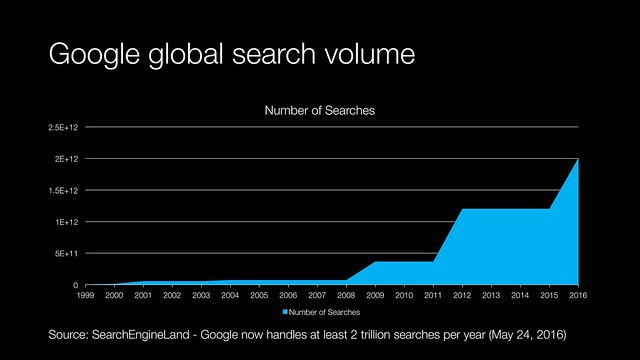
    Google search volumes

    This month I have some new data around search which came from disclosures at Google I/O in terms of search volumes. We talk about social as if search has gone out of style but its growth is still staggering. This is now driven by mobile device penetration and adoption as computing devices on the go. It also speaks to the wider number of questions that search now answers. It used to be that search answered with ‘facts’ found online. It then became more contextual with shortcuts that gave you the weather forecast or a foreign exchange rate. Mobile moved this on further to items like local recommendations.

    Partly through the search box, but also by more meta detail about the device doing the searching and its location to within a few metres due to GPS and cell tower triangulation. Voice interaction has also started to impact search volume. Image driven search still seems to be an area that could drive much more potential search volume, that would be valuable for commerce.
    Google global search volume
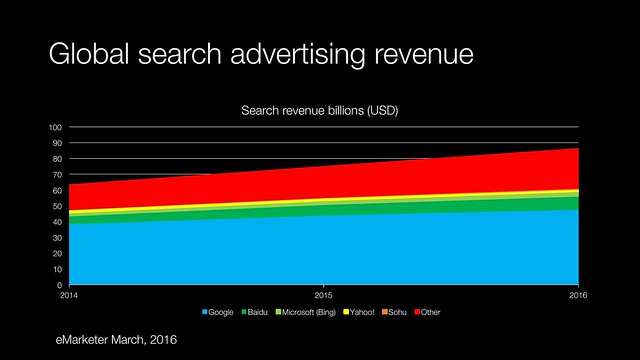
    Looking at global search revenue over time, Google’s monopoly position becomes immediately apparent. It is amazing how Bing and Yahoo! haven’t managed to grow market share but just transfer value from one to the other. In the Chinese market, Sohu has been obliterated with Baidu search. But one does have to wonder about the value of web search, when so much internet usage now happens in the WeChat eco-system.
    Global Search Revenues
    More details about me here.
    Slide20

    Full presentation

    Full presentation available for download as a PDF on Slideshare and you can find more research related posts here.

  • Mobile searches + more

    Saying a third of mobile searches are local, Google brings “Promoted Pins” to Maps – but still no development platform for third party integration. Google Maps is still behind Baidu Maps in this respect. But the pivot towards local mobile searches offers opportunities for many small and medium sized businesses. More on where 2.0 related topics here.

    Samsung will no longer make Android Wear devices, all in with Tizen OS [Update] | 9to5Google – as Benedict Evans said: Samsung is (probably) giving up on making Android Wear watches. The Apple Watch is only a partial success so far, but Android watches don’t seem to have worked at all

    I, Cringely Apple and Didi is about foreign cash and the future of motoring – I, Cringely – as ever thought-provoking, Bob Cringely’s take on Apple’s Didi investment

    EXCLUSIVE: The Dirty Advertising Practices of the Industry’s Biggest Brands, Bloggers — The Fashion Law – the legal challenges for influencers of becoming native advertising formats

    Anti-EU Campaign Offers A £50 Million Prize For Whoever Can Predict Euro 2016 – BuzzFeed News – smart data capture. Likely to skew male

    Spotify Now Lets Brands Sponsor Its Popular Playlists | IPG Lab – history repeating as consumer brands used to sponsor radio programmes like P&G’s recession era ‘soap opera’. It will be interesting to see how much traction this it gets

    BNP Paribas in partnership with Luc Besson’s next movie, Valerian and the City of a thousand planets – really interesting execution from a French bank BNP Paribas. Valerian is a classic French comic space opera based on comics by Pierre Christin and artist Jean-Claude Mézières

    Secrets of WeChat and Weibo Feed Stream — China Internet Watch  – (paywall)

    Hoffman Fabrics | Stussy – great background on the Hawaiian shirt, my favourite picture has Tom Selleck as Magnum in the background

    PDF Decrypter Pro (Windows & Mac OS X) – Remove PDF owner password and restrictions – Download FREE – handy app to have on tap. the native macOS Preview app, or trying to hack the file on ColorSync will only get you so far

    PayPal is shutting down its Windows Phone, BlackBerry, and Amazon apps | The Verge – its an Android and iOS world. This isn’t a good environment for carriers

  • Competition in logistics + more

    Failure of competition in logistics market – The EU thinks this website is the key to fixing its weak e-commerce market — Quartz – surely there is some arbitrage play for ‘trumpeting’ deliveries in and out to take advantage of lowest cost parcel routing? Given the amount of parcel carriers why is there a failure of market competition in logistics. I suspect that gathering data on this by the EU is the first step; in a similar way to what happened on mobile roaming rates. More Europe-related posts here

    WeChat failed to go global | Techinasia – the thing I took away from this foreign campaigns was how similar they were to what I would have expected a foreign company to do in China. I suspect that they weren’t localised enough and Tencent didn’t think about a compelling hook

    Housing crisis in China’s ‘Silicon Valley’: Huawei, other hi-tech giants head for cheaper cities as rising costs deter talents – also provides opportunities for start-ups to take up staff that don’t want to make the move

    Nokia could cut up to 15,000 jobs | Telecom Asia – not surprising there would have been a lot of overlap between them

    Adidas to Return Mass Shoe Production to Germany in 2017 | Business of Fashion – isn’t likely to be traditional adidas models like the Gazelle or Superstar as designs are adapted for the robot production line that Adidas intends to use

    Why Huawei is suing Samsung over cellphone patents – Recode –  the amount of redactions in this document is interesting. The optics of the court case are trying to position Huawei as an innovator. Huawei will win in the Chinese court filling. The US one could be more interesting. If Huawei is considered to be abusing its position it could find itself in an EU court case though

    A new study shows how government-collected “anonymous” data can be used to profile you — Quartz

    Even Apple is acknowledging that the “iPads in education” fad is coming to an end | Quartz – which has to be worrisome for tablets in business surely?

    Why Big Apps Aren’t Moving to Swift (Yet)

  • The New Nokia

    The New Nokia can rise from the ashes of the old. Microsoft finally let go of its licence for the Nokia brand license on May 19, 2016.
    Slide03
    There is a lot of logic to this move:

    • Microsoft has already written down the full value of the business acquisition
    • It has got the most valuable technical savvy out of the team and moved it into the Surface business
    • It removes problematic factories and legacy products

    For the businesses that have acquired the rights to use the Nokia name and the factories the upsides are harder to see.

    The factories may be of use, however there is over supply in the Shenzhen eco-system and bottlenecks aren’t usually at final manufacture, but in the component supply chain.

    There is still some brand equity left in the Nokia phone brand. I analysed Nokia along with a number of other international Greater China smartphone eco-system brands using Google Trend data.
    Slide06
    There has been a decline in brand interest over the past 12 months for Nokia of 37%
    Slide07
    Nokia still has comparable brand equity to other legacy mobile brands such as BlackBerry and Motorola
    Slide08
    The brand equity is comparable to other value mobile brands. Honor; Huawei’s value brand has had a lot of money and effort pumped into it to achieve its current position.
    Slide09
    But it’s brand equity doesn’t stack up well against premium handset brands from Greater China. The reason for this is that smartphone marketing and fast moving consumer goods marketing now have similar dynamics – both are in mature little differentiated markets. Brands need to have deep pockets  and invest in regular advertising to remain top-of-mind across as large an audience as possible. Reach and frequency are more important than social media metrics like engagement.

    In addition to advertising spend needs to be put into training and incentivising channel partners including carriers.

    They are entering a hyper-competitive market and it isn’t clear what their point of advantage will be. Given the lock down that Google puts on Android and commoditised version of handset manufacture, the best option would be to look for manufacturing and supply chain efficiencies  – like Dell did in the PC industry. But that’s easier said than done.

    Garnering the kind of investment required to seriously support an international phone brand is a hard sell to the finance director or potential external investors.

    Slide13
    Growth is tapering out.
    Slide14
    The average selling price is in steady decline
    Slide16
    This is partly because the emerging markets are making the majority new phone purchases.
    Slide15
    Consumers in developed markets are likely holding on to the their phones for longer due to a mix economic conditions and a lack of compelling reason to upgrade.
    Slide12
    All of the consumers that likely want and can afford a phone in developed markets have one. Sales are likely to be on a replacement cycle as they wear out. Manufacturers have done a lot to improve quality and reliability of devices.

    Even the old household insurance fraud standby of dropping a phone that the consumer was bored with down the toilet doesn’t work on the latest premium Android handsets due to water-proofing.
    Slide20

    More information

    The answer to the question you’ve all been asking | Nokia – Nokia’s official announcement
    Gartner highlights a more challenging smartphone sector for Nokia than when it “quit” in 2013 | TelecomTV
    Nokia is coming back to phones and tablets | The Verge
    So the Nokia brand returns.. with a Vengeance | Communities Dominate Brands

    Supporting data slides in full