Blog

  • Stone Island + more things

    Stone Island

    Arco Maher’s video lookbook for Stone Island via Dazed & Confused. With the book Maher and Stone Island are trying to draw a clear line between the Milan Paninaro sub-culture of the 1980s and urban British youth. There are clear parallels for Stone Island to draw on: conspicuous consumption, international orientation love of club related music. However the Paninaro look itself now has faded into staples of street style so is no longer distinct. Also Stone Island earned itself an unenviable reputation as the clothing of football casuals in the UK. A Stone Island top was enough to get you barred from many establishments.

    Halifax

    This Cheesy, 1980s Promotional Video for a Northern Nightclub is UK Nightlife’s Finest Hour | Thump – OMG was the first thing that sprung out of my mouth watching this. I spent a good deal of my university time in Halifax working part-time as a market research analyst. This early 1980s glamour is so faraway from what the town was when I was there. The video reminds of Fitzcarraldo; bringing culture and class to an otherwise inhospitable place for their endeavour.

    The Webbys

    The Webby Awards have a good Instagram account. This quote from Iain Tait stood out for me. Is it about agencies, the metaphysics of quality or both – you decide.


    A photo posted by The Webby Awards (@thewebbyawards) on

    BMW films

    BMW Films have returned, its a 13 minute feature film. Jon Bernthal plays the foil to Clive Owen in a role that is eerily similar to the look and feel of The Accountant. I wasn’t impressed with him on his outing as The Punisher on Daredevil, but if he keeps this up – he could work on the standalone series if Marvel gave it the go-ahead.

    Start up stock tracker

    The Startup Stock Tracker – WSJ.com – based on secondary market value (don’t expect an update every 15 minutes)

  • New Apple MacBook Pro

    I slept a few naps before pulling together these thoughts on the new Apple MacBook Pro. I have been a Mac user since it was the mark of eccentricity. I am writing this post on a 13″ MacBook Pro and have a house of other Macs and peripherals.

    Theatre
    Apple launched a new range of Apple MacBook Pro’s on October 27, 2016. This was a day after Microsoft’s reinvigoration of its Surface franchise.  Apple ignores timing and tries to plough its own furrow. But comparisons by journalists and market analysts are inevitable.

    Microsoft has done a very good job at presenting a device that owes its build quality to the schooling that Apple has given to the Shenzhen eco-system over the past two decades.

    The focus on touch computing feels like a step on a roadmap to Minority Report style computing interfaces.  Microsoft has finally mastered the showmanship of Apple at its best.

    Apple’s presentation trod a well-worn formula. Tim Cook acts as the ringmaster and provides a business update. Angela Ahrendts sits at a prominent place in the audience and appears on a few cut-in shots. Craig Federighi presented the first product setting a light self-depreciating humour with in-jokes that pull the Apple watchers through the fourth wall and draws them inside ‘Apple’. Eddy Cue plays a similar role for more content related products. In that respect they are interchangeable like pieces of Lego.

    Phil Schiller came in to do the heavy lifting on the product. While the design had some points of interest including TouchID and the touchpad the ports on the machine are a major issue.

    Given the Pro nature of the computer, Apple couldn’t completely hide behind ‘design’ like it has done with the MacBook. So Phil Schiller was given the job of doing the heavy lifting on the product introduction.

    There was the usual Jonny Ive voiceover video on how the product was made with identikit superlatives from previous launches. It could almost be done by a bot with the voice of Jonny Ive, rather than disturbing his creative process.

    It all felt like it was dialled in, there wasn’t the sense of occasion that Apple has managed in the past.

    User experience
    Many people have pointed out that Microsoft’s products looked more innovative and seemed to be actively courting the creatives that have been the core of Apple’s support. In reality much of it was smoke and mirrors. Yes Apple has lost some of the video market because its machines just aren’t powerful, in comparison to other workstations out there.

    The touch interface is more of a red herring. Ever since the HP-150 – touch hasn’t played that well with desktop computers because content creators don’t like to take their hands too far from the keyboard when work. It ruins the flow if you can touch type; or have muscle memory for your PhotoShop shortcuts.

    Apple didn’t invent the Surface Dial because it already had an equivalent made by Griffin Technology – the PowerMate. In fact the PowerMate had originally been available for Windows Vista and Linux as well, but for some reason the device software didn’t work well with Windows 7 & 8.

    I can see why Apple has gravitated towards the touchpad instead. But it needed to do a better job telling the story.

    Heat
    Regardless of the wrong headedness of Microsoft’s announcements, the company has managed to get much of the heat that Apple used to bring to announcements. By comparison Apple ploughed exactly the same furrow as it has done for the past few years – the products themselves where interchangeable.

    The design provided little enthusiasm amongst the creatives that I know, beyond agitation at the pointless port changes and inconvenience that conveyed.

    While these people aren’t going to move to Microsoft, the Surface announcements provided them with a compare and contrast experience which agitated the situation further.  To quote one friend

    Apple doesn’t know who it is. It doesn’t know its customers and it no longer understands professionals.

    Design
    Apple’s design of the MacBook Pro shows a good deal of myopia. Yes, Apple saved weight in the laptops; but that doesn’t mean that the consumer saves weight. The move to USB C only has had a huge impact. A raft of new dongles, SD card readers and adaptors required. If like me you present to external parties, you will have a Thunderbolt to VGA dongle.

    With the new laptop, you will need a new VGA dongle, and a new HDMI dongle. I have £2,000 of Thunderbolt displays that will need some way of connecting to Apple’s new USB C port. I replace my displays less often than my laptop. We have even earlier displays in the office.

    Every so often I transfer files on to a disk for clients with locked down IT systems. Their IT department don’t like file transfer services like WeTransfer or FTP. They don’t like shared drives from Google or Box. I will need a USB C to USB adaptor to make this happen. Even the encrypted USB thumb drive on my ‘real life’ key chain will require an adaptor!

    I will be swimming in a sea of extra cables and parts that will weigh more than the 1/2 pound that Apple managed to save. Thank you for nothing, Apple.  Where interfaces have changed before there was a strong industry argument. Apple hit the curve at the right time for standards such as USB and dispensing with optical drives.

    The move to USB C seems to be more about having a long thin slot instead of a slightly taller one. Getting rid of the MagSafe power connector has actually made the laptop less safe. MagSafe is a connector that is still superior to anything else on the market.  Apple has moved from an obsession with ‘form and function’ to ‘form over function’.

    The problem is one of Apple’s own making: it has obsessed about size zero design since Steve Jobs used to have a Motorola RAZR.

    Price versus Value
    So despite coming with a half pound less mass and a lot of inconvenience, the devices come in at $200 more expensive than their predecessors. It will be harder for Apple customers to upgrade to this device unless their current machine is at least five years old. I don’t think that this laptop will provide the injection in shipments that Apple believes it will.

    A quick word on displays
    Apple’s move away from external displays was an interesting one. There can’t be that much engineering difference between building the iMac and the Apple Display? Yet Apple seems to have abandoned the market. It gives some professionals a natural break point to review whether they should stay with Apple. Apple displays aren’t only a product line but a visible ambassador of Apple’s brand where you can see the sea of displays in agencies and know that they are an Apple shop. It is the classic ‘Carol Bartz’ school of technology product management. What do you think of the new Apple MacBook Pro?

    More information
    Initial thoughts on Windows 8 | renaissance chambara
    Size Zero Design | renaissance chambara
    Why I am sunsetting Yahoo! | renaissance chambara
    Apple just told the world it has no idea who the Mac is for – Charged Tech – Medium
    Apple (AAPL) removed MagSafe, its safest, smartest invention ever, from the new MacBook Pros — Quartz
    How Apple’s New MacBook Pros Compare To Microsoft’s New Surface Studio | Fast Company | Business + Innovation – a subtly cutting article on the new MacBook Pro
    New MacBook Pro touches at why computers still matter for Apple | CNet
    Apple’s new MacBook Pro kills off most of the ports you probably need | TechCrunch
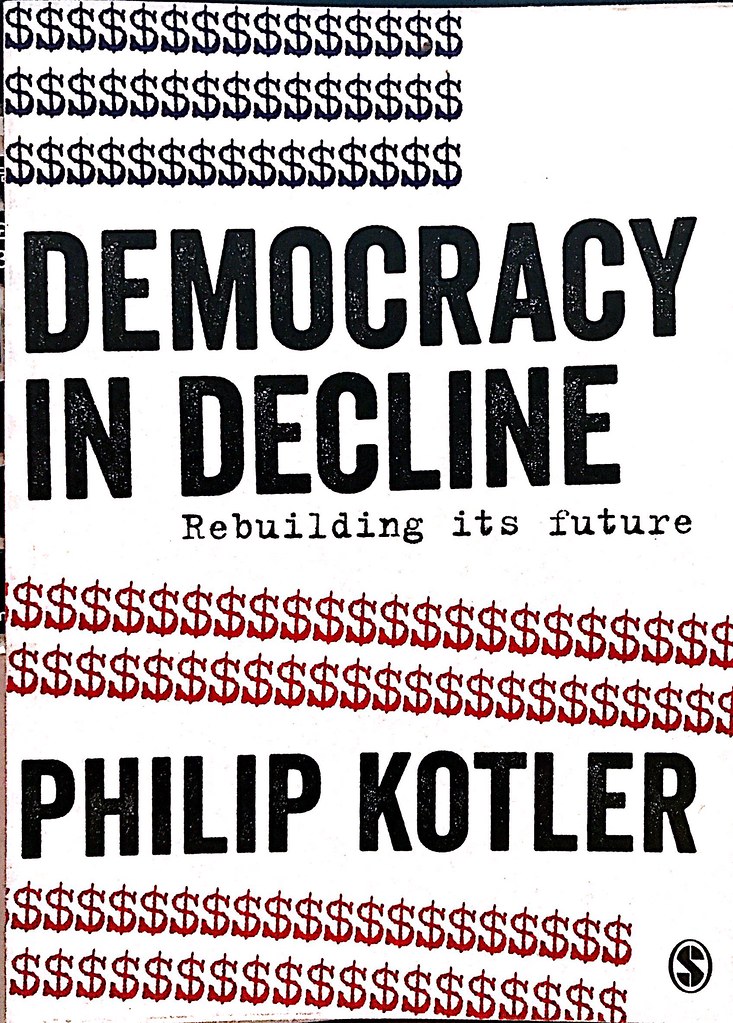
  • Democracy in Decline by Philip Kotler

    It was a curious experience for me to be reading Democracy in Decline. When I was in college Philip Kotler was a constant part of my life. His Principles of Marketing was a core text for my degree. It is a bit weird reading another book by Professor Kotler; especially one on such a dramatically different topic.
    Democracy in Decline
    In Democracy in Decline Kotler addresses what are commonly cited as weaknesses in the political system of the United States. He provides an easy to understand guide to the US political system.  Kotler then gets into what he identifies as the key points of failure in the American political system.

    1. Low voter literacy, turnout and engagement
    2. Shortage of highly qualified and visionary candidates
    3. Blind belief in American exceptionalism
    4. Growing public antipathy towards government
    5. Two-party gridlock preventing needed legislation
    6. Growing role of money in politics
    7. Gerrymandering empowering incumbents to get re-elected forever
    8. Caucuses and primaries leading candidates to adopt more extreme positions
    9. Continuous conflict between the President and Congress
    10. Continuous conflict between the federal and state governments
    11. The supreme court’s readiness to revise legislative actions
    12. The difficulty of passing new amendments
    13. The difficulty of developing a sound foreign policy
    14. Making government agencies more accountable

    Kotler’s viewpoint is unashamedly liberal and supportive of collegiate rivalry underpinned by compromise in politics. The White House he envisions is more like the Barlett administration in The West Wing or Star Trek’s United Federation of Planets rather than Hilary Clinton. The flaws he has identified are so big in scale that they would likely require a major re-engineering of American society. From the electoral system, the relationship between federal and state government, public policy and public service.

    That kind of re-engineering would require widespread societal approval. That wouldn’t happen in the riven, polarised society of America today. The books measures would be completely against the interests of the conservative movement.

    For the European reader, Kotler offers an interesting engaged analysis of the American condition, however there is little to no reflection on the commonalities of national populism in European politics. This book will only provide an understanding of the United States; and that’s ok.

    Kotler has a sub-header in the tile of the book ‘Rebuilding the future. In reality Kotler provides an effective diagnosis, but an not anything that points to an effective solution beyond hoping for the best.

  • Republic of Samsung + more

    Republic of Samsung

    Galaxy Note 7 Recall Dismays South Korea, the ‘Republic of Samsung’ – NYTimes.com – interesting how attached Korean people are to the Samsung brand. Samsung represents over 20 percent of Korean GDP and the Korean stock market – hence the Republic of Samsung. The Republic of Samsung has a wide reach in Korea. You can shop at Samsung, go to a Samsung Lions baseball game, pay for petrol to put in your Renault Samsung SUV with a Samsung Card. And go for an appointment in a Samsung hospital where you can be prescribed Samsung medicine.

    Samsung can censor the media by withdrawing its media spend. They stop negative books by pointing out that the publisher could face legal action and a lack of Samsung retail distribution. The Republic of Samsung owes its rise to former President Park who put in place the chaebol system to drive the Korean economic miracle at the end of the 1960s. The Republic of Samsung success is mirrored by the likes of LG, Lotte and Hyundai.

    Samsung ‘blocks’ exploding Note 7 parody videos – BBC News – if it wasn’t a PR train wreck before. It also reinforces how the Republic of Samsung nickname has value. Like India’s Tata, Samsung is almost like a country within a country.

    Business

    LeEco Who? Chinese Tech Giant Tries Its Luck In the US With ‘More Products Than You’ve Ever Seen’ – Slashdot – what about patents / intellectual property?

    Starbucks pushes ahead with China expansion | Marketing Interactive – interesting that they are going big in the face of declining economic growth

    Economics

    As Chinese Incomes Rise, So Does Pollution | The New Republic – it was a similar state in the UK and US during the industrial revolution. Super Fund sites would have looked familiar to the Chinese. That’s what industrially driven progress looks, smells and tastes like

    History tells us where the wealth gap leads | Aeon Essays – really interesting read

    Brexit could be halted after Government admits that MPs likely to have final say | The Independent – It raised the prospect, at the very least, that MPs and peers could amend the Brexit deal if they opposed key elements of the impact on trade, immigration or other areas. However, it could also mean Britain tumbling out of the EU – probably in early 2019 – with no deal whatsoever.

    Finance

    How One Goldman Sachs Trader Made More Than $100 Million – WSJ – junk bond trading (part of the 1980s making a return)

    Hong Kong

    Move over K-Pop: desperately seeking an international cultural icon made in Hong Kong | This Week In Asia | South China Morning Post – how does Hong Kong claim is place on the international cultural stage?

    7-Eleven, McDonald’s, Circle K … Google launches Android Pay at 5,000 Hong Kong locations | South China Morning Post – way behind WeChat and ApplePay and Octopus card

    Ireland

    Kenny: Suggestion of EC probe into Ireland ‘wrong’ | RTE – Irish Times report stirred the hornets nest

    Japan

    How I started my company in Japan | Danny Choo – really interesting read

    Luxury

    Saving the Swiss Watch Industry—Again – Bloomberg – I think this is over egged this time. The big challenges is that there is less growth globally and so less luxury purchases. The prestige brands will be fine, the mid-market Tissot and the like will have problems

    Marketing

    72andSunny Launches Social Media Influencer Division | AdWeek – it makes complete sense as ad agencies need content to amplify via paid and interact with via multi-channel story telling. It also shows how porous the walls of public relations as a discipline have been eroded

    Media

    The New York Times is buying The Wirecutter for more than $30 million – Recode – The Times will pay more than $30 million, including retention bonuses and other payouts, for the startup, according to people familiar with the transaction – so in reality less than 30 million but still a great result for Brian Lam and the team

    Yahoo to Clapper: Global, Global, Beyond our Borders, Global | Emptywheel – basically Verizon will likely look to write off the value of Yahoo!’s European businesses as they are likely to go through a legal grinder. US government likely to get kicking by EU

    Google Has Dropped Ban on Personally Identifiable Web Tracking | Propublica – Google’s ownership of Android and Chrome make this particularly interesting

    Retailing

    Hong Kong lifestyle retailer accuses competition of copying design of his shop | SCMP – interesting area for IP, what about retailers that transplant formats (Yo! Sushi etc)

    Security

    AT&T Spying on Americans for Profit, New Documents Reveal | Daily Beast – The telecom giant is doing NSA-style work for law enforcement—without a warrant—and earning millions of dollars a year from taxpayers

    The Decline in Chinese Cyberattacks: The Story Behind the Numbers | Technology Review – or just taking liberties that could be then easily bargained away to create the illusion of a win

    Every LTE call, text, can be intercepted, blacked out, hacker finds • The Register – Ruxcon Hacker Wanqiao Zhang of Chinese hacking house Qihoo 360 has blown holes in 4G LTE networks by detailing how to intercept and make calls, send text messages and even force phones offline

    GitHub – DaylightingSociety/WhereAreTheEyes: Surveillance Detection and Mapping App – interesting move that would be of value to the surveilled and the watchers

    Technology

    What is Dolby Vision? | Electronics EETimes – high dynamic range video

    Homeless on Stockholm’s silicon slopes – POLITICO – with the implication that they prefer refugees over technical talent

    Batteries May Trip ‘Death Spiral’ in $3.4 Trillion Credit Market – Bloomberg – of course this doesn’t seem to take into account the finite supply of lithium and rising cost of the metal…

    IBM claims moving to Mac drastically reduced support calls, operating costs | ExtremeTech – ironically over 20 years ago Arthur D Little Consulting did a report on this (sponsored by Apple) that showed exactly the same thing. The more things change, the more they stay the same

    Fed-Up Belichick Takes Screen Out of His Arsenal. (The Hand-Held One.) – The New York Times – not great for Microsoft’s Surface, its sponsorship of the NFL seems to be starting to come undone

    Microsoft kinda did OK this quarter – but whatever, Wall Street loves Satya Nadella – this is as much PR as financial results. Don’t get me wrong its good for Microsoft, but it shows how Ballmer was dogged by shitty PR – the Nokia decision notwithstanding

    Web of no web

    My first virtual reality groping | Mic – why should we be surprised that VR mirrors the best and worst of real life?

    Twitter Fires Its New Head of VR After Two Days | Gizmodo – where was the due diligence in the hiring process?

    Wireless

    Xiaomi is selling the concept phone of your wildest dreams – The Verge – impressive design, it will be interesting to see if it can take the crown back in China from Huawei and Oppo

    Huawei Mate 9 to sport 4X optical zoom, cost up to $1300 | Phonearena – trying to use ridiculous pricing to develop a perception of quality

    Sky’s CEO drops MVNO bombshell at results conference | The Register – I already thought Sky had a triple play, the way they presented their multi-screen entertainment offering Sky Q, it will be interesting to see if they roll this out to other countries beyond the UK

    KODAK EKTRA – Main | Kodak – this looks like a better camera orientated smartphone than the Huawei P9 or LG’s collaboration with Hasselblad

    Qualcomm Announces New X50 5G Modem, First Gigabit Class LTE Network and Router | Anandtech – we don’t know exactly how it is all going to work out; but Qualcomm has a modem for it anyway

  • Internet of hacking

    IoT should be considered the Internet of Hacking (IoH).

    Mirai – is a bot network that is powered by a range of devices including infected home routers and remote camera systems. It took over these systems by using their default passwords. The network of compromised machines is then targeted to overload a target network or service. Last week the Dyn DNS service was targeted which restricted access to lots of other services for users on the east coast of the US.

    DNS is like a telephone directory of internet destinations, if no one knows where to go it becomes a lot harder to get in touch.

    DDoSing

    Mirai didn’t spring miraculously out of thin air. It finds its history in passionate gamers who used distributed denial of service (DDoS) attacks to slow down or even kick opponents off online gaming platforms. Eventually the gaming companies got hip to it and went after the cheaters, not to be outdone the cheaters went after the gaming companies.

    Taking a service offline using DDoS became a source of extortion against online banking and e-commerce services. Attacks can be used as a form of ‘digital hit’ to take out opponents or critics like online security commentator Brian Krebs.

    Computing

    Moore’s Law meant that computing power has become so small and plentiful that it is surprising what we often have in the palms of our hands. The first Cisco router was built on the circuit board of a Sun Microsystems workstation. Home routers now are basically small computers running Linux. A CCTV camera box or a DVR are both basic PCs complete with hard drives.

    Back in 2007, BlackBerry co-founder Mike Lazaridis described the iPhone as

    “They’ve put a Mac in this thing…”

    The implication being that the power of a sophisticated PC was essentially in the palm of one’s hand. The downside of this is that your thermostat is dependent on a good broadband connection and Google based cloud services and your television can get malware in a similar manner to your PC.

    Security

    For a range of Chinese products that have been acknowledged as part of the botnet; the manufacturer acknowledged that they were secured with a default admin password. They fixed the problem in a later version of the firmware on the device. Resetting the default password is now part of the original device set-up the first time you use it.

    The current best advice for internet of things security is protecting the network with a firewall at the edge. The reality is that most home networks have a firewall on the connected PCs if you were lucky. The average consumer doesn’t have a dedicated security appliance on the edge of the home network.

    Modern enterprises no longer rely on only security at the edge, they have a ‘depth in defence’ approach that takes a layered approach to security.

    That would be a range of technology including:

    • At least one firewall at the edge
    • Intrusion detection software as part of a network management suite
    • A firewall on each device
    • Profile based permissions across the system (if you work in HR, you have access to the HR systems, but not customer records
    • Decoy honey post systems
    • All file systems encrypted by default so if data is stolen it still can’t be read

    Processes:

    • Updating software as soon as it becomes available
    • Hard passwords
    • Two-factor authentication

    Depth in defence is complex in nature, which makes it hard to pull off for the average family. IoT products are usually made to a price point. These are products as appliances, so it is hard for manufacturers to have a security eco-system. The likelihood of anti-virus and firewall software for light bulbs or thermostats is probably small to non-existent.

    The Shenzhen eco-system

    Shenzhen, just across the border from Hong Kong has been the centre of assembly for consumer electronics over the past 20 years. Although this is changing, for instance Apple devices are now assembled across China. Shenzhen has expanded into design, development and engineering. A key part of this process has been a unique open source development process. Specifications and designs are shared informally under legally ambiguous conditions – this shares development costs across manufacturers and allows for iterative improvements. This doesn’t seem to improve product security, quite the opposite, hence the internet of hacking. 

    There is a thriving maker community that allows for blurring between hobbyists and engineers. A hobbyists passion can quickly become a prototype and then into production . Shenzhen manufacturers can go to market so fast that they harvest ideas from Kickstarter and can have them in market before the idea has been funded on the crowdsourcing platform.

    All of these factors would seem to favour the ability to get good security technologies engineered directly into the products by sharing the load.

    China

    The European Union were reported to be looking at regulating security into the IoT eco-system, to try and prevent the internet of hacking, but in the past regulation hasn’t improved the security of related products such as DSL routers. Regulation is only likely to be effective if it is driven out of China. China does have a strong incentive to do this. But it is unlikely to do anything to help prevent the internet of hacking.

    The government has a strong design to increase the value of Chinese manufacturing beyond low value assembly and have local products seen as being high quality. President Xi has expressed frustration that the way Chinese manufacturing appears to be sophisticated, yet cannot make a good ballpoint pen.

    Insecurity in IoT products is rather like that pain point of poor quality pens. It is a win-win for both customers, the Chinese manufacturing sector and by extension the Party. More security related content can be found here.

    More Information

    WSJ City – Massive Internet Attack Stemmed From Game Tactics
    Your brilliant Kickstarter idea could be on sale in China before you’ve even finished funding it | Quartz
    Asus lawsuit puts entire industry on notice over shoddy router security | Ars Technica
    Europe to Push New Security Rules Amid IoT Mess — Krebs on Security
    Why can’t China make a good ballpoint pen? | Marketplace.org