Blog

  • Predict ISIS attacks + more news

    How Traffic to This YouTube Video Could Predict ISIS Attacks – Defense One interesting, but is it actionable intelligence? This reminds me a lot of the term ‘chatter’ as used in the series ’24’. Or prediction markets, which may be better for financiers investing in related areas rather than providing something that the military and law enforcement can use effectively. For instance it would affect your stance on Insurance stocks and oil futures if you were able to predict ISIS attacks. More security related posts here.

    You can now hang out with Totoro and explore Studio Ghibli worlds in virtual reality | Rocket News 24 – indicates an interesting interplay between linear media and VR. Linear media storytelling sets the scene; VR allows you to explore it. I feel that we don’t ‘get’ storytelling in VR yet, having worked on a project for New Balance. This work by Studio Ghibli offers a complementary option that media companies could get onboard with

    Lenovo and Apple are fastest growing among India’s top 10 smart phone vendors | TelecomTV Insights – we’ll see how long this lasts, India like China is focused on domestic smartphone makers. I could see Apple appealing to elites like their peers globally, but the great bulk of handsets is going to come in at the bottom.

    brandchannel: The Language Of Now: Pepsi Kicks Off Global PepsiMoji Campaign – please millennials engage with our brand! To be fair PepsiCo have tried innovations for a good while. They were one of the first brands to use QRCodes for western consumers. Western consumer usage is only now starting to catch up with it a decade or more later.

    [Podcast] Tencent And QQ With Eva Xiao | Technode – great interview as a primer on Tencent. Tencent is one of the BAT of China. BAT stands for Baidu, Alibaba and Tencent. The BAT are a set of companies with a similar position to what GAFA (Google, Amazon, Facebook, Apple) have in the west.


  • Sailfish OS + more things

    Jolla raises $12 million to continue developing Sailfish OS | Tech.eu – glad that they found funding, but things will be a lot tougher with AndroidOne’s progress and Cyanogen getting their act together with their geo-licences. Hopefully Sailfish OS will find the market share that it deserves. More wireless-related posts here.

    PLOS ONE: Tracking Protests Using Geotagged Flickr Photographs – interesting that they are using flickr. Web 2.0 era networks have more accessible data structures. Flickr has a relatively smaller community but a passionate one

    In the Cloud, Oracle Shops the Discount Aisle — The Information  – there’s a lot of upside potential to buying small, targeted cloud software businesses. It can improve their profitability by shifting their services to its own infrastructure. Most obviously, it can shrink sales and marketing costs, typically the single biggest expense for cloud software, by integrating the products into its own formidable sales organisation (paywall)

    brandchannel: Protesters Boycott Target Following Retailer’s Stand Against ‘Bathroom Bills’ – interesting challenges that brands face in the US

    Jammers, Not Terminators: DARPA & The Future Of Robotics « Breaking Defense – it could be an interesting way of maximising spectrum usage

    How Intel Missed the Smartphone Call | EE Times – interesting read, but completely misses the role that Intel played in WiMax – which didn’t help thing either

    South Korea revives GPS backup project after blaming North for jamming | Reuters

    Apple’s Uncharted Territory | Techpinions – customer upgrade cycle up to 27 months

    Cyanogen OS no longer exclusive to Yu in India, here’s why | Gizchina – so OnePlus could have been spared the hassle of creating OxygenOS

    Huawei boss says 2K displays are a waste! Do you agree? | Gizchina – tend to agree with him

    British “Spies” Among Thousands Of names Exposed Following Massive Leak At Largest Mid-East Bank | Zero Hedge – Not sure that this is true, however if it is then the hackers leaked profiles that they built up based on the bank data but went beyond to look at things like social media profiles

    The Internet Economy — Medium – no real surprise but a nice analysis

  • What about the work desk phone?

    I was in touch with a former colleague of mine the other day and they sent me a picture of my old work desk phone. It was still logged into my account and with a divert through to my mobile phone.
    Untitled
    The office had hot desking because there wasn’t enough space for everyone to be in at the same time.  We had email account size restrictions and people walked around with secondary hard drives plugged into their laptops as local and network storage wasn’t adequate enough to schlep all the documents on to a file server. There wasn’t a cloud-based equivalent of a file server in use 3either.

    Yet my former work desk phone remained logged in because no one was bothering to use it. So they have a surplus of desk telephones, when there was a shortage of pretty much every other resource the knowledge worker needed.

    Often times, people still used the land line number which followed them due to the Cisco VoIP PBX, but they diverted it to their mobile handset. The culture was very much based around conference calls, international teams would dial into a bridge number and be connected. You would see people pacing the common spaces such as corridors or reception and participating in conference calls on headsets wired into their smartphone.

    At the point of my project finishing they were just starting to roll out Skype for business. I suspect that this wasn’t going to change dramatically the use of mobile handsets, just the nature of how the call got to the recipient.

    Mobile infrastructure manufacturers have been expecting this for years, they rolled out pico-cell products aimed at enterprises to deal with reception dead spots in metal framed office buildings. What really seemed to have spurred things into action is the rise of all-you-can-eat voice tariffs.

  • AI love advice + more things

    Japanese communications company to introduce AI love advice specialist | Rocket News 24 – we can all stand around an snigger about this. But it’s also really interesting. One of the ways that Yahoo! failed to innovate around search was a concept they called knowledge search. This was about opinions rather than facts: what’s the best place to get a cup of coffee in Greenwich? Yahoo! had envisioned it would be people powered.

    Eventually it would become Yahoo! Answers – which filled up with spam content. This was a fault of incentives and community management not principle as Quora proved. The more pertinent question would be: what would stop an AI love advice specialist?

    China’s Baidu Misses Expectations As Net Profit Crashes 18.9% | ChinaTechNews – Baidu is between a rock and a hard place. Yes it has a market protected from Google. But it is also shut out of the WeChat walled garden. Alibaba is where most purchases happen so Baidu isn’t that needed and they’re at the mercy of the Chinese government. Success has a price

    Spy Chief Complains That Edward Snowden Sped Up Spread of Encryption by 7 Years  – it came from the National Security Agency. “The projected growth maturation and installation of commercially available encryption — what they had forecasted for seven years ahead, three years ago, was accelerated to now, because of the revelation of the leaks.” More on privacy related posts here.

    Microsoft Flow is like IFTTT for connecting cloud services – Business Insider – back in the day this would have been called middleware. When I started off my agency career I happened to have telecoms clients. A lot of my colleagues had small software companies that provided software components for ‘n-tier’ systems. This allowed development of flexible and reusable apps. Logic and processing of data could be built into workflows.

  • China tech data slides

    I have been pulling together China tech data slides for me that were useful for some work that I have been doing. I thought it would be worthwhile sharing these slides with a wider audience.

    This month, I have selected a few slides that shed a light on advertising and consumer behaviour in China.
    May online marketing
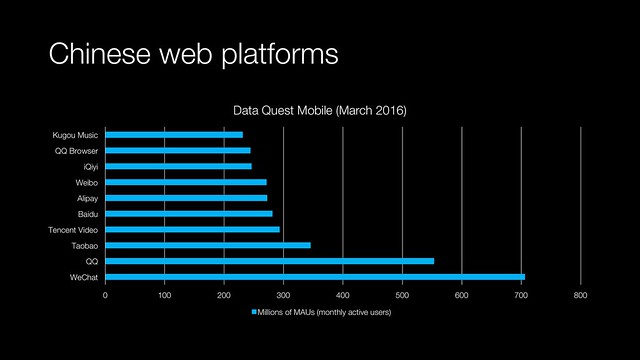
    Looking at platforms it is hard to over play the importance of Tencent in the Chinese internet which is show at the heart of the China tech data I have collated. Looking at mobile behaviour Tencent is responsible for at least four of the top ten properties: WeChat, QQ, QQ Browser and Tencent Video.
    May online marketing
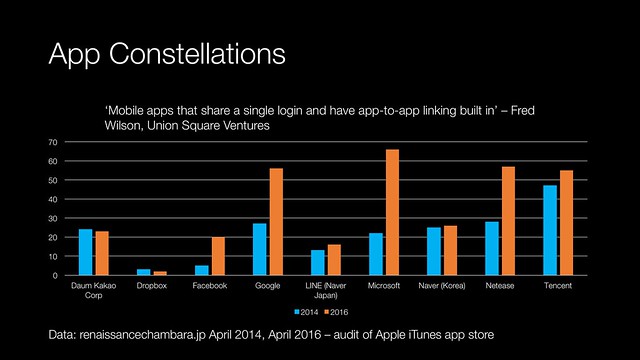
    If we look at two Chinese internet companies Tencent and Netease we can see how the companies have massively increased the number of non-game apps that they provide to keep consumers in their eco-system for their digital lives.
    May online marketing
    (Microsoft’s high number is driven by a number experimental project apps and enterprise apps). What this means is that the mobile OS becomes less important, which is one of the reasons why western brands from Samsung to Apple have been hit in the market. Their platforms give them less leverage.

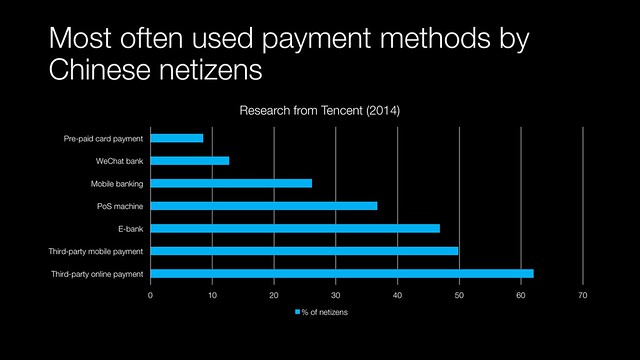
    Tencent’s WeChat is one of the most popular methods of payment in China
    May online marketing

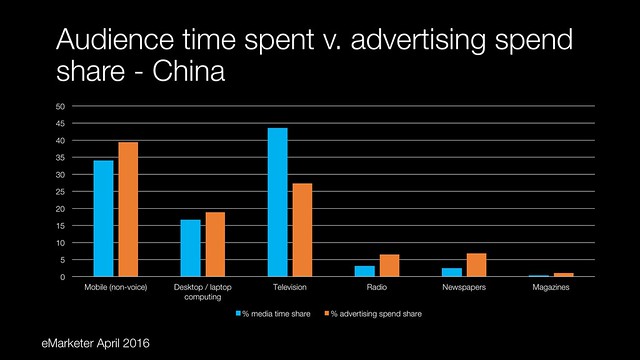
    If we look at advertising spend in the Chinese market we can see that digital and radio advertising spend over-indexes. In some ways this is surprising. Online content is huge and historically the government controlled traditional media much more tightly than online media – to the detriment of watchable content on the television. More recently, government regulation has tightened across platforms.
    May online marketing
    Print advertising only slightly over-indexes in comparison to digital or radio. On the face of it there looks to be a massive opportunity in television advertising.

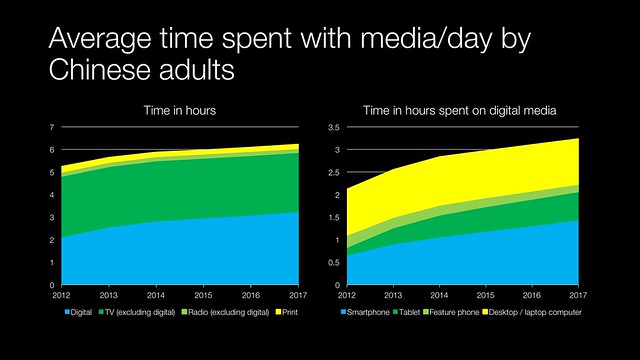
    If we look at the media market consumption habits two things immediately stand out. Television and radio are largely holding their own in the face of rapidly growing digital consumption. The rapid growth in digital consumption is being driven by non-PC devices.
    May online marketing

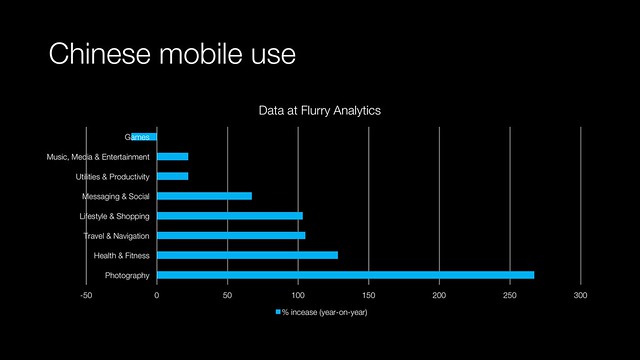
    If you want to know why Huawei has partnered with Leica to boost the perception of its smartphone camera function, one of the factors involved is the massive growth of photography in Chinese mobile behaviour. This is especially interesting when one compares it to messaging and social – WeChat the largest mobile social platform is all encompassing in its functionality and place in modern Chinese life. A second factor is the way manufacturers are trying redefine the premium smartphone sector, at a time when innovation and experiential difference have become incremental.
    May online marketing
    May online marketing


    You can see the full presentation here. More posts on China and technology related subjects.