Month: April 2018

  • Tony Kaye + more things

    Director Tony Kaye happy to be working and out of ‘Hollywood jail’ | The Drum  – He says that a story arc doesn’t really matter in six seconds. “I think you can throw anything at it, as long as it’s quite clear what it’s for. If you’re working under 20 minutes, in my opinion, you don’t need any structure. You can be as fragmented or as crazy as you want.” – Tony Kaye was a legend in the advertising world, creating some of the most iconic adverts of the 1980s and early 1990s. His Hollywood debut was American X, a brilliant provocative film with the troubled production. This saw Kaye go to the ‘Hollywood jail’ of the title where he could not get work in the film industry.

    Hackers stole a casino’s database through a thermometer in the lobby fish tank – Business Insider – “It’s probably one area where there’ll likely need to be regulation for minimum security standards because the market isn’t going to correct itself,” he said. “The problem is these devices still work. The fish tank or the CCTV camera still work.” – it’s Neal Stephenson’s Snow Crash in real life. The internet of things is now an under assessed security vector. In the right hands, a lot can be done with very little computing resources and computers have become pervasive in nature.

    An Apology for the Internet — From the People Who Built It | New York magazine – this just scratches the surface, but is an interesting read

    The Finns who refuse to give up on Sailfish OS | Engadget – given the challenges that ZTE faces. Jolla with Sailfish OS would be an ideal technology stack on their foreign handsets, particularly if they can do an English language version of the Yandex app store. That way they won’t have to localise all of their offerings as a replacement for Google Mobile Services (GMS) layer in Android. More related content here.

  • GDPR resources

    Partly due to Cambridge Analytica, General Data Protection Regulation (GDPR) is going to have a more profound impact on data usage globally. GDPR would have been seen as an extra-legal reach, but Facebook is making it look like a good idea.

    I thought I would pull together a few resources that I thought would be of interest around GDPR since there is a lot of snake oil being sold as consultancy around it at the moment. I am not going to pretend that I am an expert, so I thought it would be useful to share some of the GDPR related resources that I have been looking to learn from.

    Not only in terms of what the regulation is, but what techniques can be deplored to act in the spirit as well as the letter of regulations. Demonstrating a basic respect for the consumer won’t harm any brand, but might point to badly designed KPIs that direct and digital marketers might be measured from.

    Andreessen Horowitz put together a good podcast on it.

    Privacy by Design – The 7 Foundational Principles by Ann Cavoukian, Ph.D. (PDF) – is a must read paper for creative agencies and product teams. It is based on work that was started in the late 1990s. Cavoukian lists a site as a reference ‘privacybydesign.ca’ – but that seems to be down.

    1. Start by thinking about privacy by design from the start or as Cavoukian says preventative rather than remedial, proactive rather than reactive
    2.  Privacy as the default setting
    3. Privacy embedded into the design of systems and processes (which sounds like a reinforcement of her first point
    4. Not viewing consent in terms of a zero-sum
    5. Privacy secured throughout the lifecycle from end to end.
    6. Being open and transparent about processes to keep the organisation honest and stakeholders informed
    7. Respect for user privacy based on a user-centric ethos

    Via James Whatley’s newsletter this article on UX –  GDPR: 10 examples of best practice UX for obtaining marketing consent seems to be complementary to Cavoukian’s work. This is in sharp contrast to the dark patterns often used to force consent by many sites.

    More related posts here.

  • Dyneema + more things

    Dyneema

    The Lifestyle Applications of Dyneema – Core77 – the interesting thing for me is how old Dyneema is and how long it has taken to adopt the product. Back when I first started work before college, I worked briefly for DSM – the maker of Dyneema. Dyneema and Dupont’s Kevlar both required exceptionally pure chemicals in their process. Kevlar reputedly had to scrap a third of the product made. Both were expensive and used in special functions:

    • Ships ropes
    • Motorcycle crash helmets and robust composite moulded products
    • Ballistic vests and bullet proof armour
    • Climbing ropes

    Business

    PR Agencies Need to Be More Diverse and Inclusive. Here’s How to Start. | HBR – starting points valid but nowhere near the whole formula. Angela has written an interesting article on diversity and inclusive agencies. But Angela misses so many other data points:

    • That PR degree courses are often 90+% female graduates
    • That the industry (like advertising) does really poorly at retaining older (40+ year old) staff.
    • In the UK PR agencies struggle to attract graduates from working class backgrounds as well as from minority communities

    The article is behind a paywall. More related information here

    Mark Zuckerberg in Washington DC on machine learning and hate speech. Bringing their security team up to 20,000 people to look at issues like this. Hate speech is hard to compute in comparison to (Islamic) terrorist materials. I am guessing that what constitutes hate speech changes country by country (and its interesting that Facebook is looking at this from a global perspective, rather than placating the US first). Secondly, the language that constitutes hate speech evolves to circumvent restrictions and incorporate memes a la Pepe the Frog.

    Culture

    North Korean defectors are learning English so they can survive in South Korea | The Outline – interesting English loan words in South Korean language

    The Facebook Current | Stratechery – well worth a read

    Luxury

    Streetwear Reigns Supreme, Say Teens | News & Analysis, News Bites | BoF  – The growing popularity of streetwear negatively impacted Nike, as their appeal among teenagers dropped from 31% to 23%. In contrast, brands like Vans and Adidas have successfully leveraged an “open-source” approach, allowing pop culture to shape their brand image and consumer perception.

    Marketing

    Chinese International Students Are the New Brand Champions | Jing Daily – 31 percent of Chinese students in New York and Boston escort friends and family on shopping trips at least once every three months. Thirty-four percent purchased luxury goods to take back to China at a similar frequency

    The clock is ticking for brands to ‘go native’ | The Drum – highlights issues with native ads such as ROI

  • App constellations 2018 research

    I initially looked at app constellations back in 2014, when Fred Wilson put a name to the the phenomena. And every two years or so I have gone back and looked at a number of major internet companies to see how many different types of apps that they had in play.

    I originally selected the companies back in 2014 because I felt that they represented the largest and best of their ilk. It skews Asian because the west can be viewed as one eco-system represented by Google, Facebook and Microsoft.

    China is an enclosed eco-system; though Microsoft is actively engaged in the app eco-system there. I chose Tencent and NetEase as being my Chinese bellwethers. DaumKakao and Naver were representative of the Korean eco-system which blends highly-used domestic services with western platforms. Finally LINE of Japan (a subsidiary of Korean company Naver) provided a similar bellwether of the hybrid Japanese eco-system which mirrors Korea.

    App constellations survey methodology

    For the sake of convenience I have compared the contents of Apple’s mobile app store for each of the companies. While most of the internet companies have some Android-only or iOS-only apps; the iOS app store is still a good indicator of their app activity.

    I stayed true to the definition of app constellations in terms of deciding what kind of app should go in.

    App constellation definition

    I manually assessed each app, rather than relying on the category that the app had been submitted into. Tencent and Netease, had a number of mobile utilities that aided discussion and kept players updated on their favourite game. These didn’t fit within the definition.

    Changes in the environment

    Since 2016, a couple of things have changed:

    • Apple had a purge of apps that didn’t support 64 bit processing
    • They moved away from supporting the app store within iTunes application and on the web; to within the app store on the device

    2018 marks over a decade of mobile apps in the Apple store. Many of the major players have delisted almost as many Android and iOS apps as they currently have in the store. This happens for a number of reasons:

    • The app was serving a purpose for a fixed time
    • It is an application that has fallen so far out of favour that it is no longer worth maintaining
    • The code base no longer meets Apple’s or Google’s minimum standards
    Data analysis

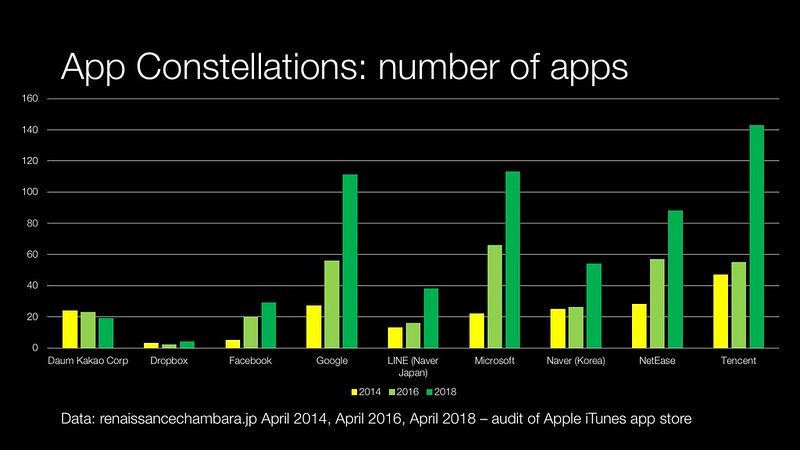
    I started off by looking at the number of apps. In terms of app constellations:  Tencent, Microsoft and Google were clear winners.
    Number of apps

    Both Microsoft and Google’s growth has been driven by ‘experimental’ apps that they have put out in the public for their own reasons and enterprise focused apps.
    compound annual growth in app number

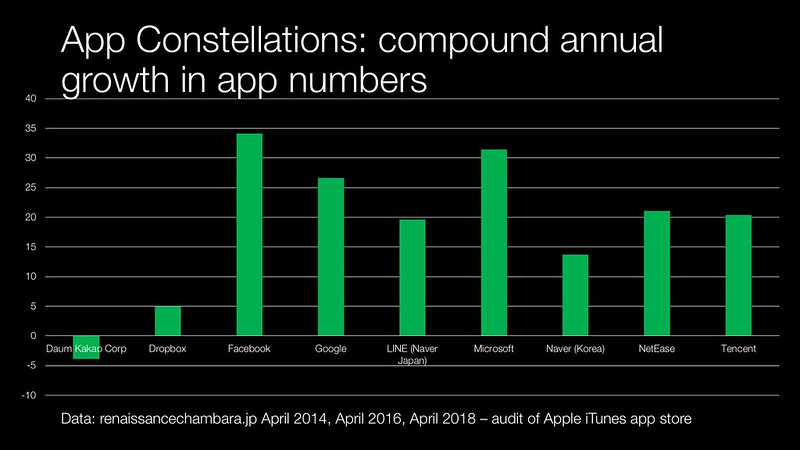
    But it was quickly apparent to me that the number of apps developed were only part of the story. What about the rate of change in numbers of apps developed? This would be indicative of the rate of change in moving to mobile. Here both Facebook and Microsoft’s pivot became immediately apparent. The Asian companies looked less impressive as they had been able to keep steady in their focus on mobile.

    All of this growth in the number of apps developed by major internet companies is all the more remarkable when you consider the following:

    • In mature markets consumers are not really downloading new apps
    • They are sticking with a few in terms of regular usage. Many of the apps on their phones don’t get used
    Notes on a few of the companies in terms of their app constellations
    • Daum Kakao – notable for being the only company who I looked at who had a decline in the number of applications versus 2016. A lot of this seems to be in service consolidation of both Daum and Kakao to remove duplications or non-core services. It is the Daum brand that has taken the biggest impact. This is understandable, since Daum struggled on the move to smartphones and Kakao is a mobile-first brand.
    • Dropbox – the growth in apps has been down to the larger business acquisition strategy at Dropbox. I don’t expect further growth like what we have seen with  Facebook’s pivot to mobile
    • Facebook – Facebook’s pivot to mobile was one of the reason why I decided to look at compound annual growth rate as well as the size of app constellation in terms of app numbers. In terms of raw app ‘SKUs’ Facebook is dwarfed by most of the other companies that I have looked at. It is only by looking at the growth in apps developed where one can really see their move to mobile
    • Netease – was interesting for its focus in a couple of areas. Like other Asian internet companies, education was a big target area, but Netease went into it with major commitment. Both NetEase and Tencent were big in magazine and book apps as well. I think this is down to the fact that ‘traditional’ web surfing is harder to do with (at the moment) when URLs are written in western script and numbers.
    • Tencent – the raw app numbers beggars belief. There are a number of reasons for this. Like NetEase, Tencent has a lot of apps solely optimised for the iPad and a separate iPhone app. There are free and paid-for product variants. Lastly Tencent will have four or five apps competing in a given category like streaming music which seems insane. Only time will tell if Tencent is spreading itself too thin; like when Yahoo! was described Brad Garlinghouse’s Peanut Butter Manifesto
    More information

    Jargon watch: app constellation – back in 2014 when I wrote this post, it still took me the best part of a week to research and describe each of the apps in the main eco-systems. It would take me much longer today due to the growth in apps

    Peanut Buttergate – analysis of Garlinghouse’s original memo about Yahoo! from back in 2006

  • Voice activated coupon + more news

    Voice activated coupon

    Google’s First Voice Activated Coupon – WPPGoogle distributed its first voice-activated coupon offering customers $15 off Target purchases placed on Google Express through Google Assistant –through desktop, mobile or Google Assistant enabled devices – I am surprised that Amazon didn’t introduce the voice activated coupon before Google.

    Beauty

    SK-II finds success in selling to younger Chinese: P&G | Advertising | Campaign Asia – luxury brand with an on ramp for college students

    China

    China Bans Online Bible Sales as It Tightens Religious Controls – The New York Times – I am concerned about Vatican appeasement of China. It looks like Neville Chamberlain

    Consumer behaviour

    Headline from China: Purchase Restriction and Red Streetwear | Jing Daily – interesting how streetwear brands are being cleared out of the way by the Chinese government to support Chinese originated brands

    How Americans Self-Sort Themselves by Age and Class – CityLab

    Culture

    The Overwhelming Emotion of Hearing Toto’s “Africa” Remixed to Sound Like It’s Playing in an Empty Mall | The New Yorker

    Molly Ringwald Revisits “The Breakfast Club” in the Age of #MeToo | The New Yorker – good read, what I remember is how those films nailed emotion

    Japan

    Japan to place accident liability on self-driving car owners – Nikkei Asian Review – makers liable only in case of a system flaw

    Online

    China’s Didi Chuxing prepares to launch Mexico operations | HKEJ Insights – China going global

    RSS is undead | Techcrunch – no RSS is alive, but Techcrunch haven’t worked out issues the RSS users have already. Much of the issues are solved by using NewsBlur and finding sources is organic rather than an instant end state. More online related topics here.

    Security

    Could Cambridge Analytica boss be probed for Philippine meddling? | SCMP  – This could get interesting. Putting aside arguments about whether Cambridge Analytica’s technology actually works as promised, Philippines law would still have been broken. It forbids all outside parties from participating in its election process.It is alleged that they were supporting Duterte, which would make the foreign reaction to it interesting as well.

    Technology

    ARM Mac: Piece of Cake Or Gas Refinery? – Monday Note – assumes that there will be a transition, which I am not convinced about

    API and Other Platform Product Changes – Facebook for Developers – reduces information that can be taken out to beef up privacy

    Wireless

    Smartphone shipments fall again in Q1 | Shanghai Daily – China looks saturated in terms of smartphones

    Cell Spotting: Studying the Role of Cellular Networks in the Internet by Rula, Bustamante and Steiner – (PDF)