Category: branding | 品牌推廣 | 브랜드 마케팅 | ブランディング

The dictionary definition of branding is the promotion of a particular product or company by means of advertising and distinctive design.

I have covered many different things in branding including:

  • Genesis – the luxury Korean automotive brand
  • Life Bread – the iconic Hong Kong bread brand that would be equivalent of wonder loaf in the US
  • Virgil Abloh and the brand collaborations that he was involved in
  • Luxury streetwear brands
  • Burger King campaigns with Crispin Porter Bogusky
  • Dettol #washtocare and ‘back to work’ campaigns
  • Volkswagen ‘see the unseen’ campaign for its Taureg off road vehicle
  • SAS Airline – What is truly Scandinavian?
  • Brand advertising during Chinese New Year (across China, Hong Kong, Singapore and Malaysia)
  • Lovemarks as a perspective on branding
  • BMW NEXTGen event and Legend of Old McLanden campaign
  • Procter & Gamble’s Gillette toxic masculinity ads
  • Kraft Mother’s Day campaign
  • Kraft Heinz brand destruction
  • Porsche Design in the smartphone space
  • Ermenegildo Zegna
  • Nike’s work with Colin Kaepernick
  • Counterfeit brands on Instagram, Alibaba and Amazon
  • Gaytime Indonesian ice cream
  • Western Digital
  • Louis Vuitton collaboration with Supreme
  • Nokia
  • Nike Korea’s ‘Be Heard’ campaign
  • Mercedes SLS coupe campaign
  • Brand collaborations in Hong Kong
  • Beats headphones
  • Apple
  • Henrion Ludlow Schmidt’s considerations of branding
  • Cathay Pacific
  • Bosch
  • Mitt Romney’s failed presidential bid
  • Microsoft Surface launch
  • Oreo Korean campaign
  • Chain coffee shop brands and branding
  • Samsung’s corporate brand
  • North Face’s brand overeach in South Korea
  • Mr Pizza Korean pizza restaurant and delivery service brand
  • Amoy Hong Kong food brand
  • Chevrolet Corvette ‘roar’ campaign promoting a build your own car service
  • The post about Weight Watchers & Kraft Heinz

    Two big consumer orientated companies: Weight Watchers and Kraft Heinz announced financial losses.

    1966 Food Ad, Kraft Foods, "Weatherproof Cookout" (2-page advert)

    Why is this significant?

    Consumer good marketing is in more turmoil than it has been for a long time. Millennial-led memes are changing the environment for consumer goods brands:

    • Authenticity
    • Natural trumps anything else for health
    • Body positivism

    There are also some structural and competitive issues:

    • Private label brand expansion; in particular Amazon
    • Online retailing disrupting traditional shopper marketing
    • Amazon’s advertising offering
    • Horizontalism
    • Subscription and delivery services
    • New product models

    Authenticity

    Authenticity is something that has become at the centre of culture. In a time when social channels and media have painted an artificial life and traditional marks of success are hard to attain ( like home ownership) experiences became important. It wasn’t enough for products to fill a need; they also need to have a story with heritage behind them. Brands have become started by ‘real people’ who’ve become influencers in areas such as make-up.

    The good news is that authenticity isn’t anti-brand, in fact the notion of credibility that you would have heard 20 years ago no longer has resonance. Naomi Klein’s No Logo or becoming a ‘sell out’ celebrity no longer resonate.

    The challenge of authenticity changes by category:

    • Processed food: considered not authentic by their synthetic nature, food delivery services and DIY meal packs act as alternatives
    • The move to beards has adversely affected shaving products, hence the Gillette pivot to women and Unilever’s bizarre adverts to encourage male body hair shaving
    • Beauty products: Authenticity has supported the launch of niche brands by influencers. This is rather different to the likes of previous brands like Gloria Vanderbilt | Murjani Corporation tie up to launch the first designer jean brand in the late 1970s

    Natural trumps anything else

    In the 1980s and 1990s we saw a take off in healthier foods from artificial sweeteners to margarines that have more beneficial properties in preventing heart disease. Butter and cheese were seen as unhealthy products. Jump forward to today. Sugar whilst not considered good, is considered a better product than artificial sweeteners. High fructose corn syrup is considered to be the great satan of sweetness.

    Now butter is back in. Margarine is losing market share year-on-year, which is the reason why Unilever divested its margarine business. Consumers looking for vegan options look towards nut butters and coconut oil. Polyunsaturate fats just don’t matter that much any more.

    TV dinners are losing out to recipe packs; where a set of fresh ingredients and a recipe are supplied to consumers instead of microwave heated processed meals. From Kraft Mac and Cheese to Uber Eats delivered macaroni and cheese.

    All of the brands, manufacturing process and supply chain prowess are problematic for consumer goods giants.

    Body positivism

    Consumers continue to flock to a fitness movement, that would be familiar to consumers in the 1980s. Health and fitness has become ever more professional with a fetishisation of high protein diets.

    In parallel to this has come along a move towards being more accepting of people regardless of their shape. This body positivism moves the dialogue away from weight loss and fitness as a health requirement to a broader lifestyle and mental wellness positioning.

    More realistic body shape models is reducing the social pressure on weight control and dieting. Working out is more about performance and strength in terms of emphasis. Again all of this impacts food formulations further.

    Body positivism means that a proportion of the population have ‘permission’ to indulge: which probably explains the popularity of comfort food like American diner fare and dessert restaurants.

    Private label expansion

    Discount stores like Aldi have gone from 2% of UK retail sales to over 7.5% last year. They focus on private label brands and only a third of the SKUs presents challenge to traditional grocery retailing. And brands already have had an uneasy relationship with mainstream supermarket private label brands that culminated in legal action like the Penguin | Puffin legal case back in 1997.

    One of the most amazing things about Amazon is how it has utilised its retailing data to target and launch a plethora of private label brands across sectors at a phenomenal pace.

    Horizontalism

    Over a decade ago now, I worked at a creative agency and we were asked to pitch by a new premium crisp (American English: potato chip) brand. They were similar to the Kettle Chip brand. The key difference was that they didn’t own the production facility. Their manufacturing partner was a private label manufacturer for supermarkets, but didn’t compete in the branded product space.

    The brand had worked with their manufacturing partner on new product development and were bringing their own marketing and branding expertise. All the big consumer companies have seen marketers get their knowledge and knowhow with them before moving off and forming these upstart brands. The brand managed to piggy back on someone else’s logistics channels.

    By comparison the likes of Mondelez have their own factories and logistics to reach their retail partners. Infrastructure provides quality and cost controls at scale but put restrictions on new category entry and new product development.

    That means that putting a product into the market takes time and costs more money to happen. Move forward ten years with Amazon and direct online sales becoming easier, you are seeing upstart brands taking advantage of horizontal services.

    It is similar to the business model that Nike rolled out in sportswear during the 1970s and how the computer industry changed as it moved into the PC age.

    Online retail disruption

    Originally it was only retailers that have had to deal with the move of consumer shopping online. Supermarkets have managed to turn their retail and warehousing presence into effective e-commerce delivery with varying degrees of success. Those that didn’t do well at it like M&S and Kroger have partnered with the likes of Ocado for the technological knowhow.

    Amazon has posed a threat to these retailers as the company has moved from not only being a rival retailer but a product search engine. Even stealing search volume from Google. Amazon has also rolled out private label products and proved itself to be a capable platform for new brands looking to launch consumer goods competing with the big brands.

    Add into this Amazon’s advertising business and the company seems to have greater king making marketing power than the traditional large supermarket chains.

    Uberisation of services has seen food delivery become a substitute product for home cooking changing consumer behaviour in a way that doesn’t favour consumer brands.

    Subscription and delivery services

    The speculation around the Amazon Dash launch hinted at the potential impact that subscription services could present to consumer companies. The classic model of Dollar Shave Club or Birchbox took the Book Club or Columbia House record subscription model. They moved it from direct mail campaigns and newspaper magazine direct response ads, to online and applied it to two very different consumer use cases:

    • Experimentation for highly engaged consumers in areas like beauty
    • Convenience for low passion products like razors

    These businesses have scared the pants off consumer businesses. Gillette has experimented with its own brand subscription service for razors. Unilever went out and bought Dollar Shave Club for a $ 1 billion valuation. They also failed to buy the Honest Company which sells baby products and household goods.

    The fear and sense of being displaced and disrupted by these new services is greater than their financial impact. It likely fulfils the nightmares that McKinsey and Deloitte presentations to the C-suite about digitalisation of business and disruption create.

    Weight Watchers & Kraft Heinz: making their tasks more difficult

    Kraft Heinz’ CMO had to deny that the company had under-invested in its brands. That statement felt eerily like the cliched moment when a football club chairman says on the record that the manager has their full support. Eduardo Luz has a tricky problem on his hands:

    • He admits that what the analysts have said is true and Kraft Heinz has underinvested in brands. That’s a CMO death sentence right there, spectacular fuck-up and unlikely to get work at another significant consumer goods company
    • Says that its a misconception that cost-cutting adversely affected brand investment. He is then relying on owner 3G Capital’s cuts to resurrect the business in the future. A 27% drop in market value is a big hole to fill for shareholders. Their approach is considered to have worked at Anheuser-Busch InBev and Burger King in terms of raising profits. 3G Capital are quite open about the fact that they use zero-based budgeting (ZBB)

    IF they are doing ZBB properly, this is what the annual plan process should look like:

    • Last year’s spend isn’t rolled over from a planning perspective – that’s the zero, essentially a blank sheet of paper. The idea is that there are no sacred cows
    • There is a research aspect to the planning
    • The plan is crafted promising a specific ROI and asking for a certain amount of investment
    • Senior management vet the plan and come back with two possible outcomes: plan approved, or pushback and ask for changes

    The benefits of ZBB

    • Efficient resource allocation by focusing on needs, requirements and benefits
    • Focus on operational efficiency
    • Can increase collaboration and co-ordination within the firm

    ZBB has its challenges

    • The benefits of brand advertising deliver ROI far longer than a year, so it doesn’t measure their full impact and isn’t optimised for brand building
    • Justifying every line item can be problematic for functions with intangible outputs like brand rather than direct response marketing
    • In a large company, there is likely to be an overwhelming volume of information to support the budgeting process
    • Time consuming

    That hasn’t stopped the likes of Unilever and Proctor & Gamble adopting it.

    If Luz thinks that ‘under investment’ in brands is a misconception. It seems reasonable to assume at least some of the following happened:

    • The research process didn’t take account of market changes and was probably focused at a brand level on operational efficiency rather than horizon scanning
    • The specific ROI promised was a misconception
    • There was inadequate training put in place to effectively plan and assess with ZBB
    • 3G Capital’s wrong-headed implementation of ZBB caused Kraft Heinz to focus on maximising the profitability of low growth areas through cuts and not focusing on investing sufficiently in (newer) high growth areas. These high growth areas are likely to be due to the kind of changing market dynamics outlined earlier in this post

    Kraft has struggled with low growth for over a decade which was the primary business reason for buying Cadbury – a higher growth business at the time that could also be used to take Kraft into new geographic markets. 3G Capital took on a serious challenge when they merged Kraft and Heinz.

    By comparison Weight Watchers seems to have had their eye on the horizon; they realised that body positivism had moved the goal posts on size and decided to refocus on health. But they thought that a rebrand rather than innovation was the way forwards. Weight Watchers weren’t fooling anyone except themselves with the move to WW and ended up with a declining subscriber base.

    But there are opportunities out there for them. Imagine if there was a Weight Watchers restaurant on Deliveroo providing healthy meals cooked just for you – as an extension of their supermarket product range? Or dietary advice and for those that want to bulk up and be everything that they can be that’s more cost effective than a dietician and more trustworthy than surfing cross fit forums?

    Instead they went from a brand that stood for something in the eyes of consumers, to something that was literally meaningless.

  • PR trends and Edelman’s recent results

    David Brain has written a good PR trends piece over at his blog on Edelman’s recent results. In particular, David focuses on the PR industry’s reaction to those results (some find it amusing to see the class swot get a B-grade). There is a temporary amnesia of other agency group problems. Go and have a read of David’s piece here.

    struggles

    PR Week ran a piece asking if Edelman’s problems were down to the agency focus on creative talent? This quote from Fleishman Hillard’s Jim Donaldson digs into some of the perceived challenges:

    “We have a slightly different approach based in part on the fact I’m not aware of a huge amount of success coming from bringing traditional ad creatives into PR agencies,” Donaldson (below, with deputy CEO Ali Gee) tells PRWeek. “That doesn’t mean this particular hire [Judy John] won’t work; maybe they’ll crack the formula. But it’s not necessarily the way we’re looking to pursue it.”

    “Partly it’s a financial thing. They can be enormously expensive. But also we haven’t seen it work elsewhere, so we look for a different sort of person that approaches things from a slightly different way.”

    Fleishman’s approach is to drive creativity throughout all parts of the agency from the bottom up, rather than bringing in crack teams of creatives.

    PR Week – Edelman’s ‘earned creative’ is noble, but does it work?

    Now you’re all caught up here’s my thoughts on David’s piece:

    • Richard’s approach isn’t right for every PR business; but that that doesn’t dispute the validity of his approach at Edelman. I still speak with corporate agencies who are still trying to ‘work out digital’. And these are successful businesses; who have had good growth and peer respect. We have PR agencies at all stages on the adoption curve . Secondly, if you are in a large marketing combine, there is a strong incentive to either integrate a la Ogilvy or hand it across the silos

    There are reasons why Fleishman Hillard et al are more conservative in there approach. PR Week covered some of the reasons. Some of the industry commentary in PR Week I viewed with a certain amount of skepticism. Here are some others to consider:

    • Having brought both digital and ‘ad agency style’ strategy to PR agencies, I know that can be hard to implement and make it stick. It’s even harder to bring it to management teams who don’t really want it. The C-suite of a global agency say one thing, but getting to regional and country level is very different. It’s a miracle we have any pioneer thinking in the PR sector at all. As an owner-manager Richard has more power than most
    • The wrong lessons were learned from the digitisation of political campaigning during the Obama elections. Some agencies thought they could replicate it as they were political wonks and roll into consumer marketing. They messed up and are now gun shy in creative and digital. I was in meetings watching agency execs talk on the benefits of democracy and political campaigning. This was in China. It was after the 2008 crisis diminished the western system’s legitimacy in the eyes of Chinese people. There are some specialists like Blue State Digital who have been much smarter

    Richard is probably having a diminished reward for his change at a time when marketing functions are changing dramatically:

    • Inhoused advertising and creative teams are now doing major strategy work. In addition to the original rapid response, tactical content. Organisations like Oliver are providing the flexibility of agenciey style staffing to inhousing operations. So brands get the best of both worlds. Its part of the uberisation of services. Oliver does run the risk of disruption by the likes of Adecco or Manpower
    • Vendors such as Adobe have stripped out some of the pockets of agency value pricing out of digital build and measurement work. Once configured automated marketer friendly reports are a lot easier and automatically distributed. You can put up local / brand specific websites much faster than legacy systems in use like Vignette / Open Text. (I don’t mean to pick on Open Text, but they are an iconic player). Having gone through the painful process being the client on the build of a global web template, I can appreciate the gains made. The template is then rolled out to local country websites via the company-wide CMS. You could have teams doing this process across tens of brands at a time around the world
    • There is a changing media agenda to a more media neutral media approach is healthier for brands than digital at all costs. Anything that promotes more critical thinking around paid and earned digital is good for the industry in the longer term. It is important to remember that thought leaders like disruption commentary has an implicit agenda. McKinsey and Deloitte look to have a series of ongoing projects in a client, rather than solving a problem. The digital disruption meme has meant that businesses have taken their eye off long term brand value. Until recently, the digital disruption meme prevented critical evalution of channels. This has changed. But with CMOs staying in their roles for short tenures, brand building may not be secure in its place on the agenda
  • Is there a luxury smartphone segment?

    There are luxury smartphones, but is there a meaningful luxury smartphone segment?

    From Apple’s iPhone price inflation to Huawei and Blackberry’s Porsche Design devices, manufacturers have looked to cater to a ‘luxury’ consumer.

    Prior to this is you had the Vertu phone with its concierge service and niche players like Goldvish catering for the the Gulf based clientele and Russian entrepreneurs. TAG Heuer tried launching its own phone.

    Pierre Cardin approach to licensing

    Prada and Bang & Olufsen had collaborations with Korean manufacturers. Even Dolce & Gabbana allowed their names to be used on a gold anodised Motorola RAZR. But these brand licensing deals rather like what Pierre Cardin were famous for in the 1970s and 80s.

    There was little input in the product beyond doing a launch.

    Luxury is an attachment

    Luxury brands have been smart enough to jump on the tech bandwagon in their product accessories. I used to have a Coach-made pouch for my Palm V courtesy of Sun Microsystems that I got given as part of a conference goody bag. (The dot-com era meant that money was thrown around willy-nilly).

    There were a variety slide in pouches from the likes of Louis Vuitton for Blackberry devices and Apple iPhones respectively. This then evolved into cases like Moschino’s famous ‘McDonald’s fries’ box.

    moschino

    Where’s the missing space?

    We know that China has become the workshop of the world. We know that Qualcomm’s reference designs, Google’s Android and Jolla’s Sailfish OS make smartphones easy (relatively speaking) to roll out.

    We also know that luxury firms are not afraid of:

    • Global supply chains and manufacturing in China
    • Attempting to step into complex manufacturing (like Louis Vuitton and Montblanc’s entry into watchmaking) or to do technology

    One only has to look at connected watches from the likes of Breitling or Louis Vuitton. Montblanc’s e-strap was way ahead of Sony’s WENA Wrist Pro Smart Watch Band.

    We know that luxury brands have moved away from the the stereotypical luxury buyer being an older western person of means to a younger Asian person with family money. That’s why we’ve seen the coalescence of streetwear and luxury brands.

    So where is the luxury smartphone? And why aren’t luxury brands embracing the space?

    Price elasticity

    I suspect that the issue is technology isn’t price elastic in the same way that luxury product categories are. Technology products by their nature are ephemeral. The benefits of technology products depends on network effects rather than exclusivity.

    In his blog post, Is the pace of technology adoption really speeding up? Nigel Scott put together evidence to show that price points and technology adoption are intrinsically linked. We are not in a state of constant acceleration of technology adoption, but instead only adopt it when the price is right.

    It would be reasonable to assume from this work that there is an inelasticity in technology pricing that makes luxury smartphones hard to sustain. It also explains why relatively low price accessories make more sense than ‘luxury’ smartphones. This seems to be a conclusion that Apple has some to (at least in China). It has rolled out discounts through third party channel members and made devices cheaper to purchase with zero interest financing.

    This makes the moves by Huawei and Samsung beyond Apple pricing with their latest phone launches a bit odd and a definite move to define a luxury smartphone segment. These must be halo effect handsets with no expectation of real profitable production; rather like Ford’s special cars like the GT-40. More luxury related posts here.

  • Legend of Old McLanden & things from last week

    BMW’s X7 advert about the Legend of Old McLanden has been cited as a piece of feminist advertising. I won’t spoil it for you watch the clip and you’ll see why.

    I think that its part of something different which has been less heralded: a return to craft in advertising. We’re starting to see a refocusing of marketing. Away from the shiny toys of ad tech and influencer networks back to advertising craft.

    The Legend of Old McLanden would fit comfortably with the golden age of TV adverts and I think that’s a good thing for brand building. Especially when we usually only see this kind of thing during the Super Bowl.

    I am a big fan of Visual Politik’s videos, but was unimpressed by this video on crypto currency. I get the attractiveness of a more decentralised internet, BUT I don’t buy into the cryptocurrency hype and believe that blockchain is at best a solution for niche problems.

    The video reminds me a lot about the techno-utopian opinions of the early web, P2P technologies etc. It has value, but it isn’t likely to be transformative in the way its implied.

    SK-II has a new instalment in its #changedestiny themed campaigns called ‘Meet Me Halfway’. This time they focused on the pressure that single Chinese women face during family gatherings for lunar new year.

    It follows on the SK-II marriage market makeover campaign done in 2016. More beauty related content here.

    Whilst many consumer brands have dashed into the influencer marketing space, it interesting that adidas have developed a contra-influencer content. It does

    Diesel’s ‘Be A Follower’ campaign took a similar line to this latest Adidas campaign.

  • Apple and Jaguar Land Rover in China

    Apple and Jaguar Land Rover blamed the Chinese economy for their recent financial results. The truth is probably more complex. What factors are affecting affecting Apple and Jaguar Land Rover that aren’t directly related to the Chinese economy?

    The reality is that Apple and Jaguar Land Rover are being buffeted by very different forces, some of which are their own making.

    Apple

    China is a unique mobile environment and in some ways it mirrors the hopes (and fears) for the internet in the late 1990s. Oracle and Sun Microsystems spent a lot of time during the dot com boom developing technologies that would allow applications to run on the web. Enterprise software sudden had a user experience that could be accessed via a web browser. Java allowed applications to be downloaded and run as needed. Netscape had a vision of the internet replicating the operating system as a layer that would run applications. Microsoft also realised this which was why they developed Internet Explorer, integrated it into Windows and killed off Netscape. The Judge Jackson trial happened and that was the start of the modern tech sector allowing Google and Apple to rise.

    Move forwards two decades and most computing is now done on mobile devices. In China, WeChat have managed to achieve what Netscape envisioned. Their app as a gateway to as many services as a consumer would need including a plethora of mini applications. It doesn’t suffer the problems that native web apps have had in terms of sluggish user experiences. In addition, WeChat has invested in a range of high-performing start-ups to built a keiretsu of businesses from cab services, e-commerce, property companies and even robotics. In the meanwhile Tencent who own WeChat have a range of consumer and business services as well.

    What this means for Apple is that many of its advantages in other markets are negated in China. The OS or even performance of a smartphone doesn’t matter that much, so long as it can run WeChat and a couple of other apps. The look and feel of the app is pretty much the same regardless of the phone OS. Continuity: where the iPhone and a Mac hand-off seamlessly to each other doesn’t matter that much if many consumers use their smartphone for all their personal computing needs.

    This has been the case for a few years now in China – but Apple haven’t found a way around it.

    As for phone industrial design – Apple lifted the game in manufacturing capability by introducing new machines and new ideas. To make the iPhone 5, Apple helped its suppliers buy thousands of CNC machines. This grew the manufacturers capability to supply and the amount of pre-owned machines that eventually came on the marketplace. It meant that other manufacturers have managed to make much better phone designs much faster.

    That meant Chinese consumers can buy phones that are indistinguishable from an iPhone if you ignore the logo and function the same because of China’s app eco-system. Again this has been the same for a few years and has accelerated due to the nature of the dominant smartphone form factor. The second iteration of the iPhone X form factor is what really changed things. The phones were different to what has come before, but they weren’t demonstrably better. They were also more expensive.

    In the mean time Huawei and others have continued to make progress, particularly in product design and camera technology – the two areas where Apple led year-on-year. Huawei devices can be expensive for what they are, but they gave domestic manufacturers ‘brand permission’ in the eyes of many Chinese consumers to be as good as the foreigners.

    This wasn’t helped by Samsung’s missteps in the Chinese market that started with the global recall of the Samsung Galaxy Note7 battery recall. Samsung hasn’t managed to make that gap back up and seems to make marketing missteps regularly such as its recent tie-in with the ‘fake’ Supreme brand holder China. If you’re a Chinese consumer the additional value or status that you used to see in foreign handset brands is now diminished. This seems to be a wider theme as domestic brands are also making similar gains in market share compared to foreign FMCG brands. Although there are also exceptions like baby formula.

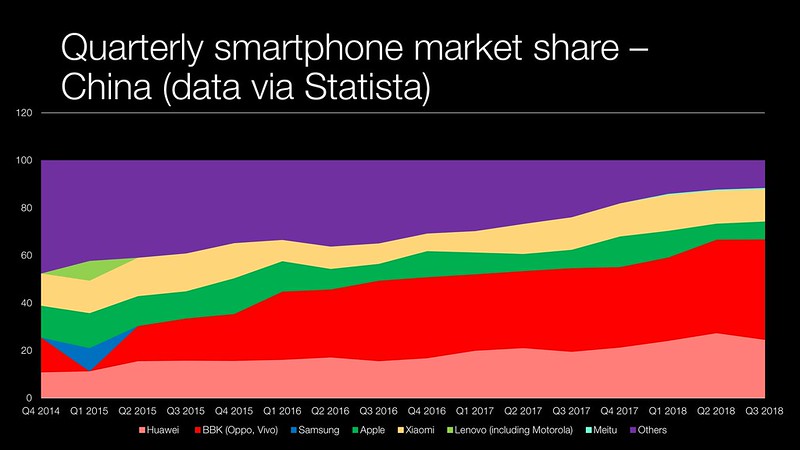
    Domestic brands have done a good job marketing themselves. BBK in particular are very interesting. Whilst Huawei makes lots of noise and bluster at how big they are, BBK creeps up. It has a number of brands in China and abroad OnePlus, Oppo, Vivo and RealMe going after particular segments. The brands are focused but run separately like companies in their own right. Apple’s marketing riffs on its global marketing (though it did a great Chinese New Year themed ad last year). This reinforces the perceived common view that foreign businesses are full of hubris and don’t sufficiently localise for China. Apple’s recent pricing strategy in a market where this is so little to show in value provided looks like the epitome of hubris.

    180120 - China smartphone market

    Finally, there has been a massive amount of consolidation of brands in the China smartphone market over the past four years. That provides for scale in terms of logistics, supply chain, design, component sourcing and marketing.

    Jaguar Land Rover

    If we move to the automotive sector and look at Jaguar Land Rover – their problems in China look self inflicted. China’s car market has declined for the first time in 20 years. But it seems to have mostly affected brands like Hyundai rather than prestige brands like Mercedes Benz or BMW. The reasons why aren’t immediately apparent. Yes diesel cars are less popular, but BMW, Audi and Mercedes make diesel cars.

    Jaguar Land Rover aren’t the only foreign brand suffering: Toyota has had problems in China since the last round of strong anti-Japanese sentiment exploded in 2012.

    More information

    Why Does WeChat Block Competitors, While Facebook Doesn’t? | Walk The Chat

    Apple’s China Problem | Stratechery

    Samsung recalls Galaxy Note 7 worldwide due to exploding battery fears | The Verge

    Samsung angers hypebeasts by partnering with fake Supreme brand in China | The Verge

    Fake News: Samsung China’s Deal With Supreme “Knock-off” Spurs Drama | Jing Daily

    Chinese car sales fall for first time in more than 20 years | World news | The Guardian