My interest in business or commercial activity first started when a work friend of my Mum visited our family. She brought a book on commerce which is what business studies would have been called decades earlier. I read the book and that piqued my interest.
At the end of your third year in secondary school you are allowed to pick optional classes that you will take exams in. this is supposed to be something that you’re free to chose.
I was interested in business studies (partly because my friend Joe was doing it). But the school decided that they wanted me to do physics and chemistry instead and they did the same for my advanced level exams because I had done well in the normal level ones. School had a lot to answer for, but fortunately I managed to get back on track with college.
Eventually I finally managed to do pass a foundational course at night school whilst working in industry. I used that to then help me go and study for a degree in marketing.
I work in advertising now. And had previously worked in petrochemicals, plastics and optical fibre manfacture. All of which revolve around business. That’s why you find a business section here on my blog.
Business tends to cover a wide range of sectors that catch my eye over time. Business usually covers sectors that I don’t write about that much, but that have an outside impact on wider economics. So real estate would have been on my radar during the 2008 recession.
What does success look like for PR campaigns? In public relations circles measuring success is as much a discussion point as the weather. The industry has attempted to deal with it. In this approach they generally have a goal to reach a singular solution. Rather like ‘how to write a press release’.
But in reality all measurement revolves around one question. What does success look like? It could also framed as:
What is the job required?
What is the problem to solve?
Measuring success then breaks down into four categories:
Outputs (how much activity has happened)
Amount of content
Paid, earned and shared distribution / reach including serendipitous engagement
Events / stunts
Outcomes
Views / opportunities to see / audience
Attendance
Followers
Propagation (shares, mentions, backlinks etc). One could also consider mentions or shares serendipitous engagement alongside comments or retweets
Competitor or category benchmarking (share of voice)
Trend-focused outcomes, where the rate of change is as important as absolute values
Sentiment – though measuring sentiment is time for an article in itself
Pre-and-post or regular stakeholder research (brand perception, talkability, recall, message penetration)
Referral traffic (normalised for seasonality and ongoing activity)
Back on February 9, 1996, John Perry Barlow wrote his declaration of of the independence of cyberspace. The declaration pointed out the folly of trying to govern something thought to be virtually ungovernable at the time.
Barlow first came to prominence writing lyrics for The Grateful Dead. His ethos came from the libertarian do your own thing ethic that underpinned much of the hippy movement. This probably come more naturally to Barlow than other people having grown up on a cattle ranch and being the son of the Republican politician.
By the time he wrote the about the independence of cyberspace; he was already had published extensively about the internet. He was on the board of directors of The WELL – an online community that sprang out of Stewart Brand’s back to the land influence catalogue of useful things The Whole Earth Catalog (The WELL stands for The Whole Earth eLectronic Link). He contributed to Wired magazine (founded by aging hippies Kevin Kelly and Stewart Brand), Barlow’s essay Economy of Ideas published in the March 1994 issue provides a clear view of the thinking that prompted him to write the declaration. He had already founded The Electronic Frontier Foundation with by John Gilmore and Mitch Kapor in response to a series of actions by law enforcement agencies that led them to conclude that the authorities were gravely uninformed about emerging forms of online communication.
The declaration was a reactionary document, brought upon by the 1996 Telecommunications Act in the US. The act eventually resulted in consolidation of US media ownership.
I suspect the similarities in style between the declaration and the Doc Searl’s et al later Cluetrain Manifesto are an intentional nod to Barlow on cyberspace.
A Declaration of the Independence of Cyberspace
by John Perry Barlow <barlow@eff.org>
Governments of the Industrial World, you weary giants of flesh and steel, I come from Cyberspace, the new home of Mind. On behalf of the future, I ask you of the past to leave us alone. You are not welcome among us. You have no sovereignty where we gather.
We have no elected government, nor are we likely to have one, so I address you with no greater authority than that with which liberty itself always speaks. I declare the global social space we are building to be naturally independent of the tyrannies you seek to impose on us. You have no moral right to rule us nor do you possess any methods of enforcement we have true reason to fear.
Governments derive their just powers from the consent of the governed. You have neither solicited nor received ours. We did not invite you. You do not know us, nor do you know our world. Cyberspace does not lie within your borders. Do not think that you can build it, as though it were a public construction project. You cannot. It is an act of nature and it grows itself through our collective actions.
You have not engaged in our great and gathering conversation, nor did you create the wealth of our marketplaces. You do not know our culture, our ethics, or the unwritten codes that already provide our society more order than could be obtained by any of your impositions.
You claim there are problems among us that you need to solve. You use this claim as an excuse to invade our precincts. Many of these problems don’t exist. Where there are real conflicts, where there are wrongs, we will identify them and address them by our means. We are forming our own Social Contract . This governance will arise according to the conditions of our world, not yours. Our world is different.
Cyberspace consists of transactions, relationships, and thought itself, arrayed like a standing wave in the web of our communications. Ours is a world that is both everywhere and nowhere, but it is not where bodies live.
We are creating a world that all may enter without privilege or prejudice accorded by race, economic power, military force, or station of birth.
We are creating a world where anyone, anywhere may express his or her beliefs, no matter how singular, without fear of being coerced into silence or conformity.
Your legal concepts of property, expression, identity, movement, and context do not apply to us. They are all based on matter, and there is no matter here.
Our identities have no bodies, so, unlike you, we cannot obtain order by physical coercion. We believe that from ethics, enlightened self-interest, and the commonweal, our governance will emerge . Our identities may be distributed across many of your jurisdictions. The only law that all our constituent cultures would generally recognize is the Golden Rule. We hope we will be able to build our particular solutions on that basis. But we cannot accept the solutions you are attempting to impose.
In the United States, you have today created a law, the Telecommunications Reform Act, which repudiates your own Constitution and insults the dreams of Jefferson, Washington, Mill, Madison, DeToqueville, and Brandeis. These dreams must now be born anew in us.
You are terrified of your own children, since they are natives in a world where you will always be immigrants. Because you fear them, you entrust your bureaucracies with the parental responsibilities you are too cowardly to confront yourselves. In our world, all the sentiments and expressions of humanity, from the debasing to the angelic, are parts of a seamless whole, the global conversation of bits. We cannot separate the air that chokes from the air upon which wings beat.
In China, Germany, France, Russia, Singapore, Italy and the United States, you are trying to ward off the virus of liberty by erecting guard posts at the frontiers of Cyberspace. These may keep out the contagion for a small time, but they will not work in a world that will soon be blanketed in bit-bearing media.
Your increasingly obsolete information industries would perpetuate themselves by proposing laws, in America and elsewhere, that claim to own speech itself throughout the world. These laws would declare ideas to be another industrial product, no more noble than pig iron. In our world, whatever the human mind may create can be reproduced and distributed infinitely at no cost. The global conveyance of thought no longer requires your factories to accomplish.
These increasingly hostile and colonial measures place us in the same position as those previous lovers of freedom and self-determination who had to reject the authorities of distant, uninformed powers. We must declare our virtual selves immune to your sovereignty, even as we continue to consent to your rule over our bodies. We will spread ourselves across the Planet so that no one can arrest our thoughts.
We will create a civilization of the Mind in Cyberspace. May it be more humane and fair than the world your governments have made before.
Davos, Switzerland
February 8, 1996
So two decades later, how does Barlow’s declaration stand in comparison that what’s actually happened? At first blush not very well. The digital economy outside China is dominated by an oligarchy of four main players: Amazon, Apple, Facebook and Google.
Scott Galloway’s presentation at DLD conference this year, highlights the winner take all nature of the online world. This is partially down to the nature of the online platform. Amazon grew to critical mass in the US as for a critical amount of time buyers didn’t need to pay state sales tax until state legislation started to catch up.
Zuckerberg and his peers marked a changing of the guard in Silicon Valley as yuppies took over from the the hippies.
Inside China there is a similar state-directed oligarchy of Alibaba, Tencent, Netease and Sina.
The oligarchy impact has been most pronounced in Europe, where consumer demand and a lack of effective competition saw Google go to 90+ percent in market share across the EU, when the US market share was less than 70 percent at the time.
Futurist and science fiction author Bruce Sterling summed it up rather well:
“Globalization” is over for 2016. We have entered an era of Internet Counter-Revolution. The events of 1989 feel almost as distant as those of 1789. The globalizing, flat-world, small-pieces-loosely-joined Internet is behind us, it’s history. The elite geek Internet could not resist those repeated tsunamis of incoming users.
It turned out that normal people like the “social” in social media a lot better than they ever liked the raw potential of media technology. In Russia and China in 2016, digital media is an arm of the state. Internet has zero revolutionary potential within those societies, but all kinds of potential for exported cyberwar. The Chinese police spy and firewall model, much scoffed at in the 1990s, is now the dominant paradigm. The Chinese have prospered with their authoritarian approach, while those who bought into borderless friction-free data have been immiserated by the ultra-rich.
In the USA it’s an older American story: the apparent freedom of Henry Ford’s personal flivver has briskly yielded to the new Detroit Big Five of Google, Apple, Facebook, Amazon, and, in last place, Microsoft.
In 2016, everything that looks like digital innovation, “big data,” “the cloud,” the “Internet of Things,” are actually promotional slogans that play into the hands of the GAFAM “Big Five.” Anybody who lacks broadband and a mobile OS is in deadly peril, especially the digital old-school likes of IBM, Cisco, Hewlett-Packard, Oracle… and the hapless TV networks, whose median viewer age is now in the 60s.
The GAFAM Big Five, the “Stacks,” will turn their wrath on the victims closest to them, well before they complete their lunge for control of cars and thermostats. However, their destiny is obvious. The rebels of the 1990s are America’s new mega-conglomerates. Google is “Alphabet,” Apple pruned the “computer” from its name, Amazon is the Washington Post. In 2016, that’s how it is, and in 2017, 189, 19, much more so.
So the not-evil guys are the new evil guys, but don’t be scared by this. It’s quite like watching the 1960s Space Age crumble from giant-leaps-for-mankind to launching low-orbit gizmos for profit. It’s comprehensible, it can be dealt with. Sure, it’s tragic if your head was in the noosphere, but if you have any historical awareness of previous industrial revolutions, this is really easy to understand. It’s already in your pocket and purse, it’s written on every screen you look at It could scarcely be more obvious.
Yes, Internet Counterrevolution is coming, much of it is here already, and it’s properly considered a big deal, but it’s not permanent. This too shall pass.
And this post hasn’t even touched on how government has looked to plug itself into all facets of online life in the interest of discovering terrorist plots, organised crime or paedophile rings. Assaults on cyberspace sovereignty are numerous, from Pakistan’s special editable version of YouTube to several governments looking for cryptographic backdoors.
At DLD 2016, you have a German politician talking about the mechanism of how the government needed to rollback citizen rights to privacy to give German start-ups a chance. In this winner takes all world, the beneficiaries are likely to be Google, Facebook Amazon and Microsoft rather than a local champion.
I started on this post in mid-January and scheduled it to go out on February 8, 2016. danah boyd also published on the declaration of Cyberspace and I recommend you go and check out here. More privacy related content here.
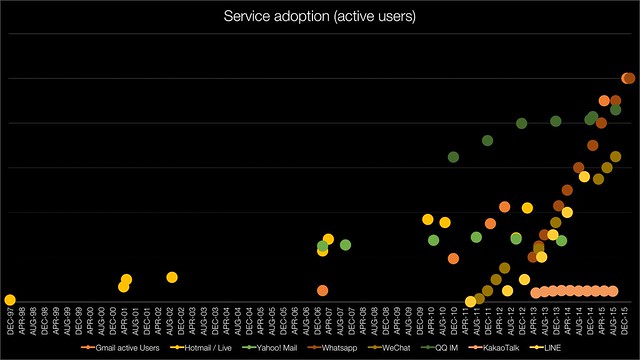
There was two announcements of services that had passed the billion strong user mark. There was a comparison between Gmail’s slow and steady approach versus Whatsapp’s swift rise.
Gmail was born as a desktop service first. It started just as web 2.0 was starting to take off. The service was invitation only for almost three years, before becoming generally available. At the time its 1GB of storage for free was revolutionary. A year later they increased the storage to 2GB. By comparison I was paying £60 a year for an IMAP mail account that was separate to my ISP. Hotmail would give you just 4MB of storage in your email.
Gmail set the standard for our expectations of email. Now email accounts will accept 25MB attachments – a standard set by Gmail. My corporate email account has a 1GB capacity copying Gmail at launch.
Yahoo! had to compete and responded with ‘unlimited storage’ after Gmail became generally available. By this time Gmail storage had grown to 2.8GB and Live.com gave 2GB. In the space of under three years Gmail had grown to 51 million users.
This was still an era when smartphones weren’t ubiquitous in the same way that they are now. I was fortunate to have mobile email access on my Nokia and Palm smartphones around this time. BlackBerry devices were a business tool, as was Windows Mobile. Data was more expensive and slower than it is now. Although Yahoo! Messenger was available on my phone it was slow. Skype worked best as an indicator of presence on mobile devices.
Smartphone ubiquity through Android and iOS was an enabler for email adoption. But Gmail didn’t receive the same boost from it that Whatsapp did.
If you didn’t have a Gmail account you could still send and receive emails to Gmail account holders. Early adopters of smartphones are likely to have already had an email account. So they would increase user engagement through accessiblity. But they would not drive a similar growth in new accounts.
Whatsapp benefited from being a closed service – you can’t message a WeChat account. Also it rode smartphones as an accelerator, it didn’t have a legacy desktop user base.
Another factor is that its competitors managed to monetise their services earlier. This was at the expense of international adoption. An extreme example of this is Korea’s KakaoTalk.
KakaoTalk has built an absolute ubiquity in South Korea. It has continued to growth beyond 90 per cent of Korean mobile users. Profitability has increased, new services launched; whilst global user numbers declined.
WhatsApp has grown fastest towards its billion strong user base in markets that are hard to monetise. It is big in Latin America, Africa and South Asia. It is only starting to build in features for brands.
Not all users are equal, many present little business opportunity for internet companies. I remember when Yahoo! was rolling out the ‘unlimited’ storage email account; it was actively discussed only providing the feature in developed market accounts rather than all users. The billion strong user base is an interesting measure, but requires further interrogation. More WhatsApp related content here.
Chips on their shoulders | The Economist – THE Chinese government has been trying, on and off, since the 1970s to build an indigenous semiconductor industry. But its ambitions have never been as high, nor its budgets so big, as they are now. More on semiconductors here and on China here.
Does Better Internet Access Wind Up Disenfranchising Lower Income Groups? – As counterintuitive as it seems, reducing the digital divide isn’t necessarily beneficial: Our results show that participation in local elections has dramatically declined in recent years, in part as the internet has displaced other media with greater local news content
You can read elsewhere about Twitter troubles, I have linked to some of the best analyses I found out there at the bottom of this article.
If you don’t have time to go through the the analyses around Twitter troubles, here’s the ‘CliffsNotes’ version:
Management turnover. Three different heads of engineering in 18 months, five different product leads in the past two years, three CFOs in 18 months and 2 COOs (mainly because the role was left vacant for over 12 months)
Growth in user numbers has been stagnant in the U.S.. The three published quarters of 2015 showed U.S. active users at 66 million. The last two quarters of 2014 were steady at 64 million
Growth in user numbers globally has been a modest 11 percent. Growth outside the U.S. was just 13% year on year in quarter three of 2015
James Whatley and Marshall Manson called the user number plateau ‘Twitter Zero’.
The ‘Promoted Moments’ advertising option is confusing to look at
Will it, won’t move beyond 140 characters
Algorithmic filtering of the timeline
Utility of the news feed is becoming diminished for the digerati
Likely reduction in user engagement
Likely uptake in bot content publication
Inability to deal with community issues like #Gamergate
Twitter’s auto-playing videos are barely more than a rounding error in the battle between YouTube and Facebook for video supremacy
What less people are talking about is what Twitter troubles means beyond Twitter.
Advertising purchases are a near-zero sum game. Facebook and other high growth native advertising platforms gain from Twitter troubles. But for marketers this is not all good news. Facebook is poor at giving marketers actionable insights and intelligence. There is no Facebook firehouse of data. Facebook only provides aggregated data.
The OTT (Over The Top) messaging platforms (WhatsApp, WeChat, LINE, KakaoTalk, Kik) are data black holes. Commercial dashboards on some accounts allow you to see how your account is doing. There is no insight of what is happening across accounts. There is no measure of influence beyond follower numbers and click-throughs.
Twitter troubles with declining relevance, has a direct effect on social media monitoring and analytics platforms.
Social media analysis of Twitter data is widespread. From consumer insights / passive market research to brand measurement and financial trading models.
I had seen data which showed a direct correlation between brand related market research conducted by respected market research firms and social media analysis using Twitter data. The implication of this was that Twitter data could provide a more cost effective alternative.
All of these research benefits are moot if Twitter is in decline or becoming irrelevant.
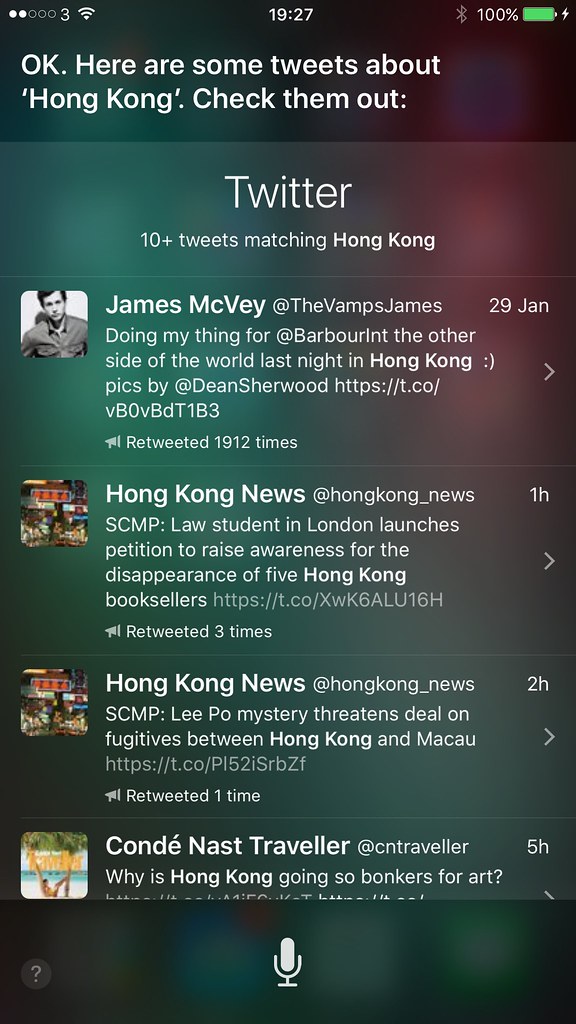
Twitter data has its use beyond market research. It is the source of breaking news for the western media. Twitter’s firehouse also goes into making smarter phones. Apple’s Siri sources Twitter content to answer news-related requests.
A poor performing Twitter has implications across the tech sector beyond online advertising. There are no obvious substitute solutions for its data waiting in the wings.
Perhaps Twitter’s earning’s call on February 10 will give a hint of improvements at the company. But I wouldn’t bet on it. More related content here.