Category: business | 商業 | 상업 | ビジネス

My interest in business or commercial activity first started when a work friend of my Mum visited our family. She brought a book on commerce which is what business studies would have been called decades earlier. I read the book and that piqued my interest.

At the end of your third year in secondary school you are allowed to pick optional classes that you will take exams in. this is supposed to be something that you’re free to chose.

I was interested in business studies (partly because my friend Joe was doing it). But the school decided that they wanted me to do physics and chemistry instead and they did the same for my advanced level exams because I had done well in the normal level ones. School had a lot to answer for, but fortunately I managed to get back on track with college.

Eventually I finally managed to do pass a foundational course at night school whilst working in industry. I used that to then help me go and study for a degree in marketing.

I work in advertising now. And had previously worked in petrochemicals, plastics and optical fibre manfacture. All of which revolve around business. That’s why you find a business section here on my blog.

Business tends to cover a wide range of sectors that catch my eye over time. Business usually covers sectors that I don’t write about that much, but that have an outside impact on wider economics. So real estate would have been on my radar during the 2008 recession.

  • The sale tag

    The sale tag is like manna from heaven for my Mum. She loves a bargain and looks forward to sales at her local stores.

    Like many people she suspects that some stores may put in special stock that they have shipped in to sell especially at this time amongst items that have just not sold.

    Allied Carpets was often the butt of jokes for its never-ending sales, but thought of as the exception rather than the norm.

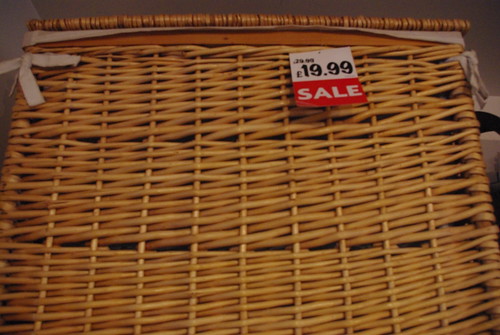
    Sale basket in Shenzhen

    A friend here in Shenzhen got this basket from a market here. The markets are usually full of production overruns and samples. I managed to pick up a couple of genuine North Face Basecamp duffle bags for 30 percent less than UK retail.

    What I found interesting about this particular item was that it had a UK sale tag attached.It reads £29.99  £19.99 SALE.

    My initial reaction was how can it be reduced if it hasn’t even reached the shopfloor yet? It was an interesting proof-point of how retailers play customers as chumps. By all means enjoy bargain hunting but don’t believe the SALE tag hype. From what my friend told me about the production overrun market; the retailer in question (Woolworths) seemed to have vastly overestimated British consumer demand for rattan laundry baskets.

    My friend had the basket for a few years. I was writing this post almost a year to the day after Woolworths Group had gone into administration, closing its stores across the UK. More retailing related content here.

  • Google Music China

    I spent some time in Shenzhen and tried the Google Music China service. It was unlike anything else I have seen and was designed especially for consumers in mainland China.

    Google Music China

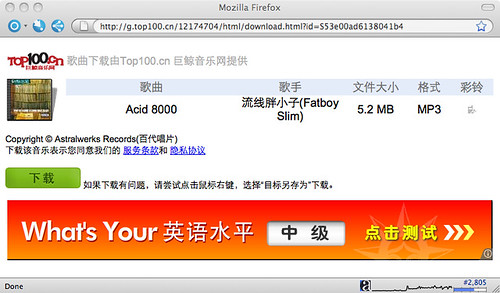
    Google Music China is impressive in terms of the size of its catalogue and ease-of-use. You have a mix of western artists and Chinese artists on the service. There didn’t seem to be a lot of censorship going on. You could download the full expletive riven Eminem experience. The music is downloaded into your computer as MP3 files and doesn’t have any DRM on it. I put it into my iTunes library. The service is powered by a Chinese partner for Google, which becomes apparent when you look at the URL on the page for an individual track.

    There didn’t seem to be a restriction on the amount of music that you could download. I got a mix of material from jazz to techno including a number of albums by The Jazz Messengers.

    Much of the music seems to have been licensed through the US right holders of the music; such as this Astralwerks license for a Fat Boy Slim track below.

    The service is free, in that I didn’t have to pay per track, or pay a subscription. Instead the music is ad funded with display ads as shown below.

    Google Music banner ad

    I do wonder what the click through rates are on the adverts that periodically get vended on the service?  More China-related content here.

  • Stussy Bearbrick

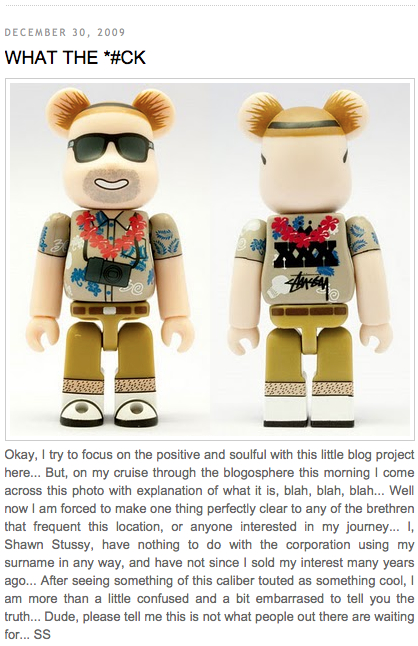
    Shawn Stussy just threw down on a Stussy Bearbrick. Admitted the Stussy Bearbrick looks pretty lame. Imagine if you set up your own company and you named after yourself because you signed all your work. Over time your signature became the most valuable design asset of the company. Over time you decide that you want to take some of your hard earned cash, take time out and do the stuff that you actually enjoy. You leave your business, having been bought out.

    However, you then have the problem of seeing your name plastered over absolute tat.

    taking your name in vain

    Welcome to Shawn Stussy’s world. They guy invented streetwear as we know it. He mixed American classics like the oxford cotton button down, denim and t-shirts together. On top of that he added American workwear beloved of surfers.  Shawn also got Japan and what they could bring to the table back when everyone else was just thinking about Sony.

    And then the copy and paste aspects of punk culture. There is a reason why Stussy designs come off like old school fanzines. They both come from a common cultural route. The backward SS was a homage to Chanel. The repeating pattern a nod to the luxury brands from Gucci and Louis Vuitton to MCM.

    Supreme, Palace, Neighborhood, Off-White all are following in his footsteps.

    I am a big Stussy fan and it is a rare season where I don’t buy something from their collection. It is hard to keep banging out new streetwear, season after season, even when you’re delving into an archive like Stussy has.  But some of the stuff ends up being pretty ropey and I sympathise with Shawn Stussy’s predicament. Which is why I look forward to seeing what his long-awaited new venture S-Double Studios will come out of the trap with. More on luxury here.

  • Saab

    Saab has been a pioneer in the automotive sector and it is now facing imminent death in the car business. Saab made the first production cars with safety belts, the first headlight washer and wiper facilities, the first impact absorbing bumper, pioneered pollen filters in the air system of its cars and the first CFC-free climate control. Saab along with the Mercedes S-Class it has had a disproportionate impact on the modern car.

    I have a personal attachment to the Saab brand. I can still remember the smell of the interior of a family friend’s Saab 99, the brooding brow over the dashboard that the VDO instruments used to look out from, the heated seats and the ignition key that also locked the gear box.

    stig_blomqvist_rally99

    Motorsport, in particular rallying was the preferred sport of my Dad and my hero didn’t wear a polyester Liverpool shirt, but a set of fireproof overalls. His name is Stig Blomqvist, one of the most talented men ever to get behind the wheel of a car. He has competed successfully in circuit racing and rallying for the past 38 years.

    saab_rally_99T

    Blomqvist’s vehicle during the late 1970s was a Saab with a distinctive avant-garde paint job that caught my imagination as an 8-year old. With the rise of four-wheel drive, he then moved to Audi, and my team allegiance went with him – when Saab bowed out of top flight rallying. But that avant garde paint job still has a place in my heart.

    Saab is now staring oblivion in the face. A financial rescue has been scuppered and the car company is likely to be consigned to the annals of history. At this point Saab reminded me of Apple circa 1996, however one thing Apple had in its darkest hours were fans of the Macintosh platform. I can remember when having an Apple Mac wasn’t cool, but marked you out as a bit of weirdo.  I know, I was one of them weirdos; and thankfully the company is still around making insanely great products that shows my loyalty was not misplaced.

    If I was a potential saviour for Saab; not even a business plan by the best brains from Goldman Sachs would persuade me after reading feedback from the loyal members of the New York Saab Owner’s Club by Michael Corkery on the Deal Journal blog on the Wall Street Journal online.

    Some of the things that caught my eye:

    1. …there are some guys in the club who are going to say : ‘good riddance they haven’t made a good car in a long time.’
    2. There are some vintage guys in the club who say that Saab hasn’t made a good car since 1999…
    3. Over the last few years club members have started bringing their non-Saab cars to meetings. It speaks to the fact that Saab has gotten away from what made them a fun driving car.
    4. There are some people who work with me and will ask for car advice. But unless they are a car person, I won’t recommend Saab. I don’t want them to come back and yell at me.

    I wouldn’t even like to guess what the net promoter score is amongst some of Saab’s long-suffering fans. Saab has lost what it was to its customers. It was no longer authentic, this isn’t about globalisation; its about a company and its brand losing its soul. This happened whilst the company was a completely-owned subsiduary of GM. General Motors is ultimately responsible for management decisions that didn’t just destroy shareholder value and brand value, they nuked it.

    The only bit of Saab that remains is in the camaraderie of the club and vintage vehicles. Graham Brown frequently talks about authenticity being the keystone for successful youth marketing, its also true for marketing to the not-so-young. More on brand related posts here.

  • Free – The Future of a Radical Price by Chris Anderson

    Free owes a debt to work done by some of the early team at Wired magazine. Encyclopedia of the New Economy by John Browning and Spencer Reiss was originally published as a three-part work in Wired magazine back in 1998. Step forward a decade or so and current Wired magazine editor Chris Anderson has been explaining some of the key concepts for his readers. The Long Tail was his first effort at this missonary work and Free – The Future of a Radical Price is his latest effort.

    I may be the wrong person to review Free because I am not the target audience. Alongside  generation-Y, I am 0ne of those people who think that its perfectly natural to have a colossal photo album on steroids in flickr, a digital memory in delicious and the world’s largest library in Google all for free (or near as damn it).

    Try explaining these economic concepts to my Mum and Dad however and you will find this tougher going: Free is aimed at people like my parents and Rupert Murdoch who don’t quite get what is going on and how best to harness it. With this audience in mind Anderson takes us on a journey of Free which is part light magazine content a la Alan Whicker and part-intellectual a la Bamber Gascoigne.

    Some of the book gave me a deja vu from Anderson’s early work The Long Tail, in particular the example about the Anderson household’s preference for DIY stop-motion animation versions of Star Wars scenes on YouTube over George Lucas’ works on DVD, (I am with them on that one, the dialogue Lucas came up should put him on trial for crimes against cinema).

    Anderson spins a good yarn, but chances are that if you read this blog on a regular basis, Free is way below your ‘web-literacy’ age.