Category: consumer behaviour | 消費者行為 | 소비자 행동

Consumer behaviour is central to my role as an account planner and about how I look at the world.

Being from an Irish household growing up in the North West of England, everything was alien. I felt that I was interloping observer who was eternally curious.

The same traits stand today, I just get paid for them. Consumer behaviour and its interactions with the environment and societal structures are fascinating to me.

The hive mind of Wikipedia defines it as

‘the study of individuals, groups, or organizations and all the activities associated with the purchase, use and disposal of goods and services.’

It is considered to consist of how the consumer’s emotions, attitudes and preferences affect buying behaviour. Consumer behaviour emerged in the 1940–1950s as a distinct sub-discipline of marketing, but has become an interdisciplinary social science that blends elements from psychology, sociology, social anthropology, anthropology, ethnography, marketing and economics (especially behavioural economics or nudge theory as its often known).

I tend to store a mix of third party insights and links to research papers here. If you were to read one thing on this blog about consumer behaviour, I would recommend this post I wrote on generations. This points out different ways that consumer behaviour can be misattributed, missed or misinterpreted.

Often the devil is in the context, which goes back to the wide ranging nature of this blog hinted at by the ‘renaissance’ in renaissance chambara. Back then I knew that I needed to have wide interests but hadn’t worked on defining the ‘why’ of having spread such a wide net in terms of subject matter.

  • My ‘Kindle brain’

    Kindle brain reminds me of a story of my friend. One of my friends had everything: a great husband second time around, a young healthy family, a nice house in a good neighbourhood and a great standard of living. I visited her when she was still on maternity leave and the afternoon went well, but one thing stuck in my mind: the concept of ‘baby brain’ – that she described where her thinking was somehow deficient and may be a liability in a work environment.  That phrase has stuck with me recently.
    Kindle 3
    Since moving to Hong Kong, I de-cluttered my life and sold or recycled the library of books I had built up previously, keeping on a small amount of them. My notes that I made in Moleskine books were scanned and stored in the cloud, you can see some of them that were used for blog posts like this on my flickr acount.

    My desire to read hasn’t stopped and Instead I have ended up buying new books electronically. I first noticed the change that was coming from my new reading habit when I found that I was reviewing less books on this  blog. The reason for that was quite simple; I was reflecting less on what I read electronically and was less engaged by it. Ideas were not having the same impact. What one article called ‘Kindle brain’.

    This phenomena has implications for electronic reference books and learning. It isn’t only books that people have noticed this effect. Business cards have made a comeback, from a previous future of ‘beaming’ contact details over IrDA or BlueTooth between devices. Artifacts seem to give content meaning and impact.

    More information
    Your paper brain and your Kindle brain aren’t the same thing | Public Radio International
    Why Startups Love Moleskines – The New Yorker
    In search of objects — Benedict Evans
    Rolodexes: A thing of the past? | Marketplace.org
    Rob Manuel » Blog Archive » In Praise of CDs

  • HSBC PMI + more things

    HSBC PMI

    HSBC will no longer provide one of the best gauges of China’s economy – Quartz – but hopefully someone else will step up to do the sponsorship instead. The HSBC PMI measure was the most reliable economic measure coming out of China that was wasn’t skewed by state-owned enterprises (SOEs). SOEs get easy state bank loans where as the private SMEs that the HSBC PMI looks at don’t have that advantage and so provide a ‘truer’ picture of what is actually going on. Does this mean a longer term difficult position for HSBC as well as transparent economic data like the HSBC PMI?

    China

    Born Red – The New Yorker – interesting profile of Xi Jinping

    Culture

    Check out MelodySheep’s album on Bandcamp. More culture related content here.

    483 lines by Seoul-based Kimchi and Chips is a welcome break from 3d projection mapping for interesting visualisations. It reminds me of the work Troika turn out

    Economics

    A generation from now, most of the world’s GDP will come from Asia | Quartz – get ready for the new order of things

    FMCG

    I was doing some research and came across the collaboration between MelodySheep and General Mills to remix Lucky Charms adverts. His interpretation shows a darker side to the kids hunting for Lucky Charms

    Innovation

    SoftBank Robot Pepper Sells Out in a Minute – Japan Real Time – WSJ – via Aldebaran Robotics (paywall) – much of this is about Japanese culture’s positive reception to robots as it is to the quality of Pepper itself. There are other robots that can fill a similar kind of customer service role. Its really worth reading about how Japanese consumers interacted with their Sony Aibo

    Japan

    This wonderful film of Tokyo by Brandon Li which somehow feels as if it should be a Guinness advert, partly due to the narration by Tom O’Bedlam

    It is interesting how the Guinness brand has came to own strong storytelling in advertising.

    Media

    Cannes: Google’s agency-sales head wants to push creativity – Campaign Asia – ZOO – Google’s creative agency butts up against agencies to get creative briefs (paywall)

    Online

    2015/16 Fixture List Released | Barclays Premier League – interesting that the FA are recommending match-by-match hashtags to build conversations on Twitter

    I have been using Ben Haller‘s Fracture fractal screensaver for almost as long as I have used Mac OS X (back when it was called Puma). Michael Clark has a site for images used creating Fracture called Fractal of the Day with achingly beautiful tripped out abstract images. The Mac has traditionally been a home to lots of passionate small software development companies who code thoughtful apps. These apps then build a passionate user community around them.  
    mandelbroitset

    Security

    GCHQ spies discredit targets on the internet – Business Insider – about what I would expect them to be doing. More security related posts here.

    Technology

    I, Cringely The U.S. computer industry is dying and I’ll tell you exactly who is killing it and why – I, Cringely – cloud computing is economics not innovation

  • Quibb + more things

    Why aren’t App Constellations working? Quibb members share some diverse opinions | Quibb – interesting that there are only US examples used in the Quibb research. There are wider issues with some of the companies mentioned especially Foursquare and the app constellations that they are building according to Quibb

    Beware the Listening Machines – The Atlantic – Orwell was only a few decades out?

    Royal Mail to deliver junk mail to shoppers after clicking on a product online | Daily Mail Online – offline retargeting

    Oculus Rift Inventor Palmer Luckey: Virtual Reality Will Make Distance Irrelevant (Q&A) | Re/code – better video conferencing and gaming sound like initial big applications

    Amazon’s New Plan to Pay Authors Every Time Someone Turns a Page – The Atlantic – novelists go with Gawker Media-esque model

    Apple Pay Coming to MBNA Customers in the UK | MBNA – interesting that MBNA is pushing this release directly out to consumers via email marketing

    Google’s DeepMind uses Daily Mail to teach computers how to read human language | Daily Mail Online – its actually about the bullet point summaries, but I can’t help feeling we are about to get screwed over by terminators with a fascist political outlook

    A Robotic Dog’s Mortality – The New York Times – dealing with loss as your Aibo no longer works and can’t be serviced (paywall)

    Kids like to beat up robots | Fusion – Half of the devil-children said they perceived that the robot seemed pained and stressed out by what they were doing to it. But they were unbothered by this, because children are evil.

    6 reasons killing off Yahoo Pipes was a bad idea | VentureBeat – interesting piece on the pervasive influence of Yahoo!’s shuttered Pipes product. More online related content here.

    China Inc is leaving Wall Street for wrong reason | SCMP – market arbitrage play, privatise in the US, sell at a higher price on the Chinese stock markets (paywall)

  • The silent majority of social

    The silent majority as a concept was introduced to the world by Richard Nixon in a speech about America’s position in Vietnam on November 3, 1969.

    1969 Official Visit Of President Richard Nixon To Saigon


    The portion of the speech that featured it is below:

    Let historians not record that when America was the most powerful nation in the world we passed on the other side of the road and allowed the last hopes for peace and freedom of millions of people to be suffocated by the forces of totalitarianism.

    And so tonight-to you, the great silent majority of my fellow Americans-I ask for your support.

    I pledged in my campaign for the Presidency to end the war in a way that we could win the peace. I have initiated a plan of action which will enable me to keep that pledge.

    Nixon’s ‘silent majority’ reference tapped into a tenet of common wisdom, that the majority of the population is generally passive in actions and discussions; a positive spin on Juvenal’s concept of bread and circuses or panem et circenses. He used the phrase to decry the selfishness of ordinary Roman citizens, their neglect of wider concerns and likely lack of civic duty.

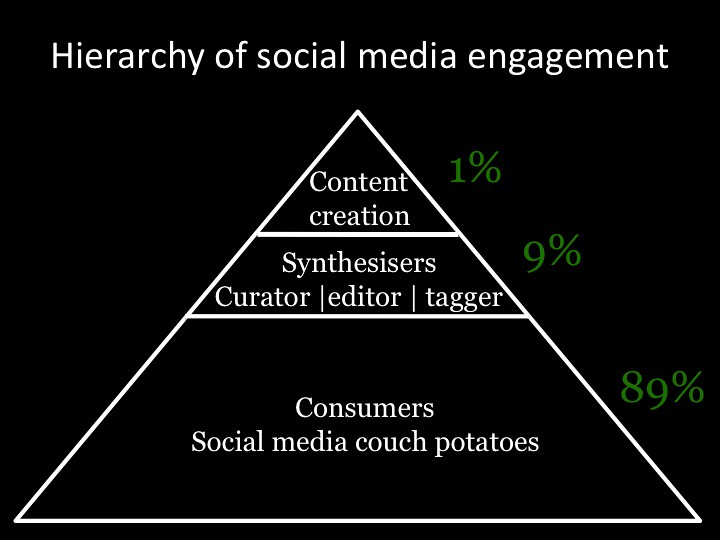
    There is a similarly silent majority today online, in spite of the democratisation of publication via social channels. A small proportion of us publish. I got the model below from Bradley Horowitz at Yahoo! but I am sure it came from someone earlier and it still holds true today
    hierarchyofsocialmediaengagement
    What this means is essentially two things:

    • Whilst the volume of social postings continues to go up, it still represents a small amount of the general population and even the online population. Most of the people, most of the time are passive consumers of social content
    • When people do post content, it isn’t generally about brands or important issues, but about being with their friends or family. They look inwardly on their lives

    Social conversation is often the province of the highly connected, the verbose and of polarised opinions (complaining about a product that really got under their skin with poor performance or fanboydom).

    Ironically search data probably tells us more about the population in general, the problem that search presents marketers with is quality of data. The major search engines (Google, Bing/Yahoo!, Yandex) no longer provide web sites with the details of the search term used to arrive on a given site as they have defaulted to HTTPS.

    Google Trends has decided to give ‘real-time’ data rather than the few days delay it previously provided on search terms. Google Trends doesn’t provide search volumes, but search ‘rate of change’ which means that static low or high search volumes won’t register. But its the closest we have online into easily understanding the nature of the silent majority of social; what they are interested in and care about.

    More online related content.

    More information
    Nixon’s ‘Silent Majority’ Speech
    Google Trends Now Shows the Web’s Obsessions in Real Time | WIRED

  • Brand storytelling: a bitter pill to swallow?

    I have been thinking about brand storytelling after watching Adam Curtis’ Bitter Lake over the weekend which is ostensibly trying to tell the story of Afghanistan from then end of the second world war to today. But it is also a parable on how the simplicity of storytelling used by the political classes to get the populace on side in the west has been ultimately counterproductive. This counterproductive nature of it, made me think about brand storytelling, that is often simple to aid both delivery and effectiveness.

    I have worked for businesses since the mid-noughties that put brand storytelling at the centre of offerings – often using simple mono-myths as models. In addition, my colleagues at one agency took this a stage further and sold their services as building on the ‘best practice’ of winning political campaigns – if you like Ogilvy on Advertising but written by Tony Blair, Bill Clinton and George W Bush.

    The truth is that our relationships with brand is often more complex and shifting than we has marketers let on. Brands have symbolic and status power which changes over time. The question that Bitter Lake seeded in my mind, is brand storytelling actually going to breed a future set of consumers with little to know brand engagement? Where brand values become a mill stone rather than a touch stone? It’s too early to tell and I don’t know the answers if it did happen, though my gut says going to an approach of radical honesty. More branding related content here.

    More information
    Bitter Lake | Wikipedia