Category: consumer behaviour | 消費者行為 | 소비자 행동

Consumer behaviour is central to my role as an account planner and about how I look at the world.

Being from an Irish household growing up in the North West of England, everything was alien. I felt that I was interloping observer who was eternally curious.

The same traits stand today, I just get paid for them. Consumer behaviour and its interactions with the environment and societal structures are fascinating to me.

The hive mind of Wikipedia defines it as

‘the study of individuals, groups, or organizations and all the activities associated with the purchase, use and disposal of goods and services.’

It is considered to consist of how the consumer’s emotions, attitudes and preferences affect buying behaviour. Consumer behaviour emerged in the 1940–1950s as a distinct sub-discipline of marketing, but has become an interdisciplinary social science that blends elements from psychology, sociology, social anthropology, anthropology, ethnography, marketing and economics (especially behavioural economics or nudge theory as its often known).

I tend to store a mix of third party insights and links to research papers here. If you were to read one thing on this blog about consumer behaviour, I would recommend this post I wrote on generations. This points out different ways that consumer behaviour can be misattributed, missed or misinterpreted.

Often the devil is in the context, which goes back to the wide ranging nature of this blog hinted at by the ‘renaissance’ in renaissance chambara. Back then I knew that I needed to have wide interests but hadn’t worked on defining the ‘why’ of having spread such a wide net in terms of subject matter.

  • Trends and fads

    Why trends and fads?

    Why trends and fads came about as a post, was that I was scrolling on my LinkedIn notifications on a Saturday (I know, I know I should keep my life free of this crap on the weekends.) Creative Review were talking about how trend forecasting had become rusty, but that got me thinking about did they understand the difference between trends and fads?

    A good deal of what I see described as trends are fads, which then got me wondering about how do I help people differentiate between trends and fads.

    Why has it become harder to differentiate likely trends and fads?

    I would argue that the difficulty in differentiating likely trends and fads is down to a few reasons.

    • The nature of culture has changed. It has become massively parallel in nature. This has in turn impacted trends
    • Culture has become elongated in nature.
    • The changing nature of culture means trends surface and submarine again over time.

    Mass to massively parallel.

    Culture has become massively parallel. Culture and its nature has been transformed over the last century. There were a few sub-cultures at best that mattered at a given given moment in time.

    The idea of the ‘teenager’ which was the first attempt to carve out a new generation was done in the post-war affluence of America and latterly European countries, Japan and Korea as economic development took hold. We might use different language now, but teenagers were the engines for the sale of goods and services:

    • New music
    • New spaces (gaming arcades, fast food restaurants, coffee shops, instant messaging platforms, social platforms)
    • New fashion looks (mods, rockers, greasers, ravers, emo, gorpcore etc.)

    At the time, the mass media helped facilitated the propagation of a mass culture. A few music publications, radio stations, newspapers and TV stations could make a break an artist. We can see this over time with the power of Johnny Carson, Merv Griffin or Ed Sullivan in the US, Gay Byrne and Gerry Ryan in Ireland or Top of the Pops and Pete Tong in the UK.

    Ed Sullivan introduces The Beatles.
    Paul McCartney remembering the 1964 show.

    However a combination of economic improvement and technology saw the mass media broaden with countless publications, TV channels, radio stations, websites and social channels until it is no longer ‘mass’ in nature.

    Add to this, the world got smaller. Travel while still expensive became cheaper from the 1970s and 1980s onwards allowing more people to discover culture from elsewhere. And this was despite a massive surge in the price of oil due to troubles in the Middle East. So trends and fads moved around the world. Liverpool lads brought the ideas of sports casual dress from Spanish and French department stores, Japan borrowed various parts of Americana and streetwear, hip hop went around the world.

    The connectivity from the worldwide web put this in overdrive. A world of culture opened up making things massively parallel, which allowed people to pick and choose their own cues. These choices gave us massively parallel culture and resulting trends.

    Culture has become elongated in nature.

    I have friends (and associates) in their late 50 and early 60s who DJ, surf, skateboard and do martial arts. These were people who remember club nights before house music let alone EDM, who can remember the first skate parks being built in the UK and knew of Stüssy because they were part of the original Stüssy tribe of interesting folks formed by Shawn himself.

    People who might listen to Radio 4 on occasion, but are still cooler and more culturally relevant than many teenagers. Probably more culturally relevant than their college age kids.

    This cultural elongation is something that we’re starting to see gen-z obsessed agencies. A good example of this is ZAK Agency’s Learn To Time Travel white paper. Part of it has been down to life stages happening later for each generation; or not at all.

    • Moving out on your own.
    • Settling down.
    • Having children.
    • Buying their own home.
    • Being able to afford to retire.

    Part of it is down to the world norms changing. I seldom have had to wear a shirt and tie, or suit to work. My Dad wore a tie right up until the mid-1980s to work, because that was expected of him. He wasn’t a banker, but a shipyard worker. Athletes can potentially stay in peak condition for longer, all made possible by the modern world.

    Despite what we believe about technology usage, for those who are 70 or younger, income influences tech adoption as much as age related knowledge. Giving all of us access to as much culture as we can mainline.

    Fads

    If you hear the phrase ‘TikTok trends’ that are fast-changing, it’s a clue that it’s likely to be a fad unless by some blessed miracle it sticks. In the 20th century, fads were often easier to spot and the 1970s in particular were a gold mine for the fad spotter.

    Fads appear, go large and then disappear. They are ethereal in nature, rather like most TikTok trends. The Pet Rock is a prime example with its swift rise and demise.

    Pet Rock

    Northern California-based copywriter Gary Dahl came up with the idea of a pet rock. Essentially adhesive googly eyes attached to a rounded pebble that might feel pleasing in your hand for skimming across a body of still water like a lake. Dahl’s insight came from sitting with friends in a bar and listening to complain about the challenges of pet care.

    Dahl started off his project by writing a satirical pet care manual for a rock, based on the kind of care guide a veterinarian might have for a new dog owner. This included on tips for when your rock was feeling anxious.

    The rock came with the instruction book for care, it sat in a nest of long wood shavings inside a card carrying crate with a handle on top and seven vent holes on each side.

    gary-dahl-2

    Dahl put his product into the market in August 1975. Dahl was apparently selling 10,000 rocks a day and it became a gag gift over the Christmas period with estimates on sales as between 1 million to 1.5 million genuine rocks. By February 1976, they started to need discounting. Dahl ploughed his profits into opening the Carry Nation’s bar in Los Gatos, which is still there.

    The Pet Rock was clearly a fad, yet it did inspire my junior school art teacher to get us to collect stones from a visit to the beach, stick googly eyes on them and varnish the whole lot. Some were brought home and the rest sold at the school fair. Dahl wasn’t able to patent his idea. As far as I know around 2010, someone started an abortive business replicating Dahl’s packaging design and rocks.

    Dahl built his freelance copywriting business up into an agency that produced radio and television ads for local businesses including wireless providers, technology firms and dot coms. The reason for this was that Campbell had been living in the Silicon Valley area as it grew up into what we know today. Dahl even wrote the For Dummies guide on advertising in 2001, which is still available today and is a good primer on the process. Dahl passed away in 2015.

    Trends are resurgent, surfacing and submarining over time.

    Take the idea of cocooning in our own soundscape as an example of a resurgent trend. If you go on the public transport headphones or AirPod type earphones are ubiquitous. If you go and work in an office, you will see a similar set up. Prior to the rise of the AirPods it would have more likely been Sony or Bose over-ear headphones rather than wireless AirPods.

    Back in the early 1970s, my Dad took the train down to London while listening to a collection of cassettes he’d made of his record collection. The trip was one he occasionally made for the shipyard where he worked at the time. It was a long slow train journey. We had a bulky luggable cassette player similar to the one below and he wore a pair of headphones bought in Liverpool that looked like sturdy ear protectors. The tape machine was more designed for basic portable recording such as a manager recording a memo to be typed up. They were occasionally pressed into service in a similar way to my Dad’s usage.
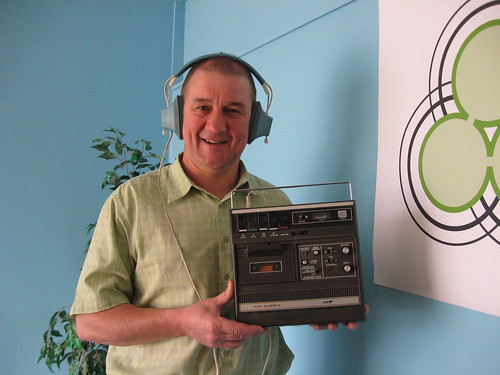
    Old personal stereo
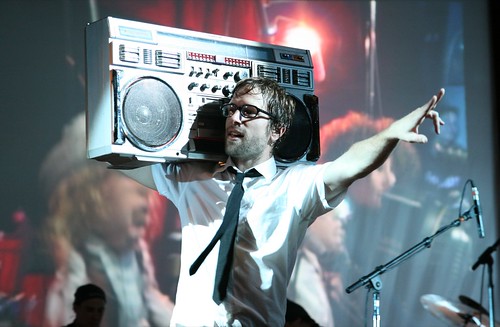
    Around about the same time, luggable stereos were being made by European manufacturers including Philips and Grundig. Soon after that Japanese manufacturers like Sharp, Sony and Panasonic released their own versions which were very successful. These were cemented into culture by young Americans who valued their portability and bass response.
    Beck at Yahoo! Hack Day
    Beck at Yahoo! Hack Day with a boom box

    Boomboxes weighed a lot, Sony provided an alternative with the Walkman and eventually the Discman. These were portable cassette and CD players respectively which offered personal listening with headphones. These were briefly joined by MiniDisc players.

    Around about the time when the web started to take off, you had early MP3 players such as the Rio series of machines and the CreativeLabs Nomad. But things took off with the Apple iPod, offering a new level of personal audio freedom.

    San Fran - ipod advert & Jim

    Eventually a confluence of the smartphone as digital Swiss Army knife and BlueTooth wireless standards provided us with our current personal audio freedom.

    Cocooning is just one example. As far back as the post-war era we have seen military surplus clothing go in and out of style. Thrifting has taken a similar route with it driving the iconic grunge look of the early 1990s and the Dpop shopping of today’s young people.

    We could quite easily come up with a list of trends that never die. The annual trend reports tweaking the relative volumes on these trends over time to match economic and socio-cultural changes.

    More related content here.

  • Six hundred pairs + more stuff

    Six hundred pairs of Nikes in a custom-built house

    The six hundred pairs of Nikes are owned by a Japanese lady who now is head of marketing for Ugg in Japan. Previously she’d spent over 20 years in sales and marketing for Nike. Her house was designed around her shoe collection and the double height ceiling in the room to host the six hundred pairs is worth watching for alone. There are more than six hundred pairs. Some of the stories about the six hundred pairs of shoes are fascinating such as how Nike Air Max 95s were responsible for thefts and muggings in Japan.

    Tom Ford

    Everyone needs a Tom Ford in their life. From personal life hacks to interior design and grooming all in the space of a few minutes. This sounds as if the interview as done around about the time that Ford was bowing out of his fashion and beauty businesses.

    Gibbs SR toothpaste

    Along with Close Up and Aquafresh; Gibbs SR toothpaste was one of the toothpastes I remember most from childhood. Unilever bundled it eventually into Mentadent and it was quietly taken off the UK market in 2018.

    I didn’t realise that Gibbs SR toothpaste was the first advertisement shown on British television. UK law had changed the previous year allowing for commercial television. The creative behind the ad was Brian Palmer of Young & Rubican (now VML).

    So, I was listening to the Uncensored CEO podcast Jon Evans when he had Les Binet and Sarah Carter on. One of them mentioned that the above ad was tested recently and scored top scores. It might be novelty, but is unlikely to be nostalgia that drove this test score. What’s more interesting it that Y&R managed to get the creative so high performing decades before the kind of tools that we have now.

    Hyper-reality

    Keiichi Matsuda took what Apple would call spatial computing to its logical conclusion in this 7 year old film HYPER-REALITY. There are a number of clever aspects to it. Watch when the device reboots in the supermarket and the glyph wearing criminal who escapes identification by the system.

    In reality, hardware will restrict how useable that these products will be. Which is the reason why the Apple Vision Pro looks so cumbersome. More related content here.

    John Glenn

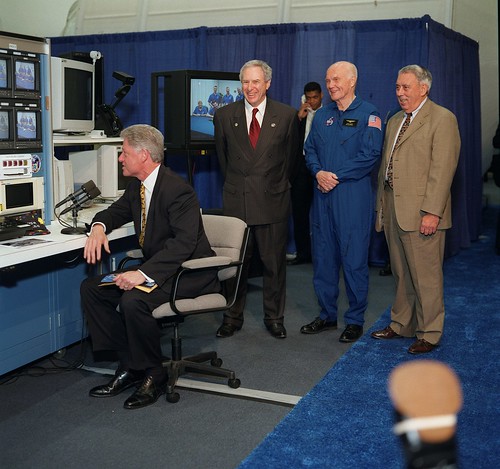
    Great interview with Mercury and Apollo programme astronaut John Glenn covering different aspects of his experience as an astronaut. We hear how astronauts became so involved in the engineering and safety aspects of the Mercury and Apollo programmes.

  • Razors for strategists

    What are razors?

    Razors are one of a series of tools that I use for problem solving. They sit alongside the idea of ‘chunking’ that is breaking a problem down into more manageable and solvable constituent parts. Razors aid in decision-making and analysis.

    Razors are rules that guide your way through a problem, or ‘cut’ your way through a problem. They simplify, they not be right in all circumstances but are right in the vast majority of them.

    They were first used by philosophers, but as we know more about the world around us, we have developed more razors and they have become more useful in a general context.

    Gillette Fusion

    This is going to be hard, isn’t it?

    Not really, we use razors in our lives all the time, often without thinking about them. The most famous one is Occam’s Razor.

    Occam’s razor

    pluralitas non est ponenda sine necessitate, “plurality should not be posited without necessity.”

    Encyclopedia Britannica

    Or to put in simpler terms, out of two or more explanations, the simpler one is mostly likely to be the right one. In certain circumstances what’s simpler is a matter of perspective and culture. Secondly, Occam’s razor prioritises simplicity over accuracy.

    The classic example of Occam’s Razor failing is the classic crime fiction trope of the death that looks like a suicide and is considered by authorities to be one. Yet by dogged investigation, it is actually proven to be a relatively cleverly executed murder plot.

    Other razors

    Here’s some razors that I have found useful over time. A good many of them have come from fields beyond the study of philosophy.

    Gall’s law

    Gall’s law “A complex system that works is invariably found to have evolved from a simple system that worked.” John Gall was a modern-day renaissance man in turn author, scholar, and pediatrician. His law comes from a book he wrote as a critique of systems design: Systemantics: How Systems Work and How They Fail… When working on customer experience related work don’t try and cover every option first, build up complexity to cover all the options from a ‘simple system’. When dealing with clients, sell the simple system as baseline framework and see how you get on. Ironically, clients are more likely to buy the simple model and then build into it over time as an additional activity.

    Hanlon’s razor

    Hanlon’s razor – “Never attribute to malice that which can be adequately explained by stupidity.” Probably more useful when pondering third party actions rather than strategy in depth, but nonetheless very useful to bear in mind in work circumstances. It featured in joke book Murphy’s Law Book Two: More Reasons Why Things Go Wrong: Bk. 2 compiled by Arthur Bloch and was attributed to Robert J. Hanlon. It probably won’t get you promoted, but might keep you sane.

    Hick-Hyman law

    Hick-Hyman law – the time it takes for a person to make a decision is a function of the number of possible choices. Psychologists William Edmund Hick and Ray Hyman, found that increasing the number of choices will increase the decision time logarithmically. This one is handy for bearing in mind when thinking about customer experiences and engagement strategy. There is such a thing as the tyranny of choice for consumers.

    Hitchen’s razor

    Christopher Hitchens

    Hitchen’s razor – what can be asserted without evidence can also be dismissed without evidence. Christopher Hitchen popularised a version of a latin proverb in his book God Is Not Great: How Religion Poisons Everything. Quod grātīs asseritur, grātīs negātur – what is freely asserted can be freely deserted. This works quite nicely with Sagan’s standard below in terms of providing evidence. Storytelling and narrative is important, but so is evidence for the deductive leaps sometimes involved.

    Hofstadter’s law

    Hofstadter’s law – “It always takes longer than you expect, even when you take into account Hofstadter’s law”. Gödel, Escher, Bach: an Eternal Golden Braid by Douglas Hofstadter is a book about the nature of “maps” or links between formal systems. Hofstadter posits that understanding these maps could be the answer to what we’d now call general artificial intelligence. Where Hofstadter’s law comes in terms of being useful for strategists is in assessing the scope of unusual or bespoke strategic asks prior to the start of a project.

    Sagan’s standard

    Polaroid Space Series 4

    Sagan’s standard – extra-ordinary claims require extra-ordinary evidence. This was popularised by Carl Sagan’s documentary series Cosmos. Sagan had also used it in essays for various publications, which were collected in the essay compilation Broca’s Brain. It encapsulates similar ideas by thinkers over the centuries. I have found this particularly helpful when reviewing colleagues decks that make big deductive leaps. The narrative might be compelling, but make sure the right amount of proof is in the right place.

    Sturgeon’s revelation

    Pyramid Books F-974

    Sturgeon’s revelation –  ninety percent of everything is crap. The Sturgeon in question reviewed science fiction and noted that while the genre had its critics one could see a similar distribution of quality in other genres and fields. George Orwell and Rudyard Kipling made similar observations but Theodore Sturgeon got the credit. When you see mediocre advertising being derided in some LinkedIn post or other, bear in mind this observation. As for Sturgeon, while he was highly regarded in the early 1960s as a science fiction writer and script writer for the original Star Trek television series – his memory primarily lives on through his revelation.

    Twyman’s law

    Twyman’s law: “Any figure that looks interesting or different is usually wrong”, an extension of the principle that “the more unusual or interesting the data, the more likely they are to have been the result of an error of one kind or another”. The Twyman in question is Tony Twyman, was a veteran market researcher in the UK. For strategists that erroneous piece of data can be like a shiny metal object to a magpie. Look at how you can verify it further and if it can’t be done, seriously consider walking on by – particularly if it fails under Sagan’s standard as well.

    Vierordt’s law

    Vierordt’s law states that, retrospectively, “short” intervals of time tend to be overestimated, and “long” intervals of time tend to be underestimated. It’s named after Karl von Vierordt who was a 19th century German medical researcher whose body of work spanned research into blood flow and also psychology. It is worth bearing in mind and testing, particularly when you are relying on a small number of qualitative research interviews.

    More related content here.
  • Y2K

    Early last year, fashion started to pillage the late 1990s and early 2000s for fashion inspiration, which became a Y2K trend on social platforms and in the fashion media. But this divorced Y2K from its original meaning. Y2K was technologist short hand for a calendar problem in a lot of legacy systems that were designed around a two digit date for years.

    The rise of micro-processors had meant that the world had more computers, but also more computer control of processes from manufacturing to building air conditioning systems.

    The HBO documentary Time Bomb Y2K leaned into the American experience of Y2K in an Adam Curtis type archival view, but without his narrative.

    Millennium layers

    There was so much to unspin from the documentary, beyond the Y2K bug, including the largely alarmist commentary. The run-up to the millennium had so many layers that had nothing to do with Y2K, but were still deeply entwined with anxiety around what might happen with Y2K.

    This included:

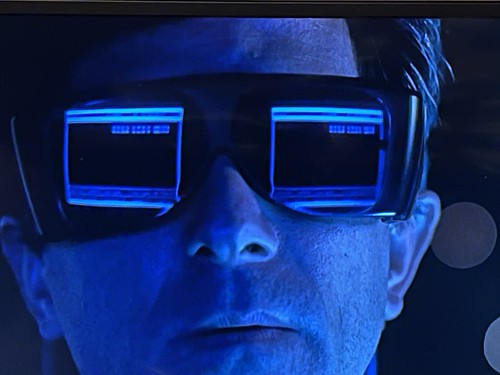
    • Internet adoption and more importantly the idea of internet connectedness on culture through the lens of cyberpunk – which in turn influenced the spangliness of fashion around this time and the preference for Oakley mirror shades that looked as if they were part of the wearer. The internet was as much a cultural construct and social object as it was a communications technology. It memed AND then got people online.
    This week
    • Telecommunications deregulation. In the United States the Telecommunications Act of 1996, saw a levelling playing field be set out and allow for new entrants across telecoms networks to television. They also defined ‘information services’ which internet platforms and apps fitted into giving them many freedoms and relatively few responsibilities. You had similar efforts at telecoms deregulation across what was then the EEC. This saw a rise in alternative carriers who then drove telecoms and data commuunications equipment sales, together with a flurry of fibre-optic cables being laid. There was a corresponding construction of data centres and ‘internet hotels‘ to provide data services. With these services came an expectation that the future was being made ‘real’. Which in turn fed into the internet itself as cultural phenomenon. The provision of new data centres, opportunities for computer-to-computer electronic data interchange (EDI) and services that can be delivered using a browser as interface also drove a massive change in business computing.
    s98_05016
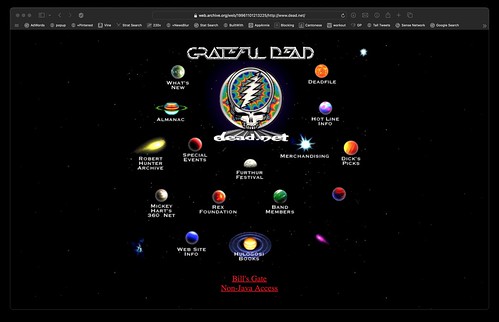
    • An echo boom of the hippy back to the land movement, many of the people involved in that movement were early netizens. Hippy favourites The Grateful Dead had been online since at least 1996 and were pioneers in the field of e-commerce. The Whole Earth ‘Lectronic Link (or The WeLL) had founders from hippy bible The Whole Earth Catalog. There was also a strong connection through Stewart Brand to Wired magazine. Long time ‘Dead lyricist Jon Perry Barlow created a Declaration of the Independence of Cyberspace – a libertarian totem for netizens up to the rise of social media platforms like Facebook.
    Dead.net circa 1996
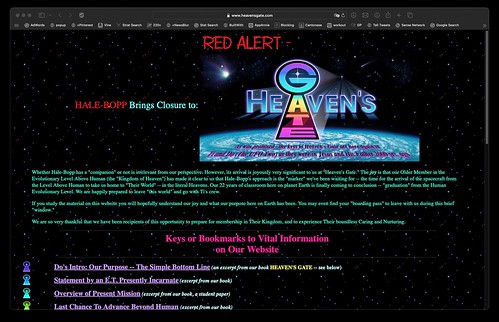
    Heaven's Gate's final home page update

    The confluence of noise around Y2K drove some anxiety and a lot of media chatter.

    Advertisers did their bit to fuel insecurities as well.

    However by October 1999, American consumers who responded to a poll by the Gallup Organisation were pretty confident that glitches would be unlikely

    • 55% considered it unlikely ATMs would fail.
    • 59% believed direct deposit processing wouldn’t be a problem.
    • 60% said they felt that temporary loss of access to cash was unlikely.
    • 60% believed credit-card systems were unlikely to fail.
    • 66% felt that problems with check processing were unlikely.
    • 70% had received Y2K-readiness information from their banks.
    • 90% were confident their bank was ready for Y2K.
    • 39% said they would definitely or probably keep extra cash on hand.
    Y2K: More Signs of the Time | Computerworld (January 10, 2000)

    Experts had felt that the Y2K challenge had largely been beat, but some prudent advice was given. I worked for a number of technology clients at the time including telecoms provider Ericsson and enterprise software company SSA Global Technologies. I had to keep my cellphone with me in case anything went wrong and we would have to go into crisis mode for our clients. Needless to say, I wasn’t disturbed during my night out at Cream by THAT call.

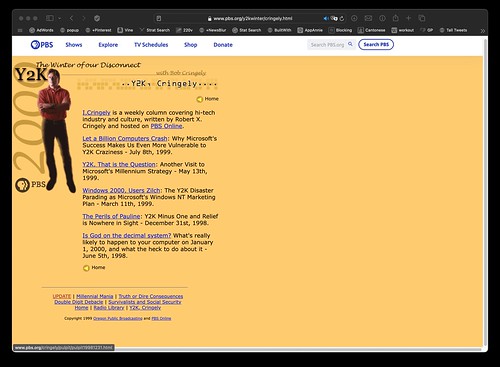
    Technology experts like Robert X. Cringely were rolled out to advise consumers on prudent precautions. Have a bit of cash in your wallet in the unlikely event that card merchant services don’t work at your local shop. Have some provisions in that dont need refrigeration in case there is a power cut. And a battery or solar powered radio just in case.

    All of these are still eminently sensible precautions for modern-day living.

    y2k Cringely

    Why were we ok?

    The warning

    There were several people who voiced warnings during the 1990s. Some of the most prominent were Ed Yourdon and Peter de Jager.

    Risk management

    During the 1990s company auditors were informing boards that they had to address Y2K. Failure to follow this would affect their ability to trade. Their public accounts wouldn’t be signed off and there would be implications for the validity the insurance policies need to run a business.

    Approaches

    IT professionals took Y2K very seriously, which meant that there was little to no impact. Some academics such as UCL’s Anthony Finkelstein posited that the problem was taken too seriously, though it is easier to say that in retrospect. There were a number of approaches taken to combat the risk of failure due to Y2K. In order of least to most ambitious they were:

    • Systems testing
    • Rip and replace
    • Recode

    Systems testing

    The Russian military had tested their systems for vulnerability to the millennium bug and announced this in the last quarter of 1999. Meanwhile businesses were often passing the testing out to contractors like Accenture with teams based in India, the former Soviet Union or the Philippines. There was a thriving market for auditing software to check if applications used two-digit dates or not. One of these was Peregrine Systems ServiceCenter 2000 Y2K Crisis Management software.

    Testing highlighted problems at Oak Ridge Laboratories who process American nuclear weapons, the alarm systems at Japanese nuclear power stations and some kidney dialysis machines.

    Problems would then be addressed by ripping and replacing the systems or recoding the software.

    Rip and replace

    Apple used Y2K as a sales tool to get Macs into businesses, including this campaign from early 1999 where the HAL computer from 2001: A Space Odyssey featured in Apple’s Super Bowl advert.

    Two years earlier IBM CEO had the company re-orientate an offering that he called e-business. There was snazzy advertising campaigns ran over an eight year period.

    Mainframes and high powered UNIX workstations became internet servers running multiple instances of Linux. IBM Consulting learned as they went building the likes of internet retailer Boxman (which would go bust due to IBM’s cack-handed software and the rise of Amazon).

    Timely replacement of business systems with e-business systems, paired with new personal computers like the latest Apple Mac allowed the firm to avoid Y2K and make speedier approaches in digitising their businesses.

    German enterprise software company SAP launched SAP Business Connector in association with webMethods in 1999, this provided an integration and migration layer for SAP and other business software applications. It also allowed the business software to be accessed using a web browser and for it to trigger business processes like email updates.

    Articles (like Robertson & Powell) highlighted the wider business process benefits that could be generated as part of a move to rip-and-replace existing systems with ones that are Y2K compliant. Reducing the amount of systems in place through rationalisation as part of Y2K preparation would then provide benefits in terms of training and expertise required.

    Recode

    Where rip and replace wasn’t an option due to cost, complexity or mission criticality recoding was looked at as an approach. For PC networks there were a few off the shelf packages to deal with low level BIOS issues

    IntelliFIX 2000 by Intelliquis International, Inc. Their product would check hardware, DOS operating system, and software. This version was free and ran a pass/fail test. The full version, which could be purchased for $79, would report the issues and permanently correct date problems with the BIOS and the CMOS real-time clock. In 1999, Stewart Cheifet of the Computer Chronicles rated the product as a very good all-in-one solution for hardware and software.

    National Museum of American History: Y2K collection

    Products similar to IntelliFIX included Catch/21 by TSR Inc.

    Longtime software makers like Computer Associates and IBM provided large companies with tools to audit their existing code base and repair them. IBM’s software charged $1.25 per line inspected. OpenText estimate that there 800 billion lines of COBOL language code out there. So having one of these tools could be very lucrative at the time.

    You might have mainframe code on a system that might not have been altered since the 1970s or earlier. Programmers in the developed world who had skills in legacy languages were looking at the end of their career as more of this work had been outsourced to Indian software factories saw Y2K as a last hurrah.

    COBOL is still very robust and runs business processes very fast, so is maintained around the world today.

    Y2K impact

    Professor Martyn Thomas in a keynote speech given in 2017 documented a number of errors that occurred. From credit card reading failures and process shut downs to of false positive medical test results across the world. But by and large the world carried on as normal.

    Academic research (Anderson, Banker et al) suggests that the most entrepreneurially competitive companies leaned hard into the Y2K focus on IT and used the resources spent to transform their IT infrastructure and software. Garcia and Wingender showed that these competitive returns were shown to provide a benefit to publicly listed company stock prices at the time.

    There were also some allegations that software companies and consultants over-egged the risks. Hindsight provides 20:20 vision.

    IT spending dropped dramatically during 2001 and 2002, and by the middle of 2003 technology started to see replacement of software and equipment bought to address Y2K. But the US department of commerce claimed that was no more than a transient effect on economic growth. This was supported by the Kliesen paper in 2003, which posited that the boom and subsequent economic bust was not as a result of Y2K preparation.

    More information

    Like It or Not, Gaudy Y2K Style Is Roaring Back | Vogue

    These Celebrity Y2K Outfits Weirdly Look Like They’re From 2023 | InStyle magazine

    20 Years Later, the Y2K Bug Seems Like a Joke—Because Those Behind the Scenes Took It Seriously | Time magazine (December 30, 2019)

    National Museum of American History – Y2K collection

    Y2K: a retrospective view by Anthony Finkelstein (PDF)

    Y2K: Myth or Reality? Luis Garcia-Feijóo and John R. Wingender, Jr.
    Quarterly Journal of Business and Economics (Summer 2007)

    Replacing Y2K technology boosts spending | The Record (July 28, 2003)

    Y2K spending by entrepreneurial firms by Mark C. Anderson, Rajiv D. Banker, Ram Natarajan, Sury Ravindran US: Journal of Accounting and Public Policy (December 2001)

    Exploiting the benefits of Y2K preparation by Stewart Robertson and Philip Powell (September 1999) Communications of ACM

    Was Y2K Behind the Business Investment Boom and Bust? Kevin L. Kliesen

    What Really Happened in Y2K? Professor Martyn Thomas (April 4, 2017) (PDF)

  • Hong Kong measurements

    The train of thought to this post about Hong Kong measurements started with a friend’s class learning do-it-yourself skills. I had rented an apartment when I lived in the city and had no need to do home repairs myself. I wondered past hardware stores, saw metric drill bits and rules.

    Metric

    My supermarket-bought groceries had their measurements on in metric. Hong Kong measurements go back to history and culture. I knew more about traditional measurements from traditional Chinese medicine shops and period Hong Kong cinema than the local ‘wet’ markets.

    I didn’t drive, but the speed limits were all in Km/H like Ireland. Pedestrian signs for the most part didn’t need distances because everything is so compact and the public transport so good.

    If I had driven, I would have seen distances in kilometres on the expressway. In fact, the only time I can remember using distances on pedestrian signs were on hikes like this one below, with distances in kilometres and approximate time that the walk should take.

    Last 1/4 of this hike

    What became apparent in my discussion that that Hong Kong measurements are more complex than would appear at a cursory glance.

    Inches and pints

    The method of instruction in the do-it-yourself was predominantly imperial measures with a metric equivalent being secondary. Timber could still be provided in 2×4 inch planks. Both imperial and metric drill bits were available to buy.

    You could order a pint, though like many other countries, you will be served a 1/2 litre glass in most bars.

    The laws governing weights and measures in trade is covered by the Weights and Measures Ordinance. This was drafted in 1988, came into force in 1989 and has been amended for formatting since. The related Weights and Measures Order of 2021 added US units were different alongside imperial measures, metric and traditional Chinese measurements. Though this seemed to be for reference, rather than encouraging the active use of American measures in Hong Kong. American products usually come with the equivalent metric sizing for items like drinks cans volume.

    Taels and Cattis

    Hong Kong uses Chinese traditional measures alongside more standard measures in certain markets – from fresh produce bought in the ‘wet’ markets to sales of gold and silver.

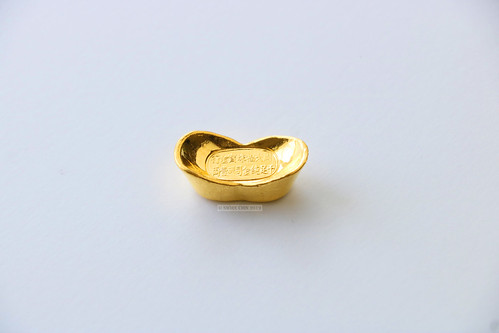
    周大福珠寶金行 千足純金 司碼 壹両 Chow Tai Fook Jewellers & Goldsmiths 9999 Gold One Tael boat bar

    Before I had got to Hong Kong I had hear of taels and cattis. Taels is the traditional unit by which gold (and silver) had been sold amongst the wider Chinese community from Liverpool to Shanghai. If you’ve sat through enough old kung fu movies, you will have heard of a bounty or reward to be paid in taels.

    However like other pre-Metric weights like hundredweights and tons; taels and cattis now mean different dimensions in different markets.

    Hong Kong hews to the traditional weights and measures for this. Taiwan’s taels and cattis are more related to the measures of the Imperial Japanese empire. Taiwan may even refer to taels and cattis using different words. Mainland China went through a period of simplification during communist rule from Chinese characters to measures. Their taels and cattis are more aligned to metric measures.

    Singapore struck much more closely to the metric system which it has adopted from 1968 – 1970. While traditional measures are included in the statutes for reference and fabric discussions still happen in terms of square yards, you will be charged for the metric measure. This was because post-independence Singapore had to make its own way in the world without the mother country of empire. China was closed off at the time and the city state had to think of its place in terms of global scale.

    So why is this all important?

    Measurements are essential to our points of reference in everyday life. The variance of points of reference can affect perceptions around attributes like value for money, or whether something is big or small. It affects how we think about tasks to be done or distances to be walked and things to be carried.

    It can be a ‘grain of sand’ in the shoe level of dissonance, familiar, yet different. Rather like the average European pondering the American distance definition of ‘a block’. Our cities aren’t built on grid systems for the most part, so we don’t have the same feel for the measure. Speaking to a New Yorker friend; a block was considered by them to about a tenth of a mile. BUT, different cities have different sized blocks and it isn’t a formal definition. It’s a quintessential American cultural artifact and yet very inexact.

    For a business there are additional factors to consider

    • Complexity of regulations.
    • Additional complexity in terms of product instructions.
    • Descriptive copywriting and advertising claims.
    • Pricing strategies and arbitrage opportunities. For instance, while Hong Kong gold might be duty free – does the differing weight from one’s home affect price considerations?

    While Hong Kong is being reintegrated back into mainland China, even apparently small issues like measurement units could become political in nature.

    As they are product of a unique history and emergent culture not shared with the mainland, rather like modern Hong Kong Cantonese. The Cantonese language evolved from being similar to that spoke in Guangdong province in the early 1960s to develop its own Hong Kong-specific idioms, lone words (from English, Japanese and South Asian languages spoken in the territory by minorities). Now with the increasing influx of mainland immigrants there is use of mandarin code switching added into the mix.

    The use of multiple measures allows Hong Kongers and their businesses to be commercial ‘citizens of the world’ in their transactions. Hong Kongers have also taken these measures abroad. Going to a China town jeweller or pawn shop will allow you to buy gold taels, even though the weight on your receipt might be in troy ounces or grams.

    Alongside Hong Kong-specific cuisine, the unique mix of measurement units may be its unique informal contribution to the world alongside archive films, long after the city becomes just another city in China.

    More Hong Kong related content can be found here.

    More information

    Chapter 8: The language of the Road – Transport Department Government of Hong Kong Special Administrative Region

    The Weights and Measures Ordinance, Chapter 68, Laws of Hong Kong

    The Weights and Measures Order (2021)

    Weights and Measures – The Customs and Excise Department Government of Hong Kong Special Administrative Region