Howard Stringer
Sony confirms Kazuo Hirai as new President and CEO, replacing Howard Stringer — Engadget – this is huge, the pivot back from entertainment to engineering and technology is happening at Sony. Howard Stringer worked for three decades at CBS, which Sony bought during the go-go years of the 1980s. He started as junior on the Ed Sullivan show. Over the years Howard Stringer built his career as journalist, producer and executive. A subjourn at a media and telecoms funded start-up for two years saw Howard Stringer return to Sony. This pivot is important as it gives insight into Sony’s convergence strategy of the early noughties. The Sony share price fell 60 percent on the watch of Howard Stringer, part of this was due to force majeure of the great Tohoku earthquake. But it also didn’t help that Howard Stringer helped build up Samsung by providing a joint venture with Sony on its Bravia televisions
Consumer behaviour
Today’s Teens Better Behaved Than Their Parents – NYTimes.com – more socially conservative
Design
Boeing finds problem in tail section of 787 Dreamliners ‹ Japan Today – problem is with shims between the carbon fibre skin and supporting framework. Carbon fibre composite construction ins relatively new in the civil aircraft industry
Old friend, new face, at Cathay Pacific’s flagship lounge | CNNGo.com
Olympus OM-D E-M5 Camera Leaked Photos | Kineda – I love the way the design harks back to the classic Olympus OM film cameras
Dezeen » Blog Archive » K01 by Marc Newson for Pentax
Economics
Beijing tells airlines not to pay EU carbon tax | SCMP.com – expect the EU to come off the worst with this Mexican stand-off
China needs 200 years to achieve free market: economist|WantChinaTimes.com – what really constitutes a ‘truly free’ economy
Chinese data suffer New Year hangover – FT.com – according to PMI index domestic demand weak, export demand strong
Poverty trap for middle classes of Europe | Presseurop (English)
The End Of Cheap China, Part III. How YOU Must Prepare For It. : China Law Blog
Finance
Private Equity: Fact, Fiction and What Lies in Between – Knowledge@Wharton
Mortgage Tornado Warning, Unheeded – NYTimes.com – corruption and crime at the dark heart of the mortgage industry
MasterCard reveals roadmap for our electronic payment future: EMV in, magnetic strips out — Engadget
Hong Kong
Hong Kong residents oppose opening roads to mainlanders|Want China Times
Final curtains for cinema complex in Time Square | SCMP.com – one of my favourite haunts in Hong Kong (pay wall)
Apple Daily Hong Kong runs ad against mainland “locusts”: Shanghaiist
Hong Kong Finance Job Cuts Hit Samsung, Daiwa – WSJ
How to
LongReply to swissmiss – finding duplicate files
Ideas
Open the Future: The Future Isn’t What It Used to Be
Study shows climate sensitivity to CO2 less than extreme projections
Innovation
Toyota Engineer Speaks on Advantages, Disadvantages of SiC Power Devices — Tech-On!
Nokia reveals polarizing secrets of ClearBlack display — Engadget – would this work for televisions?
Sony Global – Technology – SoRPlas Environmental Technology – interesting recycled plastic technology from Sony
The Vintage Knob – Online vintage audio museum, forum and image bank – the superlative engineering involved in the products are amazing
DARPA summons researchers to reinvent computing | ExtremeTech
AMD’s CTO talks heterogeneous systems architecture
A CEO’s guide to innovation in China – McKinsey Quarterly – interesting breakdown of Chinese innovation
The death of CPU scaling: From one core to many — and why we’re still stuck | ExtremeTech – really interesting read on why computers don’t have the ‘wow’ factor that they did in the past
Wanted: 3-D IC standards within six months
Rebuilding America: Proposals emerge to fix ‘dysfunctional’ R&D tax credit
Japan
Panasonic, Fujitsu, Renesas eye chip merger ‹ Japan Today
Japan’s current account surplus smallest in 15 years ‹ Japan Today
Pachinko addiction a growing problem for Japanese women ‹ Japan Today
Toyota Lets You Become A Sportscar – brings out the inner 5-year old
Trust in Japan – Sixty Second View – amazing destruction of trust
Made Better in Japan – WSJ.com – interesting how attention to detail is causing a surge in low end | high price Japanese products
The salaryman’s guide to Tokyo | The Guardian – made me laugh
Labor ministry releases definition of ‘power harassment’ ‹ Japan Today
Japan’s population to shrink two thirds by 2110 ‹ Japan Today
Korea
South Korea’s Pop Wave – Al Jazeera English – links to corruption and forced prostitution together with punishing schedules and unfair contracts blight reputation of K-pop
Luxury
French luxury giant buys into mainland firm | SCMP.com – first investment like this from LVMH. Ochirly is a mid-priced brand aimed at trendy female office workers (pay wall)
Economic Slowdown May Fuel Maturation Of China’s Luxury Market « Jing Daily
Bloomberg launches twice-yearly luxury lifestyle mag | Press Gazette – surprised that Bloomberg and Reuters hadn’t done this previously. There has been a magazine called Square Mile aimed at the city of London which occupies a similar niche.
Marketing
40 years of Super Bowl Commercials. | adland.tv
Media
Used MP3 Music Files Legal To Sell Says Federal Judge
Themes from MIDEM – Mint Digital – interesting comments on Facebook
Three Lessons for Social TV – Amy Jo Martin – Harvard Business Review
News Corporation pushes tablet title: News from Warc.com – but is closing down the London based tablet experiment using entertainment and sports content from The Sun
Reuters: News Corp clean-up squad has 100 staff reviewing emails, expense claims and phone records | Press Gazette – a hint of the Spanish Inquisition about it
Why Some Book Buyers Are Increasingly Resistant To E-Readers | mocoNews
Shoe on the other foot: RIAA wants to scrap anti-piracy OPEN Act
Warner Music Group chairman loves Spotify, calls Google Music an “oxymoron” | VentureBeat
Online
Facebook says China still a major hurdle | Market-interactive.com – I am not certain that they would be able to beat domestic rivals
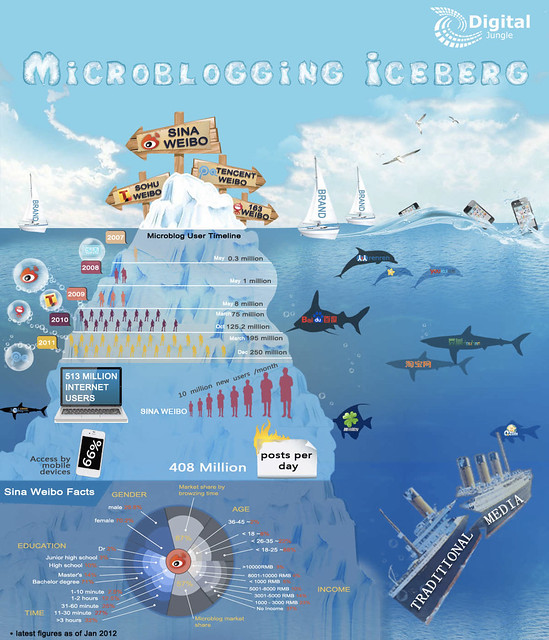
New Registrations For Sina Weibo Appear To Have Fallen Off A Cliff | DigiCha – real-world ID requirements affects Weibo
How OoVoo Became Teenagers’ Favorite Way To Video Chat – Forbes
Retailing
Facebook’s Payments Business Is Already 15% The Size Of PayPal — Sort Of – SplatF
Tesco market share drops below 30% | Irish Examiner
Amazon disappoints with dramatically lower profits for Q4 | VentureBeat
Security
Max Schrems: The Austrian Thorn In Facebook’s Side – Forbes
Students voice privacy concerns with Facebook | ZDNet
Black SMS Encrypts and Decrypts Your Text Messages – interesting application, wonder how robust the encryption actually is
Satellite phone encryption cracked – Telegraph
Where’s the Market for Online Privacy? – Forbes
A fashion revolution? | FT.com – transparent fashion business
Software
Apple Requires Retina Screenshots From iOS Devs – this is good as reduces platform fragmentation
An Ex-Zynga Engineer Is Ripping The Company Apart In Plain Sight – or why Zynga is crap to work for. Not particularly surprised by this
Google Instant, Disabled For Slow Computers
Windows Phone developer lead leaves for Amazon’s Kindle team | ZDNet
Chinese Learning App, Mandarin Madness Launches on iOS and Android | TechNode
Monocolumn – Presentations in PowerPoint – for and against [Monocle]
Technology
Samsung aims to sell 25 mil ‘smart TVs’ this year ‹ Japan Today
Apple trademark may hint at processing improvement for next-gen A6 processor
FOSS Patents: Apple removed products from German online store due to Motorola injunction based on FRAND patent – Motorola gets away with exploitation of FRAND patents, yet Samsung gets hauled in front of antitrust hearings?
Canalys: Smartphone shipments surpassed PC shipments in 2011
Ex-Apple engineer emits Zevo ZFS for Mac OS • The Register – good to see Sun’s ZFS getting new life. This will be important given the battering the cloud has taken
Sharp to cut LCD production in Osaka plant by half – Engadget
ITC judge throws out Barnes and Noble’s patent defense against Microsoft — Engadget
Japan’s DeNa moves into Chinese smartphone game market in deal with Baidu | VentureBeat
Telecoms
UK Report Blames The Internet For Terrorism, Says ISPs Should Take Down Content | Techdirt – Jesus wept
IPv6 upgrade to cost ISPs ‘hundreds of millions’ – Ixia
Apple forcing IT shops to “adapt or die”
Web of no web
Siri to get Chinese, Russian and Japanese Support Next Month | gizchina.com
Employers and Brands Use Gaming to Gauge Engagement – NYTimes.com
Wireless
Nokia on smartphone strategy: We don’t have a Plan B
Apple and Samsung will continue dominating smartphone industry
EUROPA – Press Releases – Antitrust: Commission opens proceedings against Samsung
Feature Phones Now More Profitable Than Mid-tier Smartphones – Forbes
DOCOMO, LAWSON and Radishbo-ya Agree on Business and Capital Alliances | NTT DOCOMO – interesting move into retail services by NTT
DoCoMo demands Google’s help with signalling storm – Rethink Wireless
In Europe, Some Lovers of the BlackBerry Now Seek A New Flavor – NYTimes.com