Ethics: moral principles that govern a person’s behavior or the conducting of an activity. I went to school with people who ended up on the wrong side of the law. I knew more of them when I used to DJ which was my hobby since before I went to college.
I probably still have some post-it notes around the place that I used as bookmarks from when I used to work at a call centre but that was about the extent of my ethical transgressions.
My business experience meant that I dealt with a lot of unpleasant unprofessional clients, but didn’t necessarily see anything unethical in nature. When I started writing this blog I was thinking about culture rather than ethics and the most part still do.
But business and work changed. Ethics became more important:
When I started in social and digital campaigns I didn’t think about ethics as a standalone thing. It was just part of doing a good job. It went without saying.
I don’t think any of us back then would have foreseen slut shaming, trolling, online bullying, dark patterns and misinformation
Now things are different. The lack of ethics is impacting all parts of business life.
How ad tech data is used
How content is created
How services are designed
How products are made
I think that much of the problems with ethics is cultural and generational in nature. The current generation of entrepreneurs have perverted knowledge in the quest of growth hacking and continual improvement and change for its own sake. Its a sickness at the centre of technology
YouTuber Tom Scott delves into the marketing industry and laws that force influencers to declare ads. It is worthwhile watching regardless of how involved you are in marketing. Scott points out what he considers to be inconsistencies in the principles of when to declare ads. In particular, he focuses on the role of product placement in film and TV programmes and the way that is handled.
Future of
Wired contributor and author of What Technology Wants, Kevin Kelly has spent the COVID lockdown putting together some great talks on YouTube on the future of different aspects of technological progress.
Kelly’s opinions are usually well thought out and the videos are better than sitting through a few conferences; especially TED conferences.
SolarWinds
World Affairs put together a great panel to discuss the recent SolarWinds hack and the impact it has had across both enterprises and governments.
Celebrity Zoom Bombing
I was listening to a podcast about a University of Sydney research paper on Zoom based culture building. TL;DR – it doesn’t work unless participation is truly voluntary. Most of them are painful. Lights and Shadows were commissioned to help help promote fun in a company corporate culture. Usually did creative events, but for COVID-19 they had to get creative in Zoom.
Somehow they managed to get celebrities, or convincing deep fakes to bomb existing Zoom calls.
Strong Enemy
The strong enemy is Chinese Communist Party-speak for the United States. China increasingly sees its relationship with the US to lead to eventual war. Xi Jingping has been talking more about the strong enemy in speeches aimed at the PLA to get them ready for inevitable conflict with the US. Sinocism has this great essay on it all.
Wunderman Thompson Intelligence highlighted digital sustainability as a trend. The internet is the seventh biggest polluter in the world. Data centres energy consumption is comparable to that of the largest ships.
Web designers have been looking to do their part by designing leaner, faster web pages that take up less memory.
Samsung is looking at up cycling its smartphones providing longevity rather than built-in obsolescence.
https://youtu.be/m9AL266C0lc
Ecosia, Bing and DuckDuckGo sell themselves as a more eco-friendly search engine. Due to the level of ad targeting technology, a Google search uses four times as much energy per search.
Cryptocurrency mining consumes more energy than Argentina and is increasing. That doesn’t take into account the maintenance of a blockchain: the distributed database to support each cryptocurrency transaction.
Performance per watt
Digital sustainability isn’t necessarily a new idea. A veteran Apple user would remember the launch of Intel processors on the Mac at the 2005 Apple Worldwide Developers Conference (WWDC). Jobs talks about the company’s focus on performance per watt as a key reason for the transition. Intel was thinking about processors for workstations and mobile computers, while the Power PC was being refocused on its minicomputer heartland and embedded applications.
The problem is that a lot of Apples current product designs from AirPods to MacBook Pros make up cycling all but impossible. Apple does have some interesting technology to recycle their own phones, but we don’t know how that will scale to create real digital sustainability. More related posts here.
China and the UK test HSBC Bank divided loyalties in Hong Kong — Quartz – If HSBC Bank were to spin off its China operations, it wouldn’t be the first bank to reconfigure its ties due to a changed political situation. In the 1980s, the British banks Barclays and Standard Chartered pulled out of direct operations in South Africa amid global pressure against the apartheid regime. The bank’s actions “highlighted…the fact that financial institutions were not unassailable when faced with public pressure on ethical issues. HSBC Bank is betting that the screwing China will give it is still better than the west, more from the FT here: HSBC Bank shifts ‘heart of business’ to Asia in latest strategy revamp | Financial Times
Book Review: Rural Youth Key to China’s Human Capital Crisis – Caixin Global – Rural China is so systematically neglected that it has become nearly invisible not only to most outside observers but even to urban elites within China. But this “invisible” part of China will determine its economic future. Instead of sitting in an ivory tower advising Chinese officials what to do, the authors and their team at Stanford University’s Rural Education Action Program (REAP) have been helping China’s rural youth on the ground in practical and realistic ways
Exclusive: Scientists at top British universities worked with Chinese nuclear weapons researchers – Scientists at Britain’s leading universities – including Cambridge, Edinburgh and Manchester – have worked on a string of projects with researchers at China’s nuclear weapons research institution – it doesn’t necessarily mean that they were helping the Chinese build a new generation of warheads but its not a good look
Consumer behaviour
Cultural Differences May Affect The Outcome Of A Pandemic: New Research : Goats and Soda : NPR – Tight cultures tend to have had a lot of threat in their histories from Mother Nature, like disasters, famine and pathogen outbreaks, and non-natural threats such as invasions on their territory. And the idea is when you have a lot of collective threat you need strict rules. They help people coordinate and predict each other’s behavior. So, in a sense, you can think about it from an evolutionary perspective that following rules helps us to survive chaos and crisis
Notice, Shift, and Rewire: Starting the Journey to Dismantle White Supremacy | by Anna Madill | Feb, 2021 | B The Change – interesting read. What struck me is how much this goes against efficiency and effectiveness in terms of everything one would have been taught in business management, to focus on what I’d call internal quality. It is predicated on a sufficiently slow rate of environmental change / client demands in order to allow this to happen. It is an ideal work environment (and I don’t mean that in the terms that they define it) but in a more general sense. It goes against the grain of the observations of James Gleick in his work Faster
I haven’t driven a BMW in well over 20 years, so Doug DeMuro’ update on the BMW brand was fascinating.
BMW Twitter account
The BMW brand issue hadn’t been on my radar until Doug DeMuro talked about it. A number of things seem to be happening with BMW.
The company’s customer base is predominantly gen-x and baby boomers; because their cars are expensive. For decade these people have been told that the BMW brand represents the ultimate driving machine.
An important part of the visual BMW brand: the design language that it is implementing on is problematic. In particular the ugly ‘beaver teeth grill. This is ironic given that an electric car doesn’t need a grill for its engine.
It didn’t help things that from a certain angle the rear of the BMW iX has a resemblance to the Nissan Juke.
Nissan Juke 1.6 Advance 2017 by RLGNZLZ
It has at least an internal perception that it has lost its BMW brand mojo as there is a slow steady move away from the internal combustion engine.
If you look at other YouTube automotive channels, BMW seems to be having reliability issues with its current cars and the repairs are expensive to do. Back in the early 1970s the BMW brand was tarnished with negative perceptions about the cars being rust buckets and the company managed to lick that. The current engineering problems sound more complex.
All of this makes the BMW brand sound more difficult to fix than being on the socials and being up to date with their yoofspeak.
Canada concerned as Hong Kong starts to force dual citizens to choose status – The Globe and Mail – individuals who declare themselves Canadian could now lose their residency rights to live in Hong Kong.“It’s the beginning of the end for people in Hong Kong with Canadian status,” said Vancouver immigration lawyer Richard Kurland. The policy on dual citizenship stems from a 1980 law in mainland China that was then applied to Hong Kong when the United Kingdom handed over the city to Beijing in 1997. “The law was on the books for years but it wasn’t always enforced,” Mr. Kurland said. – interesting move
The Longer Telegram: Toward a new American China strategy – Atlantic Council – single most important challenge facing the United States and the democratic world in the twenty-first century is the rise of an increasingly authoritarian and aggressive China under Xi Jinping. China has long had an integrated, operational strategy for dealing with the United States. The United States has so far had no such strategy with regard to China. This is a dereliction of national responsibility – interesting read. Right on with its diagnostics, but off base with its proposed solution. The west thought that Xi was a moderate when he came into power. He has extended his loyalists in every aspect of the party. The Jiang Zemin faction of the party, which would be an alternative aren’t liberal; they used the army to put down student protests in 1989.
Commission chief tells charities not to be ‘captured’ for politics | Charities | The Guardian – Charities that support politically or culturally contentious causes should expect their charitable status to come under regulatory scrutiny even if they are acting within the law, according to the outgoing chair of the Charity Commission. The Tory peer Tina Stowell, who is stepping down after three years in the post, warned charities against being “captured” by unnamed people who wish to push a partial view of the world and use charity platforms to wage war on “political enemies”. – this is going to be interesting
Looking downstream – Tortoise – as a long time netizen I am less certain that regulating platforms for content will work and worry about the precedent it would set for authoritarian regimes. Should OTT platforms such as Netflix, Disney+ or Amazon Prime carry news? Here my first question is how do you define news? Should they do real time news reporting, probably not even if they could. Should they do current affairs analysis – they already do if you look at the kind of documentaries that they have. I think that there should be real questions about those documentaries in terms of quality and bias? While we’re on about documentary making, surely the BBC could be doing more work with Adam Curtis or Bellingcat and have those people training the documentary film makers of tomorrow
Liu Yifei Announced as Face of Louis Vuitton China | Radii China – LVMH betting on woke western liberals not being their customer base and choosing polarising star. It also shows how far Fan Bingbing’s star has fallen since her tax troubles. Crystal Liu was the protagonist in the car crash live action version of Mulan. She’s also not as beautiful as Fan Bingbing
How Europe Became a Model for the 21st Century – DER SPIEGEL – Despite its long list of crises in recent years – including the most recent vaccine snafu – the European Union has become a global pacesetter. Its laws and regulations have established global norms. This has made the bloc a 21st century model. – I agree with the direction of this article, even if some of the examples could be debated
Silicon Valley’s iron grip on venture capital is slipping — Quartz – the shift to smaller tech hubs that’s been going on for years is set to move even faster, according to Stanford. “The pandemic has thrust the VC ecosystem into new territory where Zoom meetings and alternative deal sourcing methods reign supreme,” he wrote in an analyst note. “This shift has, at least somewhat, leveled the playing field for investor attention…Over Zoom, it doesn’t matter if the company is in the same building, city, state, or country.” – no credit given for the dissipation technology start-ups to places like Singapore and Shenzhen. For instance, social darling Clubhouse is based on Chinese voice technology. But there’s also a bigger issue about the decline in hard innovation which is easier to do in a tight cluster. Since its no longer happening, the cluster makes less sense. More on innovation here.
Bases for Trust in a Supply Chain – Lawfare – With a supply chain attack, there is a potentially long delay between the introduction of a vulnerability and its exploitation. In addition, infiltrating a supplier generally requires a well-resourced adversary and interaction with that supplier. So compared to the alternatives, preparations for a supply chain attack take longer and have a higher risk of discovery. The risks of discovery can be reduced, however, if inserted vulnerabilities resemble ordinary flaws and, thus, the malicious intent is disguised. The digital systems on which individuals and nations increasingly depend are large and complex, so today they are likely to be rife with vulnerabilities. Many of those vulnerabilities will be known, some unpatched, and others easily discovered by analysis. In short, such systems are easy to compromise.
Russian hack brings changes, uncertainty to US court system – new rules for filing sensitive documents are one of the clearest ways the hack has affected the court system. But the full impact remains unknown. Hackers probably gained access to the vast trove of confidential information hidden in sealed documents, including trade secrets, espionage targets, whistleblower reports and arrest warrants. It could take years to learn what information was obtained and what hackers are doing with it – you can’t hack paper
The Cummings effect was named by The Guardian after former government advisor Dominic Cummings. Now famous for his unorthodox approach to sight tests.
The Cummings effect describes how consumers have been testing the rules governing lockdown, often ignoring the government’s ‘stay at home’ instruction.
Dominic Cummings lampooned on sticker art by duncan c
“What is happening is people are beginning to flout the rules, they are beginning to think, ‘How can I get away with the rules?’” Paul Netherton, Devon and Cornwall’s deputy chief constable
‘Cummings effect’: why are people bending lockdown rules? – The Guardian
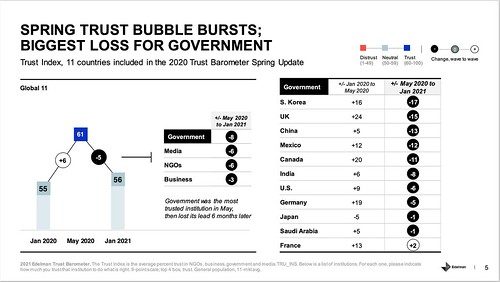
Cummings effect is part of broader trust deficit
Edelman released their Trust Barometer, and the findings were ugly for government trust, across most of the countries that they surveyed.
2021 Edelman Trust Barometer
They were also bad for societal leaders as well. Dominic Cummings bizarre behaviour was a question of the wrong thing at the right time and fits into this broader disappointment.
2021 Edelman Trust Barometer
Do as I say, not as I do
Throughout COVID-19; there has been a consistent desire for sufficient lockdowns to get COVID-19 under control. The latest bit of YouGov consumer opinion research still indicates a desire for lockdown to try and control COVID better.
However, there was evidence as far back as April that the first lockdown instructions in the UK weren’t being adhered to. UCL analysed data from Huq found that the first lockdown lasted just three weeks in areas outside London. News reports and infection rates indicate that the situation maybe similar if not worse this time around. More related content here.