Howto as a category morphed out of a few things. I learned about the power of helpful content from Stewart Brand’s Whole Earth Catalog. A second aspect of it was my natural inclination to share useful hacks.
I started writing this blog to explore the media so that I could advise clients so its roots were in the howto mentality. Over time, I built up a certain amount of authority based on the content that I shared here. This resulted in work for Econsultancy, teaching MBA students at a private Spanish university and a number of agency jobs.
Howto content tends to come when I am sharing skills and I have been developing AND that these skills can be easily codified into an article or two. I have also shared my personal workflow that I use to try and make sense of the world through online resources.
Many of the skills that I developed doing that came from a pre-social platform dominated world. Before Instagram told us how to look and TikTok told us what to think. And back when Google was actually useful, well more useful than it seems to be now.
I even wrote a couple of guides on how to get the most out of Google, but most of the advice won’t work any more as the platform did away with many shortcuts in favour of telling you which is the nearest coffee shop with free wifi.
The reason why howto ended up being one word rather than how to was down to the early version of Wordpress that I started to blog on and my lack of expertise more than anything else.
How to use RSS – isn’t a question that I thought would be ever asked. I put together a guide some eight years ago and had been meaning to update it for a while. I was reminded to do this by Wadds recent post on RSS. I realised there is likely a whole generation of netizens that hadn’t used RSS; or had used Google Reader and didn’t have a clue about what under-pinned it and how it could be useful.
‘RSS is dead‘ is a myth beloved of the social networks that want to spoon feed you algorithmically sifted world views. This myth has leaked into web development circles and I have had to fight with development teams to keep in support for the standard.
Put simply RSS is like a ticker tape for the web that allows you to get updates about new articles posted on websites.
My own journey in how to use RSS
I started off using RSS readers with NetNewsWire. NetNewsWire was an application that developed a swift cult following on Mac OSX. This would have been late 2002. I immediately saw the benefit as a PR person, having the news come to me, rather than having to go do a round robin of a list of sites in my browser bookmarks.
An RSS reader allows you to:
Collect updates from 100s of sites that you wouldn’t otherwise have time to get around
Read a precis of these updates
Organise sites into folders
At the time, only calendar, address book, email and task information synced across my work and home computers. I had only just got mobile email on a Palm PDA that connected into a Nokia 6310i via a data cable using Palm’s Mobile Internet Kit. This only allowed me to access a limited amount of the web but no RSS. This only worked with my personal email.
The problem with NetNewsWire was that there was no sync. If I read RSS at work I would then have to clear it again at home. I got around this by dragging my laptop into work and using the guest wi-fi network access. But this was misinterpreted by management.
I started using Bloglines an online RSS reader. This was eventually squeezed out of business by Google Reader. In 2013 Google killed Reader to try and force people to use the algorithmic feeds on Google+. Aside from destroying a large audience of RSS users; the cunning plan failed.
Google Reader was an RSS reader with some proprietary features including bookmarks. I decided against using Google Reader and went with Fast Ladder – which was run by Livedoor, a Japanese company. Livedoor eventually saw its CEO go to jail for securities fraud.
Since then I have been using Newsblur. Newsblur has a couple of unique features that put it head-and-shoulders above rivals like Feedly, theoldreader or Inoreader :
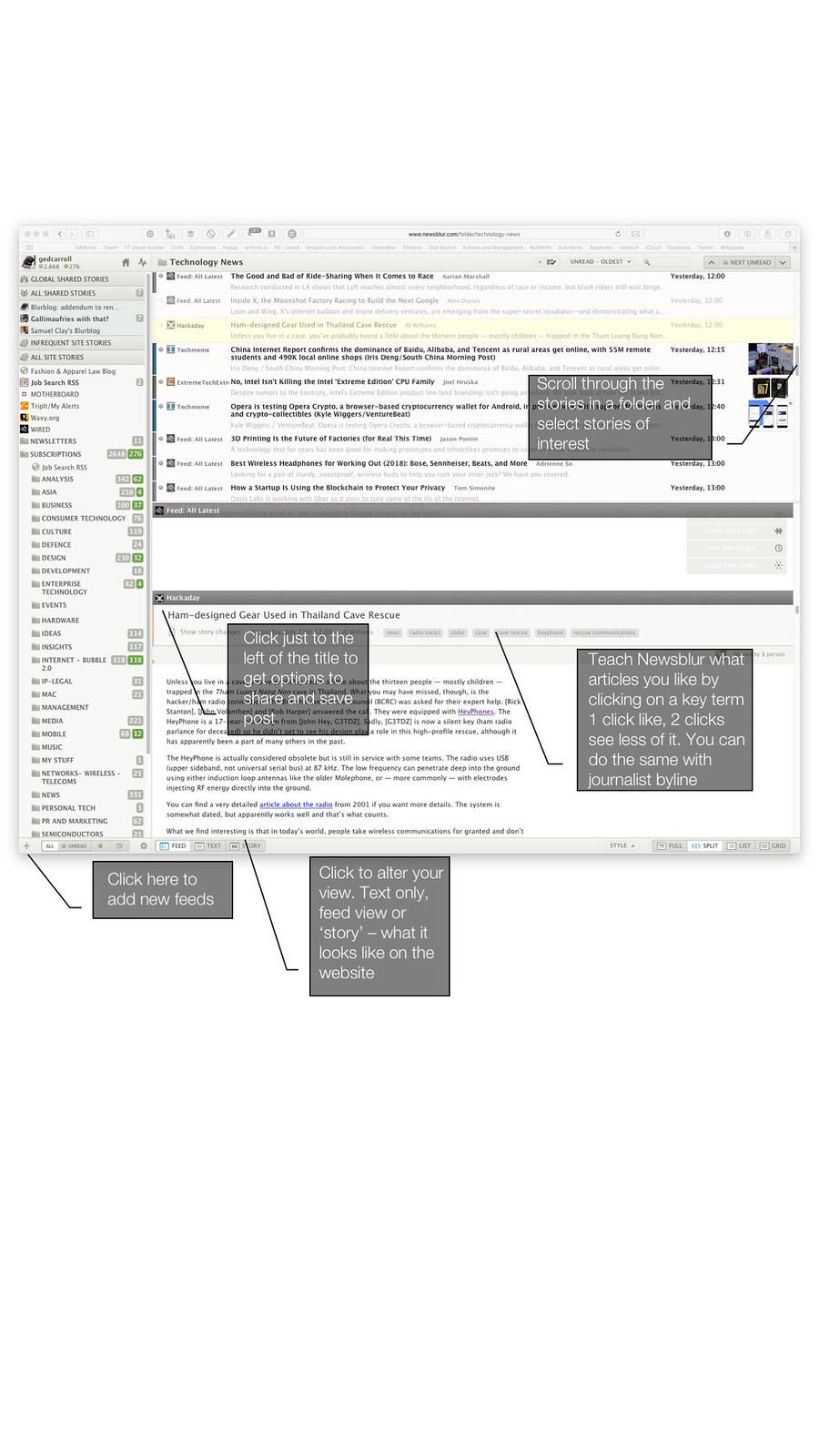
You can train the reader to highlight or hide posts that aren’t of interest
It provides three views: text-only (great for speed), feed and the article as it appears on the web page ‘in-situ’
It offers seamless integration with the pinboard social bookmarking service
Navigating your way around Newsblur
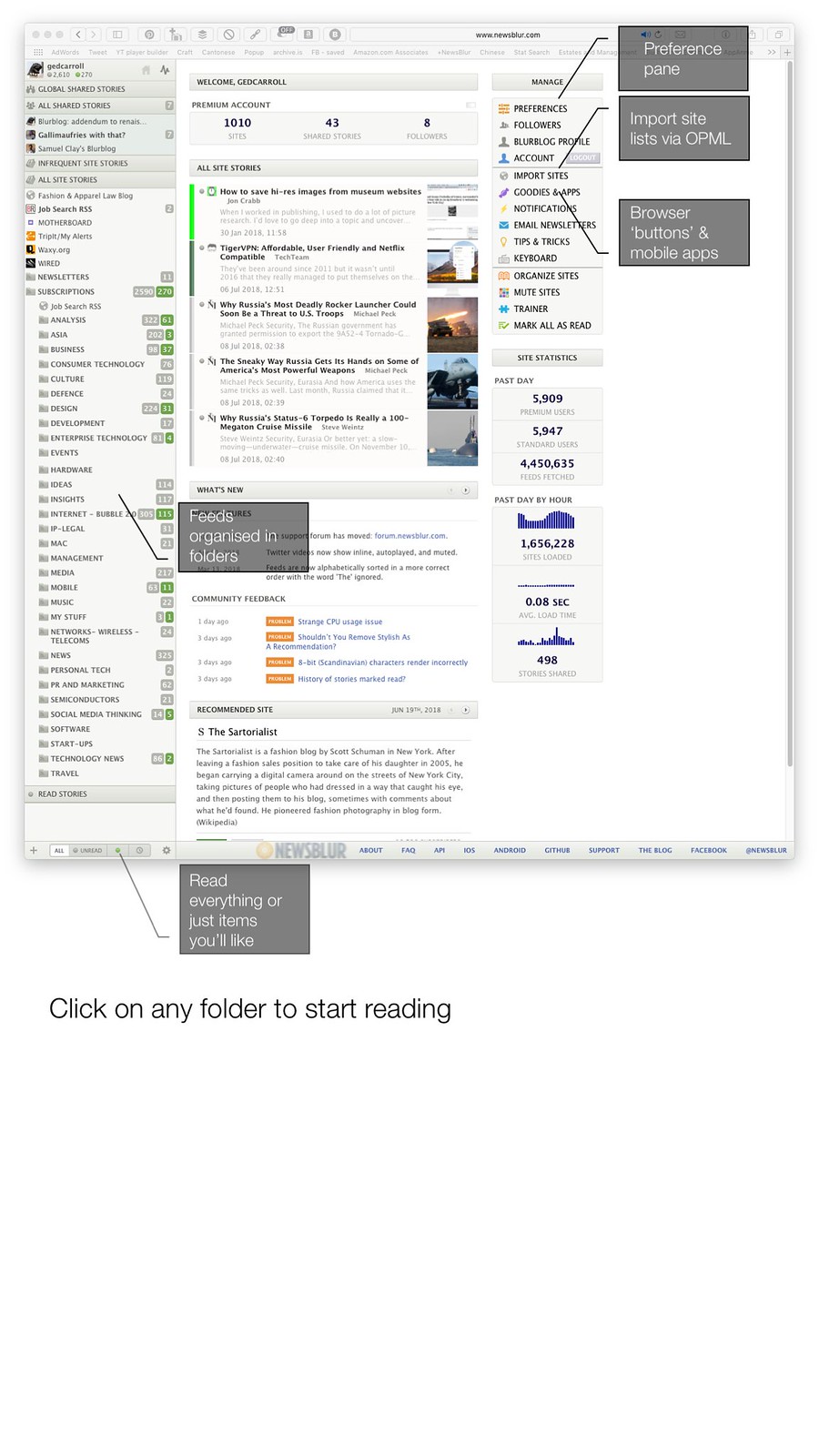
This is what the home screen looks like
What is an OPML file? If you’ve already used an RSS reader, an OPML file is a standard export file format that allows you to move from one RSS reader to another. The Goodies and Apps option gives you a bookmarklet that you can add to your browser to add new sites that you want to follow and links to apps for Mac and mobile platforms. On the desktop, using the web interface is best. On mobiles the app is pretty much obligatory to use.
Over time I’ve built up a web toolbox that help with my workflow. This is many of the ones which have bailed me out of trouble time and time again.
Communication
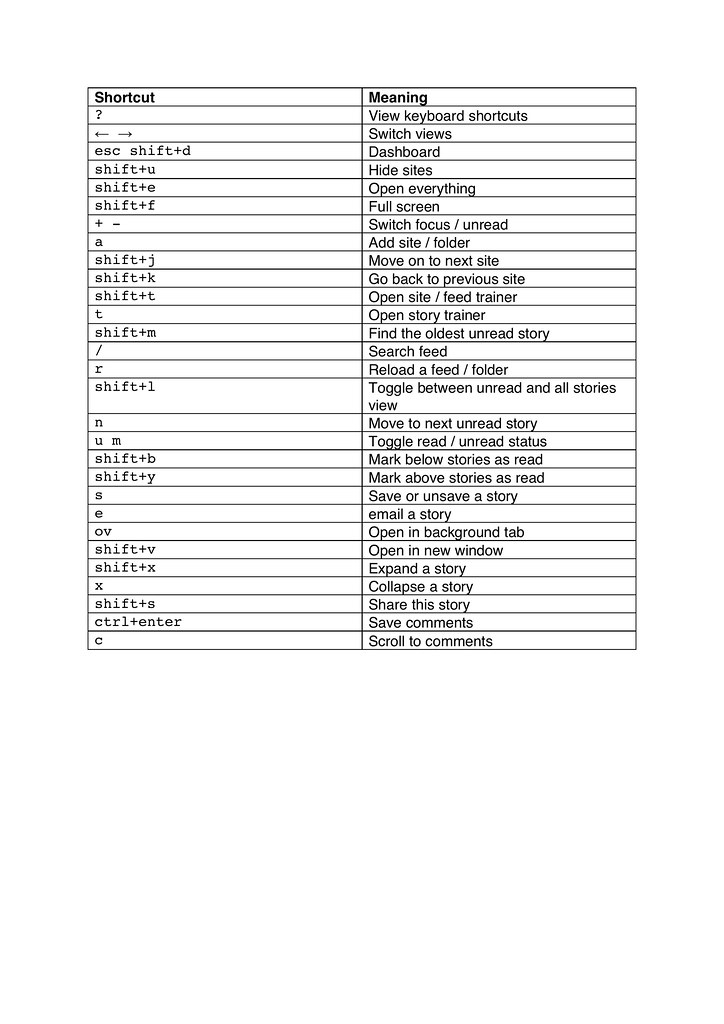
Slack – yes i know that it seems like hipster CB radio. But its popular and you are likely to need to get with the programme. I am a great believer in only accessing Slack only via the desktop interface, by booting the app up once an hour. Part of the reason for this is because it can be a time suck; in the way that email was when it came into offices back in the 1990s. A second reason is Slack keyboard short cuts make life so much easier.
Hemingway – I have paid good money for the native app, but Hemingway’s web interface is a great gateway drug to improve your writing. I have friends who would recommend the fuller featured Grammarly. Try them both and see what works best for you. In the UK a key consideration is that you can’t always get online; which is is why went with the Hemingway native app.
Development
Balsamiq – great rapid wire framing tool that I find easier than Adobe’s offerings. Also worthwhile looking at OmniGraffle – I’ve used the Mac version for years.
BuildWith – this has saved me hours of work over the years. A client wan’t extra functionality on their website. You need to know what they use to understand if you even want to pitch for it, or if you have to scramble to find a Sitecore developer to partner with.
Influencers
Takumi – make the briefing process of Istagrammers a bit easier with Takumi; when you are dealing with them en masse with this specialised outsourcing service
Digging out influencers in a given area for influencer mapping and influencer marketing programmes is a time intensive process to validate and sieve candidates. Traackr is a good tool to start this process with. They also have workflow tools in there which may be of use depending on what else you use.
Networking
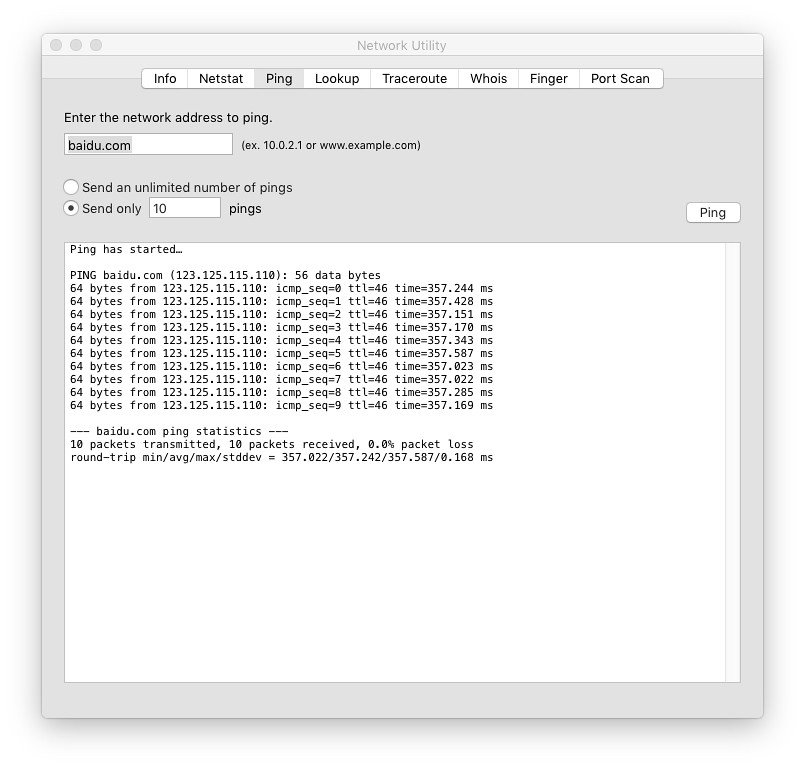
Once upon a time there there used to be a great all in one tool called Sam Spade. It was a Windows app and a web app. The Windows app hasn’t been maintained and the web app has gone. Central Ops does at least some of the things that Sam Spade used to do. If you’re a Mac user who has dug around at all in your machine you will know that there is also a handy little app called Network Utility. Central Ops provides you with a way to validate and trouble shoot email addresses and see if a domain is available for registration.
Research
Google – Yeah I know. Not exactly surprising; but I have a couple of articles on how to get the most out of the privacy-violating search engine: Grokking Google and II.
Pinboard – When you discover things, it is often hard to re-find them again with your search engine of choice.Algorithmic changes, personalisation of search results and an ever growing web can all work against you. Pinboard keeps the links that you find within easy reach. It allows you to notate the links and categorise them with tags. I use the Pinner app on my iPhone to access my Pinboard account on the go. It’s a lighter weight service than Evernote or Mendeley. If you are already an assiduous user of those services instead, keep going with them. The key thing is develop a habit that will facilitate smarter research. If you use Pinboard in association with a web page capture service like archive today and you can protect yourself if the page changes.
Standard Deviation Calculator – This just makes life so much easier. Take a string of numbers, drop them in and get the appropriate values out. This makes data analysis so much easier.
Wolfram Alpha – handy search engine with a lot of verified data. You can get tips on how to get the most out of it here.
Search marketing
Ahrefs – paid for service that’s really good at understanding your competitors SEO mojo including a back link checker and pretty comprehensive competitor research tools.
Rich Results Test – Google Search Console – see if a site takes advantage of Google’s rich results functionality (particularly handy when you are trying to highlight key information on a website). More on the how and why of them on Econsultancy.
Sitebeam – an all-in-one tool that provides comprehensive technical SEO audits on websites. It even outputs the results as a PDF. This makes life so much easier.
In order to get a brand on social media it isn’t about dropping brand assets on social channels but thinking about what it actually means.
Distillation of this process is likely to appear on a social media document:
It contextualises why social, there must be a business and brand reason to be there beyond ‘well everyone is on Facebook’ in order to get a brand on social media
An explanation of how to use the document. Those involved need to view the document as a ‘north star’ for social. It needs to be clear that the document is a set of guidelines, but not immutable
In order to get a brand on social media, you need to understand what what will look and sound like
How the brand manifests itself on social:
What’s the brand’s tone of voice on social media channels. Does it want to want to sound like an everyman, does it want a bit of distance and gravitas, does it want to be an authority on a given area?
What’s the personality? If it was a person, what kind of person would it be. This frames the content, what questions it will answer and the view point that it will take. It’s adding extra dimensions that won’t necessarily be applied in public relations, print or even TV advertising due to the nature of social channels
What are the content pillars? Think of this as the core messages. Every piece of content created and shared will demonstrate at least one pillar. These are typically things like organisation innovation, heritage, values, point of leadership (thought leadership, authority / expertise, style leadership etc)
Cross channel rules:
How will you handle hashtags
How ill you handle localised domain names? (Will their be local domains?)
Who has the right to publish what first? For instance if you look at sports brands like Nike or New Balance; you’ll see that soccer related content first appears on their specialist football channels
Should local channels link back to ‘global accounts’?
Are there any sponsorship or IP-related watch outs? When I worked on New Balance; any club kit related content had to feature a minimum of three players. Otherwise there would be problems with the players other sponsors (notably their boot sponsors and their agents who would be looking for another pay day). Who needs to approve use of sponsorships and how long will approvals take? Can you do a flow diagram to provide insight into the process? How do you handle successes or set backs of partners?
How do you handle rumours and speculation? (New iPhone launch or renewal of sponsorship deal with Tiger Woods)
How do you handle images that might have a competitor brand in shot?
Do you ignore controversial news?
Will you share partner content? What channels and handles are legitimate partner content to share?
What kind of tools will you put in place? Large brands often use an intermediary platform like Percolate that provides measurement, asset management and an approvals workflow as needed. It even allows the localisation of content by the local brand team
Social channel-specific rules
How often will you post on a given channel? This might be dictated to you by the kind of account you have on some channels like WeChat. With most others it will be driven by audience content consumption. Twitter generally lends itself to more frequent posts than Instagram or Facebook
Specific channel aims over the coming year
How will the channel be used? Are there particular segments that it is good at reaching?
What kind of content can be published? Example content categories. Best practice executions from other (non-competing) brands to get best practice ideas
Social crisis response
Crisis like accidents have an incident funnel marked by small events, the more of these that happen, the harder it is to climb out of the funnel. The trick is to limit these before they take you down the funnel.
Have a clear workflow in place to handle negative criticism. The US Air Force had a really good workflow to borrow from.
Real-time monitoring should highlight things before they escalate. How is this intelligence distributed and to whom?
Who is going to be part of the decision group, you’ll likely need people from: customer services, product expert, public relations, management. How will you ensure that employees and the supply chain speak with one voice?
Mark Ritson wrote an op-ed over at Marketing Week on influence and influencers. Whilst it lacked nuance on the subject area, a lot of what it said is true. Go over and have a read; I’ll be waiting for when you come back.
Whilst I disagree on the finer points, what Ritson wrote needed to be said. There needed to be a turning of the tide on influencers from boundless optimism to a greater degree of sobriety and critical analysis of the influencer opportunity.
I first noticed this boundless optimism when I attended the In2 Innovation Summit in May last year. Heather Mitchell on a panel. Mitchell worked at the time in Unilever’s haircare division where she is director, head of global PR, digital engagement and entertainment marketing. I asked the panel discussing influencer marketing about the impact of zero-based budgeting (ZBB) and the answer was ducked. ZBB requires a particular ROI on activity, something that (even paid for) influence marketing still struggles to do well.
This was surprising given the scrutiny that other marketing channels were coming under, I couldn’t understand how influencer marketing merited that leap of faith.
Substitute ‘buzz marketing’ for ‘influencer marketing’ and this could be 15 years ago. Don’t get me wrong I had great fun doing things like hijacking Harry Potter book launches when I worked at Yahoo!, but no idea how it really impacted brand or delivered in terms of RoI. Influencer marketing seems to be in a similar place.
Just five years ago we had managed to get past the hype bubble of social and senior executives were prepared to critically examine social’s worth. In the meantime we have had a decline in organic reach and massive inflation in both ad inventory and influencer costs. What had changed in the marketers mentality?
Onward with Mark Ritson’s main points.
Ritson’s Three Circles of Bullshit
A very loose reference to Dante Alighieri’s Divine Comedy trilogy; but for modern marketers
The First Circle of Bullshit: Are the followers real?
Are they bots?
Are they stolen accounts?
Are the user accounts active any more?
Has the account holder padded their account with bought followers and engagement. Disclosure – I ran an experiment on my Twitter account and still have a substantial amount of fake followers. More on this experiment here.
The Second Circle of Bullshit: Are influencers trusted?
Ritson did an unscientific test that showed (some) influencers would post anything for a bit of money
The Final Circle of Bullshit: Do they have influence?
Some influencers are genuinely authoritative; but this is a minority of influencers out there
Ritson alludes to the lack of organic reach amongst an ‘influencers’ followers which is likely to be 2% reach or less
Trends in influence
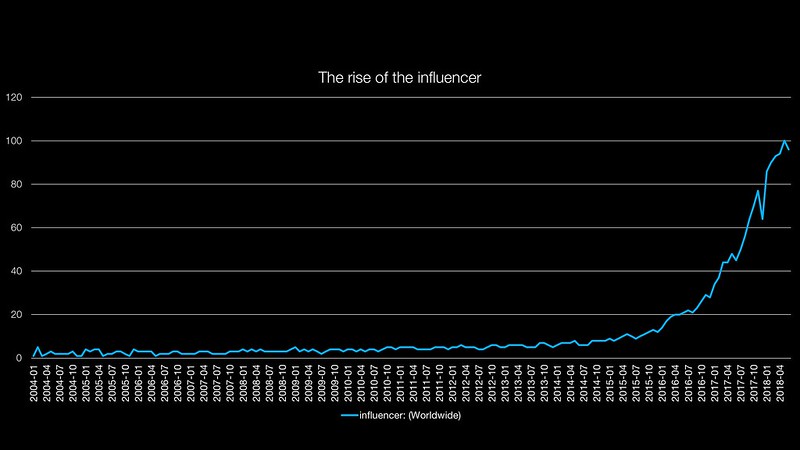
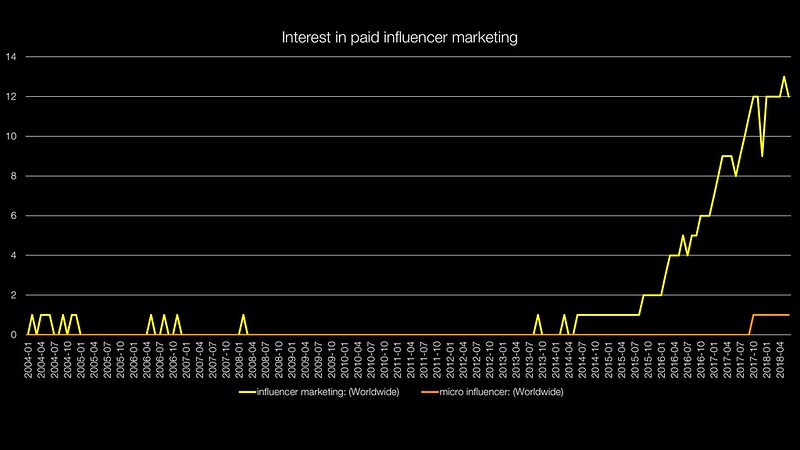
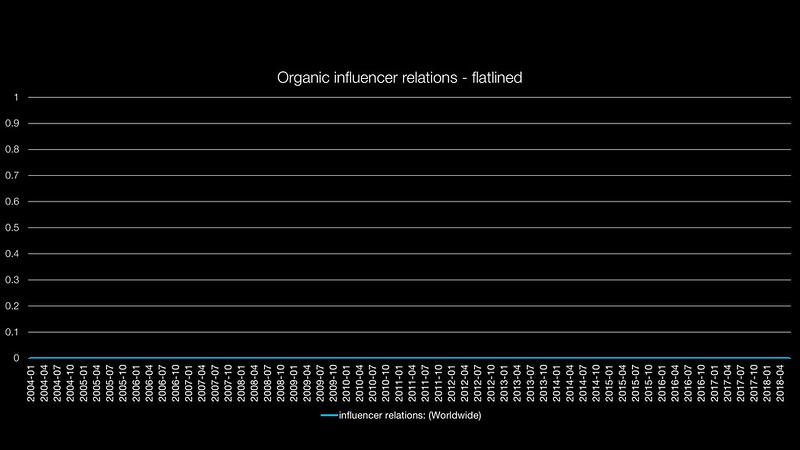
I looked at Google Trends to see what could be learned in the rate of change in searches over time. Consider Google Trends to be an inexact but accessible measure of changes in interest over time.
Global interest in influencers have been accelerating
There has been a corresponding rises in interest around paid influencer marketing
There hasn’t been the same interest peak in organic (PR-driven) influencer work
All of which supports the following hypotheses:
it’s become on-trend from the perspective of marketers, agencies and ‘influencers’
A significant amount of influencers are in it for the money – which brings into question their (long term authority and consumer trust)
A significant amount of influencers have an exceedingly good idea of their value (more likely overly-inflated)
Ego is less of a motivator for becoming an influencer than material gains
What would influence look like?
Propagation of the content by real people. Instagram, a particularly popular influencer channel, has made sharing posts difficult for followers historically. Re-gramming was a pain in the arse for the average Instagram user.
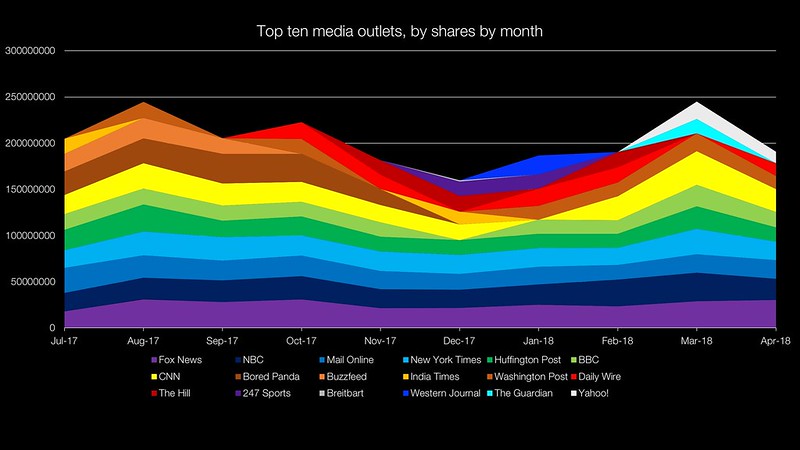
If we look at the mainstream media and how it is shared on Facebook we see that only five media brands are consistently in the top ten most shared media properties. ‘Traditional’ influencer status isn’t necessarily a garrantor of consistent successful propagation either, if Newship’s data is to be believed.
Attributed sales. Some luxury brands in China have had success collaborating with influencers and selling through their channels; the post child being Mr Bags collaboration with Longchamps.
How is the best way to use influencers in marketing?
Assuming that you are using influencers in the widest possible sense at the moment.
Treat the majority of influencers as yet another advertising format
That means that reach, the way the brand is presented, and repetition are all important – smart mass marketing following the playbook of Byron Sharp.
Viewing your influencer mention in that prism, it means estimating what the real reach would be (lets say 2% of the follower number as an estimate) and paying no more on a CPM rate than you would pay for a display advertising advert
Ensure that the brand is covered in the way that you want. Some luxury brands have managed to get around this by keeping control of the content; a good example of this is De Grisogono – a family-run high jewellery and luxury watch brand. They work with fashion bloggers that meet their high standards and invite them to events. De Grisogono provides them with high-quality photography of its pieces and the event. They get the high standard of brand presentation which raises the quality of the placement
Get repetition with the audience by repeating the placement with other content that delivers the same message with the same high standard of production
All of this might work for a luxury brand, IF you found that the amount of agency time and creative work made commercial sense. It is less likely to work for normal FMCG brands. What self-respecting influencer is going to be bossed around by a breakfast cereal?
Thinking about micro influencers, probably the area that has had the most interest from marketers recently due to them appearing to be better value than macro influencers.
Brown & Fiorella (2013) explanation of micro-influencers:
Adequately identifying prospective customers, and further segmenting them based on situations and situational factors enables us to identify the people and businesses – or technologies an channels that are closest to them in each scenario. We call these micro-influencers and see them as the business’s opportunity to exert true influence over the customer’s decision-making process as opposed to macro-influencers who simply broadcast to a wider, more general audience.
Brown & Fiorella focus on formal prospect detail capture and conversion.
This approach is more likely to work in certain circumstances; where there is low friction to conversion (e-tailing for discretionary value items).
It starts to fall apart when you deploy their approach to:
Consumer marketing
Mature product sectors
Mature brands
You would also struggle with many B2B segments where social provides a small reach and little social interaction.
Work with real influencers on long term collaborations
There is more likelihood of having audience trust if they can see and understand the long term relationship between a brand and its influencers
Better brand placement easier, with an influencer that ‘gets’ the brand
You’ve got a better chance of being able to get access and fully understand the underlying analytics of their accounts (which should be a prerequisite for long term relationship)
You can look at collaborations and attribution payment models that raise all boats
Ketchum’s David Gallagher wanted to know whether he should have his own website as part of managing his personal online brand? He initially felt that publishing on Facebook and LinkedIn was enough. There was also discussion around platforms like Medium. None of which give you real control over your content. Wadds like me felt that owning your own platform was important.
Why have a website as part of your personal online brand?
LinkedIn and Facebook don’t have the same agenda as you. Your content becomes a hostage to their business whims
It is hard for users to discover your content, Facebook and Google make it so
Even on Medium you no longer really own your content. It can’t be easily exported like content on the Blogger platform
Even in the world of Facebook, Google is still a reputation engine
So show do you manage the process?
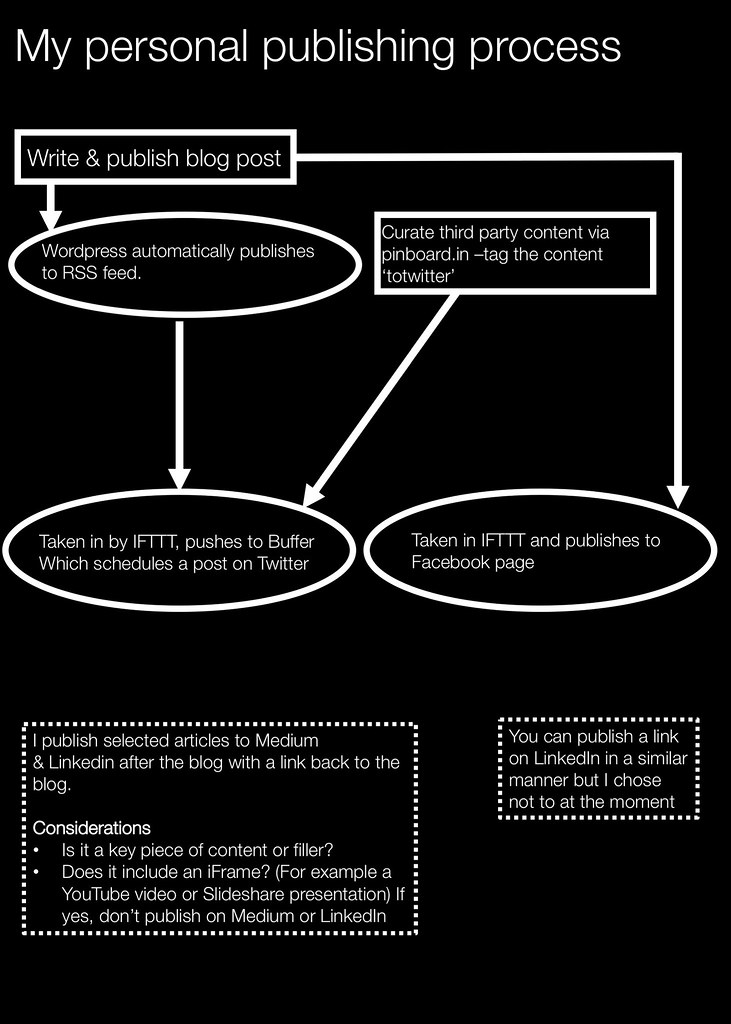
You need to find a system that works for you. Here is what mine looks like for social syndication.
IFTTT – if then, then that. A service that allows you to trigger actions based on pre-created inputs. It allows rules to be built up based around different inputs:
A photograph tagged with a particular label or hashtag
It supports numerous services including Flickr photography and pinboard.in
Buffer – buffer is a social publishing tool. I have pre-scheduled slots. It is also compatible with publishing posts sent via IFTTT.
Pinboard.in – pinboard is a way of storing your bookmarks with notes and tags online rather than on your computer. Your bookmarks then become accessible wherever you are. It is handy to be able to search things that you have found previously. Google seems to have moved away from organising all the world’s information to mainly focus on ‘now’ content. Pinboard helps you get around this.