Yōkoso – welcome to the Japan category of this blog. This blog was inspired by my love of Japanese culture and their consumer trends. I was introduced to chambara films thanks to being a fan of Sergio Leone’s dollars trilogy. A Fistful of Dollars was heavily influenced by Akira Kurosawa’s Yojimbo.
Getting to watch Akira and Ghost In The Shell for the first time were seminal moments in my life. I was fortunate to have lived in Liverpool when the 051 was an arthouse cinema and later on going to the BFI in London on a regular basis.
Today this is where I share anything that relates to Japan, business issues, the Japanese people or culture. Often posts that appear in this category will appear in other categories as well. So if Lawson launched a new brand collaboration with Nissan to sell a special edition Nissan Skyline GT-R. And that I thought was particularly interesting or noteworthy, that might appear in branding as well as Japan.
There is a lot of Japan-related content here. Japanese culture was one of odd the original inspirations for this blog hence my reference to chambara films in the blog name.
I don’t tend to comment on local politics because I don’t understand it that well, but I am interested when it intersects with business. An example of this would be legal issues affecting the media sector for instance.
If there are any Japanese related subjects that you think would fit with this blog, feel free to let me know by leaving a comment in the ‘Get in touch’ section of this blog here.
The rise and fall of Esprit, SF’s coolest clothing brand – Esprit appealed to the youth with a message of lefty, post-racial harmony. Wild prints, bright colors and baggy silhouettes reigned. Their tote bags and T-shirts hung from all the coolest shoulders, adorning fashion plates with the legendary Esprit logo. With the logo’s omnipresence at the time, it may as well have been Supreme for the teens of the late ’80s and early ’90s. – the article skips over some of the awful things that Esprit did to its Chinese emigrant workers in San Francisco.
Esprit Store in Gentings Casino, Malaysia by Ryan Lackey
The success of Esprit was down to its ‘Europeaness’. It had a Benetton kind of vibe, because they shared the same advertising creative and a similar approach to interior retail space design and bright colours. Esprit eventually listed on the Hong Kong Stock Exchange but never got its mojo back. The clean logo was designed by John Casado, who had worked for Apple on the Macintosh icons and New Line Cinema
China
Chinese documentary prompts rare criticism of Xi’s anti-corruption campaign | Financial Times – Analysts said the negative reaction to Zero Tolerance suggests the decade-long campaign has not sealed public confidence in the party’s ability to investigate itself for graft, which remains widespread….“Getting caught doesn’t mean you are more corrupt than others,” said a former official at the Supreme People’s Procuratorate, the highest government agency responsible for investigation and prosecution of criminal cases. “It just means you have bad luck.” – such a good read and reaffirms much of what I saw in China, prior to and during the early Xi premiership. The way it falls is arbitrary in nature and usually linked to power struggles
For Olympic Sponsors, ‘China Is an Exception’ – The New York Times – At the bottom of the slope where snowboarders will compete in the 2022 Beijing Olympics, an electronic sign cycles through ads for companies like Samsung and Audi. Coca-Cola’s cans are adorned with Olympic rings. Procter & Gamble has opened a beauty salon in the Olympic Village. Visa is the event’s official credit card. President Biden and a handful of other Western leaders may have declared a “diplomatic boycott” of the Winter Games, which begin next week, but some of the world’s most famous brands will still be there. The prominence of these multinational companies, many of them American, has taken the political sting out of the efforts by Mr. Biden and other leaders to punish China for its human rights abuses, including a campaign of repression in the western region of Xinjiang that the State Department has declared a genocide. – at the end of the day, brands are more afraid of Chinese consumers and the Chinese government than they are of western governments and activist consumers
Implications of Revenue Models and Technology for Content Moderation Strategies by Yi Liu, Pinar Yildirim , Z. John Zhang :: SSRN – We show that a self-interested platform can use content moderation as an effective marketing tool to expand its installed user base, to increase the utility of its users, and to achieve its positioning as a moderate or extreme content platform. For the purpose of maximizing its own profit, a platform will balance pruning some extreme content, thus losing some users, with gaining new users because of a more moderate content on the platform. This balancing act will play out differently depending on whether users will have to pay to join (subscription vs advertising revenue models) and on whether the technology for content moderation is perfect.
We show that when conducting content moderation optimally, a platform under advertising is more likely to moderate its content than one under subscription, but does it less aggressively compared to the latter when it does. This is because a platform under advertising is more concerned about expanding its user base, while a platform under subscription is also concerned with users’ willingness-to-pay. We also show a platform’s optimal content moderation strategy depends on its technical sophistication. Because of imperfect technology, a platform may optimally throw away the moderate content more than the extreme content. Therefore, one cannot judge how extreme a platform is by just looking at its content moderation strategy. Furthermore, we show that a platform under advertising does not necessarily benefit from a better technology for content moderation, but one under subscription does, as the latter can always internalize the benefits of a better technology. This means that platforms under different revenue models can have different incentives to improve their content moderation technology.
What China thinks of possible war in Ukraine | The Economist – Both see a world order being reshaped by American weariness and self-doubt, creating chances to test and divide the democratic West. Chinese and Russian diplomats and propaganda organs relay and amplify parallel narratives about the benefits of iron-fisted order over American-style dysfunction. Joint military exercises demonstrate growing trust – but China will be very cautious and nationalists want the Russian Far East back where it belongs as part of China
Handspring was a key part of my first agency job. It was the dot com era, Jeff Hawkins, Donna Dubinsky, and Ed Colligan had founded Palm Inc. and left after it was sold to 3Com. They then went on to make modular PDAs with the Handspring Visor – which tapped into the clear plastic designs pioneered by Apple’s iMac. And then they built the PDA with smartphone capability called Treo. 3Com had made a Palm device in 1999 that used the Mobitex mobile data network, which was more analogous to a two way pager with a limited walled garden of content a la vintage AOL. Palm’s version of the Palm PDA has a common connector that could be used to connect external peripherals, such as the OmniSky sled which converted your PDA into an internet connected smartphone.
But it was Handspring who had the ‘heat’ and the wherewithal to provide a neat connectivity slot for its peripherals to sit in, providing a neater experience. Springboard is a documentary about Handspring
Of course, the outcome of PDA based smartphones isn’t all sweetness and light as Scott Galloway shows with our modern mobile device usage.
Myst
Ars Technical are doing some great oral histories of games creation. This one on Myst is very close to my heart. What’s particularly interesting is how the game was developed at a moment in time with the transition to CD ROM media. This resulted in a huge leap forward in what the technology was capable of doing, comparable to the early web in terms of creative disruption. It also made me really, really miss HyperCard.
Jimmy Wang Yu
Taiwanese martial artist, actor and gangster Jimmy Wang Yu carved the way for Jackie Chan and Bruce Lee in Hong Kong cinema. This documentary on him is first rate.
Windows
Interesting CNBC documentary on the hegemonic position of Microsoft Windows in personal computers.
Audi S1 Hoonitron and vehicles of Cyberpunk 2077
Ken Block’s collaboration with Audi has produced some interesting material. Growing up in the 1980s, group B rallying held a fascination for me, so that’s what got me interested in the Block / Audi collaboration at first. But what’s interesting about Block’s prototype electric Audi Quattro S1 is the speed at which Audi is able to put together a prototype working car with modern technologies. All of which implies ever more opportunities for automotive customisation for customers and the potential for additive manufacturing at the luxury end of the market. Hoonitron does sound like a late 1970s Taiwanese or Korean copy of a Sony television set.
While we’re on about car design, there is also this great video on the vehicles in Cyberpunk 2077. 14 out of 10 for pure style.
Tudor Pelagos FXD
Tudor have been on point in their marketing. Their new version of the Pelagos has some lovely design cues, even if its modern day association with the French navy is marketing fluff. PELAGOS FXD – more from the Tudor press room.
Fake socialite
A graduation project by an art student from the Central Academy of Fine Arts in Beijing did an experiment that has sparked a debate about class, inequality and the massive wealth gap in modern China. In the video you see her attempt to live 21 days for free in Beijing. She disguised herself as a socialite and slept in the halls of extravagant hotels and enjoyed free food and drinks. What surprised me is that the work hasn’t been suppressed and that she hadn’t been arrested. It also shows how Xi Jingping’s concept of common prosperity is designed to tap into a deep tension in society at the moment.
Paper and glue
MSNBC put together an amazing documentary on French street artist JR who does giant photo collages as street art. Here’s the trailer.
https://youtu.be/7NmxynGAmrM
Hong Kong Christmas
Hong Kong’s relationship with Christmas is a complicated one. A substantial minority of Hong Kongers are practicing Christians. Until the opening up of China in the late 1970s, Hong Kong was a substantial supplier of toys, Christmas decorations and lights. And then there is the multinational community living alongside Hong Kongers, which brings the western commercialism of Christmas. For many Christmas is a ‘pre-lunar new year celebration, both are big on the colour red and the decorations for one used to bleed into the other in public spaces. So I thought the joy of this Christmas street market might appeal to readers here.
Is there an end in sight to supply chain disruption? | Financial Times -There are major barriers to ending supply chain disruption by decoupling from China. Japan is trying to reduce supply chain disruption by replicating Chinese factories in other countries like Thailand and Indonesia. Here are some of things stopping multinational corporations from making that happen. In order to end supply chain disruption, I would imagine that a higher degree of automation is key, which will require corresponding improvements in automation technology. This doesn’t just mean software but also in mechanical engineering. The main issue for fine motor control in robots is the design and price of harmonic drives. This doesn’t operate on a Moore’s Law speed and scale of innovation. Increased automation also likely means major changes in approach to product design. Back in the golden era of consumer electronics just prior to the consumer adoption of the internet, circuit boards were less dense because they were designed for automated ‘pick-and-place’ machines. Nokia had a similar approach to its phones prior to the pivot to Windows and Qualcomm chips. The reason why Apple needs iPhones made in China is because a lot of the final assembly is closer to the work of a watchmaker servicing a mechanical watch than you would credit. So lots of cheap, (younger, smaller, delicate, usually female) hands are required. Our financial system’s obsessive, narrow focus on shareholder value will curtail these movements. Look at how Apple crows about how green they are and yet makes the virtually unrecyclable Air Pods by the million. Until that changes and the computers are assembled from modular boards, closer to their home market the supply chain won’t change despite the political, economic, national security and moral imperatives otherwise. Which is why Apple amongst others point out that they have an inability to move production out of China. This will get even harder as China moves up the semiconductor value chain. Once they are building memory modules and modern silicon fab processes, its game over for manufacturing elsewhere in the electronics sector. China is also the sole provider for many of the ingredients in multi-vitamins and pharmaceutical products. They process and mine just under 90 percent of the world’s rare earth metals – key for a large swathe of technologies from magnets to chips and batteries. They have a similar position in solar cell polysilicon and lithium ion battery ingredients.
JAXPORT promises less supply disruption
So ending supply chain disruption would mean replicating whole ingredient manufacturing chains and industry knowhow that multinationals had migrated to China decades ago. All of these actions to reduce supply chain disruption may not be received very well by China itself. China has bought key infrastructure around the world: power generation, ports, water supply, rail networks and more. All of which means that they get a greater say in how the world’s supply chain works. Xi Jingping has been straight forward in saying that he wants the world to rely on China more, and China to rely on the rest of the world less. Decoupling from Chinese supply chain disruption has taken on even more importance with the rise of Chinese secondary sanctions. More on nearshoring to avoid Chinese supply chain disruptions here: China’s economic woes: An opportunity for U.S. manufacturing?
China
Scientists believed Covid leaked from Wuhan lab – but feared debate could hurt ‘international harmony’ – An email from Dr Ron Fouchier to Sir Jeremy said: “Further debate about such accusations would unnecessarily distract top researchers from their active duties and do unnecessary harm to science in general and science in China in particular.” Dr Collins, former director of the NIH, replied to Sir Jeremy stating: “I share your view that a swift convening of experts in a confidence-inspiring framework is needed or the voices of conspiracy will quickly dominate, doing great potential harm to science and international harmony.” Institutions which held the emails have repeatedly resisted efforts to publish their content. The University of Edinburgh recently turned down an Freedom of Information request from The Telegraph asking to see Prof Rambaut’s replies, claiming “disclosure would be likely to endanger the physical or mental health and safety of individuals”. – this is going to turn into a dumpster fire
Dutch university gives up Chinese funding due to impartiality concerns | Netherlands | The Guardian – Amsterdam’s Vrije Universiteit (VU), the fourth largest university in the Netherlands, has said it will accept no further money from the Southwest University of Political Science and Law in Chongqing and repay sums it recently received. The announcement came after an investigation by the Dutch public broadcaster NOS last week revealed VU’s Cross Cultural Human Rights Center (CCHRC) had received between €250,000 (£210,000) and €300,000 annually from Southwest over the past few years. According to NOS, the CCHRC used Southwest’s money to fund a regular newsletter, organise seminars and maintain its website – which has published several posts rejecting western criticism of China’s human rights policy
Why is it still considered OK to be ageist? | Financial Times – A study by academics at Yale found that people with a negative approach to ageing deal with it worse mentally and physically and die seven and a half years younger. To put this in context, mild obesity shortens life by three years, extreme obesity by 10. Hardly surprisingly, this has prompted a great deal of fuss at government level. Policymakers and health professionals obsess over obesity. But what about the damage done by poor attitudes to ageing? Until I read about the survey I had no idea it was even a thing: the fact that ageism can actually kill you is a well-kept secret. It is also a costly one. According to the WHO report, the resulting ill health places an additional annual burden on the US healthcare of $63bn. I realise that health policymakers have been busy since the report came out last March, but still there hasn’t been a peep out of them
I love this 60 Minutes Australia film about an Australian inventor
Equations built giants like Google. Who’ll find the next billion-dollar bit of maths? | David Sumpter | The Guardian – The PageRank story is neither the first nor the most recent example of a little-known piece of mathematics transforming tech. In 2015, three engineers used the idea of gradient descent, dating back to the French mathematician Augustin-Louis Cauchy in the mid-19th century, to increase the time viewers spent watching YouTube by 2,000%. Their equation transformed the service from a place we went to for a few funny clips to a major consumer of our viewing time.
Murata’s Thailand move heralds Japan tech shift from China | Financial Times – “The most populous country today may be China, but in 2030 that will be India, and further down the road it will be Africa,” Nakajima said. “Will those economies be aligned with China or the US? We don’t know. We should be able to respond to both scenarios.”
Legal
Hong Kong: how colonial-era laws are being used to shut down independent journalism – police recently told reporters that opinion articles aren’t the only ones that can be regarded as seditious. Media interviews with exiled activists and features on clashes between protesters and riot police can also be considered seditious if the content is deemed by the government to be “fake news” or inciting hatred towards the government and endangering national security
Hong Kong independence activist Edward Leung released from jail, told to stay silent — Radio Free Asia – Hong Kong barrister and former lawmaker Siu Tsz-man said supervision orders are sometimes issued to released prisoners involved in violent crimes, including murder and manslaughter, and require the former prisoner to maintain contact with supervision officers and remain at a stable residence. But Siu said the order to stay away from the spotlight was unprecedented. “I have never heard of this happening before,” Siu said. “My staff have never heard of a supervision order under which the person isn’t allowed to give interviews to the media.” Siu declined to comment on whether the order was appropriate without knowing the details of the case. “The point of a supervision order isn’t to confine someone at a certain location and not let them leave,” he said. Some drew parallels between Leung’s release and the continuing controls on released political prisoners in mainland China – similar in nature to an ASBO but inherently political in nature
Virginia burglaries work of ‘crime tourists,’ authorities say – The Washington Post – Authorities call them “crime tourists.” Law enforcement experts say cells of professional South American burglars, particularly from Colombia and Chile, are entering the country illegally or exploiting a visa waiver program meant to expedite tourism from dozens of trusted foreign countries. Once here, they travel from state to state carrying out scores of burglaries, jewelry heists and other crimes, pilfering tens or hundreds of millions of dollars’ worth of goods each year, the FBI estimates. Experts said the groups often operate with impunity because they have found a kind of criminal sweet spot. Bail for nonviolent property offenses is often low, so an arrested burglar often quickly gets bond and skips town for the next job, experts said. The crimes often don’t meet the threshold for the involvement of federal authorities. And they attract less attention at a time when U.S. authorities are contending with a rise in homicides. Dan Heath, a supervisory special agent with the FBI’s criminal investigations division, said “South American theft groups,” as the agency calls them, are a growing problem across the United States — and in countries including India, Britain and Australia, where they often employ similar tactics. “They represent an enormous threat right now in our country,” Heath said. “They are tending to thread the needle in avoiding both state and federal prosecution.”
VW fired senior employee after they raised cyber security concerns | Financial Times – A senior Volkswagen employee was dismissed weeks after raising the alarm about alleged cyber security vulnerabilities at the carmakers’ payments arm, which is soon to be majority-owned by JPMorgan. The manager alerted bosses in September 2021 to concerns that VW’s system in the region was “open to fraud” following an attempted cyber attack, and maintained that $2.6m sitting in the company’s accounts could be stolen, according to documents seen by the Financial Times. The staff member, who also told superiors that VW could face regulatory action if the vulnerabilities were not addressed, was then fired in October. – not terribly surprising
Software
After ruining Android messaging, Google says iMessage is too powerful | Ars Technica – “Google clearly views iMessage’s popularity as a problem, and the company is hoping this public-shaming campaign will get Apple to change its mind on RCS,” writes Amadeo in closing. “But Google giving other companies advice on a messaging strategy is a laughable idea since Google probably has the least credibility of any tech company when it comes to messaging services. If the company really wants to do something about iMessage, it should try competing with it.” – if this wasn’t an admission of failure by Google I don’t know what is. Google has a history of failed or closed communication services Google Talk (GTalk) (which was retired when Google decided to move away from an open messaging standard , Google Hangouts (which was spun out of Google+ messaging functionality), Google Allo and Google Wave
Christine Lee and Foreign Interference: what the UK can learn from Taiwan | China Dialogues – As part of the transition from authoritarianism to democracy, Taiwan retooled its political commissar system (zheng wei 政委) – formerly responsible for policing political loyalty toward the regime – into an institution that safeguards democracy by working to identify Chinese influence at all levels of Taiwanese politics and society. Political commissars (PCs) not only receive extensive military training but also develop a deep understanding of the Chinese Communist Party’s political warfare tactics. Most major government departments and private sector organisations in Taiwan will have PCs operating within their ranks, monitoring and reporting evidence of foreign interference. As many democracies facing Chinese influence and interference do not have such well-established systems in place, Taiwan’s zheng wei system may provide a starting point for how anti-foreign influence institutions can work effectively within democratic societies
Technology
EETimes – Arm Predicts Stagnation if Nvidia Deal Fails – without investment from Nvidia, Arm would be seriously disadvantaged in its bid to grow in data center markets and compete against Intel Corp. and x86 incumbents. The filing also explains why an Arm stock offering is a non-starter while noting that Arm faces stiff competition from emerging RISC-V competitors – interesting that they don’t mention ARM China crisis at all. Nvidia have now walked away from it and Softbank is supposed to be preparing a public offering for ARM
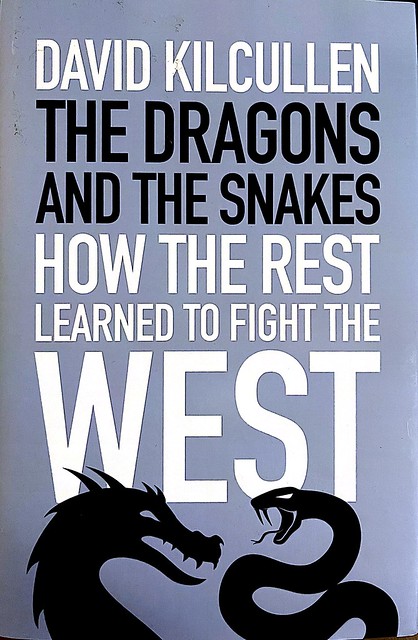
David Kilcullen wrote a number of books on the strategic challenges faced by the west in the war on terror. His book The Dragon and The Snakes looks at the challenges that the west faces from China (the dragon), Russia and Iran (the snakes). I was finishing reading this book as the Ukraine | Russia crisis broke this month, dominating the news headlines.
Out of the cold war
The Dragon and The Snakes starts with what shaped the modern world. The modern world was shaped out of the cold war. Western doctrine was defined by meeting a numerically superior force with superior technology. At the time, China and Russia were in dispute over a number of issues. At the chime of Chairman Mao, the death of Stalin and changing posture of the Soviet Union led to a fissure that widened over time. In the cold war was not only a war for influence between capitalism and communism; but also evolved into a war between Soviet communism and Maoist communism. China and Russia both supplied North Vietnam, but China invaded Vietnam partly due to it being more in the Soviet camp than the Chinese camp (this is is somewhat simplifying a multi-causal conflict, but has a truth in it).
China and US had limited cooperation with regards Russia which was brought in by Nixon’s famous visit to China and the machinations of Henry Kissinger who believed in systems and the ends justifying the means.
The flat topography of Kuwait and Iraq, together the latest 1980s weapons systems from the cold war made the first gulf war quick and provided an eye-raising demonstration of modern warfare. The campaign was just 42 days long.
Pivotal moments of change
Kilcullen goes on to discuss pivotal moments of change for both Russia and China in The Dragon and The Snakes.
The first gulf war. China noted that integrated satellite and aerial reconnaissance with associated command and control information systems; full spectrum jamming to ensure battlefield communications superiority; better coordination of naval and ground offensive forces than ever achieved before; highly accurate missile systems; integrated command, control, communications and intelligence for directing the battle. Mechanised units with air support then won the battle. But they also noticed the economics of war were not in favour of technology. Bombers and missiles were dubbed flying mountains of gold and used to attack targets worth less than the weapons system. Secondly more technology meant a shorter weapons system life. Weapons systems average service life went from 30 years to 10 years during the cold war due to technological obsolescence.
Kosovo – NATO’s intervention emphasised the nature of modern warfare to Russia. But it also emphasised the threat that the west posed. The Russians have a cultural connection to the Serbians. One incident in particular stuck out: the bombing of the Chinese embassy in Belgrade. The Chinese embassy attack showed a number of things. The bombing of the embassy was a demonstration of precision bombing. Unfortunately it was the right target, wrong building and was the sole CIA designated attack of the war. The CIA gave the military the wrong coordinates for a Yugoslav storage facility, instead they were the coordinates for the embassy
It fuelled Chinese perceptions that the US and west were willing to attack them, this stoked nationalism at home and basically broke the Kissinger-era detente and trust with the US. Thus there was a common view from both Russia and China
China realised that it needed to adapt from being an Asian land army to having an expeditionary component and defending against a likely American led expeditionary force
It reinforced Chinese views about the technological nature of war
Russian invasion of Georgia. While the two Chechen wars had been a meat grinder that exhibited many of the Soviet era armies weaknesses and corruption, it was the invasion of Georgia that proved to be the emphasis to professionalise and improve. Russians learned and built doctrine from the experience. Air power had proved vulnerable to relatively cheap MANPADs (man portable air defence systems). Armour disrupted by anti-tank missiles. Neither of which would have been a surprise to students of the Arab Israeli conflicts of the 1960s and 1970s, but were relearned again. Out of this experience sprang a lot of the ideas around hybrid warfare and applying technology to area denial systems in an asymmetric way, from an economic perspective.
Afghanistan, Iraq. Both of these wars showed the limits of the western way of war-fighting. Weapons systems became expensive, the west didn’t have the stomach for deaths and insurgents were finding ever new ways of using consumer technology. Google Maps and Google Earth were used for planning, command and control of both terrorists and private military contractors. Consumer drones conducted surveillance and even delivered bombs. All of the western weaknesses were noted, most of all the perceived lack of western will. Afghanistan reinforced views in Russia and China that the west was in an accelerating slope of decline.
Ukraine and Syria. Ukraine and Syria have allowed Russia to refine its war fighting techniques from a communications and technological perspective, as well as testing asymmetric techniques and also defending against them.
Wider parameters of war
Kilcullen highlights the way hacking, espionage, propaganda, weaponised diaspora, elite capture online crime, organised crime, misinformation, bribery, soft power, sharp power and private military operators mean that we are in a war that western leaders currently refuse to acknowledge. This then further emboldens Russia, China and the likes of Iran and North Korea. It felt strangely prescient that I was reading the book when MI5 issued a security warning about Christine Lee and Russia threatened to invade Ukraine.
Byzantine outlook
Disturbingly in The Dragon and The Snakes, Kilcullen thinks that the best way that the west can handle China and Russia is learning from the Byzantine empire’s ability to forestall collapse. This implies a few things:
He doesn’t believe that the west can find its way to effectively combatting China or Russia
He doesn’t believe that western systems of governance will survive
He believes that dragon and the snakes have more durable and effective systems of governance and war
All of which indicates an increasingly dark dystopian future.
In The Dragons and The Snakes Kilcullen provides a cogent well-researched and written picture of our current situation. If his work scares the crap out of enough people, we may even get answers to the multitude of problems that he outlines. More on the book here.
ASML fire hits EUV lithography production | EE News Europe – EUV lithography is used to provide the latest semiconductor manufacturing processes. ASML is world’s only provider of EUV lithography equipment, so the fire is of concern. EUV or extreme ultra violet light is important to provide ever smaller silicon chips. YouTuber Asianometry provides a few good video explanations of EUV lithography and its importance for the technology industry.
Star China investor Boyu seeks to navigate Xi Jinping’s tech crackdown | Financial Times – Liu Tianran, son of vice-premier Liu He, a confidante of Xi Jinping, established Skycus Capital in late 2016. Skycus has invested in units of Chinese technology giants Tencent and JD.com, which are Ant and Alibaba’s biggest rivals. Wen Yunsong, the son of former premier Wen Jiabao, founded the New Horizon investment fund in 2005, when his father was in power.
China’s business crackdown threatens growth and innovation | Financial Times – It would not be a surprise if China returned to a version of the joint private-state ownership model adopted under the leadership of Mao Zedong in the 1950s. This would amount to a de facto nationalisation of private companies — at least those in sectors such as data collection, national cyber security and financial services
SCMP | Hong Kong chief executive election 2022: why this year’s leadership race is unusual – the narrowed political spectrum which he said would prevent any non-pro-establishment hopeful from entering the arena. “Whoever is running, they will hold very similar political visions … There won’t be much to fight over. The competition will be just like Omicron versus Delta,” he said, referring to variants of the coronavirus.
How to
How a super reader gets through 52 books a year | Financial Times – Skim non-fiction. Fiction demands a close, word-for-word reading. But it’s more important to understand, not read most non-fiction, says US author and consultant, Peter Bregman. This can mostly be done by confining yourself to the table of contents, introduction, conclusion, and a few pages of each chapter.