Legal is defined as everything connected with the system of law within a country or area. The definition Law is a system of rules created and enforced to regulate behaviour, usually it belongs to a country or an area.
Online and innovation have often evolved way in advance of laws and the legal system’s ability to cope.
The emphasis that different systems have produces a number of challenges. China’s systems are locked down under their view of cyber sovereignty to avoid a contagion of western ideas. Yet they and other authoritarian regimes treat the open western systems as a battle space to destabilise other countries and attack their critics.
The US system favours free speech over privacy, which directly clashes with European values. Much of these European values were shaped in the aftermath of having lived under Warsaw Pact era authoritarian regimes.
There is a clash of the ages undertaken over ethics and power and what’s legal. The law offers up more questions and ethical traps than answers. It’s into this legal morass that my posts tend to land, usually at the point of intersection between ethics, the law and technology.
When I started using the web I believed that it was a unique extra-legal space similar to what John Perry Barlow outlined at the start of the ‘web’ as we now know it. The reality is that the net has already been staked out by businesses that look rather similar to the robber barons of the gilded age. Authoritarian regimes found it surprisingly easy to bend to their will and now sell their expertise around the world.
Partly due to Cambridge Analytica, General Data Protection Regulation (GDPR) is going to have a more profound impact on data usage globally. GDPR would have been seen as an extra-legal reach, but Facebook is making it look like a good idea.
I thought I would pull together a few resources that I thought would be of interest around GDPR since there is a lot of snake oil being sold as consultancy around it at the moment. I am not going to pretend that I am an expert, so I thought it would be useful to share some of the GDPR related resources that I have been looking to learn from.
Not only in terms of what the regulation is, but what techniques can be deplored to act in the spirit as well as the letter of regulations. Demonstrating a basic respect for the consumer won’t harm any brand, but might point to badly designed KPIs that direct and digital marketers might be measured from.
Andreessen Horowitz put together a good podcast on it.
Google’s First Voice Activated Coupon – WPP – Google distributed its first voice-activated coupon offering customers $15 off Target purchases placed on Google Express through Google Assistant –through desktop, mobile or Google Assistant enabled devices – I am surprised that Amazon didn’t introduce the voice activated coupon before Google.
RSS is undead | Techcrunch – no RSS is alive, but Techcrunch haven’t worked out issues the RSS users have already. Much of the issues are solved by using NewsBlur and finding sources is organic rather than an instant end state. More online related topics here.
Security
Could Cambridge Analytica boss be probed for Philippine meddling? | SCMP – This could get interesting. Putting aside arguments about whether Cambridge Analytica’s technology actually works as promised, Philippines law would still have been broken. It forbids all outside parties from participating in its election process.It is alleged that they were supporting Duterte, which would make the foreign reaction to it interesting as well.
What Siri creator Norman Winarsky thinks of Apple’s Siri now — Quartz – not terribly surprising. Norman Winarsky is now a partner at a number of Silicon Valley venture firms. Whilst he is better known in business space now as a lecturer on business, entrepreneur and VC, he is an academic at heart.
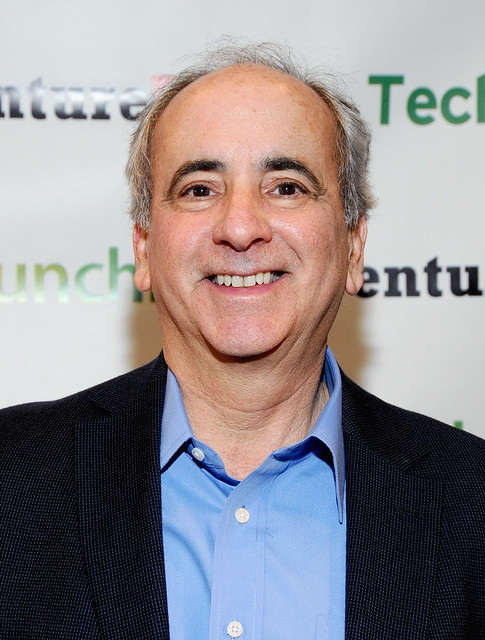
Norman Winarsky via the TechCrunch account on Flickr
Norman Winarsky studied and eventually ended up with a doctorate in mathematics. He started his private sector career at RCA Research (RCA’s answer to Xerox PARC or IBM Research), he had a career there for a number of decade as that moved through various owners. Eventually it became the east coast campus of SRI. Norman Winarsky went on to help found the SRI process for spinning off businesses and technology licensing. He was a co-founder of one of those businesses: Siri – that was bought by Apple. It will be interesting to see if Norman Winarsky has another high impact idea in him moving forwards. More related content here.
That’s the key finding from an analysis of regional and global agency deals by global marketing management consultancy Trinity P3 and Mark Ritson
Alibaba rival JD.com posts first annual profit as a public company | TechCrunch – The company’s fiscal profit was helped by a surprise $35 million profit in Q1 and a lucrative Q3 quarter in which it posted a RMB 1 billion ($151 million) profit thanks to its own efforts on Single’s Day, China’s online shopping bonanza. The company posted a RMB 909.2 million (US$139.7 million) loss for Q4, but that marked a 28 percent decrease year-on-year.
While Alibaba has a higher profile — with enormously profitable quarters — JD.com has quietly built out its e-commerce by expanding into financial services, offline retail and more
Consumer behaviour
This Chinese billionaire felt lost in US without WeChat, mobile payments | South China Morning Post – The chairman of Legend Holdings, the controlling shareholder of Lenovo, said China was now comparable to Japan and ahead of the US in terms of mobile internet technology, digital content and innovative business models.“If you haven’t stayed abroad for a long time, you might not understand [the difference],” said Liu, citing his recent experience in the US. His insights give credence to how Chinese technology companies have cultivated a hi-tech universe so large that it exists almost exclusively on its own – sustained by the country’s 1.4 billion people – but cut off from the rest of the world by Beijing’s Great Firewall, which blocks content not approved by the government. – the problem is that Chinese systems are ‘Galapagos’ technologies
BlackBerry suing Facebook for patent infringement | CNBC – “Blackberry’s suit sadly reflects the current state of its messaging business. Having abandoned its efforts to innovate, Blackberry is now looking to tax the innovation of others. We intend to fight,” Facebook general counsel Paul Grewal said – you see Facebook has sucked the blood out of other businesses for too long. I have little sympathy with them in this suit. It will be interesting to see how robust BlackBerry’s patents are and whether it would be cheaper for Facebook to pay them off or buy the business outright. The question is who is next after Facebook in Blackberry’s legal sights?
Luxury
Balenciaga is Putting its Money Where its Logo-Covered Hoodie Is for F/W 2018 | The Fashion Law – garments on the brand’s runway bore a phone number, +33156528799, which turns out to be Balenciaga’s “new hotline.” Call the number and you can answer a 20-question survey, inquiring about your age, primary language, height, and shoe size, as well as your favorite form of transportation, type of music, season, taste (your options are: Bitter, Salty, Sour, Sweet, or Umami), and so on.
A way for Balenciaga to better understand its customers? Maybe. Considering that the message is ends with the following note: “Thank you for taking the time to answer our questions. All data will be erased now,” I, for one, am guessing this is more interactive experience than fact gathering mission. If we have learned anything over the past several years, it is that “experiences” are everything to the modern-day consumer – I can imagine a choir of marketers howling in a symphony of pain about this
Meet the billionaire millennial pouring money into British fashion… and she’s only 27 | Telegraph Online – ‘My generation has completely different shopping habits,’ says Yu. ‘People born in the 1960s and ’70s buy into established brands such as Dior and Chanel. For them, it’s about showing status and where they fit into society. But my generation isn’t into logos – it’s not cool, it’s too obvious. [And] we prefer to shop online. We’ve become very interested and hungry for young, emerging designers.’
P&G’s Marc Pritchard calls for ‘fewer project managers’ at agencies as he vows to destroy ‘maze of complexity’ – “For media, data and analytics is enabling us to bring more media planning in-house, replacing multiple layers,” said Pritchard. “When it comes to buying, our purchasing people can negotiate with the best of them, so we’re doing more private marketplace deals in-house. And if entrepreneurs can buy digital media, why can’t the brand team on Tide, Dawn and Crest be entrepreneurs and do the same? They can, and they will.”
He explained that P&G wants and needs brilliant creatives, and will invest in such talent. But “creatives represent less than half of agency resources, because they’re surrounded by excess management, buildings and overhead.”
Media
Time for news to fight back | The Australian – Mark Ritson arguing that that agencies may be pushing clients into digital media because it can result in greater commissions for the agencies — in some cases almost 3 times greater than for traditional media (paywall)
Retailing
Smartphone users are spending more money each time they visit a website – Recode – The amount of money people spent per visit to online retailers has increased 27 percent since the beginning of 2015, according to new data from Adobe Analytics. Meanwhile, the length of smartphone website visits has actually declined 10 percent
Silicon Valley Is Over, Says Silicon Valley – The New York Times – In recent months, a growing number of tech leaders have been flirting with the idea of leaving Silicon Valley. Some cite the exorbitant cost of living in San Francisco and its suburbs, where even a million-dollar salary can feel middle class. Others complain about local criticism of the tech industry and a left-wing echo chamber that stifles opposing views. And yet others feel that better innovation is happening elsewhere – like Shenzhen? I think a lot of the problem with Silicon Valley is that it doesn’t build hardware any more. Bright people are mobile for the right pay, what you can’t easily do is the kind of commercialisation and manufacturing speed as a feedback loop like you see in Southern China
I’ve noticed new counterfeit accounts popping up on Instagram over the past few months. Below is screenshots taken from one example account focused on The North Face as a brand.
Interesting photoshoot shots probably re-grammed from the brands marketing materials or a magazine shoot. Looking at these pictures they maybe from marketing materials aimed at the Japanese market. Why Japan? It makes live easier for the counterfeiters in a number of ways
The sites are likely built by people who read Chinese as their first language. That means that a lot of Japanese writing is somewhat intelligible to them
Japanese marketing teams tend to do better photoshoots
Japan has a reputation for Japan market only exclusive products that are more attractive than those sold in Europe. The North Face’s Purple Label and Black Label lines started out as Japan market exclusives
When you move from the Instagram account and go through to the site to buy your items….
You come through to a great convincing looking site design. Only the URL (northfacew.com) and the artificially low prices give away the counterfeit nature of the goods on sale. For customers that aren’t as sophisticated Facebook now has its classifieds section. Think Gumtree but inside Facebook. That provides a great opportunity for your more traditional local sellers of snide goods.
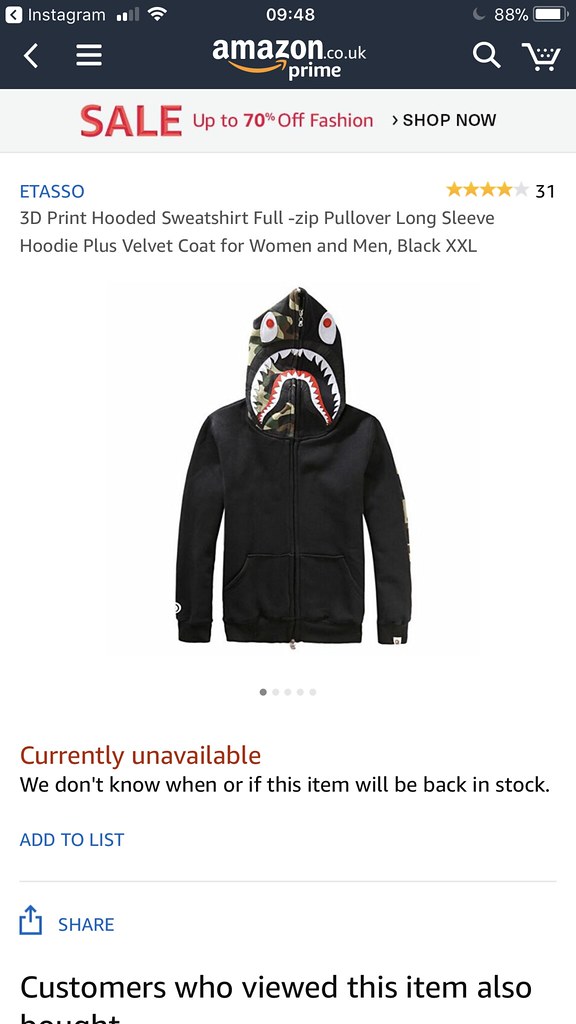
Here’s a second example of counterfeit product on Instagram. This time they are counterfeit versions of A Bathing Ape (BAPE) streetwear label and their iconic shark head hooded top.
This time they are selling the products through Amazon merchants accounts. While Amazon would kill to have premium and luxury streetwear brands like BAPE and Supreme on their website. That isn’t going to happen due to these brands embracing the ‘drop’ model of limited product disruption.
Instagram has a lot of heat from brands, but this could turn very quickly when they realise that Instagram can be a facilitator of counterfeit products sales. This could shimmy a lot of brand advertising on Instagram
Look at how Alibaba and eBay have been vilified in the past. The Amazon merchant scheme like eBay should be doing more against these vendors, which are predominantly small to medium sized Chinese companies. If this was 30 years ago, these goods would have been coming from similar companies in Thailand and South Korea.
The Shallowness of Google Translate – The Atlantic – Google Translate really weak on language that uses metaphors or symbolic elements in their discussion. So examples that I am familiar with Google Translate failing on include both Cantonese and Mandarin. It’s Mandarin is slightly better, likely due to a wider body of material to work from.
Are you addicted to your smartphone? You may need professional help | SCMP – it is interesting that ‘internet addiction’ isn’t diagnosed as say obsessive compulsive behaviour or sociopathy but its own unique disorder. The likes of TV soap operas or music offered similar escapes – the amount I spent on vinyl was definitely the wrong side of sanity (paywall)
Watchdog voices fears of privatisation risk to ethical standards – FT.com – Commissioners tended to assume that providers would conform to ethical standards so they were not explicitly incorporated into either the selection of providers or contracts. If monitoring occurred at all, it was focused on performance and financial measures rather than ethics, the committee said. (Paywall) – because that’s going to work well…
In a Mobile-First World, Shorter Video Ads Drive Results | Facebook Business – Average watch time for both the 6-second and 30-second video ads was the same, but ad recall was significantly higher for the 6-second ads. The difference in ad recall underlines the importance of keeping video ads short and communicating key messages in the first few seconds. – And here is the flaw in the argument
Daring Fireball: Only Apple – interesting article. I think that Apple’s decision to not try and build a curates egg helps, also iOS and OSX are being evolved rather than being completely shaken up at the moment. Lastly Apple has to worry about a smaller amount of variance in hardware than other software teams
Web of no web
BBC News – Tomorrow’s Cities – thought that this was interesting primer for smart cities, internet of things, programmable web, machine-to-machine