Legal is defined as everything connected with the system of law within a country or area. The definition Law is a system of rules created and enforced to regulate behaviour, usually it belongs to a country or an area.
Online and innovation have often evolved way in advance of laws and the legal system’s ability to cope.
The emphasis that different systems have produces a number of challenges. China’s systems are locked down under their view of cyber sovereignty to avoid a contagion of western ideas. Yet they and other authoritarian regimes treat the open western systems as a battle space to destabilise other countries and attack their critics.
The US system favours free speech over privacy, which directly clashes with European values. Much of these European values were shaped in the aftermath of having lived under Warsaw Pact era authoritarian regimes.
There is a clash of the ages undertaken over ethics and power and what’s legal. The law offers up more questions and ethical traps than answers. It’s into this legal morass that my posts tend to land, usually at the point of intersection between ethics, the law and technology.
When I started using the web I believed that it was a unique extra-legal space similar to what John Perry Barlow outlined at the start of the ‘web’ as we now know it. The reality is that the net has already been staked out by businesses that look rather similar to the robber barons of the gilded age. Authoritarian regimes found it surprisingly easy to bend to their will and now sell their expertise around the world.
3G graduation sees DoCoMo celebrating 3G wireless services and how they fitted into consumers lives. While DoCoMo has its service running for another couple of years, rival Au has shut down its 3G network this year. The ‘Graduation’ in 3G graduation is used in a similar way to how US technology companies use ‘sunset’ as a euphemism for shutting down a service.
In sectors outside technology like the 3G graduation film, the term graduation is signify an artist leaving an idol group. Japanese Idol groups like AKB48 and Morning Musume mirror the interchangeable team nature of Puerto Rican boy bandma Menudo. Like Japanese idol groups, Menudo appeared in adverts for big brands like Pepsi and McDonalds across Latin and South America (including Portuguese speaking Brazil). They even appeared in a Pepsi ad that ran in the Philippines. They also did two TV specials. Japanese idol groups contain pop stars with the following characteristics:
a type of entertainer marketed for image, attractiveness, and personality in Japanese pop culture. Idols are primarily singers with training in acting, dancing, and modeling. Idols are commercialized through merchandise and endorsements by talent agencies, while maintaining a parasocial relationship with a financially loyal consumer fan base.
When members leave the group due to contract violations, ageing out, or wanting to build a career of their own, they ‘graduate’. Like the 3G graduation film idols share an association with school imagery.
https://youtu.be/dKxjw3YntBk
Kit-Kat anime advert
Nestlé Kit-Kats are popular in Japan. They are especially popular during exam time. The reason for this is that the Japanese pronunciation of KitKat, “Kitto Katto,” sounds similar to the phrase “Kitto katsu,” which means “I believe you will win/you can do it.” The homophone nature of Kitto Katto meant that Kit-Kats became a good luck charm, with people having them or giving them as gifts for big days such as school entrance exams or even job interviews.
This explains why this anime advert directed by Naoko Yamada is around the theme of “Kikkake wa Kit Kat de,” or “Kit-Kat Creates the Chance,” and has a school related setting.
This is apparently the first of what promises to be a series of adverts being done by Yamada for Kit-Kat.
Modern car mechanical design
For someone who hasn’t bought a car in 25 years, hearing about how unreliable BMWS and Mercedes cars have become is a bit of a shock. I have driven hire cars and am aware that cars are now heavily reliant on computers. What I hadn’t realised was how cheap mechanical parts had become under the hood. The reason why they had been engineered down to a price, was to allow for the price of all the new electronics that make up the car driving experience now.
I started my work life off in a corporate research lab were we were developing a way of making a plastic manifold cover for a small Ford of Europe engine. This engine was destined for the Ford Fiesta and the first Ka if we had managed to get everything to work. The idea was that the engine would be a sealed unit. When it needed to be replaced it would undergo a factory recondition, or would be recycled. This was about reducing environmental impact, without impacting profits. But looking at some of the parts going into these cars now, I am shocked.
More in this video here.
Amazon luxury watch copies
Amazon is a den of iniquity in terms of shoddy products and fakes. German watch YouTuber shows the variety of watches that steal the design language of watches from the likes of:
Nomos
TAG Heuer
Breitling
Rolex
Audemars Piguet
Patek Philippe
All of these come in at about $100 price. It is interesting how the Chinese factories turning these watches out have managed to get their way around the brand police. Finally, I am surprised to see Chinese manufacturers relying on a cheap, but reliable Seiko movement for the most part. Which is probably down to the weird deficiencies in Chinese engineering that means that you don’t see Chinese made rollerball pen refills.
The amazing design of the jerry can
Great video by a Scottish YouTuber who covers why the jerry can was such a clever product design and the history of the fuel container. I did not realise that they were tested in the Spanish civil war. More here.
NFTs and Ralph Bakshi’s animated adaptation of The Lord of The Rings
The problems with NFTs. NFTs sprung out of the move to decentralised finance or cryptocurrency. NFT are smart contract linked artefacts. These were seen as a panacea for creatives to make money during COVID. This video is an interesting discussion on NFTs, and uses the analogy of investors buying real estate that drove the 2008 mortgage crisis. The crypto-economy has many of the same drivers.
The guy who made this video also did a really good exhaustive history of Ralph Bakshi‘s The Lord of The Rings film that preceded Peter Jackson’s The Lord of the Rings trilogy by a couple of decades, and the BBC’s radio adaptation by a few years. I am a fan of all three, but am in no doubt that Peter Jackson’s film in some places is a shot-for-shot copy of Bakshi’s film and borrows dialogue from both Bakshi and the BBC.
Its really hard to get your head around the situation playing out in Ukraine. One of the best set of videos that I have seen to try and make sense of what’s going on in Ukraine is done by Chris Cappy. He admits in the last video that his jocular tone is a way of dealing with the horror of it all and his analysis seems to be on point. I have embedded his Ukraine related videos here:
Beyond the horror playing out with Russia’s invasion of Ukraine; what will be some of the global impact of the Russian invasion of Ukraine?
I have put down some thoughts on the effects of Russia’s invasion of Ukraine into three buckets:
Short term effects
Medium term effects
Long term effects
Short term effects
Bread riots and inflation
The invasion of Ukraine will disrupt the country’s wheat harvest. Ukraine is responsible for 10% of all global wheat production and is a major exporter.
Developing world consumers are already suffering from the rise in food prices. This might be felt especially hard in the Middle East, where the price of bread is often subsidised by the government to help prevent riots. It was one of the factors that drove the ousting of former Egyptian president President Hosni Murbarak as part of the Arab spring series of movements.
There have been past bread riots in other countries like Algeria and Jordan at a time of massive civil disturbances. One of the first impacts of Russian actions in Ukraine may play out with disturbances in the developing world.
Russia is also a wheat exporter, but ironically won’t benefit from the price rise due to long term contracts that it has with China. China previously leased land responsible for 5 percent of wheat production in Ukraine. China had also invested in Ukrainian pork farms.
Oil and gas
The impact on global oil and gas prices has been immediate. Oil prices had been high anyway as the oil industry ramped up and tried to match post-COVID shock supply chains struggle to get back in sync. Sanctions on Russian oil have been implemented by oil traders faster than western governments have implemented them. Taking Russia out as a supplier is likely to drive western customers in a number of directions in the medium and long term. In the short term we may have power and heating shortages. Russia currently doesn’t have pipeline capacity to ship oil and gas to China in the kind of volumes that would compensate for reduced Western demand. So you might see some of that oil being shipped in sanctions busting tankers, again the challenge would be finding ‘ghost boats’ that have capacity.
Western inflation versus China inflation
China has probably worked out the calculus of products that it loses in the short term, versus long term products from Russia as a pariah state at below global prices as Russia won’t have a choice. So we can expect China to benefit from lower inflation inputs than other countries in the short to medium term. It will be inputs from oil and gas to wheat or titanium foam. This gives some Chinese businesses a comparative advantage versus their competitors, particularly western countries.
Western European concerns about energy, particularly running into winter are acute and energy transformation to lower carbon options will take time.
Russian inflation
The rouble has dropped in value by 30 percent as soon as sanctions went in. So one would think that the effect on inflation would be immediate. But you also have multinational companies withdrawing from Russia. In the short term, many products from fast moving consumer goods to clothing and home furnishings will quickly no longer be available. Even smartphone sales of Chinese brand smartphones have plummeted, which gives you and idea of what western sanctions don’t do, the plummeting rouble will do instead.
Many of these multinational companies will no longer be manufacturing in Russia either, which will create a decrease in both supply and demand. So the impact on short term inflation may take a while to become clear. It is likely to impact unemployment as well.
Russian banks and the central bank are extremely capital constrained which will not only affect monetary policy but providing sufficient credit to keep businesses going. What you will see is a brain drain of the educated and the talented as they don’t really have a future at home. Which is why Russian’s have been paying €9,000 for a railway ticket from St Petersburg to Helsinki. Talented Ukrainians are either engaged fighting the Russian army in Ukraine, are internally displaced in western Ukraine or have already left the country.
If Russia goes to martial law then all bets are off in terms of financial damage because that would likely be the least of government’s concerns in terms of maintaining other aspects of control.
Medium term effects
CHIPS Act & strategic capability
The US has looked to promote domestic semiconductor manufacturing through government investment. However inert neon and krypton gas, which is used in the semiconductor manufacturing process is supplied by Ukraine. Russia and the Ukraine were responsible for half of all global production of these gases. This will impact US national security and development of semiconductor manufacturing as a strategic capability.
Neon mirrors shortages of critical materials for western countries that will impact high technologies and engineering using performance materials. Western countries will have to think about how they update their own strategic capacity to make these materials. This covers a wide swathe of materials including:
Lithium – something that Ukraine has large deposits of
Industrial and jewellery grade diamonds.
Uranium
Titanium foam. Titanium foam is the raw material that titanium alloys are made from. Currently two out of the top three producers are China and Russia. Given what has happened with Russia, the risk calculus will change around China.
There has been a steady tempo of voices on the need to have strategic capability in critical areas like lithium and rare earth metals. This will likely be mirrored by China with its five year plans. The degrees of will to achieve strategic independence will dictate the amount of time that it takes to implement.
Innovation
Being cut off from western capability will place two problems on Russian innovation:
Access has been cut off to critical resources. Yandex has already expressed concern on how this will affect their business.
Over time, access will be reestablished through extraordinary means, but will incur additional costs. So Russian innovators might be able to acquire foreign critical materials with enough money. These will have to be funnelled through front companies in third countries in places like China and the Middle East. This is effectively a tax on Russian innovation.
Russia has some semiconductor capability, but it is way behind modern manufacturing, so it relies on foreign manufacture.
This all means Russia will be an ideal market for Chinese vendors. Huawei has already been helping Russia with their networking and information security needs. Other Chinese vendors will end up dominating other aspects of Russian technology from automation to smartphone apps. Over time Russia will fall behind and end up being a supplier of raw materials and source of skilled labour for Chinese enterprises. Having a Russian version of WeChat and Weibo with similar censorship would be attractive to the Russian government.
Russia is already behind in semiconductor manufacture, but it might be helped by China’s similarly sanctioned semiconductor companies. Russia has been trying to get self sufficient in products like computer servers, but Chinese chips will be seriously behind the chips that they’ve already had made in Taiwan.
Russia will probably do everything that it can to shield its defence industry from impact. Not only in support of its policy aims, but its one of the few value add sectors where Russia is a peer with China. Otherwise post-Ukraine, Russia’s negotiating position with China would be more akin to China’s relationship with sub-Saharan African countries or Sri Lanka.
Maintenance
Most of the civilian Russian aircraft fleet is of Boeing and or Airbus aircraft. The only access to maintenance parts will be the ones that they have on the shelves. Over time Russia might be able to reverse engineer and manufacture at least some parts. Electronics may prove harder. However Russian aircraft no longer have the amount of destinations that they can fly to with passengers or air freight, so they can likely cannibalise much of the fleet for spare parts. And since the majority of the aircraft are leased from Irish companies, there will be little blow-back that the Russian government would be bothered about at the moment.
Maintenance will also need to be done on trains and the railway network, oil and gas extraction equipment, manufacturing production lines and even hospital medical equipment. A similar mend and make do approach will likely be needed for all these sectors, which will slow down economic activity and make it harder to climb out of recession.
Rebuilding
If the second Chechen war is anything to go by, rebuilding Ukraine will be a very costly endeavour that will need to be bankrolled by either Russia or the west. As the west found out in Iraq, winning the war is the easiest and cheapest part. Rebuilding and trying to a puppet government in power with an insurgency funded by western citizen direct contributions and government funding could be a real challenge. As would trying to integrate Ukraine into Russia. Even the most draconian of measures have a high financial cost as well as societal and moral related issues.
Footage has also indicated that Russia will need to rebuild its military apparatus. The tyres were rotting off Russian and Belorussian vehicles for the want to proper care and maintenance programmes. In preparation of a future conflict with NATO, or further down the line China, Russia couldn’t afford to take those kind of losses. Wars are a shop window for the defence industries and this won’t be doing any favours for foreign sales of Russian armed vehicles, anti-aircraft systems or aircraft.
The performance of equipment in Ukraine is in sharp contrast to the veneer of professionalism and technical excellence shown by Russian forces operating in support of, and on the ground in Syria.
Russia will need to replenish ammunition supplies, maintain or replace artillery barrels and replenish field rations. Word will get around about the poor state of field rations. It will need to revamp its approach to logistics and supply chain management because everything that I listed was entirely preventable. All of this rebuilding will be challenging if Russia faces a sustained insurgency. China spends more on internal security than it spends on external facing military. NATO estimates that Russia would need to have a minimum 400,000 soldiers to maintain control of Ukraine. If Russia followed the same density of soldiers to population that it had in Chechnya, it would need 4 million soldiers.
There are some terrible options to consider:
Cull a proportion of the population, Russia is already a pariah state after all. Ignoring for morality of this for a moment which would be a huge issue in Russia, we know that this would represent tremendous logistical challenges as it did for Nazi Germany. But former Russian leaders, notably Josef Stalin killed a lot of Ukrainians including starving many of them to death and Mr Putin has proved himself to be a student of history
Internal exile. Stalin exiled the Cossack community of Crimea to Siberia. It decimated social cohesion and the ramifications of this exile is still felt by the Cossacks. Russia could do this to portions of the Ukrainian people. This would present a logistical challenge and an economic burden on Russia. If Russia thinks that sanctions are bad now, either of these two options would make current economic decline sound like paradise.
Paying for rebuilding will be challenging, if Russia manages to hold Ukraine, it might be able to exploit its rich natural resources like lithium deposits. But these will be sold at a considerable discount to the likes of China or India. We are unlikely to see Russia as a serious player in the lithium ion battery market.
Russian recession
When you take jobs, economic activity and capital flow out of an economy a recession will be inevitable. Many of the jobs that Russia will lose will be in middle class sectors including management, banking, the professions and business services. No matter what these companies do to try and mitigate the impact on their former staff, the impact will be felt economically in Russia.
Add to that the obliterated economy in Ukraine that might be dragging Russia down even further.
Over the longer term Russia will be selling their export products at a discount due to fewer customers and a more expensive route to market. So it will be harder for Russia to climb out of recession.
Reshaping of supply chains
Russian oil and gas has previously focused predominantly on selling oil and gas to Europe and Turkey and will be covered with sanctions. It will take a while to make alternative pipeline capacity to go east to China. Previously Russia has made use of foreign LPG terminals. Presumably these will cut access to transport by sea for Russia. Liquified natural gas tankers are expensive and Russia’s largest domestic LPG terminal is on the wrong side of the world, just down from St Petersburg on the Gulf of Finland. This would be the equivalent of drinking a venti mug of coffee with a teaspoon.
Russia has been experimenting with shipping some LPG by train to Northeastern China. In terms of helping finance future projects, China isn’t likely to fund LPG projects that would give Russia to foreign markets other than itself. This would be one of the first areas where we see Russia clearly as the junior geopolitical partner beholden to China. So a gas pipeline to China is likely to be the preferred route to market.
Russia is in a slightly better position with oil. its easier to ship by sea and for the right price, Russia could find customers beyond China.
Consumer sanctions busting
Russia will have already started thinking about sanctions busting, but doing this in a big way will take time, money and planning. At a consumer level, Russians will be looking to safeguard wealth through portable assets that are liquid, or can be easily made liquid. This means foreign currency, crypto-wallets, luxury watches, diamonds and precious stones. There has already been a run on the rouble at Russian banks as citizens look to obtain foreign currency and Russia has implemented capital controls on people leaving the country.
Cybercrime
It’s only a matter of time for Russia to tap its cyber criminal community and state hackers to come up with a source of foreign currency to help the Kremlin. These will be more capable than what North Korean state hackers have historically being doing. Ransomware payments will likely come over cryptocurrency. The problem with cryptocurrency is that the exchanges are becoming increasingly centralised, so criminals will be playing cat and mouse with the likes of Binance. The cryptocurrency sector in Hong Kong may be more fruitful. The COVID quarantine situation and regulatory uncertainty in Hong Kong won’t deter Russians keen to launder crypto into foreign currency and access to the global financial system.
Finance
Russia will try to get around foreign payments through a number of ways. Asianometry have done a really good exploration of this topic and I figure that you could do with a video break in this dystopian discussion of Russia and Ukraine. We have seen Russian banking systems sign up with Union Pay, which has limited acceptance in the west (usually big department stores that rely on the Chinese tourist trade like Selfridges in London and Brown Thomas in Dublin).
Long term effects
At the moment there isn’t a clear off-ramp for sanctions against Russia. One might see softening of sanctions in the developing world, for Russian products at the right price. The longer that sanctions remain, the harder it will be for Russia to regain its global economic standing once they are lifted. Russia hasn’t been a trusted partner at the best of times due to systemic corruption. Systemic corruption will be further fuelled as the country falls under Chinese influence, there won’t be a need to meet ESG driven checks and balances. It will face sustained cynicism in the west with regards its motives and will increasingly become less relevant.
In addition it will be locked into draconian financial deals with China which would make it harder to kick start the Russian economy. Globalisation will have created alternatives for its higher value goods, so will need to rely its commodities. It will be a third line supplier for strategic materials like industrial diamonds, uranium or titanium because of the trust deficit.
Russia declining, China rising
Russia is already struggling for relevance in the Russian Far East. The economic gravity is moving away from Russia towards China. Chinese companies are leasing farm land and forestry. Russian financial distress will encourage this trend much faster. The Russian Far East is part of an ‘unfair treaty’ between Russia and China during the 19th century. While China tries to keep a lid on the discussion about this, it is on the radar of Chinese nationalists. The question of Russian sovereignty will come up at some point and Russia won’t be able to secure any foreign support.
China will be Russia’s banker of last resort and given that the yuan isn’t transferrable, Russia won’t be able too disconnect at a later date. China will use favourable pricing to get hold of Russian resources, Russian expertise and privileged market access. All of this will come at the expense of Russian businesses, entrepreneurs and the Russian taxpayer.
Russia will have been cleared off the map for sporting events, an area that China attaches great importance to for national pride.
The fall against China will transform the China-Russia relationship in a coercive way, similar to what we have seen China do with African countries.
Sanctions busting
Taking apartheid era South Africa as an example. South Africa was able to buy arms from East Germany, despite the communist state’s support of the ANC. Chinese arms were purchased by South Africa and used to equip their allies fighting in Angola. If the price is right, Russian arms will still be sold abroad. We know that North Korea has serviced and refurbished Soviet-era equipment like T-55 tanks for a long time and Iranian arms pop up across the developing world including medium range missiles and drones. So there will be customers there for Russia, at the right price. What we might end up seeing is that Chinese arms are seen as ‘more premium’ due to superior technology. Russian private military contractors will be used to earn foreign currency, wherever there is money on the table.
We can expect Russia to be able to obtain at least some material that it considers to be vital to its needs and there will be some strange bedfellows involved. This might be through convoluted and more expensive means. Countries that fully supported Russia in the UN are pariah states anyway, so they would be of limited use as conduits. But they are likely to be customers for Russian exports. For instance, North Korea could be enjoying more oil at a lower price, if the rail link across the Russian border would be able to handle a long tanker train. Or if Russian ‘ghost tankers’ manage to do transhipment.
So they may use third parties countries that abstained from the UN motion
Algeria, Equatorial Guinea and Iraq. Russia presents an arbitrage opportunity for these countries. If Russia is desperate for foreign currency reserves, these countries could buy Russian oil at less than their own cost of production. Perform an offshore ship-to-ship transfer or fake paperwork for a full tanker and sell Russian oil as their own. Russia would be losing money this way but it offers an opportunity to get hold of foreign currency.
China is going to be Russia’s leading economic and development partner. This is likely the key conduit for foreign products into Russia. However, where China is restricted in key areas such as technology, Russia will need to look further afield.
Bangladesh and Pakistan. Pakistan has a lot of experience in sanctions busting and used to build their nuclear weapons programme over the past number of decades. It also has an ambivalent relationship with western countries, although its tight relationship with China might make its willingness to help Russia have limits.
Bangladesh and Pakistan are the number two and number three countries in ship breaking. When Russia needs ‘ghost tankers’, being able to buy ships that are due to be scrapped will be the easiest way of doing this. Having ships pirated in the straits of Malacca by corrupt Indonesian military or Filipino Islamic terrorist groups would be a higher risk, less reliable source of ‘ghost tankers’. If Russia wants to sell oil or arms, it will need access to shipping. Ghost ships are already estimated to represent about 10 percent of global oil tanker capacity. Prices have already been rising for older ships due to be scrapped prior to the Ukraine invasion as the demand for ‘ghost ships’ had increased.
South Africa and India. India and South Africa are long-time partners of Russia in the diamond trade and would be likely called upon to help Russia get its diamonds on the global market. India is responsible for most of the diamonds cut globally. Its diamond businesses also have a crisis of credit. Both South Africa and India are part of the Kimberley Process. Both of these factors make them ideal countries to launder Russian diamonds through if the price is right.
The United Arab Emirates is in a unique position. It is an established Russian trading partner with an established Russian community and the kind of financial sector infrastructure to help build an offshore shell game to hide Russian sanctions busting. It has many of the benefits of London in terms of expertise, but none of the ESG related problems that ‘Londongrad‘ now has due to the invasion of Ukraine.
Cultural impact
Russia feels that it is linked culturally much more closely to the west in terms of music, literature and even sports. This will be unprecedented, even during the cold war, there were cultural and sports exchanges. Being cut off from these exchanges had a huge impact on apartheid-era South Africa. It is likely to impact how Russia sees itself, the sense of isolation due to its pariah status will be palpable. I can’t see Russia pivoting to China in those areas, they have too little in common from a cultural perspective.
The rich and powerful who enjoy a global cosmopolitan lifestyle will feel this impact in a very acute way, the middle classes will also feel the impact but will be equally concerned with their reduced financial status.
Ghost ships tankering black market oil to and from sanctioned countries around the world
Tanker companies warn of rise in armada of ghost ships | Financial Times – older ships are being bought and then used for sanctions running as these ghost ships. Ghost ships have safety implications due to their age. Given that these ghost ships are operated on the down low, they won’t have the same maintenance and you don’t know how their sailors are treated. What’s also interesting is the economic data implied by the ghost ships. Looking at this article black market oil (excluding pirate ships stolen in places like the Straits of Malacca) shipped by the ghost ships fleet is running at about 10 percent of all oil consumed worldwide. The fleet of ghost ships must have suddenly increased if the supply of ships being sent to be scrapped has dropped in the way it has. How have the operators of ghost ships managed to short circuit the ship breaking business? How are the ghost ships avoiding the world’s largest navies and surveillance networks? Will the number of ghost ships continue to grow?
Here’s a picture of Chinese tanker vessel, just to give you an appreciation of how big each of the ghost ships must be.
China’s Self-Defeating Economic Statecraft | Foreign Affairs – Observers routinely worry that by throwing around its ever-growing economic weight, the country is managing to buy goodwill and influence. During the COVID-19 pandemic, Beijing has exploited its dominance of manufacturing supply chains to win favor by donating masks and now vaccines to foreign countries. And it has long used unfair state subsidies to tilt the playing field in favor of Chinese companies. – the lesson that China seems to take away is that bullying works. Until China sees that bullying doesn’t work it won’t listen
Enemies of My Enemy | Foreign Affairs – The strongest orders in modern history—from Westphalia in the seventeenth century to the liberal international order in the twentieth—were not inclusive organizations working for the greater good of humanity. Rather, they were alliances built by great powers to wage security competition against their main rivals. Fear and loathing of a shared enemy, not enlightened calls to make the world a better place, brought these orders together. Progress on transnational issues, when achieved, emerged largely as a byproduct of hardheaded security cooperation. That cooperation usually lasted only as long as a common threat remained both present and manageable. When that threat dissipated or grew too large, the orders collapsed. Today, the liberal order is fraying for many reasons, but the underlying cause is that the threat it was originally designed to defeat—Soviet communism—disappeared three decades ago. None of the proposed replacements to the current order have stuck because there hasn’t been a threat scary or vivid enough to compel sustained cooperation among the key players – until now China’s belligerence in East Asia and wider
‘Lying flat’: Why some Chinese are putting work second – BBC News – there are young rural migrants in Beijing or Shanghai, who now realise “how far behind they are, in terms of being able to make enough money to buy a house, or compete with the city kids who grew up speaking English and wearing sophisticated clothing”. Dr Johnston explains some of this group may now be thinking of returning to their home towns and taking lower-paid jobs instead to be with their families. On the other side, there are the children of richer, successful parents who are not “as hungry as the super-achieving kids from poorer families”. Dr Johnston thinks China’s so-called “tiger” culture is an added barrier, where parents feel under intense pressure to help their child achieve, that school on its own is not enough
The Pandemic Changed Youth Culture in the Asia Pacific – What Does that Mean for Brands? – “proactively making fundamental life changes to shape a new future in a post-pandemic world which will never be the same again,” says Vice Media. ‘The Next Chapter – Re-Emergence’ is the latest from VICE Media Group’s ongoing series of youth culture tracking studies which monitors behavioural change to forecast the future of culture. The online quantitative study of 1,740 Gen Z and Millenials was conducted via VICE, Refinery29, i-D websites and social channels in Australia, India, China, Japan, Korea, Singapore, Indonesia, Malaysia, Philippines, Thailand and Vietnam. – it looks like they expect to change how they work. If that means greater balance it might go down badly with Chinese and Vietnamese authorities who would be concerned that this looked like ‘lying down’
Pandemic triggers exodus of older people from UK workforce | Financial Times – interesting that businesses aren’t adapting to these new dynamics in the workforce, much of what is in the article is also echoes in this US IBM case. IBM Execs Call Older Workers ‘Dinobabies’ in Age Bias Lawsuit – Internal emails show IBM executives calling older workers “dinobabies” and discussing plans to make them “an extinct species,” according to a Friday filing in an ongoing age discrimination lawsuit against the company. The documents were submitted as evidence of IBM’s efforts “to oust older employees from its workforce,” and replace them with millennial workers, the plaintiff alleged. It’s the latest development in a legal battle that first began in 2018, when former employees sued IBM after the company fired tens of thousands of workers over 40-years-old. One high-ranking executive, whose name was redacted from the lawsuit, said IBM had a “dated maternal workforce.” “This is what must change,” the email continues, per the filing. “They really don’t understand social or engagement. Not digital natives. A real threat for us.”
Which London-listed Russian firms could be hit by sanctions? | Russia | The Guardian – Under the most extreme scenario, companies operating in the UK, US or EU – including most of the world’s major financial institutions – could be forbidden from any transactions with sanctioned entities. That could mean the indefinite suspension of their shares, and an inability to issue new debt or shares in London. Asked whether the UK was likely to impose sanctions that would damage the interests of big British companies, Bernardine Adkins, a partner at the London law firm Gowling WLG, said: “I’ll believe it when I see it.” “The modern way of sanctions tends to be very focused, and they’re not sweeping to hurt the economy,” she added.
Norton Rose directs Hong Kong office to make China pivot | Financial Times – Norton Rose, whose biggest clients include HSBC and AIG, is the latest international business to reconsider its Hong Kong strategy. Both the Mandarin Oriental hotel group and Pernod Ricard have asked executives to move temporarily out of Hong Kong in response to strict pandemic restrictions. Bank of America is reviewing whether to relocate some of its staff to Singapore. The head of a large recruitment consultancy in Hong Kong said similar changes were happening at other global companies. “As expats retire they are most likely to be replaced by Mandarin-speaking people,” he said. “The old set-up of having a local team who speak Mandarin doing the deal, but the guy at the top is white, that will change across the board.” – Hong Kong refocusing on being just another city in China – Chinese banks’ Hong Kong ranks on track to outnumber global rivals | Financial Times
Next China: Hong Kong Elections Uncertain as Covid Crisis Spirals – Bloomberg – there was little surprise this week when Tam Yiu-chung, Hong Kong’s sole representative member of China’s top legislative body, suggested postponing the election. His logic was simple: Some of those who might run will be too busy dealing with the outbreak to campaign. If more voices begin jumping in with the same line, a delay could very quickly become fait accompli. – way before COVID got out of control there were no candidates putting themselves out there. Even self publicist CY Leung hadn’t throw his hat in the ring
Why Are Luxury Labels Cheaper Online? – The Chosun Ilbo (English Edition): Daily News from Korea – Business > Business – According to Statistics Korea, purchases through overseas online retailers last year surpassed W5 trillion for the first time ever and surged 26.4 percent compared to 2020. Clothing and accessories accounted for W2 trillion of the total. The Korea Consumer Agency said a survey last year showed consumers here believe products are around 25 percent cheaper from foreign online retailers than in Korea. Yet importers insist they have no choice but to slap huge margins on goods due to high operating costs as well as tariffs and delivery fees. One staffer with a major importer said, “Department stores charge 20 to 30 percent in fees to sell our products, plus we have to cover advertising and store overheads.” But industry insiders say big businesses and department stores in Korea compete fiercely for exclusive import deals with foreign luxury brands, which ends up costing them a lot of money. They end up agreeing to unrealistic volumes and expensive advertising to bring in popular luxury brands and pass the cost on to the customer. Another reason is simply that demand seems insatiable, so people will pay whatever is asked. The head of a foreign luxury brand’s Korean branch said, “The market is changing in Korea and China where the more expensive products are, the higher the demand is. For instance, handbags must cost at least W9 million and coats more than W4 million to be considered a ‘luxury’ product. That means lower-tier brand prices are also rising.”
Musicians like Neil Young lack the market power to force Spotify’s hand over Joe Rogan – It’s a simple case of gigantic supply and relatively limited distribution. As the world turns to music streaming, only a handful of global players led by Spotify, Apple and Amazon control the market. Five companies represent 80% of the global streaming opportunity. Now, turn that around and think about it from an artist’s point of view. Spotify currently has 70 million songs and adds an additional 60,000 each and every day. These stupendous numbers have two implications. First, even when an artist like Young pulls his music from the service there are literally millions of potential replacements to fill the gap in a listener’s playlist. Second, artists cannot fuck with any of the big distributors of their music, because losing access to 31% of the market is the difference between success and failure for many of the record companies that run these artists
Foreign money funding ‘extremism’ in Canada, says hacker | Canada | The Guardian – A hacker who leaked the names and locations of more than 90,000 people who donated money to the Canadian trucker convoy protest has said it exposed how money from abroad had funded “extremism” in the country. In an exclusive interview, the hacker told the Guardian that Canada was “not safe from foreign political manipulation”. “You see a huge amount of money that isn’t even coming from Canada – that’s plain as day,” said the hacker, who belongs to the hacktivist group Anonymous. The leaked data showed that more than 90,000 donations were made via GiveSendGo, with most funds appearing to come from Canada and the US. According to the data, individuals in countries including the UK, the Netherlands, Ireland and Denmark also donated. Amarnath Amarasingam, a professor at Canada’s Queens University and an expert in extremism and social movements, tweeted that of the 92,844 donations, “51,666 (56%) came from the US, 36,202 (29%) came from Canada, and 1,831 (2%) came from the UK.” US-based donations totalled US$3.62m, while Canadians donated US$4.31m, he added.
Want to buy an Ineos Grenadier? Here’s how | CAR Magazine – In some very rural parts of the UK, for example, we will partner with companies whose franchises are agricultural franchises – JCB, Massey Ferguson, those kind of franchises. They are next to auction centres and livestock centres. Their neighbours are NFU regional offices, that kind of thing. Because that is where the customers go and they live and they work.
The rise and fall of Esprit, SF’s coolest clothing brand – Esprit appealed to the youth with a message of lefty, post-racial harmony. Wild prints, bright colors and baggy silhouettes reigned. Their tote bags and T-shirts hung from all the coolest shoulders, adorning fashion plates with the legendary Esprit logo. With the logo’s omnipresence at the time, it may as well have been Supreme for the teens of the late ’80s and early ’90s. – the article skips over some of the awful things that Esprit did to its Chinese emigrant workers in San Francisco.
Esprit Store in Gentings Casino, Malaysia by Ryan Lackey
The success of Esprit was down to its ‘Europeaness’. It had a Benetton kind of vibe, because they shared the same advertising creative and a similar approach to interior retail space design and bright colours. Esprit eventually listed on the Hong Kong Stock Exchange but never got its mojo back. The clean logo was designed by John Casado, who had worked for Apple on the Macintosh icons and New Line Cinema
China
Chinese documentary prompts rare criticism of Xi’s anti-corruption campaign | Financial Times – Analysts said the negative reaction to Zero Tolerance suggests the decade-long campaign has not sealed public confidence in the party’s ability to investigate itself for graft, which remains widespread….“Getting caught doesn’t mean you are more corrupt than others,” said a former official at the Supreme People’s Procuratorate, the highest government agency responsible for investigation and prosecution of criminal cases. “It just means you have bad luck.” – such a good read and reaffirms much of what I saw in China, prior to and during the early Xi premiership. The way it falls is arbitrary in nature and usually linked to power struggles
For Olympic Sponsors, ‘China Is an Exception’ – The New York Times – At the bottom of the slope where snowboarders will compete in the 2022 Beijing Olympics, an electronic sign cycles through ads for companies like Samsung and Audi. Coca-Cola’s cans are adorned with Olympic rings. Procter & Gamble has opened a beauty salon in the Olympic Village. Visa is the event’s official credit card. President Biden and a handful of other Western leaders may have declared a “diplomatic boycott” of the Winter Games, which begin next week, but some of the world’s most famous brands will still be there. The prominence of these multinational companies, many of them American, has taken the political sting out of the efforts by Mr. Biden and other leaders to punish China for its human rights abuses, including a campaign of repression in the western region of Xinjiang that the State Department has declared a genocide. – at the end of the day, brands are more afraid of Chinese consumers and the Chinese government than they are of western governments and activist consumers
Implications of Revenue Models and Technology for Content Moderation Strategies by Yi Liu, Pinar Yildirim , Z. John Zhang :: SSRN – We show that a self-interested platform can use content moderation as an effective marketing tool to expand its installed user base, to increase the utility of its users, and to achieve its positioning as a moderate or extreme content platform. For the purpose of maximizing its own profit, a platform will balance pruning some extreme content, thus losing some users, with gaining new users because of a more moderate content on the platform. This balancing act will play out differently depending on whether users will have to pay to join (subscription vs advertising revenue models) and on whether the technology for content moderation is perfect.
We show that when conducting content moderation optimally, a platform under advertising is more likely to moderate its content than one under subscription, but does it less aggressively compared to the latter when it does. This is because a platform under advertising is more concerned about expanding its user base, while a platform under subscription is also concerned with users’ willingness-to-pay. We also show a platform’s optimal content moderation strategy depends on its technical sophistication. Because of imperfect technology, a platform may optimally throw away the moderate content more than the extreme content. Therefore, one cannot judge how extreme a platform is by just looking at its content moderation strategy. Furthermore, we show that a platform under advertising does not necessarily benefit from a better technology for content moderation, but one under subscription does, as the latter can always internalize the benefits of a better technology. This means that platforms under different revenue models can have different incentives to improve their content moderation technology.
What China thinks of possible war in Ukraine | The Economist – Both see a world order being reshaped by American weariness and self-doubt, creating chances to test and divide the democratic West. Chinese and Russian diplomats and propaganda organs relay and amplify parallel narratives about the benefits of iron-fisted order over American-style dysfunction. Joint military exercises demonstrate growing trust – but China will be very cautious and nationalists want the Russian Far East back where it belongs as part of China
Is there an end in sight to supply chain disruption? | Financial Times -There are major barriers to ending supply chain disruption by decoupling from China. Japan is trying to reduce supply chain disruption by replicating Chinese factories in other countries like Thailand and Indonesia. Here are some of things stopping multinational corporations from making that happen. In order to end supply chain disruption, I would imagine that a higher degree of automation is key, which will require corresponding improvements in automation technology. This doesn’t just mean software but also in mechanical engineering. The main issue for fine motor control in robots is the design and price of harmonic drives. This doesn’t operate on a Moore’s Law speed and scale of innovation. Increased automation also likely means major changes in approach to product design. Back in the golden era of consumer electronics just prior to the consumer adoption of the internet, circuit boards were less dense because they were designed for automated ‘pick-and-place’ machines. Nokia had a similar approach to its phones prior to the pivot to Windows and Qualcomm chips. The reason why Apple needs iPhones made in China is because a lot of the final assembly is closer to the work of a watchmaker servicing a mechanical watch than you would credit. So lots of cheap, (younger, smaller, delicate, usually female) hands are required. Our financial system’s obsessive, narrow focus on shareholder value will curtail these movements. Look at how Apple crows about how green they are and yet makes the virtually unrecyclable Air Pods by the million. Until that changes and the computers are assembled from modular boards, closer to their home market the supply chain won’t change despite the political, economic, national security and moral imperatives otherwise. Which is why Apple amongst others point out that they have an inability to move production out of China. This will get even harder as China moves up the semiconductor value chain. Once they are building memory modules and modern silicon fab processes, its game over for manufacturing elsewhere in the electronics sector. China is also the sole provider for many of the ingredients in multi-vitamins and pharmaceutical products. They process and mine just under 90 percent of the world’s rare earth metals – key for a large swathe of technologies from magnets to chips and batteries. They have a similar position in solar cell polysilicon and lithium ion battery ingredients.
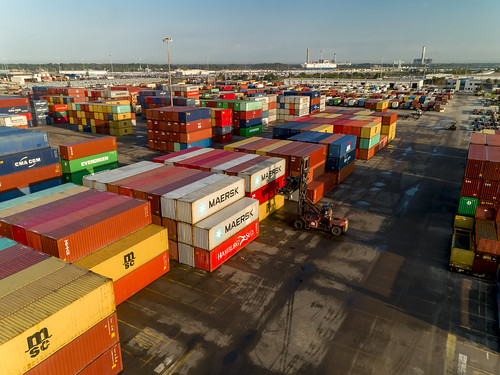
JAXPORT promises less supply disruption
So ending supply chain disruption would mean replicating whole ingredient manufacturing chains and industry knowhow that multinationals had migrated to China decades ago. All of these actions to reduce supply chain disruption may not be received very well by China itself. China has bought key infrastructure around the world: power generation, ports, water supply, rail networks and more. All of which means that they get a greater say in how the world’s supply chain works. Xi Jingping has been straight forward in saying that he wants the world to rely on China more, and China to rely on the rest of the world less. Decoupling from Chinese supply chain disruption has taken on even more importance with the rise of Chinese secondary sanctions. More on nearshoring to avoid Chinese supply chain disruptions here: China’s economic woes: An opportunity for U.S. manufacturing?
China
Scientists believed Covid leaked from Wuhan lab – but feared debate could hurt ‘international harmony’ – An email from Dr Ron Fouchier to Sir Jeremy said: “Further debate about such accusations would unnecessarily distract top researchers from their active duties and do unnecessary harm to science in general and science in China in particular.” Dr Collins, former director of the NIH, replied to Sir Jeremy stating: “I share your view that a swift convening of experts in a confidence-inspiring framework is needed or the voices of conspiracy will quickly dominate, doing great potential harm to science and international harmony.” Institutions which held the emails have repeatedly resisted efforts to publish their content. The University of Edinburgh recently turned down an Freedom of Information request from The Telegraph asking to see Prof Rambaut’s replies, claiming “disclosure would be likely to endanger the physical or mental health and safety of individuals”. – this is going to turn into a dumpster fire
Dutch university gives up Chinese funding due to impartiality concerns | Netherlands | The Guardian – Amsterdam’s Vrije Universiteit (VU), the fourth largest university in the Netherlands, has said it will accept no further money from the Southwest University of Political Science and Law in Chongqing and repay sums it recently received. The announcement came after an investigation by the Dutch public broadcaster NOS last week revealed VU’s Cross Cultural Human Rights Center (CCHRC) had received between €250,000 (£210,000) and €300,000 annually from Southwest over the past few years. According to NOS, the CCHRC used Southwest’s money to fund a regular newsletter, organise seminars and maintain its website – which has published several posts rejecting western criticism of China’s human rights policy
Why is it still considered OK to be ageist? | Financial Times – A study by academics at Yale found that people with a negative approach to ageing deal with it worse mentally and physically and die seven and a half years younger. To put this in context, mild obesity shortens life by three years, extreme obesity by 10. Hardly surprisingly, this has prompted a great deal of fuss at government level. Policymakers and health professionals obsess over obesity. But what about the damage done by poor attitudes to ageing? Until I read about the survey I had no idea it was even a thing: the fact that ageism can actually kill you is a well-kept secret. It is also a costly one. According to the WHO report, the resulting ill health places an additional annual burden on the US healthcare of $63bn. I realise that health policymakers have been busy since the report came out last March, but still there hasn’t been a peep out of them
I love this 60 Minutes Australia film about an Australian inventor
Equations built giants like Google. Who’ll find the next billion-dollar bit of maths? | David Sumpter | The Guardian – The PageRank story is neither the first nor the most recent example of a little-known piece of mathematics transforming tech. In 2015, three engineers used the idea of gradient descent, dating back to the French mathematician Augustin-Louis Cauchy in the mid-19th century, to increase the time viewers spent watching YouTube by 2,000%. Their equation transformed the service from a place we went to for a few funny clips to a major consumer of our viewing time.
Murata’s Thailand move heralds Japan tech shift from China | Financial Times – “The most populous country today may be China, but in 2030 that will be India, and further down the road it will be Africa,” Nakajima said. “Will those economies be aligned with China or the US? We don’t know. We should be able to respond to both scenarios.”
Legal
Hong Kong: how colonial-era laws are being used to shut down independent journalism – police recently told reporters that opinion articles aren’t the only ones that can be regarded as seditious. Media interviews with exiled activists and features on clashes between protesters and riot police can also be considered seditious if the content is deemed by the government to be “fake news” or inciting hatred towards the government and endangering national security
Hong Kong independence activist Edward Leung released from jail, told to stay silent — Radio Free Asia – Hong Kong barrister and former lawmaker Siu Tsz-man said supervision orders are sometimes issued to released prisoners involved in violent crimes, including murder and manslaughter, and require the former prisoner to maintain contact with supervision officers and remain at a stable residence. But Siu said the order to stay away from the spotlight was unprecedented. “I have never heard of this happening before,” Siu said. “My staff have never heard of a supervision order under which the person isn’t allowed to give interviews to the media.” Siu declined to comment on whether the order was appropriate without knowing the details of the case. “The point of a supervision order isn’t to confine someone at a certain location and not let them leave,” he said. Some drew parallels between Leung’s release and the continuing controls on released political prisoners in mainland China – similar in nature to an ASBO but inherently political in nature
Virginia burglaries work of ‘crime tourists,’ authorities say – The Washington Post – Authorities call them “crime tourists.” Law enforcement experts say cells of professional South American burglars, particularly from Colombia and Chile, are entering the country illegally or exploiting a visa waiver program meant to expedite tourism from dozens of trusted foreign countries. Once here, they travel from state to state carrying out scores of burglaries, jewelry heists and other crimes, pilfering tens or hundreds of millions of dollars’ worth of goods each year, the FBI estimates. Experts said the groups often operate with impunity because they have found a kind of criminal sweet spot. Bail for nonviolent property offenses is often low, so an arrested burglar often quickly gets bond and skips town for the next job, experts said. The crimes often don’t meet the threshold for the involvement of federal authorities. And they attract less attention at a time when U.S. authorities are contending with a rise in homicides. Dan Heath, a supervisory special agent with the FBI’s criminal investigations division, said “South American theft groups,” as the agency calls them, are a growing problem across the United States — and in countries including India, Britain and Australia, where they often employ similar tactics. “They represent an enormous threat right now in our country,” Heath said. “They are tending to thread the needle in avoiding both state and federal prosecution.”
VW fired senior employee after they raised cyber security concerns | Financial Times – A senior Volkswagen employee was dismissed weeks after raising the alarm about alleged cyber security vulnerabilities at the carmakers’ payments arm, which is soon to be majority-owned by JPMorgan. The manager alerted bosses in September 2021 to concerns that VW’s system in the region was “open to fraud” following an attempted cyber attack, and maintained that $2.6m sitting in the company’s accounts could be stolen, according to documents seen by the Financial Times. The staff member, who also told superiors that VW could face regulatory action if the vulnerabilities were not addressed, was then fired in October. – not terribly surprising
Software
After ruining Android messaging, Google says iMessage is too powerful | Ars Technica – “Google clearly views iMessage’s popularity as a problem, and the company is hoping this public-shaming campaign will get Apple to change its mind on RCS,” writes Amadeo in closing. “But Google giving other companies advice on a messaging strategy is a laughable idea since Google probably has the least credibility of any tech company when it comes to messaging services. If the company really wants to do something about iMessage, it should try competing with it.” – if this wasn’t an admission of failure by Google I don’t know what is. Google has a history of failed or closed communication services Google Talk (GTalk) (which was retired when Google decided to move away from an open messaging standard , Google Hangouts (which was spun out of Google+ messaging functionality), Google Allo and Google Wave
Christine Lee and Foreign Interference: what the UK can learn from Taiwan | China Dialogues – As part of the transition from authoritarianism to democracy, Taiwan retooled its political commissar system (zheng wei 政委) – formerly responsible for policing political loyalty toward the regime – into an institution that safeguards democracy by working to identify Chinese influence at all levels of Taiwanese politics and society. Political commissars (PCs) not only receive extensive military training but also develop a deep understanding of the Chinese Communist Party’s political warfare tactics. Most major government departments and private sector organisations in Taiwan will have PCs operating within their ranks, monitoring and reporting evidence of foreign interference. As many democracies facing Chinese influence and interference do not have such well-established systems in place, Taiwan’s zheng wei system may provide a starting point for how anti-foreign influence institutions can work effectively within democratic societies
Technology
EETimes – Arm Predicts Stagnation if Nvidia Deal Fails – without investment from Nvidia, Arm would be seriously disadvantaged in its bid to grow in data center markets and compete against Intel Corp. and x86 incumbents. The filing also explains why an Arm stock offering is a non-starter while noting that Arm faces stiff competition from emerging RISC-V competitors – interesting that they don’t mention ARM China crisis at all. Nvidia have now walked away from it and Softbank is supposed to be preparing a public offering for ARM