Category: media | 媒體 | 미디어 | メディア

It makes sense to start this category with warning. Marshall McLuhan was most famous for his insight – The medium is the message: it isn’t just the content of a media which matters, but the medium itself which most meaningfully changes the ways humans operate.

But McLuhan wasn’t an advocate of it, he saw dangers beneath the surface as this quote from his participation in the 1976 Canadian Forum shows.

“The violence that all electric media inflict in their users is that they are instantly invaded and deprived of their physical bodies and are merged in a network of extensions of their own nervous systems. As if this were not sufficient violence or invasion of individual rights, the elimination of the physical bodies of the electric media users also deprives them of the means of relating the program experience of their private, individual selves, even as instant involvement suppresses private identity. The loss of individual and personal meaning via the electronic media ensures a corresponding and reciprocal violence from those so deprived of their identities; for violence, whether spiritual or physical, is a quest for identity and the meaningful. The less identity, the more violence.”

McLuhan was concerned with the mass media, in particular the effect of television on society. Yet the content is atemporal. I am sure the warning would have fitted in with rock and roll singles during the 1950s or social media platforms today.

I am concerned not only changes in platforms and consumer behaviour but the interaction of those platforms with societal structures.

  • Ooredoo Myanmar + more things

    Ooredoo

    Ooredoo heralds commercial launch in Myanmar | TotalTelecom – interesting how Facebook was used to engage Burmese early adopters and potential retail partners. Ooredoo is an international mobile network operator headquartered in Qatar. Ooredoo has presence in Algeria, Indonesia, Iraq, Kuwait, Myanmar, Maldives, Oman, Palestine, Qatar, and Tunisia. (Disclosure: I worked on the pre-launch activity for Telenor Myanmar, a rival of Ooredoo)

    Consumer behaviour

    YouTube generation V research – males 18 – 34 years old. Self-serving but useful (PDF)

    FMCG

    Colgate’s Unseen FDA Pages Flag Concerns Over Triclosan – Bloomberg – Triclosan looking controversial. (Disclosure: I worked on Colgate China and Malaysia business). More FMCG related content here.

    Gaming

    Sands China sets first-half record | SCMP – interesting how this US gaming outfit has improved despite an overall cooling in gambling

    Media

    Facebook PMD Sprinklr’s Newest Acquisition: TBG Digital – finally someone bought TBG, they’d been shopped around long enough

    Security

    Meet MonsterMind, the NSA Bot That Could Wage Cyberwar Autonomously | WIRED – what happens if it gets spoofed and attacks an innocent third-party?

    London cops cuff 20-year-old man for unblocking blocked websites • The Register – the case law around this could be interesting

    Technology

    Sony Says 10 Million PlayStation 4 Game Consoles Have Been Sold Worldwide – that is a tremendous leap forward for PlayStation, I hope that they can keep up this momentum

    Cor blimey: Virgin Media pipes 152Mb fibre to 100,000 East Londoners • The RegisterThe company has suffered a number of DNS outages recently and refuses to let either the media or its customers know just what the problem is

    Why Robots Aren’t the Bellhops of the Future | Motherboard – If you happen to have a rich person handy, ask them: luxury is an interaction with the world, not a thing. I certainly don’t say this as a rich person

    Wireless

    China vs. Qualcomm: Chip’s ‘Nationality’ Still Matters | EE Times – would prefer a bit more balance in the editorial but still interesting article
  • Time lapse & things this week

    I don’t know what it was about this week, but I ended up looking at a whole pile of time lapse videos. These videos have become much more accessible. Modern smartphones have it as a standard feature, it has become easier to do time lapse video with professional photography equipment. Cheap time lapse timers are now available and there is software to easily stitch it all together.

    First up beautifully assembled footage of summertime in New York, this doesn’t give you a real feel of the humidity in New York. It is mesmerising though.

    Next a time lapse video that zooms pans and warps time in Pyongyang, North Korea. It is all the more remarkable given the careful curation of content that comes out about North Korea.

    Pirate Jams put together a mix of late 1980s to early 1990s tracks and their own recordings that sampled many others for i-D magazine and came up with this joyful mix. It is as at home on your car stereo as it is in your Zumba class. It fits into a wider nostalgia in dance music exemplified by nu-disco and mash-up culture.

    The Vinyl Factory put together 20 tracks as an introduction to the early balearic sound for generation-z. Balearic was a minority interest when it was originally out. The eclectic mix of music that people now listen to and genres from tropical house to nu-disco make Balearic sound as relevant today as it did in the mid-1980s.

    Burberry put together a great video showcase that shows how they use the Tencent WeChat / Weixin platform or as they put it Burberry and WeChat have created a series of creative collaborations and platform firsts that leverage WeChat’s unique functionality and responsive content capabilities. – This is very much in keeping with Burberry’s long push into exploring what digital retail would mean in a luxury environment?More related content here. Note: The original video seems to have been taken down as the licence on the music by Ed Harcourt had likely ran out.

  • A content desert?

    I started thinking about the idea of a content desert for a few reasons:

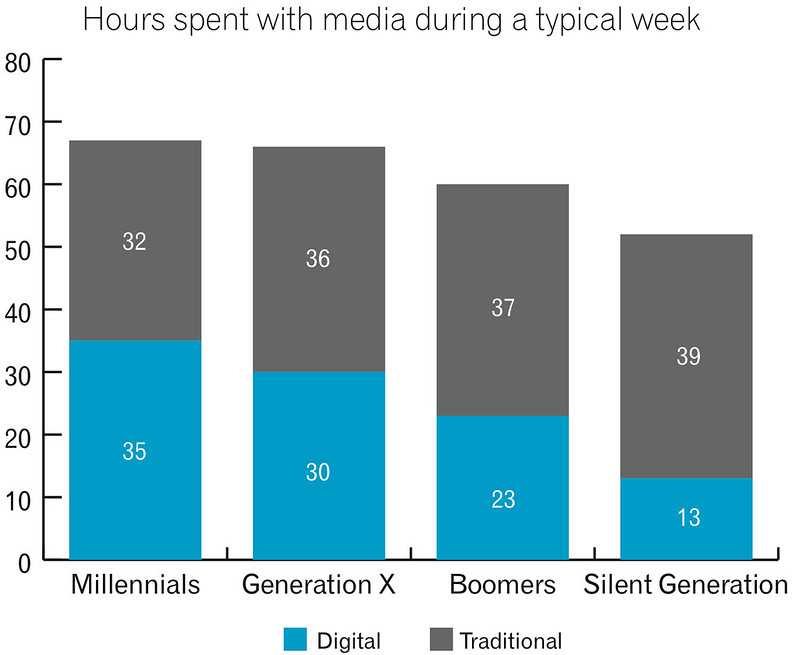
    Experian Marketing Services put out a really nice whitepaper out in June as part of their ConsumerSpeak series called Millennials come of age. One graph stood out to me; the split across generations between traditional and digital media consumption.
    media diet
    On the face of it, two things struck me, consumption of online media increased between millenials and generation X – but not in a way that makes them radically different – . There was also a marginal increase in overall consumption between generation Y and generation X. Is this due to media literacy, less commitments or they were having to work harder to get a similar amount of value from their media consumption?

    We had a focus group in the office looking at the personal media consumption habits of 18 – 24 year olds with an interest in sport. One of the things that came out of this was that they would only buy a magazine about their favourite sport if they were getting on a long plane journey. They thought it was ‘too expensive’ to spend £4 on a magazine. A colleague who sits near me loves the magazine and gets a lot out of the long form articles published in it. He uses these articles as social currency, in the office and with friends. However the panelists that we met felt that they could get everything they needed from sources that they perceived to be of equal quality via free online media.

    This stuck with me for a few days, then I realised why I kept churning it around in my mind. It reminded me of the kind of dialogue and decision-making process that was made by poorer people around food and nutrition. A mix of skewed value systems and economics brought a food desert into these areas.

    I wonder if we aren’t seeing the same thing in the media industry, whilst we know that Buzzfeed and their ilk provide easily-consumed low-quality content usually about first world problems or childhood nostalgia – are generation Y merely getting the media that they deserve? Will there be a content desert? How would a content desert impact brands and perceptions of value?

    A few things give me hope that there may not be; Vice Media is building the global news network that is defining the 2010s in the same way that Aljazeera defined the post-9/11 world and CNN defined the end of the cold war. Although you could argue that with Vice the bill is paid by branded entertainment on behalf of sponsors like Nike and Intel.

    Television has entered a new golden era in dramas; will media companies take the opportunity to reinvigorate factual programming? More related content here.

  • James Brown & other news

    James Brown

    Get on Up James Brown – Discover Who Sampled Mr. Dynamite: – like this timeline Universal Music did in conjunction with whosampled.com. At one stage The Funky Drummer and Lyn Collins ‘Think’ produced by James Brown seemed to underpin every record.

    Design

    Color-changing ‘Stained Glass’ Made With Energy-storing DSSCs | Nikkei TechOn! – interesting materials for experiential stuff

    There’s Good News About Ford’s Hardcore New Truck | TIME – interesting that Ford has gone with an aluminium monocoque

    FMCG

    P&G to shelve majority of its brands | Marketing Interactive – interesting move, one that Unilever did a number of years ago. It follows on from them apparently getting rid of marketers

    New Confectionery Data – What is it Telling Us? | Euromonitor International – interesting dynamics including cost of cocoa

    Hong Kong

    Jimmy Lai describes Occupy Central organisers as ‘having no strategy’ in leaked email | SCMP – no one is asking who is leaking this stuff and why

    Luxury

    Diane Von Furstenberg To Launch Fashion Jewelry Line : News : Fashion Times – interesting move particularly in light of global jewellery sales dropping overall

    Marketing

    How Facebook Sold You Krill Oil – NYTimes.com – A few years ago, the company was telling brands to increase the number of people following their pages. Now it says fans are largely irrelevant. Until late last year, it was promoting the power of ads in which people’s likes and comments about a brand were turned into endorsements sent to their friends. After legions of user complaints — and a class-action lawsuit — Facebook switched gears again. Now it boasts about its ability to pinpoint potential customers on their cellphones and Facebook.com based on its data about them. (Paywall)

    A new creative tool to help your Facebook ads | Marketing Interactive – optimise ad visuals

    Online

    Rakuten: Viber has 608 million registered accounts, is the future of our company – I really like Rakuten as a business, but I think that they are putting too much faith in Viber. I have an account on Viber but seldom use it

    With the launch of its CDN, it’s clear Apple is just as webscale as Facebook or Google — Tech News and Analysis – the interesting thing about this is that Apple still is working on the assumption of a ‘dumb cloud, smart device’ philosophy because it recognises that even when it’s at the last mile networks are imperfect. This is in stark contrast to Google

    Security

    China boots Kaspersky and Symantec off security contractor list | The Register – Symantec I can understand, but Kaspersky was an interesting move

    Exclusive: Hackers Infiltrate Chinese TV Station | Foreign Policy – it was a foolish prank at best. But it is interesting that digital television is vulnerable to hacking like this, classic digital interruptive move

    How one judge single-handedly killed trust in the US technology industry | ZDNet – interesting American op ed. The problem is that American exceptionalism is now affecting American digital commerce

    Bits Blog: Judge Rules That Microsoft Must Turn Over Data Stored in Ireland | New York Times – I thought that this was the case anyway with the Patriot Act? (paywall)

    Technology

    Now that it’s conquered recruiters, LinkedIn is going after salespeople | Quartz – I thought that they had doubled down on sales people a good while ago?

    Every company is becoming a data company – Quartz – its a bit like saying every company became an electronics company 20 years ago. People still think of them in their categories, except where the category has been marginalised – a car will still be a car even if it now features an onboard data centre and cloud connectivity

    This Box Can Hold an Entire Netflix | Gizmodo – storage and power density on this is huge

    Web of no web

    New indoor positioning system lets you do Batman-like echolocation on your phone | ExtremeTech – this could be invaluable for app augmented retailing

    Wireless

    TfL Propose Scrapping Text Payment For C-Charge | Londonist – interesting move reflecting decline of SMS and feature phones

  • Google Glass & things this week

    Google Glass and IBM

    An IBM video from 2000 did a pretty good use case and flaws of Google Glass. Good work (I presume by Ogilvy & Mather, but I maybe wrong). Looking on the bright side of things for Google Glass, this probably protects them from IP court cases, given the ad could be cited as prior art. All of this makes me wonder why companies like Google when working on Google Glass aren’t doing desk research looking for content like this through to science fiction and the challenges flagged up or unanswered questions. More related content here.

    Five years ago I would have wanted to watch this because Oakley was some kind of engineering wonderland, now I watch it curious to know how Kevin Spacey’s voice over would clash with the conservative designs currently coming out of Oakley post-Luxxotica takeover. Funnily enough the voiceover would have worked almost as well with his appearance in Call of Duty: Advanced Warfare.

    My colleague Phee went for a Gorkana briefing with the Wall Street Journal, as a Storify embed.

    Apple made a really nice 30-second spot to promote the MacBook Air range. The ad plays on how consumers personalise their computers as an analog for love. I started modifying the shell of my laptop as an anti-theft measure. Prior Apple laptops becoming so popular my customisations were limited to the software layer. Organising my desktop and having a desktop wallpaper of my own.

    One day a client tried to walk off with my laptop (they actually had a Lenovo), I managed to stop them, but then decided to customise it so there was no question of who’s laptop it was. Less about love, more about basic survival. For many of my geekier friends, a laptop lid, like a t-shirt is a billboard sharing their advocacy of a development language or the Open Source movement.

    There is something WestWorld-esque about the faceless robots in this film about K-league baseball team Hanwha Eagles and their devoted supporters. The film also makes an interesting point about how fandom and participation have changed with online participation mediated though the robots. It’s a fascinating approach and a next stage in consumer behaviour.