It makes sense to start this category with warning. Marshall McLuhan was most famous for his insight – The medium is the message: it isn’t just the content of a media which matters, but the medium itself which most meaningfully changes the ways humans operate.
But McLuhan wasn’t an advocate of it, he saw dangers beneath the surface as this quote from his participation in the 1976 Canadian Forum shows.
“The violence that all electric media inflict in their users is that they are instantly invaded and deprived of their physical bodies and are merged in a network of extensions of their own nervous systems. As if this were not sufficient violence or invasion of individual rights, the elimination of the physical bodies of the electric media users also deprives them of the means of relating the program experience of their private, individual selves, even as instant involvement suppresses private identity. The loss of individual and personal meaning via the electronic media ensures a corresponding and reciprocal violence from those so deprived of their identities; for violence, whether spiritual or physical, is a quest for identity and the meaningful. The less identity, the more violence.”
McLuhan was concerned with the mass media, in particular the effect of television on society. Yet the content is atemporal. I am sure the warning would have fitted in with rock and roll singles during the 1950s or social media platforms today.
I am concerned not only changes in platforms and consumer behaviour but the interaction of those platforms with societal structures.
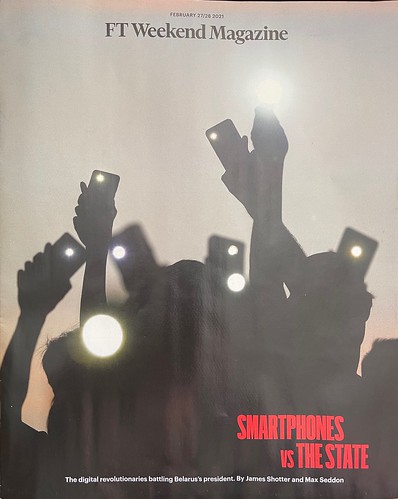
Nexta media operation and its role in the Belarus protests was the main article in this weekend’s FT magazine.
FT magazine on Nexta
A few things about the article. The old maxim of ‘hearts and minds‘ is still true despite technology. Secondly, Belarus seems to view media and propaganda as a tactic rather than something strategic. This surprised me given that Belarus has always been authoritarian in nature and Soviet in terms of the way it operated. It is at odds with the way countries like Vietnam and China operate.
Finally, the irony that the smartphone is the instrument of protest. Nexta seem surprisingly well organised in a way that wasn’t seen with voices around the Hong Kong protests.
YouTube has a lot of digitised archive footage. First up is unused footage shot in 1962 filmed for a Pathé film This is Hong Kong.
The next reel was shot six years later. Again it was footage that ended up on the cutting room floor of Pathé. The footage was shot for one of its Colour Pictorial episodes. These were film magazines that screened prior to the main feature film in a cinema. Television would be soon squeezing cinema as the main form of video based news and documentaries.
Some of this footage was familiar to me from my times going and living in Hong Kong, whilst other aspects of it were unrecognisable. Both of these films reminded me of Miroslav Sasek’s book This is Hong Kong.
Japan
This footage is said to be taken in Tokyo, Osaka and the countryside in Japan during the 1980s. Though the airplane through bamboo scaffolding footage from 0.23 – 0.25 seems to have been taken on the run in to Hong Kong’s old Kai Tak airport. Some of it is beautifully shot.
It is underpinned by a an ambient track that works really well.
ASICS have put together a film to promote the shoe.
Berocca integration of radio and voice services
Finally Berocca did an innovative radio advert to take advantage of voice services as part of its radio advertising campaign. Alexa has a well documented API stack for building skills, which is what Berocca is encouraging consumers to use. I could see this happening more as Alexa is rolled out in automotive environments.
How Klarna’s pastel pink exterior began to crack | Dazed – Klarna isn’t new technology, its unsecured financing. Once you scratch beneath Klarna’s technology veneer you realise that Klarna is like pre-internet business like a shopkeepers lay away or the catalogue agents who used to work for Freemans and Littlewoods. Previously the catalogue companies were vertically integrated with retailing and consumer finance. Now Klarna does the unsecured consumer finance, de-risking the retail business. But this business model leaves Klarna with all the risks. Klarna also has age-old problems regarding fraud. I am also concerned about the consumer debt risk that Klarna represents.
Ex-officials, academics call for US to work with Europe to counter China | South China Morning Post – “A road map for US-Europe cooperation on China”, published by the Paul Tsai China Centre at Yale Law School on Wednesday, the experts said steps needed to be taken as an “urgent priority” in six key areas: trade, technology, human rights, climate, pandemic plans, and reform of international institutions
Dead poet rekindles cultural feud between South Korea and China | Apple Daily – “There is general consensus that Yun is Korean and it is not in dispute,” he said, adding that “the Chinese hegemony is imposing its values on South Koreans.” – first trying to steal kimchi, now trying to steal Korean patriots; the Chinese government has no shame
The China challenge | Financial Times – the interesting thing is the way China is co-opting Goldman Sachs and others as a fifth columnist hook into the US until they have their digital currency ready to challenge the dollar as global reserve currency
Is The Role of Digital Becoming Obsolete Within Luxury Companies? – recent changes at the top level management at LVMH may signal a wider move within the luxury industry to move away from “digital transformation” and a shift towards a “total immersion” in their business.
Adam Curtis knows why we all keep falling for conspiracy theories | WIRED UK best read with The China model has come to America – Asia Times – Far too few Americans grasp the implications of such a view taking root among their own elite. Though more and more Americans are awakening to the challenges inherent in China’s growing economic, technological, and military capabilities, few understand the threat that China’s governing philosophy and structures pose to the US. – assumes that US philosophy will stand on its own merits, or in other words magical thinking or a blind spot
1 in 12 Irish people access radio on digital devices | RTÉ – About 8% of the population, or 330,000 people, listen each day using a digital device, the report found. Just under 5% listen via a mobile device, 2% on a PC and around 1.5% on a Smart Speaker and the remainder on a TV set or DAB (Digital Audio Broadcasting). – 77% on FM. This makes sense given high car ownership, poor mobile coverage and slow progress of DAB head units in cars
China eyes ‘virtual production’ technique used in The Mandalorian to help local film industry catch up to Hollywood in visual effects | South China Morning Post – the scenes were not shot on location, on a movie set, or using a green screen. They were filmed in front of a giant LED wall display that could project an imaginary world as one that appears real to the audience. Known as “virtual production”, the digital background are generated in real time by a powerful computing game engine, allowing filmmakers to combine live-action footage with visual effects in real time. The technology could revolutionise filmmaking because real world settings can be replaced. China, with more than 20 billion yuan (US$3.1 billion) of box office revenue in 2020, is known for its theme parks across the country that double as locations for film shoots. In the town of Hengdian in China’s eastern province of Zhejiang, for instance, the so-called “movie city” built a replica of the Forbidden City for filmmaking
Facebook Meets Apple in Clash of the Tech Titans—‘We Need to Inflict Pain’ – WSJ – The war of words and ideas will ultimately play out in court, regulatory agencies and user decisions as both companies defend themselves against antitrust investigations. The potential regulatory settlements and legal decisions are likely to affect hundreds of millions of consumers’ phones in coming years. A Facebook spokeswoman, Dani Lever, said the choice between personalized services and privacy was a “false trade-off,” and that Facebook provides both. “This is not about two companies. This is about the future of the free internet,” she said, asserting that small businesses, app developers and consumers lose out under Apple’s new rules. “Apple claims this is about privacy, but it’s about profit, and we’re joining others to point out their self-preferencing, anticompetitive behavior.” – spoken like a true sociopath
I haven’t driven a BMW in well over 20 years, so Doug DeMuro’ update on the BMW brand was fascinating.
BMW Twitter account
The BMW brand issue hadn’t been on my radar until Doug DeMuro talked about it. A number of things seem to be happening with BMW.
The company’s customer base is predominantly gen-x and baby boomers; because their cars are expensive. For decade these people have been told that the BMW brand represents the ultimate driving machine.
An important part of the visual BMW brand: the design language that it is implementing on is problematic. In particular the ugly ‘beaver teeth grill. This is ironic given that an electric car doesn’t need a grill for its engine.
It didn’t help things that from a certain angle the rear of the BMW iX has a resemblance to the Nissan Juke.
Nissan Juke 1.6 Advance 2017 by RLGNZLZ
It has at least an internal perception that it has lost its BMW brand mojo as there is a slow steady move away from the internal combustion engine.
If you look at other YouTube automotive channels, BMW seems to be having reliability issues with its current cars and the repairs are expensive to do. Back in the early 1970s the BMW brand was tarnished with negative perceptions about the cars being rust buckets and the company managed to lick that. The current engineering problems sound more complex.
All of this makes the BMW brand sound more difficult to fix than being on the socials and being up to date with their yoofspeak.
Canada concerned as Hong Kong starts to force dual citizens to choose status – The Globe and Mail – individuals who declare themselves Canadian could now lose their residency rights to live in Hong Kong.“It’s the beginning of the end for people in Hong Kong with Canadian status,” said Vancouver immigration lawyer Richard Kurland. The policy on dual citizenship stems from a 1980 law in mainland China that was then applied to Hong Kong when the United Kingdom handed over the city to Beijing in 1997. “The law was on the books for years but it wasn’t always enforced,” Mr. Kurland said. – interesting move
The Longer Telegram: Toward a new American China strategy – Atlantic Council – single most important challenge facing the United States and the democratic world in the twenty-first century is the rise of an increasingly authoritarian and aggressive China under Xi Jinping. China has long had an integrated, operational strategy for dealing with the United States. The United States has so far had no such strategy with regard to China. This is a dereliction of national responsibility – interesting read. Right on with its diagnostics, but off base with its proposed solution. The west thought that Xi was a moderate when he came into power. He has extended his loyalists in every aspect of the party. The Jiang Zemin faction of the party, which would be an alternative aren’t liberal; they used the army to put down student protests in 1989.
Commission chief tells charities not to be ‘captured’ for politics | Charities | The Guardian – Charities that support politically or culturally contentious causes should expect their charitable status to come under regulatory scrutiny even if they are acting within the law, according to the outgoing chair of the Charity Commission. The Tory peer Tina Stowell, who is stepping down after three years in the post, warned charities against being “captured” by unnamed people who wish to push a partial view of the world and use charity platforms to wage war on “political enemies”. – this is going to be interesting
Looking downstream – Tortoise – as a long time netizen I am less certain that regulating platforms for content will work and worry about the precedent it would set for authoritarian regimes. Should OTT platforms such as Netflix, Disney+ or Amazon Prime carry news? Here my first question is how do you define news? Should they do real time news reporting, probably not even if they could. Should they do current affairs analysis – they already do if you look at the kind of documentaries that they have. I think that there should be real questions about those documentaries in terms of quality and bias? While we’re on about documentary making, surely the BBC could be doing more work with Adam Curtis or Bellingcat and have those people training the documentary film makers of tomorrow
Liu Yifei Announced as Face of Louis Vuitton China | Radii China – LVMH betting on woke western liberals not being their customer base and choosing polarising star. It also shows how far Fan Bingbing’s star has fallen since her tax troubles. Crystal Liu was the protagonist in the car crash live action version of Mulan. She’s also not as beautiful as Fan Bingbing
How Europe Became a Model for the 21st Century – DER SPIEGEL – Despite its long list of crises in recent years – including the most recent vaccine snafu – the European Union has become a global pacesetter. Its laws and regulations have established global norms. This has made the bloc a 21st century model. – I agree with the direction of this article, even if some of the examples could be debated
Silicon Valley’s iron grip on venture capital is slipping — Quartz – the shift to smaller tech hubs that’s been going on for years is set to move even faster, according to Stanford. “The pandemic has thrust the VC ecosystem into new territory where Zoom meetings and alternative deal sourcing methods reign supreme,” he wrote in an analyst note. “This shift has, at least somewhat, leveled the playing field for investor attention…Over Zoom, it doesn’t matter if the company is in the same building, city, state, or country.” – no credit given for the dissipation technology start-ups to places like Singapore and Shenzhen. For instance, social darling Clubhouse is based on Chinese voice technology. But there’s also a bigger issue about the decline in hard innovation which is easier to do in a tight cluster. Since its no longer happening, the cluster makes less sense. More on innovation here.
Bases for Trust in a Supply Chain – Lawfare – With a supply chain attack, there is a potentially long delay between the introduction of a vulnerability and its exploitation. In addition, infiltrating a supplier generally requires a well-resourced adversary and interaction with that supplier. So compared to the alternatives, preparations for a supply chain attack take longer and have a higher risk of discovery. The risks of discovery can be reduced, however, if inserted vulnerabilities resemble ordinary flaws and, thus, the malicious intent is disguised. The digital systems on which individuals and nations increasingly depend are large and complex, so today they are likely to be rife with vulnerabilities. Many of those vulnerabilities will be known, some unpatched, and others easily discovered by analysis. In short, such systems are easy to compromise.
Russian hack brings changes, uncertainty to US court system – new rules for filing sensitive documents are one of the clearest ways the hack has affected the court system. But the full impact remains unknown. Hackers probably gained access to the vast trove of confidential information hidden in sealed documents, including trade secrets, espionage targets, whistleblower reports and arrest warrants. It could take years to learn what information was obtained and what hackers are doing with it – you can’t hack paper
MACAU DAILY TIMES 澳門每日時報 » Hong Kong | Thousands flee for UK, fearing China crackdown – What’s surprising is not the content of the article itself. There are plenty of pieces in the English language media around the world about the fear of a China crackdown due to the Hong Kong National Security Law driving Hong Kongers away. (The reality is less likely to be a China crackdown and more likely to be a progressive anaconda-type squeeze.) I am surprised to see this article in the usually tame Macau media. Which left me with the question why? My initial thoughts were that space constrained Macanese could take up some of the slack in Hong Kong as locals vacate? If so it would solve problems in the housing market and the need to build additional infrastructure in Macau.
Majority of B2B advertising is ‘ineffective’ | Marketing Week – Of the 1,600 B2B ads shown to a sample of 6 million people worldwide over the past four years, 75% scored one star or less on System1’s FaceTrace emotional measurement tool – so ineffective in brand building, but potentially effective in terms of performance marketing? We don’t know
Today’s jet fighter designers don’t get the point – Asia Times – the cockpit itself is “beautiful,” full of screens that allow you to bring up an incredible amount of information about the fighter with just a few finger swipes, and customize the data to tailor it for the particular mission. The F-35 is the first to use touch screen technology. Unlike switches, which take up permanent cockpit space, touch screens allow the same LCD screen space to be instantly repurposed, the report said. One minute, a display could be used to pull up data on an aircraft’s fuel reserves, and the next, it could help target an enemy position on a mountainside. That goes a long way toward simplifying the cockpit and not overwhelming a pilot with wall-to-wall physical switches, dials, and single-use displays, the report said. But the problem with touch screens, the pilot explains, is a lack of tactile feedback. Switches have a nice, satisfying click that instantaneously lets the user know they were successfully flipped, the report said. The anonymous pilot reports failing to get a result from a touch screen about 20% of the time – the need for haptics has never been clearer
China Raises Threat Level Over Rare Earths — Radio Free Asia – “Rare earth ore exports are limited in value, and the global demand for raw materials is relatively low,” said Liu Enqiao of Anbound Consulting. But Liu added that the decline “might be partly due to China’s tightening of regulations on strategic resources” under the country’s new export control law, which took effect on Dec. 1.
Artificial Intelligence Will Define Google’s Future. For Now, It’s a Management Challenge. – WSJ – most of Google’s problems related to AI are rooted in the company’s approach to managing staff, adding that science, and not ideology, should guide ethical debates. “Google is the coddler-in-chief,” he said. “Their employees are so coddled that they feel entitled to make more and more demands” regarding how the company approaches AI and related issues. – TL;DR – millennial and gen-z Googler snowflakes preventing the company from creating amoral shareholder value
Wired magazine had an interesting article on revisiting old technology magazines. The idea was that while in some ways technology has progressed. In other ways, good ideas got bypassed. There are a number of Good ideas that might have more currency now. There is a contrasting ahistoric technology view held by some Silicon Valley luminaries.
Bret Victor gave a presentation ‘from 1973’, showing the fallacy of the ahistoric technology viewpoint. These ideas will be of more relevance to the audience of programmers, but you can grasp the gist of what’s going on.
One of the reasons I stuck with the Mac platform was that small development houses and lone programmers built useful software based on similarly niche concepts.
Now these software applications, alongside web services that have been developed in a similar way, like Newsblur and Pinboard are a key part of my workflow.
McDonalds Japan have a reputation for doing localised products to appeal to Japanese consumers. The flavours and the marketing are grounded in Japanese culture. They have tapped a well loved manga Touch (published during the 1980s) for an advert to promote the 30th anniversary of the chicken Tatsuda burger.
The Oxford Union is trying to keep its programme of speakers going via online sessions. Including Hong Kong exiled dissident Nathan Law.
Oxford Union
Finally Asian Boss appealed to viewers for donations as they are struggling financially and are likely to shut down soon without money. This raises questions about the effectiveness of monetisation on YouTube, even with a lightweight structure media organisation like Asian Boss.
Should you wish to do so, you can donate directly to Asian Boss here.