Category: media | 媒體 | 미디어 | メディア

It makes sense to start this category with warning. Marshall McLuhan was most famous for his insight – The medium is the message: it isn’t just the content of a media which matters, but the medium itself which most meaningfully changes the ways humans operate.

But McLuhan wasn’t an advocate of it, he saw dangers beneath the surface as this quote from his participation in the 1976 Canadian Forum shows.

“The violence that all electric media inflict in their users is that they are instantly invaded and deprived of their physical bodies and are merged in a network of extensions of their own nervous systems. As if this were not sufficient violence or invasion of individual rights, the elimination of the physical bodies of the electric media users also deprives them of the means of relating the program experience of their private, individual selves, even as instant involvement suppresses private identity. The loss of individual and personal meaning via the electronic media ensures a corresponding and reciprocal violence from those so deprived of their identities; for violence, whether spiritual or physical, is a quest for identity and the meaningful. The less identity, the more violence.”

McLuhan was concerned with the mass media, in particular the effect of television on society. Yet the content is atemporal. I am sure the warning would have fitted in with rock and roll singles during the 1950s or social media platforms today.

I am concerned not only changes in platforms and consumer behaviour but the interaction of those platforms with societal structures.

  • Arsenal defrauded + more things

    Arsenal and 30 ad agencies ensnared in alleged BYD fraudulent misrepresentation case | Marketing | Campaign AsiaMore than 30 domestic agencies are crying foul after Chinese electric-car brand BYD absolved itself of payment obligations for RMB1.1 billion (US$16.4 million) worth of advertising production and roadshow fees last week. The automaker claimed these agencies have been dealing with a fake employee from an “illegal” entity carrying out marketing activities on behalf of BYD by “forging” the company’s seal. BYD made statements on its website (English) and Weibo account (Mandarin), naming a “criminal suspect” Liki Li (李娟) who managed to engineer a potentially sham sponsorship deal with football club Arsenal in April 2018, and has since been detained by the Chinese public security bureau. “Hereby we reiterate that BYD was never involved in and is not responsible for any fraud issues,” read one statement. “Please make sure to report to the authority responsible whenever you find yourself a victim.” The 30+ agencies suffering in this legal quagmire certainly see themselves as victims, with many raising objections to how BYD is handling the case so irresponsibly. The exposé party was begun by Jingzhi PR (上海竞智广告) three days ago, posting an ugly narrative on its WeChat account of how three years of creative design and test-drive execution for BYD was suddenly invalidated in this about-turn – not particularly surprised that this happened. I am surprised that it happened to Arsenal. Sports teams like Arsenal have historically been savvy in navigating the Chinese media ecosystem.

    I’m not DTF, OKCupid – Hacker Noon – great analysis of pandering advertising

    Amazon’s Curious Case of the $2,630.52 Used Paperback – The New York Times – is it merchants trying to pretend something is more rare than it is, or machine driven automated pricing errors? (paywall)

    Google Maps API Becomes ‘More Difficult and Expensive’ | Slashdot – so much that you can say about this. Google is Alphabet’s cash cow, with changes like this it’s losing developer hearts and minds. I think its part of a wider trend away from “Don’t Be Evil” to “Greed is good”. The economics of cloud services should surely be going in the opposite direction to Google’s pricing changes?

    Jackie Chan tried to replace Bruce Lee after he died, and so did Bruce Li – screen name of a Taiwanese actor behind slew of Lee rip-offs | South China Morning Post – great article on how the Hong Kong film industry coped with the death of Bruce Lee as a box office draw. I just couldn’t see Jackie Chain as a Bruce Lee analogue – thankfully he found his own way

    China’s ‘red education’ history tours and the rise of communist cosplay | South China Morning Post – from opening up under President Deng to the go go growth of President Hu, the party had sublimated into the back of Chinese people’s lives. President Hu is bringing the party back to the forefront with nationalistic characteristics. Hence Chinese citizens doing ‘founding of the republic’ style cos-play

    Salmon Theory – well worthwhile reviewing when you have a period of stuckness

  • Fall of Nokia & other things this week

    BBC 4 ran a great hour long documentary film: The Rise and Fall of Nokia is an oral history on the fall of Nokia from Nokia veterans. You can’t give a good comprehensive telling on the rise and fall of Nokia story in just one hour, but you can get a sense of what Nokia was. Some of the culture change that came with success  was really, really  dark. More on Nokia here.

    Danny Dyer nailed the zeitgeist on Brexit last week. Which led some the B3ta community to put together the Danny Dyer Presents: “Pwopa Nawty Noises!” (B3ta.com) – livens up conference calls no end.

    I was a big fan of HBO’s The Newsroom drama; it was more of the intelligent dramas over the past few years. The intro to the first episode seems even more prescient now

    I am very late to this but Techcrunch’s Bubbleproof drama from last year neatly skewers the current state of technology start-up culture (in the west at least).

    I’ll leave you with this amazing animated film from Hong Kong. It’s on KickStarter for funding and looks amazing with hints of traditional martial arts films, science fiction and psychedelia. More information on the film website.

  • Ads into testing + more things

    Why we should relish putting ads into testing – VCCP – bit of an odd concept. The TV ads that I’ve worked on have all gone into testing at concept stage. Ads put into testing have their concepts polished using research from Kantar to maximise effectiveness. I couldn’t understand not putting ads into testing of some sort. More related content here.

    Death of corporate media relations | WSJ – brands don’t trust or need media according to one editor. With their own social media accounts, blogs and websites, they go directly to their audience

    For China, Tech Giant Tencent Is Both a National Champion and a Threat – WSJ  – Tencent, which has more than 45,000 employees, recently began moving into a new $600 million Shenzhen headquarters, a futuristic complex with skywalks linking twin skyscrapers.

    The architects had a bold plan for the executive suite. They wanted to station Mr. Ma and his top lieutenants in a central command post with high visibility, like the bridge on a battleship.

    That wouldn’t do, architects were told. One reason: Too many government officials come calling, and their visits need to be discreet. The executive offices were placed instead in the upper reaches of the highest tower.

    Is timeless UI design a thing? | Imaginary Cloud – wait a minute this is an article about whether good design should be a fad or timeless??? WTF

    Inside China’s Dystopian Dreams: A.I., Shame and Lots of Cameras – The New York Times – “Reform and opening has already failed, but no one dares to say it,” said Chinese historian Zhang Lifan, citing China’s four-decade post-Mao policy. “The current system has created severe social and economic segregation. So now the rulers use the taxpayers’ money to monitor the taxpayers.”

    Google Cloud changes abuse prevention process after viral customer complaint – Business Insider – Google appears a lot more vulnerable. In the many discussions about this incident on Reddit and other online message boards, a big complaint that has surfaced is an inability of Google Cloud customers to contact human customer-service reps in emergencies – not ready for enterprise use

    Japan Tests Silicon for Exascale Computing in 2021 – IEEE Spectrum – wow surprised that ARM is better than SPARC for this?

    bellingcat – After Strava, Polar is Revealing the Homes of Soldiers and Spies – bellingcat – it has been patched now, but worthwhile reading through to understand the journalist’s methodology

    How fast-food restaurants are designed – Curbed

    Millennials Favor Netflix, OTT, Not Demo-Targeted Services 07/06/2018 – interest and passion point segmentation rather than generational

    Music’s ‘Moneyball’ moment: why data is the new talent scout – all of this can get gamed thru payola very easily. It recognises popularity rather than talent and begs the question, why would you go with a record label if you were already ‘making it’ nowadays?

    The Cultural Context of Chinese Fan Culture: An Interview with Xiqing Zheng (Part One) — Henry Jenkins – great read on Chinese fan culture that is used to explore transgressive scenarios

    Memory Loss: Prices Weaken for Chips Used in Smartphones, Self-Driving Cars – WSJ – cyclical memory chip price fluctuations

    Yes, Make Psychedelics Legally Available, but Don’t Forget the Risks – Scientific American Blog Network – interesting that this is on a blog of Scientific American magazine. It feels like the next step along from the medicinal cannabis movement that seems to have gotten a lot of traction

    Demo One disc that came with the early PlayStation’s had an application called V-CD that played music CDs and had a great visualiser to go along with the music. As I am not a gamer, this is why I miss the original PlayStation so much.

    Negativland Interviews U2’s The Edge :Negativworldwidewebland – for many people the hypocrisy that is U2 didn’t manifest itself until some time in the noughties. Negativland’s dispute with them back in 1991 was one of the reasons why Mondo 2000 had them interview The Edge a year later and showing him up. I bet the publicist got fired for this

    German Police Accused of Carrying Out Some Pretty Stupid Raids – or smart overreaching raids….

    Tencent’s WeChat is now host to 1 million mini-programs | SCMP – no data on mini app usage, but this has to be hurting the Android eco-system in particular

  • The influence post

    Mark Ritson wrote an op-ed over at Marketing Week on influence and influencers. Whilst it lacked nuance on the subject area, a lot of what it said is true. Go over and have a read; I’ll be waiting for when you come back.

    Whilst I disagree on the finer points, what Ritson wrote needed to be said. There needed to be a turning of the tide on influencers from boundless optimism to a greater degree of sobriety and critical analysis of the influencer opportunity.

    I first noticed this boundless optimism when I attended the In2 Innovation Summit in May last year.  Heather Mitchell on a panel. Mitchell worked at the time in Unilever’s haircare division where she is director, head of global PR, digital engagement and entertainment marketing. I asked the panel discussing influencer marketing about the impact of zero-based budgeting (ZBB) and the answer was ducked. ZBB requires a particular ROI on activity, something that (even paid for) influence marketing still struggles to do well.

    This was surprising given the scrutiny that other marketing channels were coming under, I couldn’t understand how influencer marketing merited that leap of faith.

    This time last year I noted:

    Substitute ‘buzz marketing’ for ‘influencer marketing’ and this could be 15 years ago. Don’t get me wrong I had great fun doing things like hijacking Harry Potter book launches when I worked at Yahoo!, but no idea how it really impacted brand or delivered in terms of RoI. Influencer marketing seems to be in a similar place.

    Just five years ago we had managed to get past the hype bubble of social and senior executives were prepared to critically examine social’s worth. In the meantime we have had a decline in organic reach and massive inflation in both ad inventory and influencer costs. What had changed in the marketers mentality?

    Onward with Mark Ritson’s main points.

    Ritson’s Three Circles of Bullshit

    A very loose reference to Dante Alighieri’s Divine Comedy trilogy; but for modern marketers

    The First Circle of Bullshit: Are the followers real?

    • Are they bots?
    • Are they stolen accounts?
    • Are the user accounts active any more?
    • Has the account holder padded their account with bought followers and engagement. Disclosure – I ran an experiment on my Twitter account and still have a substantial amount of fake followers. More on this experiment here.

    The Second Circle of Bullshit: Are influencers trusted?

    • Ritson did an unscientific test that showed (some) influencers would post anything for a bit of money

    The Final Circle of Bullshit: Do they have influence?

    • Some influencers are genuinely authoritative; but this is a minority of influencers out there
    • Ritson alludes to the lack of organic reach amongst an ‘influencers’ followers which is likely to be 2% reach or less
    Trends in influence

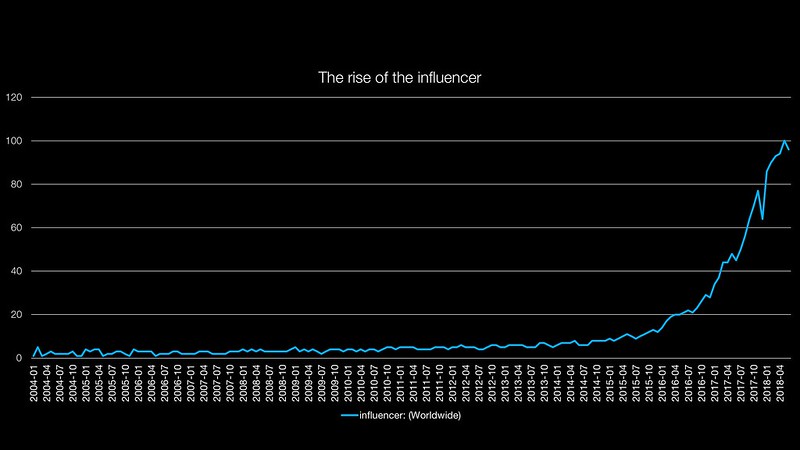
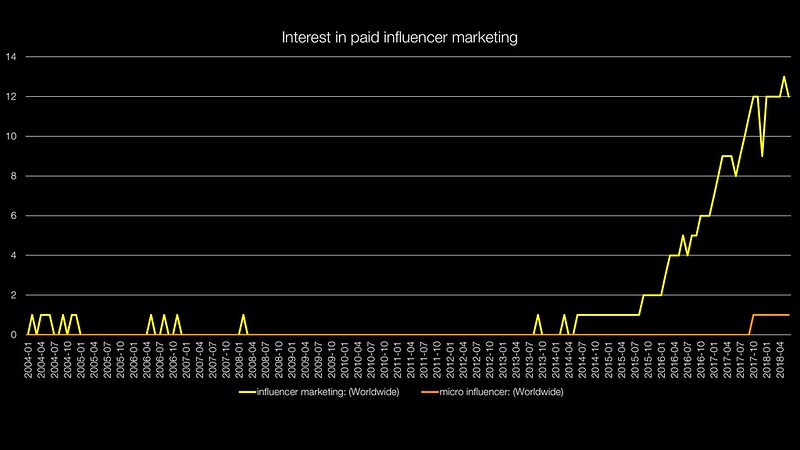
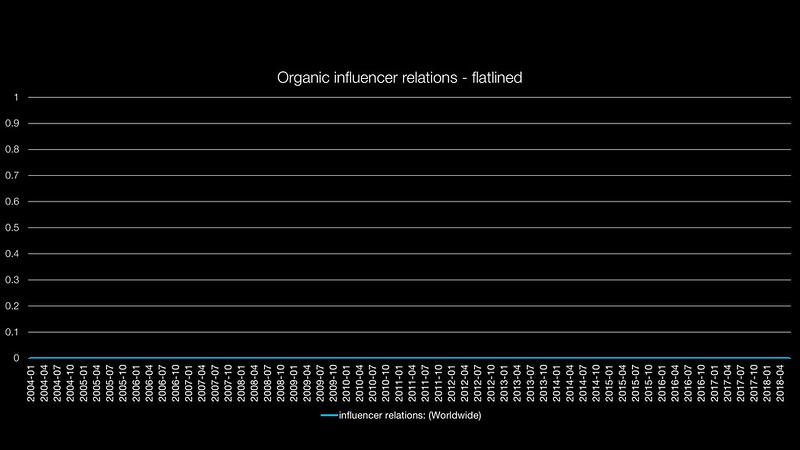
    I looked at Google Trends to see what could be learned in the rate of change in searches over time. Consider Google Trends to be an inexact but accessible measure of changes in interest over time.

    Global interest in influencers have been accelerating

    Influence: Google Trends

    There has been a corresponding rises in interest around paid influencer marketing

    Influence: Google Trends

    There hasn’t been the same interest peak in organic (PR-driven) influencer work

    Influence: Google Trends

    All of which supports the following hypotheses:

    • it’s become on-trend from the perspective of marketers, agencies and ‘influencers’
    • A significant amount of influencers are in it for the money – which brings into question their (long term authority and consumer trust)
    • A significant amount of influencers have an exceedingly good idea of their value (more likely overly-inflated)
    • Ego is less of a motivator for becoming an influencer than material gains
    What would influence look like?

    Propagation of the content by real people. Instagram, a particularly popular influencer channel, has made sharing posts difficult for followers historically. Re-gramming was a pain in the arse for the average Instagram user.

    Slide4

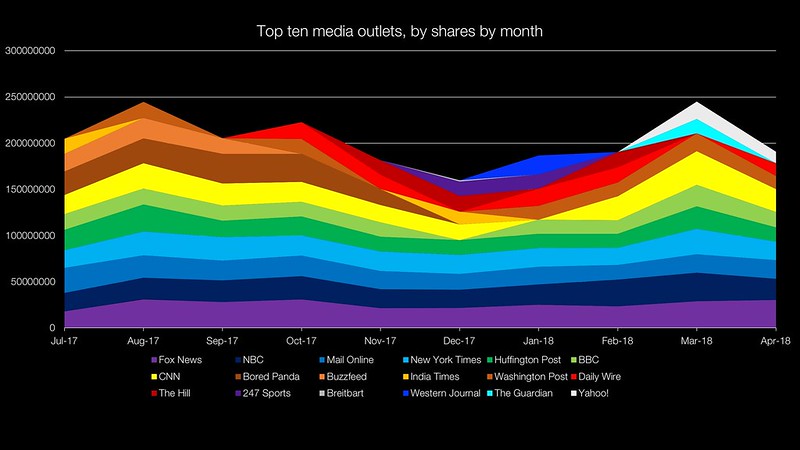
    If we look at the mainstream media and how it is shared on Facebook we see that only five media brands are consistently in the top ten most shared media properties. ‘Traditional’ influencer status isn’t necessarily a garrantor of consistent successful propagation either, if Newship’s data is to be believed.

    Attributed sales. Some luxury brands in China have had success collaborating with influencers and selling through their channels; the post child being Mr Bags collaboration with Longchamps.

    How is the best way to use influencers in marketing?

    Assuming that you are using influencers in the widest possible sense at the moment.

    Treat the majority of influencers as yet another advertising format

    That means that reach, the way the brand is presented, and repetition are all important – smart mass marketing following the playbook of Byron Sharp.

    • Viewing your influencer mention in that prism, it means estimating what the real reach would be (lets say 2% of the follower number as an estimate) and paying no more on a CPM rate than you would pay for a display advertising advert
    • Ensure that the brand is covered in the way that you want. Some luxury brands have managed to get around this by keeping control of the content; a good example of this is De Grisogono – a family-run high jewellery and luxury watch brand. They work with fashion bloggers that meet their high standards and invite them to events. De Grisogono provides them with high-quality photography of its pieces and the event. They get the  high standard of brand presentation which raises the quality of the placement
    • Get repetition with the audience by repeating the placement with other content that delivers the same message with the same high standard of production

    All of this might work for a luxury brand, IF you found that the amount of agency time and creative work made commercial sense. It is less likely to work for normal FMCG brands. What self-respecting influencer is going to be bossed around by a breakfast cereal?

    Thinking about micro influencers, probably the area that has had the most interest from marketers recently due to them appearing to be better value than macro influencers.

    Brown & Fiorella (2013) explanation of micro-influencers:

    Adequately identifying prospective customers, and further segmenting them based on situations and situational factors enables us to identify the people and businesses – or technologies an channels that are closest to them in each scenario. We call these micro-influencers and see them as the business’s opportunity to exert true influence over the customer’s decision-making process as opposed to macro-influencers who simply broadcast to a wider, more general audience.

    Brown & Fiorella focus on formal prospect detail capture and conversion.

    This approach is more likely to work in certain circumstances; where there is low friction to conversion (e-tailing for discretionary value items).

    It starts to fall apart when you deploy their approach to:

    • Consumer marketing
    • Mature product sectors
    • Mature brands

    You would also struggle with many B2B segments where social provides a small reach and little social interaction.

    Work with real influencers on long term collaborations
    • There is more likelihood of having audience trust if they can see and understand the long term relationship between a brand and its influencers
    • Better brand placement easier, with an influencer that ‘gets’ the brand
    • You’ve got a better chance of being able to get access and fully understand the underlying analytics of their accounts (which should be a prerequisite for long term relationship)
    • You can look at collaborations and attribution payment models that raise all boats
    • You can lock out rivals out of relationships
    More information

    Mark Ritson: How ‘influencers’ made my arse a work of art | Marketing Week
    Edelman Digital Trends Report – (PDF) makes some interesting reading
    Instagram Marketing: Does Influencer Size Matter? | Markerly Blog
    Influence Marketing: How to Create, Manage and Measure Brand Influencers in Social Media Marketing by Danny Brown & Sam Fiorella ISBN-13: 978-0789751041 (2013)
    Facebook Zero: Considering Life After the Demise of Organic Reach
    Quantifying the Invisible Audience in Social Networks – Stanford University and Facebook Data Science
    PLOS ONE: Detecting Emotional Contagion in Massive Social Networks by Lorenzo Coviello,Yunkyu Sohn, Adam D. I. Kramer,Cameron Marlow, Massimo Franceschetti, Nicholas A. Christakis, James H. Fowler
    Senior Execs Not Convinced About Social’s Worth | Marketing Charts
    Measuring User Influence in Twitter: The Million Follower Fallacy – Cha et al (2010) – (PDF)
    Visualizing Media Bias through Twitter. Jisun An. University of Cambridge. Meeyoung Cha. KAIST. Krishna P. Gummadi. MPI-SWS et al – (PDF)
    Mr. Bags x Longchamp: How to Make 5 Million RMB in Just Two Hours | Jing Daily
    It’s time that we talk about micro-influencers

  • Cyberpunk 2077 & other things

    E3 largely past me by, except for this trailer for forthcoming game Cyberpunk 2077.  Loving the William Gibson’s sprawl trilogy era meets synth-wave vibe to Cyberpunk 2077. Cyberpunk 2077 is being developed by the same studio that adapted The Witcher books to computer games.

    This is a few years old, but Blu e-cigarettes put together a good documentary seven-episode series on dance music and DJ culture that is well worth watching

    Think influencers can be filled with entitlement, who inflate their follower numbers and leech off marketing budgets and want an alternative? You wouldn’t be alone. Virtual personalities have been a thing for a few years in Japan thanks to  Yamaha’s Vocaloid software; you have a purely artificial ‘idol’ (popstar) who appears as a hologram. Virtual YouTube personalities have followed and it was only a matter of time for one of them to start speaking in English to increase their reach.

    I’ll let Sakura Fujima introduce herself. And here’s the kind of content we can look forward to expecting from her

    I’m a big fan of Carhartt and love this advert

    MTV are looking to get hold of some sweet streaming production money by bring back golden oldies including Daria. Expect more dry witticisms and the same monotone delivery that was very gen-X zeitgeist. This time Daria is becoming more woke, by blowing off her bestie Jane and focusing on her black friend Jodie instead.

    While its not likely to affect your post club kebab shop any time soon big food has been showing some interest in automation (like McDonald’s self-service ordering and apps). There will obviously be a trade-off between the likely returns on capital expenditure versus the ready availablility of cheap flexible labour. The number of available products for sale and their relative complexity is another consideration. This Bay Area installation is taking things to their logical conclusion.

    creator burger robot serves this gourmet diner classic for 6 dollars from designboom on Vimeo.