It makes sense to start this category with warning. Marshall McLuhan was most famous for his insight – The medium is the message: it isn’t just the content of a media which matters, but the medium itself which most meaningfully changes the ways humans operate.
But McLuhan wasn’t an advocate of it, he saw dangers beneath the surface as this quote from his participation in the 1976 Canadian Forum shows.
“The violence that all electric media inflict in their users is that they are instantly invaded and deprived of their physical bodies and are merged in a network of extensions of their own nervous systems. As if this were not sufficient violence or invasion of individual rights, the elimination of the physical bodies of the electric media users also deprives them of the means of relating the program experience of their private, individual selves, even as instant involvement suppresses private identity. The loss of individual and personal meaning via the electronic media ensures a corresponding and reciprocal violence from those so deprived of their identities; for violence, whether spiritual or physical, is a quest for identity and the meaningful. The less identity, the more violence.”
McLuhan was concerned with the mass media, in particular the effect of television on society. Yet the content is atemporal. I am sure the warning would have fitted in with rock and roll singles during the 1950s or social media platforms today.
I am concerned not only changes in platforms and consumer behaviour but the interaction of those platforms with societal structures.
The IPA’s The Long And The Short Of It (TLATSOI) has been a north star for agency strategists since it was published in 2013. It’s now been out there long enough to understand the limits of its approach. This post started with a blog post that talked about the IPA’s The Long And The Short Of It (TLATSOI) role in the planning and strategy process of the ad industry.
The IPA’s original research had flaws that dictated the limits in the methodology:
Focusing purely on successes brings in biases due to the research being taken out of context. Context provided by the ‘complete’ population of good, mediocre and awful campaigns rather than award winners
There aren’t any lessons on how not to truly mess up
TLATSOI isn’t a LinkedIn article
Its easy to throw shots over the table when someone has done a lot of work. TLATSOI isn’t an article on the ‘five morning habits of Warren Buffet’ to make you successful.
Les Binet and Peter Field analysed 996 campaigns entered in the IPA Effectiveness awards (1980 – 2010). That would have taken them a considerable amount of time to do. They then managed to write it all up and distill it down into a very slim volume on my bookshelf.
The work is an achievement and Binet & Field deserve our gratitude and respect. Secondly, other marketing disciplines don’t have their version of TLATSOI. We couldn’t critique TLATSOI if it didn’t exist.
Let’s say we want to stand on their shoulders and build something more comprehensive than TLATSOI. Just what would it take?
The limits of working with what you have
Binet and Field worked with what they have. If you’ve ever written an award entry you’ll know pulling it together is a pain in the arse. 996 award entries represents thousands of weeks of non-billable agency time. This was also strained through their empirical experience in the business, which adds a ‘welcome’ bias.
Now imagine if that kind of rigor in terms of documentation and analysis was put into mediocre campaigns. The kind of campaign where the client logo barely makes into the agency credentials deck.
Without a major agency (nudge, nudge, wink, wink BBH) providing all their warts-and-all data, the initative won’t start.
It will be hard to get what is needed. Agency functions aren’t geared up to deliver the information. A technological solution would take a good while to put in place; and like all IT projects would have a 70% failure rate.
In an industry where careers are made and talent attracted on ‘hits’; theres a big chunk of realpolitik to address.
How would you keep a lid on the dirty laundry?
We live in a connected world. To the point that there are now likely to be four certainties. Birth, death, taxes and data breaches. Imagine a data dump, some Excel skills and what was a bit of snark would do to an agency’s reputation? The stain of an ad agency equivalent of the movie industry Gold Raspberries would likely bury careers.
What do we measure?
My friend Rob Blackie started some of the thinking on effectiveness data SLA tiers
A = Tests the objective directly using a Randomised Control Test (RCT) in a real world environment (e.g. measured at point of sale).
B = RCT tests of proximate objective (e.g. brand), direct measurement of impacts without correction for population bias or confounding factors (e.g. a sunny week drives a lot of ice cream consumption). Or case studies (independent), quality survey data on changes in behaviour, testing in an artificial environment. For instance a Nielsen Brand Lift study
C = Case studies (non-independent), data sources that may contain significant bias compared to the underlying population. For instance: Award entries.
D = Indicative data such as PR coverage, social media Likes and similar.
E = Anecdotes. Extra points for quality, and reproducibility across different suppliers / evaluators.
There are challenges capturing long-term branding factors such as advertising ‘ad stock’ or ‘carryover‘. That then takes you into fundemental questions:
How long is the minimum viable time of campaign duration to be considered for assessment?
How long should we be measuring long term branding effects? How do you measure ‘clientside’ quality issues:
Resourcing / budgets
Product
Ambience in the case of client-owned channels
Adequate quality briefs. Are the objectives written well? Are they relevant to the business
Mission creep or changing company agendas
All of this means that getting to the greater volume of poor campaigns as well as the best is easier said than done. The best way to kick it off would be having large agencies to work together on putting together data sets.
This summary of the WWDC 2018 keynote has been re-organised to try and provide a bit more coherence as Apple took things in a slightly different order to try and create ‘surprise and delight‘.
WWDC 2018 highlighted how cross-platform they’ve evolved Continuity and Siri to try and make them more useful (if, not smarter). All fo the changes outlined at WWDC 2018 represent a slow and steady progression to a more programmatic world.
I’ve made some notes in green that are designed to flag points of interest to marketers and advertising folk.
App Store
10 years old (and the app store search is still not where it should be)
World’s largest app marketplace
500 million weekly visitors (might be due to moving away from iTunes for app updates)
$100,000,000 developer revenues to date
Swift
350,000 apps coded in it (no measure of the variable quality though)
iOS 12
Focus on system optimisation
Faster app and function launches
They haven’t dropped any devices previously supported by iOS 11; a nod to longer device lives
AR Kit – v 2
Adobe Creative Cloud support
USDZ format support throughout the system including News app
Multi-player AR experiences (demoed with Lego). Attribute digital assets to a physical object – interesting execution
Measure – digital tape measure
Facilitated by MEMs, presumably the software technology comes out of AR work. Handy hack, I could have used this when I was eBaying stuff. I could see it being nice for things like home furnishings retailers and clothing e-commerce
Photos
Search suggestions – tries to predict what you want
Searches EXIF data for locations, events etc
For you function is a bit like Facebook memories
Photo sharing – recommended what to share and who to share them with. If its going to another iPhone user it prompts the recipient to share photos that they may have taken. Implications for social photo sharing apps
Full resolution over Messages
Siri
Shortcuts to any app. It reminds me a little bit of Apple Script. Allows you to build multi-app behaviours – drag-and-drop
Suggestions based on app usage, calendar, locations
Possible implications for app usage – content opportunities to suggest ‘Shortcut workflows’ to build. Poses a bit of a thread for IFTTT’s smarthome ambitions
Default iOS apps
Stocks
Better charts
Native iPad and Mac version
Integration of Apple news in Stocks
Voice Memos
iPad and Mac native version
iCloud support
iBooks renamed to Apple Books
Redesigned
Car Play
Supports third party navigation apps presumably to try and reduce iPhone to Android migration
Efforts to limit mobile distraction
Do Not Disturb – improved view without notifications during bed time
Can be triggered from calendar or location (meetings, going to the cinema)
Notifications – huge pain point addressed, particularly with people used to Android devices
Notifications ‘tuning’ – so that you can only see the notifications from apps you care about
Grouped notifications: app, topic and thread
Screentime
Tracks device usage for the user
Child app usage
Child locks on mobile device usage
FaceTime
Group FaceTime supporting up to 32 participants. Shows the speaker by making their tile bigger. Challenges to Skype, WhatsApp
Integration into Messages, so you can go from group message to Group FaceTime
watchOS 5
Walkie Talkie – push-to-talk app – watch-to-watch. Surely it would make sense on iOS and macOS as well?
Web content on watchOS via WebKit
tvOS
AppleTV 4K to support Dolby Atmos and Dolby Vision certified
AppleTV as cable set-top box for (Salt in Switzerland, Canal+ in France, Charter Spectrum). OTT on iPhone and iPad as well. If cable companies move to just being media content aggregators, how will this affect DOCSIS and FTTH roll out?
Zero-sign on for content when part of a cable TV offering
3rd party remotes will work with AppleTV
macOS – Mojave
Dark Mode – dark skin of OS. Nice level of integration and easier to work with during the evening, but not exactly ground-breaking
Desktop stacks – arrange by date, kind or tag
Contextual quick actions in Finder – can include Automator actions
Screen capture for video should make presentations a lot easier
Dev tools to make it easier to move iOS apps to the Mac framework – used this time on Apple default apps, Apple will roll out to developers in 2019
Beefing up security including app permissions to cover your mail database, camera and microphone use
Safari
Shutting down tracking on likes, shares and comments. Strong focus on attacking ‘Fingerprinting’ – making it harder to track – Macs will be harder to distinguish from one and other (its also in iOS 12). Only providing basic web fonts as data, no data on legacy plug-ins and cutting back on app set-ups
Favicons in tabs (this annoyed the bejesus out of me, its a small thing but I am glad to see it)
App Store
Revamped App store allows more content to market your app and improve usage / engagements. Opportunities for in-appstore content marketing (demo videos, ongoing articles with tips etc)
Ratings and review API (which will likely be a bit annoying). This will provide an incremental benefit for app marketers
Microsoft Office and BBEdit will be in the Mac app store – huge boost for the credibility of the Mac App Store
Machine learning
CreateML – trying to make machine learning training easier for apps
CoreML 2 – Improved machine learning performance using batch predictions
More related content here. More details for Apple developers here.
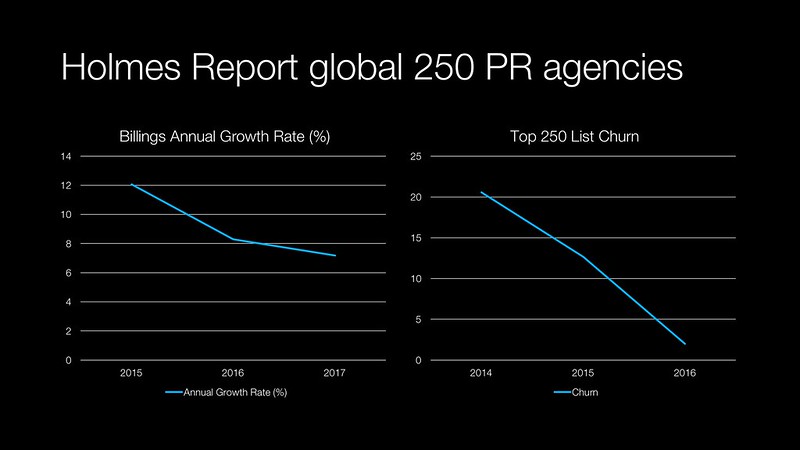
The Holmes Report came out with their top 250 (biggest) PR agencies around the world in terms of billings. I decided to delve into the numbers for financial years 2014 – 2017.
Macro picture
What the numbers suggested at a macro level were three things:
Overall billings growth was declining year on year
The amount of agencies that were appointed into the top 250 (and were dropped) declined year on year. There is less market disruption
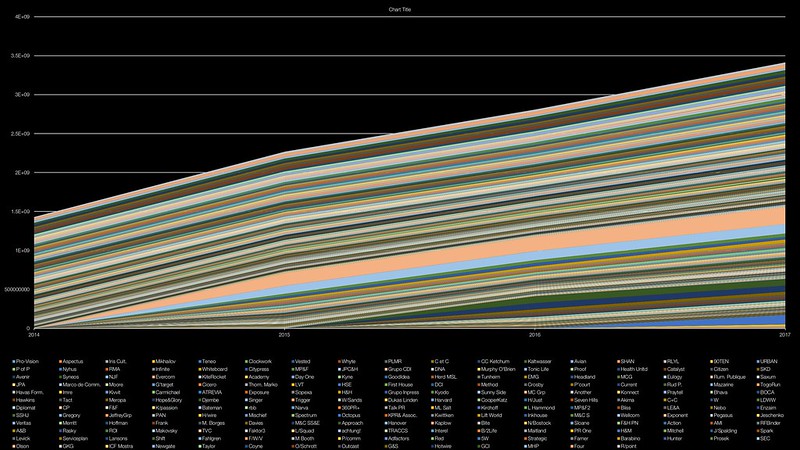
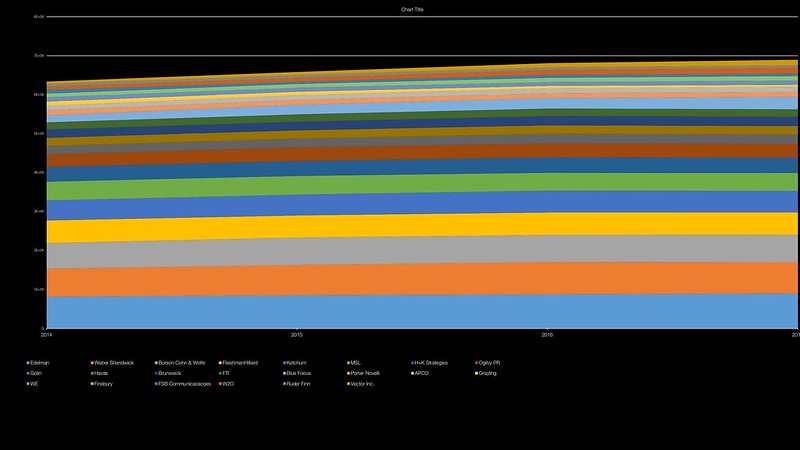
The bottom 190 agencies (by size over successive years) accounted for less than half the billings of the top 25 for financial year 2017
This supports a hypothesis of slowing market growth and solidifying market dynamics at a macro level. Strategic acquisitions start to make less sense compared to improving efficiences and effectiveness. But if you were going to buy an agency MC Group in Germany looked to be the stand out choice in terms of changing the fortunes of a large agency billings
We’re also seeing a likely tyranny of large numbers kicking in for the biggest agencies. Mid-sized agencies can be more agile due to less layers of management and less complex environmetns to worry about. They may be multi-market; but they’re not truly global. Which makes strategy and planning much easier.
PR agencies are people businesses. At the core they sell manpower by the hour. Bigger agencies have more people, which means a greater management overhead, not unlike Fred Brooks’ The Mythical Man-Month essays on software engineering. There are more processes, which have built up over time and greater inertia to change. Then you get office and intra-office real politik. You can try and keep this down, but it is a function of scale; the battle against it becomes ever harder and you can only focus on its worst excesses. It tends not to surface when its impact only goes downwards in the management structure.
Agency-specific hypothesis
This next part was inspired by David Brain’s post on the performance of large agencies.
PR seems to be acquired in a more tactical manner than previously. This has been happening for a number of reasons.
A decline in Full Metal Jacket syndrome in comms planning. This nonsensical quote about Vietnamese people in Full Metal Jacket makes similar false assumptions. I’ve seen similar false assumptions in past global comms campaign planning that I have seen. Usually that meant creating something in the US and then expecting it to work on a fraction of the budget elsewhere. This means that there is less international work for agency networks. This has a negative impact on inter-office best practice transfer and building relationships.
The influence of Byron Sharp. For many consumer marketers, How Brands Grow – based on years of marketing science research is the bible. When you look at Sharp’s work there are a couple of clear points when you use public relations as a tactic.
Zero-based budgeting (ZBB) has changed the marketing planning game. It pits public relations campaign efficiency and effectiveness versus other disciplines in sharp focus. In addition, some organisations have mistaken ZBB as a one-way ratchet tightening marketing spend. ZBB isn’t about continual cost-cutting, but continual optimisation – something that seems to have been lost in translation.
PR agencies haven’t taken full advantage of the opportunity afforded by digital and social for a number of reasons:
There is a tension. Between the focus on financial efficiency and effectiveness that the macro numbers suggest versus the investment in tools and personnel required. Where are the studios, strategists, planners and media desks?
There has been an expertise drain across the industry as agencies deskill; paying new people into roles less than the person who previously filled it. This means that over time there is a trench in expertise between office leaders and the rest of the team, making it harder for the office to scale and a loss of institutional knowledge. This has led to a lack of diversity in thinking amongst many PRs; let alone gender, race and age diversity. From experience I’ve found that digital natives aren’t necessarily the best digital strategists
Clients haven’t embraced the change. Social in particular sits elsewhere amongst the marketing team. There is a similar division with paid media. The focus (particularly in Europe) on performance marketing over brand marketing hasn’t helped. Hubspot-style content marketing is a reductive process that isn’t the friend of PR agencies; despite their expertise in content
The window of opportunity closes as organic reach declines. Social media marketing effectiveness requires paid media budget. Agencies have jumped in too late with insufficient confidence. Traditional senior management agency PRs have been curiously hung up on this. Yet we see: corporate communications as adverts in the FT and WSJ and consumer PRs do paid advertorials and paid product placement
Applied Materials Sags on Weaker Revenue Outlook – Barron’s – looks promising overall for the semiconductor market. Applied Materials saw over 25% in machinery sales for making microchips and displays, indicating overall buoyant demand across consumer electronics manufacturers. Much of this is driven by memory chips that go into a wide range of products, from smartphones to cars. The main item of concern that I saw in Applied Materials sales was the high proportion of sales to Chinese manufacturers. This was in sharp contrast to a drop of supplies to Taiwan factories. As supply chains decouple from China, this reliance will be a real issue. Applied Materials also have to worry about having their devices torn down and reverse engineered by Chinese government sponsored efforts to become self sufficient.
WSJ City – China secures access to 70% of world’s lithium supplies – Chile is the low carbon equivalent of Saudi Arabia. The rosy numbers are based on: current consumption rates that are low (electric cars are still a novelty) and doesn’t pair it with their position on rare metals – China also dominates super capacitor technology. Time for hydrogen powered cars
This Is How a Newspaper Dies – POLITICO Magazine – In 1976, long before the internet arrived, Los Angeles Times media reporter David Shaw wrote in a lengthy Page One report about the newspaper’s worsening vital signs. “Are you now holding an endangered species in your hands?” he wrote. – I’d alluded to this here.
The debate over privacy on Facebook got me thinking about the internet we envisaged. Reading media commentary on Tim Cook’s recent address at Duke University prodded me into action.
What do I mean by we? I mean the people who:
Wrote about the internet from the mid-1990s onwards
Developed services during web 1.0 and web 2.0 times
I’ve played my own small part in it.
At the time there was a confluence of innovation. Telecoms deregulation and the move to digital had reduced the cost of data and voice calls. Cable and satellite television was starting to change how we viewed the world. CNN led the way in bringing the news into homes. For many at the time interactive TV seemed like the future of media.
Max Headroom
Starship Troopers
The Running Man
Second generation cellular democratised mobile phone ownership. The internet was becoming a useful consumer service. My first email address was a number@site.corning.com format email address back in 1994. I used it for work, apart from an unintended spam email sent to colleagues to offload some vouchers I’d been given.
My college email later that year was on a similar format of address; on a different domain. I ended up using my pager more than my email to stay in touch with other students. Although all students had access to the internet at college, the take-up was still very low. At college I signed up for a Yahoo! web email. I had realised that an address post-University would be useful. Yahoo! was were I saw my first online ads. They reminded me of garish versions of classified ads in newspapers.
After I left college I used to go to Liverpool at least once a week to go to an internet cafe just off James Street and check my email account, with a piece of cake and a cup of coffee. I introduced my friend Andy to the internet (mostly email), since we used to meet up there and then go browsing records, clothes, hi-fi, studio equipment, event flyers and books at the likes of HMV, the Bluecoat Chambers, Quiggins, The Palace and Probe Records.
I found out that I had my first agency job down in London when I was called on my cell phone whilst driving around to Andy’s house to catch up after a week at work.
The internet was as much as an idea as anything else and the future of us netizens came alive for me in the pages of Wired and Byte. Both were American magazines. Byte was a magazine that delved deeper into technology than Ars Technica or Anandtech. Wired probed the outer limits of technology, culture and design. At the time each issue was a work of art. They pushed typography and graphic design to the limits. Neon and metallic inks, discordant fonts and an early attempt at offline to online integration. It seemed to be the perfect accompanyment to the cyberpunk science fiction I had been reading. The future was bright: literally.
Hacking didn’t have consumers as victims but was the province of large (usually bad) mega corps.
I moved down to London just in time to be involved in the telecoms boom that mirrored the dot com boom. I helped telecoms companies market their data networks and VoIP services. I helped technology companies sell to the telecoms companies. The agency I worked for had a dedicated 1Mb line. This was much faster than anything I’d used before. It provided amazing access to information and content. Video was ropey. Silicon.com and Real Media featured glitchy postage stamp sized clips. My company hosted the first live broadcast of Victoria’s Secret fashion show online. It was crap in reality, but a great proof of concept for the future.
I managed to get access to recordings of DJ sets by my Chicago heroes. Most of whom I’d only read about over the years in the likes of Mixmag.
All of this pointed to a bright future, sure there were some dangers along the way. But I never worried too much about the privacy threat (at least from technology companies). If there was any ‘enemy’ it was ‘the man’.
In the cold war and its immediate aftermath governments had gone after:
Organised labour (the UK miners strike)
Cultural movements (Rave culture in the UK)
Socio-political groups (environmentalists and the nuclear disarmament movement)
I had grown up close to the infamous Capenhurst microwave phone tap tower. Whilst it was secret, there were private discussions about its purpose. Phil Zimmerman’s PGP cryptography offered privacy, if you had the technical skills. In 1998, the European Parliament posted a report on ECHELON. A global government owned telecoms surveillance network. ECHELON was a forerunner of the kind of surveillance Edwards Snowden disclosed a decade and a half later.
One may legitimately feel scandalised that this espionage, which has gone on over several years, has not given rise to official protests. For the European Union, essential interests are at stake. On the one hand, it seems to have been established that there have been violations of the fundamental rights of its citizens, on the other, economic espionage may have had disastrous consequences, on employment for example. – Nicole Fontaine, president of the european parliament (2000)
I advised clients on the ‘social’ web since before social media had a ‘name’. And I worked at the company formerly known as Yahoo!. This was during a brief period when it tried to innovate in social and data. At no time did I think that the companies powering the web would:
Rebuild the walled gardens of the early ‘net (AOL, CompuServe, Prodigy)
Build oligopolies, since the web at that time promised a near perfect market due to it increasing access to market information. Disintermediation would have enabled suppliers and consumers to have a direct relationship, instead Amazon has become the equivalent of the Sears Roebuck catalogue
Become a serious privacy issue. Though we did realise by 2001 thanks to X10 wireless cameras that ads could be very annoying. I was naive enough to think of technology and technologists as being a disruptive source of cultural change. The reason for this was the likes of Phil Zimmerman on crypto. Craig Newmark over at Craigslist, the community of The Well and the Electronic Frontier Foundation. The likes of Peter Thiel is a comparatively recent phenomenon in Silicon Valley
We had the first inkling about privacy when online ad companies (NebuAd and Phorm) partnered with internet service providers. They used ‘deep packet inspection’ data to analyse a users behaviour, and then serve ‘relevant ads.
Tim Cook fits into the ‘we’ quite neatly. He is a late ‘baby boomer’ who came into adulthood right at the beginning of the PC revolution. He had a front row seat as PCs, nascent data networks and globalisation changed the modern world. He worked at IBM and Compaq during this time.
Cook moved to Apple at an interesting time. Jobs had returned with the NeXT acquisition. The modern macOS was near ready and there was a clear roadmap for developers. The iMac was going into production and would be launched in August.
Many emphasise the move to USB connectors, or the design which brought the Mac Classic format up to date. The key feature was a built in modem and simple way to get online once you turned the machine on. Apple bundled ethernet and a modem in the machine. It also came with everything you needed preloaded to up an account with an ISP. No uploading software, no errant modem drivers, no DLL conflicts. It just worked. Apple took care selecting ISPs that it partnered with, which also helped.
By this time China was well on its way to taking its place in global supply chains. China would later join the World Trade Organisation in 2001.
The start of Tim Cook’s career at Apple coincided with with the internet the way we knew it. And the company benefited from the more counter culture aspects of the technology industry:
Open source software (KDE Conqueror, BSD, Mach)
Open standards (UNIX, SyncML)
Open internet standards (IMAP, WebCAL, WebDav)
By the time that Facebook was founded. Open source and globalisation where facts of life in the technology sector. They do open source because that’s the rules of business now. It is noticeable that Facebook’s businesses don’t help grow the commons like Flickr did.
Businesses like Flickr, delicious and others built in a simple process to export your data. Facebook and similar businesses have a lot less progressive attitudes to user control over data.
Cook is also old enough to value privacy, having grown up in a less connected and less progressive age. It was only in 2014 that Cook became the first publicly gay CEO of a Fortune 100 company. It is understandable why Cook would be reticent about his sexuality.
He is only a generation younger than the participants in the riots at the Stonewall Inn.
By comparison, for Zuckerberg and his peers:
The 1960s and counterculture were a distant memory
The cold war has been won and just a memory of what it was like for Eastern Europeans to live under a surveillance state
Wall Street and Microsoft were their heroes. Being rich was more important than the intrinsic quality of the product
Ayn Rand was more of a guiding star than Ram Dass
They didn’t think about what kind of dark underbelly that platforms could have and older generations of technologists generally thought too well of others to envisage the effects. You have to had a pretty dim view of fellow human beings. More on privacy here.