Category: online | 線上 | 온라인으로 | オンライン

The online field has been one of the mainstays since I started writing online in 2003. My act of writing online was partly to understand online as a medium.

Online has changed in nature. It was first a destination and plane of travel. Early netizens saw it as virgin frontier territory, rather like the early American pioneers viewed the open vistas of the western United States. Or later travellers moving west into the newly developing cities and towns from San Francisco to Los Angeles.

America might now be fenced in and the land claimed, but there was a new boundless electronic frontier out there. As the frontier grew more people dialled up to log into it. Then there was the metaphor of web surfing. Surfing the internet as a phrase was popularised by computer programmer Mark McCahill. He saw it as a clear analogue to ‘channel surfing’ changing from station to station on a television set because nothing grabs your attention.

Web surfing tapped into the line of travel and 1990s cool. Surfing like all extreme sport at the time was cool. And the internet grabbed your attention.

Broadband access, wi-fi and mobile data changed the nature of things. It altered what was consumed and where it was consumed. The sitting room TV was connected to the internet to receive content from download and streaming services. Online radio, podcasts and playlists supplanted the transistor radio in the kitchen.

Multi-screening became a thing, tweeting along real time opinions to reality TV and live current affairs programmes. Online became a wrapper that at its worst envelopes us in a media miasma of shrill voices, vacuous content and disinformation.

  • North Korea + more news

    North Korea

    North Korean Restaurants in China Close Amid Regional Tensions | Radio Free Asia – quality of food or China – North Korea politics? While both North Korea and China claim a close political kinship

    Business

    Nestle Targeted by Dan Loeb in Activist’s Biggest-Ever Bet – Bloomberg – Third Point up to its usual tricks, or something more?

    Consumer behaviour

    We Analyzed 100 Million Headlines. Here’s What We Learned (New Research) | Buzzsumo – probably the most depressing post on data driven content strategy in a while. (Rocks with head in hands whilst having no respect for audience)

    Culture

    The Vault Of The Atomic Space Age – amazing 20th century tech photography

    Design

    The Beautiful, Impossible Dream of a Simpler Smartphone | WIREDThe Apple Watch’s purpose (at least at first) was to quieten the demands of the iPhone

    FMCG

    Coffee Ripples – Home of the Ripple Maker – there is something soul destroying about this product

    Hong Kong

    Activist investor calls Hong Kong market rout | Reuters – network of mainland business people running a ‘pump and dump’ scheme on Hong Kong small caps market

    Ideas

    The iPhone Was Inevitable – The Atlantic – interesting how much testing of concepts went into the iPhone. It also emphasises the idea of the technium

    Legal

    Ends, Means, and Antitrust – Stratechery by Ben Thompson – worthwhile reading with regards Google’s EU antitrust trouble

    Luxury

    London Luxury Home Values Fall 6.8% in Year Since Brexit Vote – Bloomberg – by the looks of this the luxury home market is splitting. The track funded by banking and related professions is in decline. But luxury homes funded by inward foreign property investment seems to have suffered less, if at all

    Media

    Facebook video ad viewability rates are as low as 20 percent, agencies say | Digiday

    Security

    Internal Memo: Sir Martin Assures WPP Staff That Everything Is Fine in Wake of Cyberattack | AdWeek – WPP’s love of Windows left so many people exposed. Insistance on proprietary encrypted USB sticks would make working from home harder

    The global ransomware attack weaponized software updates – The Verge – this is epic

    China’s New Cybersecurity Law: The 101 | China Law Blog – interesting requirements laid down for data protection including use of encryption

    Software

    WeChat Developer Error Codes | Grata – so handy for English-speaking  developers

    Twist is Slack without the annoying distractions | TechCrunch – more of a feature that Slack can replicate rather than an alternative app?

    Tencent OS Ceases Services This Week | ChinaTechNews – Tencent finally wrapping up its distribution of Android. With WeChat’s dominance the OS has become a burden rather than an asset

    Where Technology Meets Culture: Week 1 of Living in Beijing – not news to readers of this blog, but a great summary of the WeChat economy in action

    Technology

    Apple Should Buy IBM | Forrester Blogs – Forrester seems to have a far higher opinion of Watson than many people I know in the industry. This comment from Max Pucher shreds Colony’s argument: As an ex-IBMer, Apple afficionado and Machine Learning expert I could not diisagree more. Apart from the immense cultural clash there is no need to buy IBM to get Watson. Watson is a marketing stunt that sells a consulting package to create a custom ML setup. What won Jeopardy was a glorified full text search engine that can’t be used for anything else. Siri is not grand but a lot more powerful than Watson.

    With ML-Kit in the next Apple software releases it will empower the Apple ecosystem to use machine learning extensively and widely. With Watson ML needs 50 IBM experts to do some pattern recognition application. At Apple a million creative developers will jump at the opportunity to use the embedded power of audio, image and video recognition in the platform.

    Apple’s GPUs will play a significant role in that.

    IBM is all AI hype and no substance snd while buying IBM would possibly be good for current IBM customers, Apple would not gain anything. But it shows how good IBM is in that form of marketing. IBM did the same stunt with Deep Blue when Joel Benjamin won against Kasparov with the help of a machine … that wasn’t AI either …

    Moore’s Law’s End Reboots Industry | EE Times – really interesting analysis of slowing process in semiconductors affects other industries

    American Chipmakers Had a Toxic Problem. So They Outsourced It – Bloomberg – technology’s tabacco moment is already upon us

  • Louis Vuitton personalisation + more things

    Louis Vuitton Personalisation

    Louis Vuitton personalisation feature is really interesting. It brings NikeID magic to their retail experience. Customisation makes even more sense in a luxury context like the Louis Vuitton personalisation feature. I think that it will also impact secondhand sales – flair is much more of a personal decision, which will impact secondhand sales.

    If the Louis Vuitton personalisation could be done as an after-market, then that gives Louis Vuitton additional incremental retail revenue.

    Digital catnip

    Scott Galloway manages to get his academic colleague Adam Alter to highlight some of the techniques used to make apps as digital catnip. B.J. Fogg pretty much wrote the book on captology literally: Persuasive Technology: Using Computers to Change What We Think and Do.

    Nir Eyal took Fogg’s work and simplified it even further in his book Hooked. Adam Alter and Scott Galloway provide a good primer to the principles involved and the likely outcomes.

    Jennifer Cardini

    The soundtrack of my week has been this mix by Jennifer Cardini of Correspondent Records. Cardini has a background in DJing, music and sound design which explains some of the atmospheres.

    Instagram lead generation

    This is probably old news, but it was the first time that I noticed it in my feed. Instagram has an email collection facility that reminded me of Twitter cards. Its a great idea that can help tie Instagram engagement closer to e-commerce sales

    Untitled

    Flickr search

    Flickr has been tweaking its design and has improved its search. These changes have largely happened under the radar. In my experience, the biggest move was that the ‘camera roll’ has been depreciated in menu positions so that you no longer click on it by accident. It’s good to see the continual improvements in a time of substantial change at Yahoo! / Oath or whatever Verizon calls it. Flickr talked about the changes it made to the user’s profile page on its blog.

    SaveSave

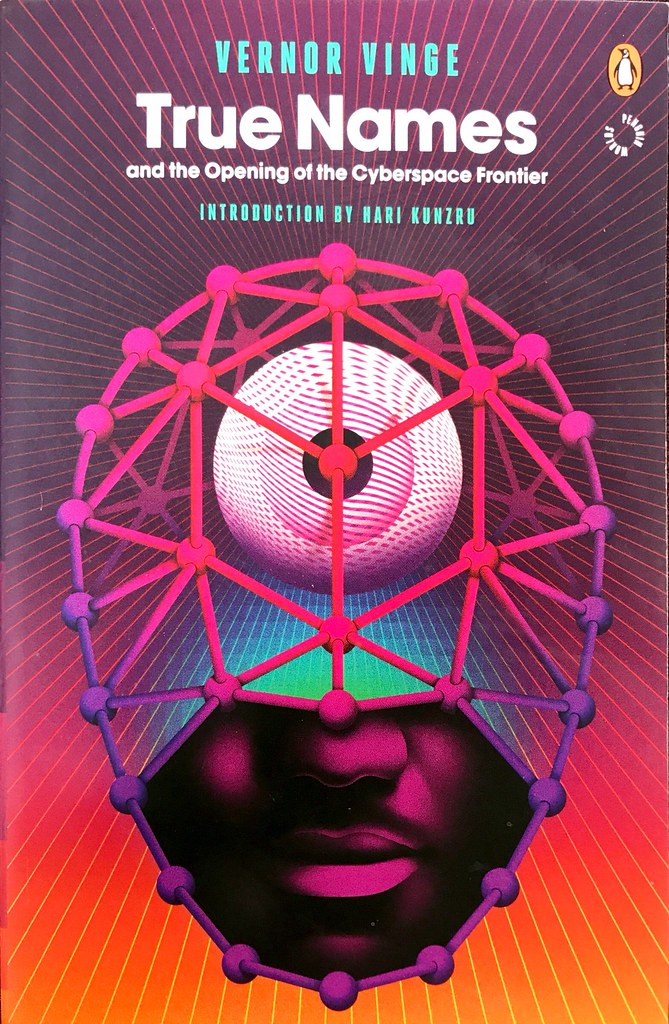
  • True Names by Vernor Vinge

    I was inspired to read True Names by a podcast. New York Times journalist John Markoff was interviewed by Kara Swisher on the Recode podcast in February and talked about reading science fiction to better understand how technology is likely to affect us.
    Untitled
    It’s actually a great piece of advice. Back in the day, large corporates used to employ authors to write stories based on scenarios as part of their research programmes. Many people have attributed the clamshell mobile phone to the Star Trek TV series and the flip communicator devices.

    Markoff outlined his favourite stories.

    “Snow Crash” by Neal Stephenson (1992): “The premise is, America only does two things well. One is write software, and the other is deliver pizzas. [laughs] What’s changed?”
    “The Shockwave Rider” by John Brunner (1975): Markoff said he built his career on an early understanding that the internet would change everything. He said, “[The Shockwave Rider] argued for that kind of impact on society, that networks transformed everything.”
    “True Names” by Vernor Vinge (1981): “The basic premise of that was, you had to basically hide your true name at all costs. It was an insight into the world we’re living in today … We have to figure it out. I think we have to go to pseudonymity or something. You’re gonna participate in this networked existence, you have to be connected to meatspace in some way.”
    “Neuromancer” by William Gibson (1984): Markoff is concerned about the growing gap between elders who need care and the number of caregivers in the world. And he thinks efforts to extend life are “realistically possible,” pointing to Gibson’s “300-year-old billionaires in orbit around the Earth.

    I had read Snow Crash relatively recently and Neuromancer was revisited last year. I had a vague recollection of The Shockwave Rider and True Names, but hadn’t read them in over 20 years.

    Vinge’s True Names is published by Penguin with a collection of essays from a range of technology thinkers including

    • Chip Morningstar and Randy Farmer who founded Habitat one of the first massive online multiplayer games, back when dial up bulletin boards were the bleeding edge. Farmer worked at Yahoo! when I was there and was involved in Yahoo! 360 and still consults on community / social platform issues
    • Bruce Schneier wrote about how security products fail us. Bruce is one of the world’s leading commentators on all things hack and cryptography related
    • Mark Pesce is better known now as an Australian-based computer academic, but two decades ago he invented VRML – a way of representing the internet as a 3D thing and prescient in the light of Oculus Rift and others.
    • Marvin Minsky; was a pioneer in AI and machine learning provided an afterward to the story

    That True Names managed to attract essays from these people should be an endorsement in itself.  Re-reading it two decades on, Vinge’s story echoes and riffs on the modern web. Hacking, cyberterrorism, constant government surveillance and the tension between libertarian netizens versus the regulated  real world. The central theme of Mr Slippy; a hacker who is identified by US government officials and co-opted as an unwilling informant and agent provocateur feels reminiscent of LULZSec leader and super grass Sabu. It’s amazing that Vinge wrote this in 1981 – although he envisages the web as being rather like a Second Life / Minecraft metaverse – with NeuroSky style interfaces.

    Penguin’s careful curation of essays riffing on the themes of True Names is where the real value is in my opinion. For someone who cares about technology and consumer behaviour. It is worthwhile keeping this book on the shelf and diving in now and again. More related posts here.

    More information
    Want to understand the future? Read science fiction, John Markoff says. | Recode
    Habitat Chronicles – thoughts on gaming, online products and community building by Chip Morningstar and Randy Farmer
    Schneier on Security
    Mark Pesce’s professional website and his columns for The Register
    Vernor Vinge lecture on long-term scenarios for the future via The Wayback Machine

  • Pornographers + more news

    Pornographers and social search

    Can These Pornographers End ‘MILFs,’ ‘Teens,’ and ‘Thugs’? | The Nation – when I was working on social search and folksonomies at Yahoo! a decade ago, yet pornographers are now amongst the most active users of the technology. A few things about how the pornographers worlds have changed. At the centre of this is the change in the market. Back in the day adult media companies and performers had their own sites that they sold their content through. They were found via search and audience aggregation sites that had teaser content.

    Then the tube sites came along and changed the game, the pornographers got pirated and mediated all at the same time. In order to get tube platform search to work for them, they had to embrace tagging, which revolved around the language that customers

    Business

    Haul For One: U-Haul Adapts & Reuses Abandoned Buildings | Urbanist – some of these are stunning for a modernist sucker like me

    DARPA Funds Development of New Type of Processor | EE Times

    Economics

    China’s Operation Australia: payments, power and politicians | Sydney Morning Herald – surely its what you’d expect an intelligence agency to do. Not really surprising, except for the change in tonality from Australia about China

    FMCG

    Chinese consumerism will reshape the world, and maybe even destroy it — Quartz – anything to do with China is the speed at which all this has occurred. What would the outcomes of that speed be? People wouldn’t have as many brand associations. Those brand associations would have built up in relatively short amount of time, as opposed to [being] handed down intergenerationally. Because of that speed, the amount of anxiety about having the right brand would be greater in that environment than in a place where this is unfolding slowly. Interesting also that Gerth talks about the right (communist) brands under Mao when people wanted a bike, a sewing machine and a wrist watch. I would also argue that there was latent knowledge of brands from pre-revolutionary times in older people based in Shanghai or historic brands like Tongrentang (TRT) founded in 1669

    Innovation

    WWII vehicle boneyards were essentially war machine landfills | Mashable  – Americans were so eager to get their hands on cheap surplus Jeeps that auto companies urged the government to leave them overseas, fearing they would cut into new car sales.

    I, Cringely The Robots are Coming! – I, Cringely – interesting read, but one that poses as much challenges as solutions

    Marketing

    What influencer marketing really costs – Digiday – interesting ranges in here

    Apple launches Business Chat for iMessage in developer preview | VentureBeat – looks like they have been taking a lesson or two from WeChat. I had seen Salesforce integration with iMessage and iChat demo-ed at one of the Cloudforce conference

    An aversion to logos could be Essential’s undoing | total telecom – its even more ridiculous that Essential actually have a logo that evokes Paul Rand and Saul Bass

    Media

    The One Big Reason Why BuzzFeed Needs TV – Bloomberg – so much for the online media business…. old media is the new sexy

    Apple’s new anti-tracking system will make Google and Facebook even more powerful – The Verge – a more marginal improvement than you’d think

    The Telegraph to publish daily edition on Snapchat – from 5pm today – I wonder what the monetisation model looks like?

    Entertainment Accounts Closed as Party Emphasizes News Control | China Digital Times – China clamping down on celebrity scandal accounts as well as accounts that would be disruptive to government

    Pathology of a Fake News Story – Thoughts On Journalism – Medium

    Facebook study shows what TV viewers are doing during commercial breaks | silicon beat

    Online

    Pinboard Blog – Pinboard acquires del.icio.us – a certain amount of irony in this which I’ll write about another time

    Security

    Russian malware link hid in a comment on Britney Spears’ Instagram | Engadget – really canny technique

    Software

    Apple is finally serious about artificial intelligence | Quartz – i’d disagree with the headline, but it has a good overview of the AI development pieces from Apple’s keynote

    Apple Just Joined Tech’s Great Race to Democratize AI | WIRED

    Why Apple is struggling to become an artificial-intelligence powerhouse – The Washington Post – Washington Post was bought by Jeff Bezos

    Technology

    Tom Oberheim On The Art Of Synthesizer Design | Synthtopia – amazing interview with Tom Oberheim on how he got into synthesiser design and talks about his products

    Andy Rubin’s new company already got screwed by Apple – BGRAlthough Apple didn’t object to the investment, SoftBank didn’t want the conflict to happen

    Car Fact Of The Day | Marginal Revolution – Huge increase in complexity in cars

    Google vs. Uber: How One Engineer Sparked a War – WSJ – interesting write up of Andrew Levandowski’s role in it. I didn’t realise he was Belgian and its interesting how Google Street View helped birth its autonomous car project

    Telecoms

    Network Time Protocol Hardened To Protect Users From Spying, Increase Privacy – Slashdot

    Web of no web

    Japan puts up satellite in step to build homegrown GPS- Nikkei Asian Review – Quasi-zenith devices to allow location data accurate to 6cm

    Listen and create ambient sounds easily – Ambient Mixer – great for sounds to work by

  • WWDC 2017

    WWDC 2017 overview

    WWDC 2017 is the most important Apple event of the year as the software dictates There was a mix of hardware and software updates. Apple put a lot of focus on  virtual reality, augmented reality and prepping their operating systems for handling larger amounts of data.  There was work done to further optimise video and photo usage on device.

    WWDC 2017 had bad news for online advertisers and a number of consumer electronics manufacturers. Online advertising using retargeting or autoplay video is going to be blocked in Safari. The new HomePod speaker took aim at ‘casual hi-fi’ like Sonos, Bowers & Wilkins and Bose.

    Developments that Apple showcased at WWDC 2017 indicated that it is working very hard to try and understand user intent, which is one of the first pieces it needs to put in place to develop the experience of a truly programmable world. What do I mean by a programmable world? A ‘web of no web’ where device intelligence behaves as if it understands user intent like a good valet. It is moving in a stepwise manner towards this.

    What was more surprising is how Apple has gone big on VR and AR creation and consumption. Whilst video post-production houses probably have the most to complain about when it comes to Apple’s Pro equipment, they are not name checked. Apple has started to move to address their concerns. The external graphics support in macOS implies that a furture Mac Pro will have the software to match hardware.

    More details by platform:

    macOS

    The name High Sierra implied an OS update that might seem incremental to consumers, but has major technology changes under the hood.

    • Data – Apple File System as default (many features similar to Sun Microsystems’ ZFS). Faster for file swaps and giving a faster computer experience
    • Video – better quality video algorithms with smaller file sizes and integration with
    • Graphics – upgraded Metal API – Apple had been using it on machine learning applications within the OS. Metal 2 has been used to accelerate system level graphics and provides access to app developers. There is OS support for external graphics accelerators. The external graphics developer kit is based on AMD Radeon card.
    • MacOS supports VR through Metal for VR. Steam, Unity and Unreal supporting VR on the Mac. Apple seems to believe that VR and AR content is the desktop publishing of the 21st century, they have gone hard on making the best creators platform that they can
    Safari
    Focus on being the fastest browser experience, even in comparison to Chrome
    • Autoplay blocking – which will impact advertising network video views
    • Intelligent tracking prevention – positioned to target advertising retargeting and cross-site tracking
    Mail
    Productivity refinements including a split screen view
     
    Photos
    • Uses machine learning to improve searching and photo recognition and integration with photo-editing

    tvOS

    • 50 media partners integrated into TV app
    • Amazon is coming to Apple TV. Interesting move of detente between Apple and Amazon

    iOS

    iOS 11 – focus on underlying technologies:
    • Machine learning APIs – to help adoption of CoreML on device for third party apps
    • ARKit – to aid AR in apps. Clever work done on scaling and ambient light. This about providing a market for the content which which would be created on the Mac
    • Chinese specific features: including support for QRcodes, SMS spam filtering. Chinese users have a particular set of contexts and these innovations could become popular in the west
    • Interface tweaks in control centre and the lock screen.
    Messages
    • Improving discoverability of app stickers and apps – much needed
    • Automatic synchronisation of Messages across devices, delete once, delete across all devices
    ApplePay
    • Person-to-person payments as an iMessage app. Obvious competitor would be WeChat in China and PayPal in the west
    Siri
    • Improved expressive nature of the voice.
    • Follow-up questions, presumably to improve context
    • Provides translation services
    • Siri integration into a wide range of apps including WeChat and OmniFocus They’ve tried to use on-device learning to try and improve context and being helpful. Siri knowledge is synched across devices. Uses web history to improve Apple News and custom dictionary spellings
    Apple Maps
    • Indoor navigation for airports
    Photos
    • Better image compression to save space on device. New depth API that can be accessed by 3rd party apps
    • Video autorotates a la Snapchat / Snap glasses
    App Store
    • Apps now reviewed in less than 24 hours
    • First app redesign in nine years. Tweaks to improve discoverability and merchandising of apps including in-app sales
     watchOS
     
    • The biggest feature in watchOS 4 is the Siri-powered face. The Siri-powered watch face provides contextual information on the ‘home screen’. It takes into account past habits, time, location etc. Apple’s language around this was interesting, they described it as an ‘Intelligent proactive assistant’.

    More details by hardware

    Mac hardware
    • iMac – improved displays, brighter and support for 1 billion colours. Moving to Kaby Lake Intel processors. Up to 64GB of RAM on the iMac and 2TB SSD. Discrete Radeon graphics cards on larger iMacs. – big focus on VR development.
    • MacBook – Kaby Lake processors. Pro machines get updated graphics as well. The MacBook Air gets a processor boost.
    • iMac Pro – single piece machine with workstation specification including 10Gbit Ethernet. Presumably as an interim measure until the Mac Pro arrives next year. How upgradeable would the iMac Pro be, which is a key consideration for workstations
     
    iPad hardware
    • iPad Pro – 20% bigger screen, 120Hz screen refresh rate. Doubling default memory sizes up to 512GB
     
    Apple HomePod
    Apple is going after Sonos and brown goods companies like Bose, Bowers & Wilkins and Bang & Olufsen. The Siri functionality is a hygiene factor rather than a serious competitor to Amazon Echo. There was a big emphasis on the privacy functionality of Siri in HomePod
     
    Further reading

    WWDC 2015: you know the Apple news, but what does it mean?
    48 hours with the Apple Watch
    Eight trends for the future: web-of-no-web
    Eight trends for the future: contextual technology

    More content on WWDC 2017