The online field has been one of the mainstays since I started writing online in 2003. My act of writing online was partly to understand online as a medium.
Online has changed in nature. It was first a destination and plane of travel. Early netizens saw it as virgin frontier territory, rather like the early American pioneers viewed the open vistas of the western United States. Or later travellers moving west into the newly developing cities and towns from San Francisco to Los Angeles.
America might now be fenced in and the land claimed, but there was a new boundless electronic frontier out there. As the frontier grew more people dialled up to log into it. Then there was the metaphor of web surfing. Surfing the internet as a phrase was popularised by computer programmer Mark McCahill. He saw it as a clear analogue to ‘channel surfing’ changing from station to station on a television set because nothing grabs your attention.
Web surfing tapped into the line of travel and 1990s cool. Surfing like all extreme sport at the time was cool. And the internet grabbed your attention.
Broadband access, wi-fi and mobile data changed the nature of things. It altered what was consumed and where it was consumed. The sitting room TV was connected to the internet to receive content from download and streaming services. Online radio, podcasts and playlists supplanted the transistor radio in the kitchen.
Multi-screening became a thing, tweeting along real time opinions to reality TV and live current affairs programmes. Online became a wrapper that at its worst envelopes us in a media miasma of shrill voices, vacuous content and disinformation.
My mind cast back to one of the first modules I studied at college. There was a lecture on the role of complaint resolution as part of customer services. The idea was that effective complaint resolution engendered trust in a customer service function and was more likely to increase brand loyalty and recommendation to other people. In reality Ehrensberg-Bass Institute have explored this area in more depth and found that customer penetration is more important than customer loyalty.
US National Archives: Approaching Logan Airport. 05/1973 by Michael Manheim
I suspect that the benefit in complaint resolution is more around a premium brand positioning rather than the business benefits of loyalty. This is an interesting frame to consider AirHelp’s global airline ranking. Unlike SkyTrax that focuses on experience, AirHelp weighs its ranking heavily on complaint resolution.
British Airways came 82nd out of 83 airlines assessed, which won’t be a surprise to anyone who has flown with them over the past four years.
Many airlines that would have a high SkyTrax service ranking, didn’t perform as well on complaint resolution.
So there wasn’t a clear correlation between experience resolving lots of customer complaints or a highly evolved service offering.
Emerging car brands scrutinised by Bloomberg and Grant Thornton | Manufacturer – “Chinese brands are dominating the scene with good products, big screens, and impressive interfaces.” However, the challenge arises when considering pricing, as Chinese EVs like the XPeng’s G9 SUV was 72,000 euros competing against the likes of BMW and Mercedes. So they’re going to find it very, difficult and it’s going to come down to price.” Dean pointed out MG’s success in the UK market was achieved by hitting exactly the right sweet spot in terms of pricing. The MG ZS, the second-best-selling battery electric vehicle in the UK, is priced at an average of £31,000, making it compelling in terms of competitive pricing especially in a country where consumers are not fiercely loyal to specific brands. – interesting reading. The way for Chinese vendors to win would be to have Chinese incentivised lease financing, particularly in a time of higher interest rates a la Huawei in the telecoms markets.
American men are dying younger. – by Richard V Reeves – I just don’t think this can be addressed in the current climate of othering and privilege. It would be like trying to hold a meaningful discussion on immigration a few decades ago.
Xi in Nanning; Shanghai and Beijing real estate tweaks; More Hong Kong bounties; Sim Love | Sinocism – the Hong Kong puts bounty on the head of US citizen who has criticised the Hong Kong government in the US. They are all ethic Chinese. So China and the Hong Kong government think that ethnic Chinese wherever they are should be loyal to their respective administrations – in essence their face is their passport. Not even Israel does something similar with the the world’s Jewish community, or Ireland with our diaspora.
Innovation
Quantum Breakthrough: Caltech Scientists Unveil New Way To Erase Quantum Computer Errors – Researchers from Caltech have developed a quantum eraser to correct “erasure” errors in quantum computing systems. This technique, which involves manipulating alkaline-earth neutral atoms in laser light “tweezers,” allows for the detection and correction of errors through fluorescence. The innovation leads to a tenfold improvement in entanglement rates in Rydberg neutral atom systems, representing a crucial step forward in making quantum computers more reliable and scalable.
The inspiration for this post on FOOH (fake out of home advertising) was Ryan Wallman’s marketing predictions for 2024 on LinkedIn. In particular two of his five predictions
2. Someone will post a viral ad that is a) fake and b) terrible. Hundreds of people will comment: ‘Genius!”
5. Marketers will try to emulate the success of Barbie but will completely misconstrue its relevance to their brand, culminating in a series of fucking stupid and totally unsuccessful stunts.
Ryan Wallman
As with many marketing predictions, they are equally applicable for 2023 as well as next year (and probably several years on).
These two particularly resonated with me, due to the current trend of FOOH. This is where a creative agency has put together photography or video showing an out of home execution that doesn’t exist.
These aren’t concepts that have been mocked up for a client to show them how indicate how their campaign would look when activated. Or as a creative calling card by an agency or team to catch the eye of a new client a la the famous Volkswagen Polo car bomb advert which leaked out on to the general public.
Instead, they are created with the express intent with fooling a good deal of the public that the execution is real. In the case of Maybelline, it was pushed out on third party influencer accounts on TikTok and YouTube as ‘truth’.
Other examples
The Popeyes and Truff collaboration campaign can be seen here. British Airways mocked up a billboard at the Glastonbury festival, but wouldn’t have been able to buy the space even if it wanted to.
The Independent were fooled by Jacquemus with these FOOH-ed giant handbags. It is particularly interesting that a mainstream news media channel was fooled.
And I find that troubling for a number of reasons. And let’s illustrate this through a quick thought experiment.
The John Holmes thought experiment
You probably don’t know me, I am an overweight white male with a shaven head and distinctly average in every physical way.
A quick John Holmes primer
John C Holmes via Wikipedia
The late Mr Holmes was taller than me. He was an army veteran and then worked a number of blue collar jobs from ambulance driver to factory worker and forklift truck driver. He eventually hit a patch of unemployment and agreed to do nude modeling and appear in pornographic films. At the time these films were closely linked with organised crime in the US. Times things changed. During the early 1970s the industry saw a golden age where porn films became mainstream culture. Roger Ebert reviewed these films for the Chicago Sun-Times and his peers did similar at the likes of the New York Times.
Holmes became a popular culture figure and his name spread far wider than the viewership of his films. Mark Wahlberg’s character in Boogie Nights is heavily influnced by John Holmes. He was famous for his penis size.
For the latter part of his adult life he was an addict, which affected his ability to work. The movie Wonderland dramatises a low point in Holmes life and his association with murder of the Wonderland drug gang.
Back to the thought experiment
By some strange incident, a video of me stepping out of the shower and then putting a towel happens to be made. A creative chum decides to make lemonade from these lemons and uses <insert generative AI video tool du jour here> to create a realistic looking, but fake, appendage.
Nothing has changed, I am still as I introduced myself earlier, distinctly average in every physical way. Then I add it to a dating profile. In my opinion it would be both unedifying and distinctly dishonest. This is what brands are doing when they create FOOH campaigns to generate social currency (virality, talkability etc).
Authenticity
These videos and photos are demonstrations of creative craft and creativity, but good judgement asks not only can something be done, but should it be done. It’s often not part of an ad format that makes it clear that the image isn’t ‘real’ and there is no ‘wink-wink’ moment to bring the audience in on the truth. This isn’t ‘truth well-told’ as advertising as McCann the advertising agency would have put it.
Brands step across the line of believability, inevitably letting consumers down.
Authenticity vs. fakery
While FOOH showcases the incredible capabilities of CGI and digital storytelling, so do 3D digital billboards. 3D billboards do it in a more honest, authentic and entertaining way. The Air Max Day billboard campaign in Tokyo would be genuinely memorable, creating a sense of wonder and generate talkability.
By comparison FOOH is a fiction cosplaying as reality. FOOH raises questions about the authenticity of the brand experience itself. Advertisers push the boundaries of what is possible with a minimum spend. These simulations of awe-inspiring moments dilute the credible real-life experiences we’ve come to appreciate. Authenticity is a pivotal factor in establishing trust between a brand and its audience. What does it say about the brand as a corporate citizen, when they are normalising fraud, lies and astro-turfing on social platforms? We have enough problems in the media eco-system already, without brands making it worse. FOOH can be seen as a manifestation of brand sociopathy.
Welcome to my January 2024 newsletter which marks my 6th issue – bringing us to a half dozen issues in total. Here’s a quick video introduction that I recorded with HeyGen.
Dozen as a word in the English language comes from the french douzaine – meaning an assembly of 12 things of the same nature. This in turn was derived from roots in Latin. Weirdly enough the use of dozen plunged to a nadir in 1983 and then enjoyed steady growth to reach its most recent peak in 2018.
The sun rises reluctantly over the horizon every morning, disappearing each afternoon, but that doesn’t mean that inspiration stops. But each day is getting slightly more daylight here in London and in a few months we could be complaining about the heat.
Watch Registry – how a confluence of EU regulations and surging crime has driven a new category of online service.
Pebble – micro-blogging service Pebble went under in November last year. Here’s what we lost.
Loneliness – its impact and some of the solutions that are evolving to address it.
Backroom – how one of my photos went around the web and ended up in an online game.
Every old idea is new again – a mix of collective amnesia and the less than perfect memory of the web means that old ideas have their time as new creative.
Books that I have read.
Over the new year, I curled up on the sofa with 2034 by Elliot Ackerman and Admiral James Stavridis. Ackerman and Stavridis plot out a political pot boiler about what a future war with China might look like. The realpolitik of the book feels real, the main issue would be the complete passivity of smaller powers like the United Kingdom and France. The rise of India and the fall of China as a global power at the end is an interesting commentary on the current Xi-led government. The book seems to set out to do a few jobs. First and foremost it’s a call to arms about American preparedness (it isn’t prepared). Secondly, it’s a warning about over-relying on technology, over base skills like astral navigation – something that the advertising industry could learn from as we fumble forward across AI, martech and adtech in a time of declining effectiveness. But the book also irritated me and pulled me out of of the story with magical thinking in Chinese technology and having every part of a plane including an ejector seat open to being hacked and disabled. I could imagine car manufacturers leaving their safety systems open, but would have thought that the military would have been more sensible about their safety equipment.
How Did Britain Come to This?: A century of systemic failures of governance by Gwen Bevan. How Clement Attlee’s administration solved issues of minimal government in the post-war period and these solutions held up until the early 1970s. How Margaret Thatcher’s solution of markets for everything suffered from market failures over the years. All of which resulted in geography as destiny in terms of social outcomes.
Among the Braves: Hope, Struggle, and Exile in the Battle for Hong Kong and the Future of Global Democracy by Shibani Mahtani and Timothy McLaughlin – an interesting portrayal of Hong Kong’s pro-democracy movement from the perspective of foreign journalists in the region. McLaughlin writes for The Atlantic and is based out of Singapore, Mahtani does a similar role for the Washington Post. The whole society movement of the protests is something that comes out in the books and makes me think that the authorities will have a longer term job to keep their illiberal agenda going. But on the flipside the American foreign policy looks weak and ineffective in the face of China. What most surprised me was how the authors uncovered details inside the government and the police force. Probably the most explosive allegation is that the Organised Crime and Triad Bureau of the Hong Kong Police were monitoring the WhatsApp group chat used by multiple rival gangs to organise the attack on Yuen Long train station. There is a large overlap between rural political committees in the Yuen Long area and triads. We know that the police did not prevent it, did nothing about it when it happened and conducted minimal prosecutions. Chief executive Carrie Lam was getting her news from the television rather than intelligence gathered using open source, human intelligence sources and ‘exquisite‘ means. Some members of the government related to mainland affairs seem to have had an indication of what was coming, but there is no evidence that Lam knew.
Things I have been inspired by.
Swiss International Airlines, the city of Geneva and the Grand Prix D’Horologerie de Genève did a classic PR stunt in October 2023. A flight crew member supervised by a watchmaker assembled a mechanical watch mid-flight between Geneva and New York at an altitude at 30,000 feet. In the idea you have precision, innovation, expertise, professionalism, quality and skill. A solid fusion of complementary brands, brand planning and creative ideation.
Unfortunately, the story seems to have been eclipsed by the Israel – HAMAS conflict in the Gaza region. The uncertainty of the news agenda illustrates the weakest point of a campaign relying purely on earned media.
Etsy and agency The Orchard nailed gift buying with their spot ‘Dad’. The insight that family members often don’t want gifts and are concerned about clutter or the ‘wrong type’ of gifts is on-point. There is the additional layer of thriftiness that comes from being part of an immigrant family – be they Irish or Asian.
The idea also had me reflect on the time I spent helping to sort through my late Uncle’s belongings on the family farm back home in Ireland. There were ‘new old stock’ ties still in their packaging and an Insignia aftershave / shower gel gift set from sometime in the early 1990s in his drawers. Stashed there after being gifted, but unneeded.
Thoughtful gifts are priceless.
While the ad is aimed at Christmas, I saw it as I thought about my Dad’s birthday. My own parents exhibit the traits of not wanting gifts and thriftiness. But in my case, no Etsy-sleuthing was required however, with a bit of cajoling he knew precisely what he wanted from the Toolstation catalogue. The collector gene runs deep in the Carroll family.
https://youtu.be/4VI6rgps_Bc?si=pHQpElVLc_KlDecI
The Orchard for Etsy
While a lot of London had their out of office on until January 15th, New Balance had their skates on previewing Scorpius, Rose Water and Medusa Azúl variants of the 1906R in association with Action Bronson. The clever thing that they have done is that each of the colour ways have a variation in brightness, appealing to sneaker heads of different temperaments. For me this was more exciting than Louis Vuitton’s collaboration with Timberland also announced this month.
7-Eleven Hong Kong did one of the first campaigns that merged generative AI techniques with traditional advertising production values including extensive use of green screens and wire work that would have been more at home in the fantasy martial arts films Hong Kong made famous.
4.5 billion years in an hour. A great way to bring data to life in a way that we wouldn’t otherwise be able to fathom. It also works well as a background for writing late at night as well. It did remind me of Hitchhiker’s Guide to The Galaxy for some reason, and that’s no bad thing.
I was looking at the underlying code on one of my flickr photo pages and came across this recruitment advert embedded in the code. I thought it was quite cleverly done in terms of targeting a technical audience.
A bit of a late find for me, the Computer History Museum held a 2-hour event interviewing key people in the development of the Apple Mac, in order to celebrate the 40th anniversary of its launch. There is so much that can be still learned today from their experience. You can watch it here.
Finally, Tom Coates shed more light on what we are likely to see platform-wise from a post-Twitter future.
Things I have watched.
It’s cold and dark and I make no apology for my films being unapologetically escapist and and entertaining to try and counterweight the drab conditions.
Something Wicked This Way Comes – Something Wicked This Way Comes was made in the UK during that many Disney fans describe as the studios ‘dark period’. From 1967 – 1984, the Disney family connection to the business was severed through deaths and a resignation. Film quality declined while shows and theme parks supported the business until Michael Eisner . Something Wicked This Way Comes has a fantastic cast including blaxploitation starlet Pam Grier, Broadway and Hollywood veteran Jason Robards and a young Jonathan Pryce, now better known as David Cartwright, former spook and River Cartwright’s grandfather in Slow Horses. The film is based on a book by Ray Bradbury. The film has a similarly surreal nature to Willy Wonka and The Chocolate Factory.
I sat and watched Wild Palms. I hadn’t watched it all the way through previously and I found it much more rewarding to watch than similar shows like Twin Peaks. There is that slight dissonance and discomfort you have watching it that reminded me of reading JG Ballard’s works.
The Criterion Collection released a sympathetic digital remastering of Frederico Fellini’s La Dolce Vita. With a lot of similar projects the work adds little, but The Criterion Collection are no ordinary publisher and the film needed a lot of work. So much so, that it took donations from Gucci and government bodies to ensure that the work was done to a high standards. The results are right there on screen, the sound has had excessive background noise cleaned up as well. It isn’t excessively loud like the audio on the remaster of Sergio Leone’s crowning achievement Once Upon A Time in the West, but it does benefit from the clarity provided. The films commentary on the hollowness of the media industry is timeless as is its tour of Rome: ancient and modern.
Michael Fassbender’s Road to Le Mans – Porsche sponsored online film series that goes through Michael Fassbender’s journey to drive the Le Mans 24 hour race.
I am a huge fan of French police dramas from the 1960s to the present day and was really impressed by Netflix show Blood Coast. It features Olivier Marchal on some of the writing and directing duties. Marchal created Braquo, which ran for three seasons until 2016.
Not exactly something to watch, but the Hot Money: The New Narcos is an amazing high adrenalin podcast with the Kinahan family and the Dubai Super-cartel at the centre of it all.
Useful tools.
ABBYY Business Card Reader.
ABBYY Business Card Reader allows you to convert business cards into contacts.app entries on your iPhone or iPad – this then syncs with my Mac as part of iCloud services. While I don’t receive as many business cards as I used to, this is still a really useful time-saver.
WolframAlpha.
WolframAlpha is a handy shortcut for data points that Statista, WARC etc. doesn’t or won’t have.
Beeper.
Beeper is a multi-protocol messaging client. You can have Slack, LinkedIn, iMessage, WhatsApp and Discord all in one client. It works on both Macs and iPhones.
WaveAI Note taker.
Wave AI is an app that provides call note taking functionality using speech to text conversation. It is based on a freemium business model. Give it a try to see if it works with your style of working. An alternative to consider is Vienna Scribe, both seem to give better results than otter.ai
Portable second monitor.
When working away from the office or home, I have found a second monitor to come in handy. The one I use is from ASUS and comes with a protective cover that doubles as a stand.
Ok this is the end of my January 2024 newsletter, I hope to see you all back here again in a month. Gong hei fat choy for the forthcoming Chinese new year. It will be the year of the dragon on February 10th.
The inspiration for this post on every old idea is new again came from my opening up Rakuten‘s Viber messaging app on my iPhone. Viber is a messaging platform and also does voice over IP, including out to the phone network. It is a hybrid of Skype and WhatsApp in terms of functionality. Viber is popular in parts of Asia, much of central and Eastern Europe, Greece and Russia – often as a second string to Telegram or Zalo.
Scratchcards, giveaways
I saw the following image in Viber.
Viber’s scratch card giveaway promotion.
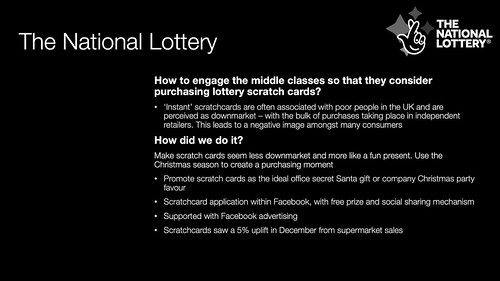
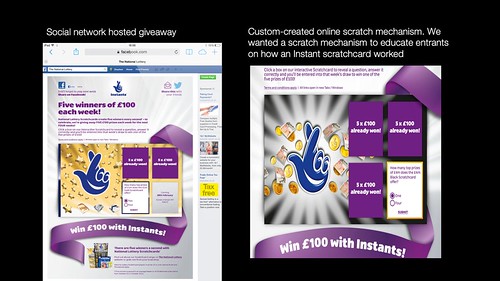
Which took me right back to roughly the same time of the year back in 2012, when I worked at Ruder Finn and did a similar digital scratch card execution to promote The National Lottery scratch cards in the run up to Christmas.
I was fortunate to work with a great creative and technology team: Stephen Holmes and Dru Riches-Magnier on the project. The promotion was executed within a high security environment because Camelot’s IT standards were way beyond what we usually worked with.
Here’s the case study that I wrote up about the scratch card project in my portfolio.
This was the most stressful time I had during my time working at Ruder Finn and one of two high points in terms of the work that we did.
So when I saw the Rakuten Viber execution, I had a deja-vu moment and the epiphany that every old idea is new again.
Strawberry fields forever & the square mile
So how do we get to a point where every idea is new again? Years ago I used to DJ in bars, clubs and parties. A couple of young lads on a music production course saw a record label release one of their assignments to tap into the psychedelia and dance-indie hybrid sound. The record was a cover version of a Beatles track with a Soul II Soul type break beat underneath. It became successful and topped the charts.
There were a surprising number of people who didn’t realise that it was artfully created cover version of The Beatles, I even heard the original described as a poor version of Candy Flip.
Newness is a matter of perspective. This was brought home to me at a talk that Damien McCrystal gave years ago. This was about the time that he was a business columnist at The Observer. I can’t remember the context but McCrystal said that the memory of ‘the square mile’ (think Wall Street in US parlance) was about eight years.
Which was the reason why the 2008 mortgage crash looked eerily like the savings and loans crisis of the 1980s. And that is despite most of the people in investment banks having a passing familiarity of Michael Lewis’ insider account Liar’s Poker which outlined how derivatives fuelled much of the 1980s Savings & Loans crisis.
I got to read it in college, despite having no interest in entering the world of finance. By and large I managed to stay clear of finance aside from being an in-house marketer early on in my career at what’s now HBOS and credit card provider MBNA. I also had a bit of early luck in my career timing, as I left MBNA before the payment protection insurance scandal hit the sector.
This was the classic example of every old idea is new again, but with the added wrinkle that a bad set of ideas can suddenly turn into good ones over time.
But as a strategist, this taught me to be careful on interventions pointing out a given concept is an old idea, given that every old idea is new again at some point.
The racket sport padel seems to have got the zeitgeist, if not the player numbers yet. We haven’t really seen a surge in sports fads since the 1980s. During that time skateboarding rose from a peak in the late 1970s, to a more stable underground sport that we have today. The closure of a squash racquet factory in Cambridge, saw the sport globalise manufacture and playing. In a few short years rackets went from gut strings and ash wood frames to synthetic strings and carbon fibre composite rackets. It was as much a symbol of the striving business man as the Filofax or the golf bag. Interest was attracted by a large amount of courts and racket technology that greatly improved the game.
Squash had its origins in the late 19th century and took the best part of a century to reach its acme in the cultural zeitgeist. Skateboarding started in the late 1940s and took a mere 30 years to breakout. Padel falls somewhere between the two. Padel was invented in 1969. But it took COVID-19 to drive its popularity in Europe and North America.
There is a new world professional competition circuit for 2024. And it has attracted the interest of court developers looking to cater to what they believe is latent consumer demand.
Finally, you can get three padel courts in the space for one tennis court. More on the padel gold rush from the FT.
The challenge is if padel is just a fad, or has it longevity? Skateboarding is popular, but many councils didn’t see the benefit of supporting skate parks built in the 1970s around the country. Squash still has its fans but doesn’t have the same popularity that it enjoyed in the 1980s.
What’s it like being a Disney adult? – The Face – this is much more common in Hong Kong, but then people had annual passes to go there. I found it interesting that The Face othered it as a sub-culture
Vittles Reviews: There Is Always Another Province – Province-chasing isn’t just a Western phenomenon; China is still so vast that when the barbecued food of Xinjiang, one of China’s border provinces, showed up in a former sausage shop on Walworth Road at Lao Dao, it didn’t need to open to the general public for months, choosing only to take bookings via Chinese social media. The paradox is that the success of regional Chinese restaurants has created a Western audience which wants more, but that same success has allowed these restaurants to bypass those customers altogether
Culture
Television: one of the most audacious pranks in history was hidden in a hit TV show for years. – Watch enough episodes of Melrose Place and you’ll notice other very odd props and set design all over the show. A pool float in the shape of a sperm about to fertilize an egg. A golf trophy that appears to have testicles. Furniture designed to look like an endangered spotted owl. It turns out all of these objects, and more than 100 others, were designed by an artist collective called the GALA Committee. For three years, as the denizens of the Melrose Place apartment complex loved, lost, and betrayed one another, the GALA Committee smuggled subversive leftist art onto the set, experimenting with the relationship between art, artist, and spectator. The collective hid its work in plain sight and operated in secrecy. Outside of a select few insiders, no one—including Aaron Spelling, Melrose’s legendary executive producer—knew what it was doing. The project was called In the Name of the Place. It ended in 1997. Or, perhaps, since the episodes are streamable, it never ended
Rode acquire Mackie | Sound On Sound – this is big for podcasters, but also for artists that record in their own studios. Mackie mixers have powered the home grown set-ups of artists like The Prodigy, The Crystal Method, Brian Eno, Daft Punk and Orbital.
Health
China e-cigarette titan behind ‘Elf Bar’ floods the US with illegal vapes | Reuters – In the United States, the firm simply ignored regulations on new products and capitalized on poor enforcement. It has flooded the U.S. market with flavored vapes that have been among the best-selling U.S. brands, including Elf Bar, EBDesign and Lost Mary. In the United Kingdom, by contrast, Zhang has complied with regulations requiring lower nicotine levels and government registration while building an unmatched distribution network — and driving a surge in youth vaping
Hong Kong’s first ‘patriots-only’ district council poll reflects political tale of two cities, as some eagerly rush to vote and others shy away | South China Morning Post – Hong Kong on election day splits into two camps, with one eager to vote out of civic duty and others giving polling stations wide berth over lack of political diversity. ‘I thought more people would come and vote because there has been more publicity,’ one elector says after discovering sleepy atmosphere at local polling station – the question is will Beijing take anything from this voter turn out? Does it signal suppressed but indignant separatists, or Hong Kongers who are more focused on prosperity and weekend Netflix? If they suspect the former then the security situation is likely to get more dire
Inside Louis Vuitton’s Hong Kong spectacle | Vogue Business – While Hong Kong is gradually recovering from the pandemic lockdowns, growth in Mainland China is slowing. According to HSBC estimates, luxury sales there are expected to grow 5 per cent in 2024, a sharp deceleration compared with 2023’s projected 18 per cent.