Category: online | 線上 | 온라인으로 | オンライン

The online field has been one of the mainstays since I started writing online in 2003. My act of writing online was partly to understand online as a medium.

Online has changed in nature. It was first a destination and plane of travel. Early netizens saw it as virgin frontier territory, rather like the early American pioneers viewed the open vistas of the western United States. Or later travellers moving west into the newly developing cities and towns from San Francisco to Los Angeles.

America might now be fenced in and the land claimed, but there was a new boundless electronic frontier out there. As the frontier grew more people dialled up to log into it. Then there was the metaphor of web surfing. Surfing the internet as a phrase was popularised by computer programmer Mark McCahill. He saw it as a clear analogue to ‘channel surfing’ changing from station to station on a television set because nothing grabs your attention.

Web surfing tapped into the line of travel and 1990s cool. Surfing like all extreme sport at the time was cool. And the internet grabbed your attention.

Broadband access, wi-fi and mobile data changed the nature of things. It altered what was consumed and where it was consumed. The sitting room TV was connected to the internet to receive content from download and streaming services. Online radio, podcasts and playlists supplanted the transistor radio in the kitchen.

Multi-screening became a thing, tweeting along real time opinions to reality TV and live current affairs programmes. Online became a wrapper that at its worst envelopes us in a media miasma of shrill voices, vacuous content and disinformation.

  • An odyssey to get online

    I have gone through a number of journeys to get online. This year I will have been connected to the internet for 20 years. I actually had email even longer. Back in 1994, I was working on a temporary contact at a company called Optical Fibres – a collaboration between Corning and UK cable maker BICC. Even back then there was price pressure on optical fibre as globalisation kicked in, less than a decade later where I worked is now a greenfield site, half of which is included in the space for expansion of a Toyota engine factory.

    I had an email address that was a number.
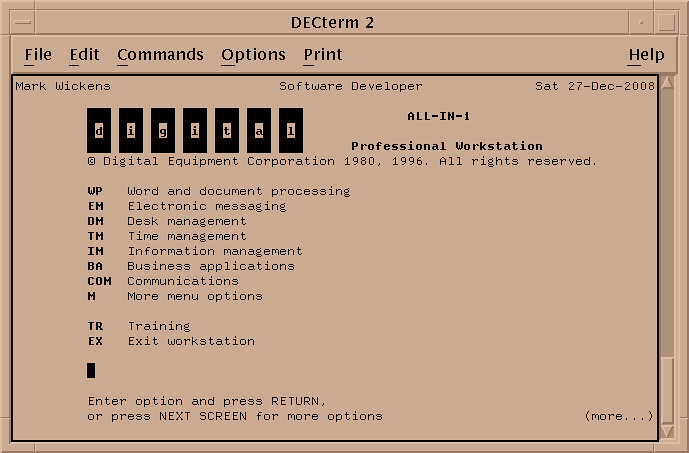
    DEC ALL-IN-1
    It was attached to a DEC VAX ALL-IN-1 productivity suite account. I was able in theory to email anyone who worked at Corning sites around the world. But email was my only form of being able to get online..

    While ALL-IN-1 was able to support external (pre-internet) email networks like CompuServe, I only dealt with people internally. It was a step up from having to check the pinboards in communal areas and the sporadic internal mailroom deliveries.

    Having managed to get online, I sent my first spam email, when I tried to offload some Marks and Spencers vouchers that I had been given on to my colleagues, but that’s a story for another time.

    In September that year I went back to school, this time to university. Computer labs had changed a bit in five years or so since I left secondary education. The computers were on an ethernet local area network, this local network was connected to the nascent internet.

    I had an email address with a ‘@hud.ac.uk’ domain, but my name was still a number. My teachers didn’t use email as part of their teaching process then and you couldn’t submit your work via email. Email was a POP3 format. Given that it saved emails on the machine I spent an inordinate amount of time getting my own computer up for running on the college facilities against the rules.

    It involved a mix of software and hardware kludges, since I had to make use of the AppleTalk port on the laptop to somehow connect to the ethernet network at college.

    Internet access at college was quite liberating. I was able to do online research and cite online articles. I kept in touch with a couple of friends at college and university from home who also had email at the time: for free.

    I got a Yahoo! email address during my last year of college so that I had something which would last me beyond graduation.

    My year after graduation was largely lacking in connectivity. I hunted around for an cyber cafe which were starting to crop up around the place. I eventually found one around the corner from James Street station which I used to go to with my friend Andy on a Saturday. I would bring a floppy disk with my CV on to reply to a series of job ads from The Guardian, PR Week and Campaign. I showed Andy how to use Netscape during this time.

    The cafe atmosphere and dedication to good coffee was reminiscent of independent cafes today in London, I remember seeing a couple of multimedia art exhibits there occasionally – this was back when Flash was bleeding edge and promised a whole new world of visual stimulation.

    A move to London meant around the clock access to the net through work. I lived in a house of five Serbs and no phone line and smartphones were HP personal organisers that allowed you to clip a Nokia 2110 on the back or an infra red connection between an Ericsson SH-888 phone and a laptop or early PalmPilot device.

    I built up a collection of early house music sets encoded in Real Media files from an FTP site in Chicago hosted by the people who ran what become Deephousepage. At the time they used a faculty account at the University of Wisconsin-Madison, which would have provided high quality free hosting.

    A lot of this material was legendary to me, only a small amount of it made it on cassettes as far as Liverpool in the late 1980s. 1980s Chicago was as distant to me as the Northern Soul scene in Wigan some 20 years previously.  My FTP client would run at work during the weekend, I would bring in a CD-R and get it burnt down during the week. I also did the same for the latest software that I used on my Mac.

    After 18 months of shared housing, I bought my own place to the north of London in the Home Counties, nothing fancy, but it was my own space and I could finally have a phone line. At this time, Freeserve was offering fixed price connectivity dialling into a free phone 0800 number. And I had my first email account at home.

    I had a Palm Vx PDA which allowed me to sync web content on to the device and read it on the way home .

    I moved job, wasn’t that keen on it and started to think about what was next and getting ready to potentially go freelancing.
    Jaguar
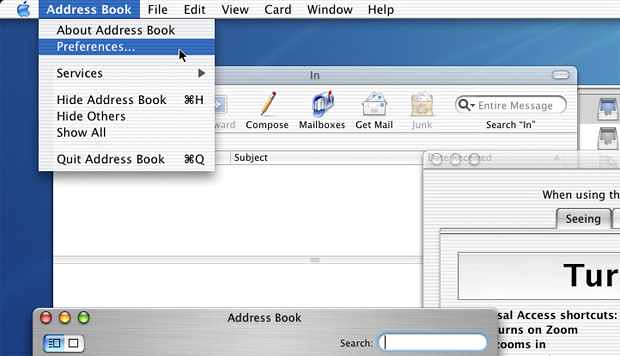
    The economy went into dot.com freefall and I finally upgraded my computer to a second generation iBook. I then upgraded that machine to OS X and the new operating system highlighted to me the need to go and start using internet broadband. Freeserve was my first choice of DSL provider, simply because it was easy to upgrade from my dial up connection.

    The internet suddenly started to become much more useful. Yahoo! Messenger and email kept me connected to my London-based friends when I walked out of the agency role I had into the world of freelancing.

    Around this time, I got my first smartphone, a Nokia 6600. I had tried using my Nokia 6310i phone as a wireless modem for my Palm PDA but it was a painful process. What moved things forward was the IMAP email account I got as part of Apple iTools. IMAP allows email to be synched across different devices.

    This was all still done over GPRS and later EDGE. 3G services were limited, crippled and the network reception was awful – truth be told it still is in many places. Truth be known things have improved incrementally.

    I went through a succession of Palm Treo and Nokia Symbian smartphones until finally moving to the iPhone. The killer application was an address book that just worked rather than corrupting my data or bricking the handset.

    Whilst the first five years I saw big changes in my wired netizen status, over the past five years my connectivity has changed little if at all. The key change being an iPad at home as an additional mode of access. I still use DSL, mobile internet which is patchy and upgraded equipment around the same essential paradigms. More online related content here.

    More information

    Quick History of ALL-IN-1 | Email Museum

  • The silent majority of social

    The silent majority as a concept was introduced to the world by Richard Nixon in a speech about America’s position in Vietnam on November 3, 1969.

    1969 Official Visit Of President Richard Nixon To Saigon


    The portion of the speech that featured it is below:

    Let historians not record that when America was the most powerful nation in the world we passed on the other side of the road and allowed the last hopes for peace and freedom of millions of people to be suffocated by the forces of totalitarianism.

    And so tonight-to you, the great silent majority of my fellow Americans-I ask for your support.

    I pledged in my campaign for the Presidency to end the war in a way that we could win the peace. I have initiated a plan of action which will enable me to keep that pledge.

    Nixon’s ‘silent majority’ reference tapped into a tenet of common wisdom, that the majority of the population is generally passive in actions and discussions; a positive spin on Juvenal’s concept of bread and circuses or panem et circenses. He used the phrase to decry the selfishness of ordinary Roman citizens, their neglect of wider concerns and likely lack of civic duty.

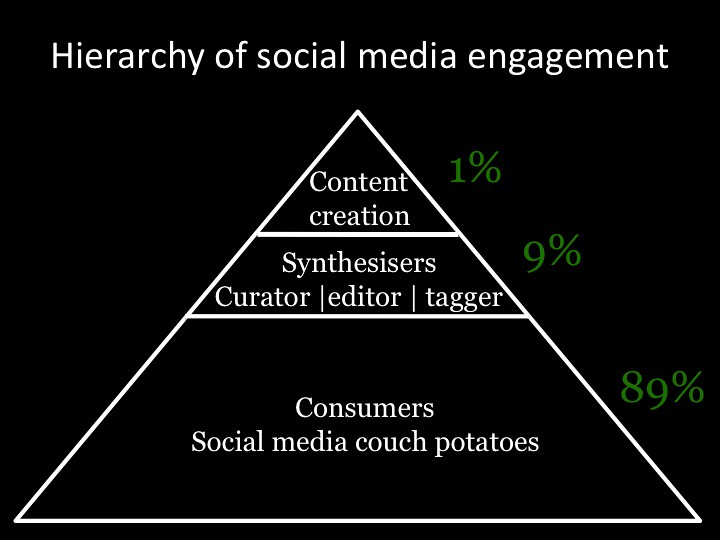
    There is a similarly silent majority today online, in spite of the democratisation of publication via social channels. A small proportion of us publish. I got the model below from Bradley Horowitz at Yahoo! but I am sure it came from someone earlier and it still holds true today
    hierarchyofsocialmediaengagement
    What this means is essentially two things:

    • Whilst the volume of social postings continues to go up, it still represents a small amount of the general population and even the online population. Most of the people, most of the time are passive consumers of social content
    • When people do post content, it isn’t generally about brands or important issues, but about being with their friends or family. They look inwardly on their lives

    Social conversation is often the province of the highly connected, the verbose and of polarised opinions (complaining about a product that really got under their skin with poor performance or fanboydom).

    Ironically search data probably tells us more about the population in general, the problem that search presents marketers with is quality of data. The major search engines (Google, Bing/Yahoo!, Yandex) no longer provide web sites with the details of the search term used to arrive on a given site as they have defaulted to HTTPS.

    Google Trends has decided to give ‘real-time’ data rather than the few days delay it previously provided on search terms. Google Trends doesn’t provide search volumes, but search ‘rate of change’ which means that static low or high search volumes won’t register. But its the closest we have online into easily understanding the nature of the silent majority of social; what they are interested in and care about.

    More online related content.

    More information
    Nixon’s ‘Silent Majority’ Speech
    Google Trends Now Shows the Web’s Obsessions in Real Time | WIRED

  • Prada ‘it’ bag + other news

    Prada ‘it’ bag

    Here’s Prada’s New ‘It’ Bag, the Inside – Racked – interesting that Prada is trying to design itself out of its current financial slump due to low demand in Asian markets. Part of the problem that Prada has is retail presence, the poor experiential aspects of the brand and the ease of faking Prada products, especially Prada Sport products. More luxury related posts here.

    Ethics

    The “dreams” of Google’s AI are equal parts amazing and disturbing | Quartz – I can see this taking the place of fractals and stereographs in culture

    Class ceiling? City firms enforce ‘posh’ hiring test | CNBC – and this is news because? It’s been this way for decades

    Gadget

    Apple TV’s 4K Future – I, Cringely – interesting data around bandwidth requirements. More gadget related posts here.

    How to

    Google Trends Now Shows the Web’s Obsessions in Real Time | WIRED – absolutely huge for marketers and PRs

    Luxury

    Montblanc touts adventure with elaborate video campaign – Luxury Daily – interesting how this links back to sales

    Media

    Introducing autoplay video and a new standard for viewability | Twitter Blogs – because consumers want auto-playing video ads (NOT). This is going to be as annoying AF, I am surprised that Twitter learned the wrong lessons from watching Facebook

    Online

    Facebook Moments App Helps Users Swap and Organize Photos | SocialTimes – interesting expansion of Facebook’s app constellation into pictures

    Security

    Why Facebook’s New Photo App Isn’t Coming Out in Europe | TIME – creepy facial recognition technology

    Software

    Android-based Huawei smartwatch delayed in China due to ban on Google services | South China Morning Post – at the moment Huawei doesn’t have an alternative to integrate with, but that may change (paywall)

    Web of no web

    China’s NetDragon makes bid for Promethean World to widen its compass in online education | South China Morning Post – really interesting acquisition. Online games to smart boards (paywall)

  • China bubble + more things

    Stand Back: China Bubble Will Burst – Bloomberg View – I don’t think it will go pop, though it will correct, probably not this year. The China bubble has become an existential threat to global markets, because of the scale of the China bubble. At the end of the day, China’s retail investors are starved of investment opportunities, that is one of the factors driving the China bubble and it won’t change suddenly. More finance related content here.

    Apple News curation will have human editors and that will raise important questions | 9to5Mac – big implications for PR news stories and media exposure

    Western Firms Caught Off Guard as Chinese Shoppers Flock to Web – WSJ – over estimated bricks and mortar sales, but also resurgent local brands utilising online channels

    WSJ moves to a single global edition | Marketing Interactive – higher stakes for PR people and advertisers

    White hackers in China young and underpaid | WantChinaTimes.com – explains motivation for black hat activity beyond the intellectual challenge

    [WATCH] Google’s Amazing Location-Aware Search Finds Answers About Nearby Places – not terribly surprising definitely the direction that Google and others have been looking to go with location as a context to user intent in search for a good while

    8 Smart Folders You Need on Your Mac & How to Set Them Up | Makeuseof – handy way of getting organised on the Mac

    Alice Rawsthorn on the pros and cons of new digital interface design | Putting People First – interesting as it touches tangentially on dedicated purpose design and the faults of icons under glass and digital menu driven design

    Paul Ford: What is Code? | Bloomberg – interesting long form article

    Exclusive: Facebook earns 51 percent of ad revenue overseas – executives | Reuters – Facebook using specific methods tailored to the country including optimizing video and pictures for slower connections in India, where an ad product called “missed call” also helps customers avoid phone call charges. Many people in India dial a friend and hang up to send a signal without incurring charges. Facebook incorporated this system into its ads. A person can place a “missed call” by clicking on a mobile ad from Facebook and receive a return call with information, for example the score of a cricket game, sponsored by a brand.

    LG G4 Teardown – iFixit – beautiful inside and out reminds me of the Mac design approach

  • Yahoo Q2 2015 progress report on product prioritisation

    With the Yahoo Q2 2015 progress report on product prioritisation  – Yahoo! published a list of properties that it was closing down and services that it was changing support on over the next few months. Most of the coverage amongst the people I follow has been around the shutdown of Yahoo! Pipes, as despite its flakey behaviour it was tremendously useful for putting together cheap, fast services to help with social media monitoring. I ‘built’ monitoring pipes for the likes of Microsoft and AMD after I had left Yahoo! that included careful key word filtering. This allowed them to take this feed and syndicate ‘good’ news machine translated into different languages on different micro-sites. This ‘Pipe building’ process took just a few hours.

    My friend Mat Morrison had put it up to much more inventive uses.

    Yahoo! Pipes, like the Fire Eagle location service came out of a golden age of web development. An influx of talent into the business like Bradley Horowitz, Simon Willison, Stewart Butterfield, Tom Coates and Joshua Schachter brought with it a web 2.0 philosophy of data being:

    • Portable – consumers could back up their own data at any time, or use it to move to a rival service. In stark contrast to the Facebook and WeChat walled gardens of today
    • Data is to be manipulated – data could be overlaid or processed through other services, like crime data on maps, or Pipes

    But enough eulogising; Pipes was an interesting idea that never got the support from consumers or Yahoo! that it needed. The service was flakey at times, if it was a car it would have been a late 1970s/early 1980s vintage Alfa Romeo or Lancia – it was that bad. It is obvious from the Yahoo! Pipes blog that it has been in a mode of minimal maintenance for years – the last post prior to the shut down notice was posted in 2012 to outline a work around from Yahoo! shutting down its Babelfish translation service (which was originally on AltaVista.com in the late 1990s and relied on technology licenced from Systrans).

    Lets look at some of the other services that Yahoo! has sunset this time around.

    The market specific services are interesting, as they paint a picture of Yahoo! under-performing across international markets and in sectors where it previously had a strong advertising offering. Take the cars section across the main European markets, looking at the UK offering – there is no page takeover by a car brand, there is no sponsored content and there is two banner ads (one for AutoTrader, one for BSkyB), one tiny rich content ad at the bottom of the page for the new Terminator film and one re-targeting module. If this is an indicator of what other European markets are like then automotive advertising at Yahoo! Europe is in a bad way.

    TV and film properties have little to no ads on the front page, again no takeovers or sponsored content. So Yahoo! seems to be struggling with getting advertising spend in two key sectors.

    If we go to Asia, the move out of the Philippines is particularly interesting, presumably driven by advertising opportunity – or the lack there of. But when you look at the economic indicators of the Philippines, there is a consistent growth predicted in retail sales according to Statista
    philippines retail sales

    According to Ken Research, the Philippines online advertising market grew with a compound annual growth rate (CAGR) of 43.4% during the period 2008 – 2013 and is predicted to grow almost 15% CAGR between 2013 and 2018. E-tailing is expected to grow by 101.4% CAGR over 2013 – 2018. So why is Yahoo!, which has been established in the Philippines unable to capitalise on the in-market growth. Is it that Yahoo! sees ways to earn more money elsewhere and the opportunity cost is too high in the Philippines, or is it a broken advertising sales machine?

    The closure of Yahoo! Entertainment in Singapore is more curious as Yahoo! still manages to get advertising from major brands. As I write this Oreo has a full page frame running and there is a dynamic banner by group shopping site Qoo10.

    Yahoo! Mail and Contacts support of older Macs and iPhones. I was surprised that these were called out. Yahoo! Mail is depreciating support for devices running iOS4 or older and running the native mail application. A couple of things here; given Apple’s expertise at upgrading iPhone users speedily why would this even be an issue?

    Secondly,  why does Yahoo! need to make a special effort to support accounts that were presumably using POP3 or IMAP email standards? The webDEV standard would make a similarly curious point about Yahoo!’s depreciation of support for contacts on a Mac running OS X 10.8 and earlier. It just doesn’t make any sense to me.

    Former CEO, Carole Bartz famously said of Yahoo! that you can’t cut your way to growth. So what do these ‘product updates’ say about Yahoo!? Over the past two years prior to this update, Yahoo! has already closed over 60 services, where does it all stop? More technology related content here.

    More information
    Q2 2015 Progress Report On Our Product Prioritization | Yahoo! Blog
    Pipes End-of-life Announcement | Yahoo Pipes Blog
    Q4 2014 Progress Report | Yahoo! Blog