The online field has been one of the mainstays since I started writing online in 2003. My act of writing online was partly to understand online as a medium.
Online has changed in nature. It was first a destination and plane of travel. Early netizens saw it as virgin frontier territory, rather like the early American pioneers viewed the open vistas of the western United States. Or later travellers moving west into the newly developing cities and towns from San Francisco to Los Angeles.
America might now be fenced in and the land claimed, but there was a new boundless electronic frontier out there. As the frontier grew more people dialled up to log into it. Then there was the metaphor of web surfing. Surfing the internet as a phrase was popularised by computer programmer Mark McCahill. He saw it as a clear analogue to ‘channel surfing’ changing from station to station on a television set because nothing grabs your attention.
Web surfing tapped into the line of travel and 1990s cool. Surfing like all extreme sport at the time was cool. And the internet grabbed your attention.
Broadband access, wi-fi and mobile data changed the nature of things. It altered what was consumed and where it was consumed. The sitting room TV was connected to the internet to receive content from download and streaming services. Online radio, podcasts and playlists supplanted the transistor radio in the kitchen.
Multi-screening became a thing, tweeting along real time opinions to reality TV and live current affairs programmes. Online became a wrapper that at its worst envelopes us in a media miasma of shrill voices, vacuous content and disinformation.
Perfect Porsche? This British-built 911 restomod comes close : CityAM – the idea of the perfect Porsche is contextual and highly personal. I would prefer a car that looks like an early air-cooled car, with no aerodynamic spoiler or flared arches and Fuchs wheels. There are a number of vendors doing a restomod 911. US company Singer is probably the most famous with its muscular looking restomod 911 models. In the article, there is a particularly interesting bit is about the redistribution of parts and lightweight replacement parts in the 911 restomod by Theon Design.
Chinese censors take aim at former premier Wen Jiabao’s essay | Financial Times – really interesting that this appeared in a Macao publication, like it was designed to give it a few days out there. Wen was generally a bit more soft-hearted than Hu when the two were in the politburo. And Hu was moderated by the committee approach of the politburo. Xi had learned from Bo Xijlai that populism and nationalism worked and has a hawkish view that is untempered by the politburo.
China’s keyboard warriors like to fight . . . each other | Financial Times – China’s grassroots nationalist bloggers seem less like that unified “main force” than dispersed militias which argue with one another as much as they do with external enemies. “The difference between Chinese nationalist factions is probably bigger than the difference between all of them and an American patriot,” says one Beijing-based blogger who is researching a book on Chinese internet culture. And while the CCP’s professional trolls may generate reposts and likes, “volume is not influence”, he adds – interesting article. I keep thinking about how different red guard groups used to fight against each other during the cultural revolution
Design
Trapped on Technology’s Trailing Edge – IEEE Spectrum – Repairing the system entailed either redesigning a few circuit boards and replacing other obsolete integrated circuits for US $21 million, as the B-2 program officers chose to do, or spending $54 million to have the original contractor replace the whole system. The electronics, in essence, were fine—they just couldn’t easily be fixed if even the slightest thing went wrong. – which makes me wonder about the internet of things.
Luxury
Why Chow Tai Fook sees opportunity in rural China and lower-tier cities | Marketing | Campaign Asia – Surrey Pau, deputy general manager of Chow Tai Fook Jewellery Group, responsible for market expansion, explained how and why the brand intends to seize opportunities in China’s fourth-and-fifth-tier cities, despite a natural bias in the sector towards selling luxury items to tier-one markets. Charts comparing urban (blue) and rural (yellow) growth rates Growth in rural China “Some people believe that in rural areas you don’t have much of an income, that you rely heavily on agriculture and have a very simple economic structure,” Pau said. “However we believe that is just a myth.” Comparing household consumption and spending trends in rural and urban areas, Pau sees the countryside soon catching up with cities, helped by government support to rural areas. And along with higher incomes, the brand is seeing people shift to devoting more disposable spending to lifestyle improvements, including cosmetics and jewellery. The other macrotrend is the massive rise in ecommerce spending. And thanks to recent infrastructure investments in new networks, the digital playing field has been levelled to a great degree in China – I don’t think that there’s the growth in Chinese lower tier cities and rural areas that Chow Tai Fook thinks
Marketing
6 Elements Of Digital Brand Dominance | Branding Strategy Insider – The old adage “stick to your knitting,” for example, a colloquial version of “build on your core competence,” tends to narrow a company’s imagination. Yet a bold imagination is a requirement for leaders today. Netflix, Amazon, Facebook, and Google would not be what they are if their CEOs and executive teams had not imagined a future that did not yet exist. – but do these businesses also suffer from a lack of focus and a conglomerate discount at some point?
Nano-influencers – those with 1,000 to 5,000 followers – had the lowest proportion of fraud, occurring in 42 per cent of accounts. The most common tactics used included buying followers, likes and comments from click farms, buying story views, and engaging with comment pods – where a group of Instagram users get together and systematically engage with each other’s posts
Lycamobile names CEO to lead digital push beyond expatriates | Financial Times – they’ve tried to do this previously. Lycamobile was usually the first SIM that EU migrants got to establish themselves in the UK. They then moved on to domestic aimed products. Brexit has made this move a life or death struggle now
Back in 2005, I worked in the search group at Yahoo!. One of the projects that I worked on was Yahoo Answers. 16 years later, Yahoo Answers is being closed down. I thought I would capture some of my memories and inside knowledge on Yahoo Answers.
But first we need some context so that what I write later about Yahoo Answers will make sense.
The beginning
Let’s go back to the beginning. Back to the early-1990s. Jerry Yang and David Filo founded Yahoo!. It fits the classic Silicon Valley archetype story and you can find plenty of accounts of it elsewhere. The key is what Yahoo! originally was. Its a list of links for websites. Once the list grew above 200 links or so; Jerry and David came up with a way of displaying this list by grouping it into subject areas.
What would later be called a web directory. There were other directories around about this time like:
Netscape Communications had their own directory when they acquired Gnuhoo, this eventually became DMOZ and then Curlie. Gnuhoo did rely on a search engine to help you find things in their directory. This is available as open source code at GitHub
All of them had a certain amount of editorial input over what was good. Yet Yahoo! became the top one through buzz marketing – cheap ways to do brand building.
When I was there, I worked with an agency to organise event hijacking at the Harry Potter and the Half Blood Prince book launch at Waterstones flagship store on Oxford Street. Yahoo! would vinyl wrap any employee’s car for free. There were also strategically placed billboards, such as this one in San Francisco.
People who managed this directory were known as web surfers. But there was also search engines out there, like the Knowbot search engine for Telnet developed in the late 1980s. There was Archie which was the closest to what we think of as a search engine now. Archie searched FTP archives around the world.
As computer science post-grad students, Filo and Yang would have been familiar with the idea of the search engine. At the time David Filo felt that no machine would provide better filtering than a human. Media accounts of the time showed that Silicon Valley venture capitalists were all in favour of search engines over directories.
Peer companies like:
Webcrawler
Metacrawler
Lycos
Ask Jeeves
Infoseek
Excite
AltaVista
All offered what we’d recognise as reasonable search experiences. But Filo’s comments on human filtering is something that we will revisit later.
Web portal & web advertising
Search engines were the future but as the dot com era took off it wasn’t apparent how to monetise them.
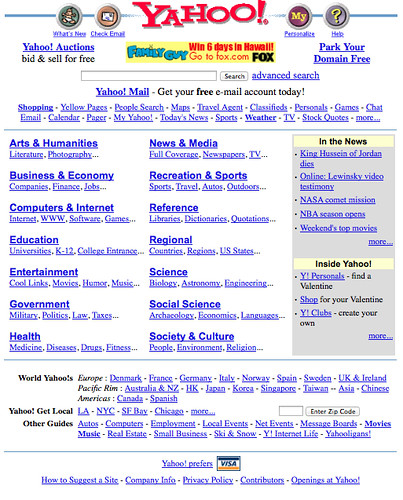
Yahoo! home page early on the morning of March 3, 1999
At the height of the dot com era; Yahoo! had about 40 million users a month. You have to remember there weren’t that many people online in comparison to now. Internet usage had grown from 45 million users in 1995 to over 410 million by 2000. At the time it didn’t seem to matter that Yahoo! took longer to load as a website compared to its peers. Longer page times, meant that you could get away with less equipment in your data centre hosting the website and supporting infrastructure.
The internet didn’t give birth to culture in the same way that memes, influencers and platforms do now. Instead it was the meme. It was all over the mainstream media, often tied up with ideas of cyberpunk culture, bulletin boards and the ‘information superhighway’. Examples of this included:
The Site by MSNBC
The i in iMac was for internet. The idea was that you could take the computer out of its box, plug it in to your wall socket and telephone socket. When you turned it on, it would configure you an internet service. The cool product design was a byproduct of this internet appliance plus personal computer thinking
Movies: The Lawnmower Man, Hackers, The Matrix, Ghost In The Shell
Books: Snow Crash, William Gibson’s Neuromancer
A plethora of internet magazines, including Ziff-Davis’ Yahoo! Internet Life which was a mix of technology and gadget reviews, media and celebrity content and website recommendations. Yahoo! Internet Life was published from 1996 to 2002
It felt like something big was going to happen, even if we didn’t know what it was. What was obvious was the potential for advertising online. And the clearest analogue was newspaper advertising due to the long page format of web pages.
Web portals came about for a number of reasons:
There was now the technology to pull content from different sources together. You would have:
Weather forecast
Horoscope
Up to date news
Local information (for major cities like San Francisco)
Business
Finance
Entertainment and celebrity news
Like the newspaper before it, it offered the first media you needed, but on the web.
It was mainstream enough for brands to advertise against for brand building.
By the time I was leaving college, Yahoo! Mail accessed through the Yahoo! home page made perfect sense.
So before the dot com bubble bursts Yahoo! had a major media business valued at 2.8 billion dollars, or about $70 dollars per user. Which sounds expensive, but when you consider that Google is now worth about $386 per user, it’s not that bad. Secondly, online advertising per impression was much more lucrative back then and ad fraud was much less of an issue.
What there wasn’t was a way of taking advantage of the highly relevant search results provided by search engines and adequately monetising them. So companies had three ways of monetising search:
Companies created portals the so called ‘homepages of the web’ to put display adverts on like My Yahoo! or MSN.com and search was a service alongside news, weather and horoscopes
They became infrastructure companies selling search functionality in the background a la Inktomi
They sold inclusion in their directory. This was controversial as it went against the editorial integrity of the directory and still a hot button when I arrived at Yahoo! in 2005
The bubble bursts
In the US stock market we had was now known as the internet or dot.com bubble. Looking at the NASDAQ composite data, it seemed to start in the last quarter of 1995, six months or so before Yahoo! went public in April 1996. It reached its nadir in the last quarter of 2002.
In reality, this was more than about websites. Telecoms deregulation, satellite networks and the rise of cellphones had seen a boom in new companies and network equipment providers to support them. The need for servers had created booms in:
Computers: SGI, Sun Microsystems and IBM
Networking equipment: US Robotics, 3Com, Cisco
Software: VA Linux, RedHat, Open Text
Software as a service: I2, Salesforce, NetSuite
Web hosting and ‘data hotels’: Equinix, Intel, Rackspace, PSINet
Telecoms and ISPs: Level3, Global Crossing, Earthlink, Iridium, GlobalStar, AOL, @Home Network
NASDAQ composite index covering the dot com boom and crash
Add into that artificially high growth in earnings for enterprise IT companies in the run up to the Y2K bug issue and the whole sector was left with a bad hangover.
Eric Steiner tells his tale as the CEO of Inktomi in 2004
Steiner’s talk is interesting because it shows how the search business, selling search capability to the likes of Microsoft, Amazon and eBay had slow and steady growth rather than outstanding growth during this time.
Yahoo! went through a traumatic time. When I worked at Yahoo! Europe, I was told online advertising sales dropped to a third of what they were during the dot com boom. The European business managed to hold on by its finger tips thanks to revenues from online dating services.
Some of the ‘smart bets’ Yahoo! made during the boom times looked like hubris. The exemplar of this was Yahoo!’s acquisition of Broadcast.com. Broadcast.com provided video streaming (then called web casting) and internet radio services. It was the technology partner for the first online Victoria Secret Fashion Show streamed online. Yahoo! acquired it for 5.6 billion of Yahoo! stock. This was a bad decision, but thankfully, they didn’t pay cash.
When I joined Yahoo! the Broadcast.com acquisition was still a scar on acquisition decision-making. You can attribute the impact of this to subsequent failed purchases of Google and Facebook.
GoTo and Google
In 1998, the company GoTo.com launched paid advertising placement in search engine results. The next year they introduced real time bidding. It was renamed Overture and started providing these services for Yahoo! and others. It started to become successful as a business.
Meanwhile, Google had moved from a research project to a serious search engine. In 2000, Google began selling advertisements associated with search keywords. This was against Page and Brin’s initial opposition toward an advertising-funded search engine, they saw themselves more as a ‘search appliance’ business rather like Inktomi. Yahoo! adopted Google search around about the same time that Google started its search advertising business.
This put Google in front of a large number of consumers and helped Google further refine its search engine.
Google’s own offering was the exact opposite of Yahoo!. It prided itself its clean design with just a search box. Google also had a fanatical obsession with reducing page load times and the time taken to return search results.
This was what more and more people wanted. Google used the dot com crash to build its business and its infrastructure. It wasn’t until its 2004 IPO that rivals realised how much of a head start Google had.
Google revolutionised data centre server design, reducing cost and increasing the amount of servers that it could use. By contrast every Yahoo! data centre hardware purchase went via David Filo. If you used Yahoo! small business hosting, you were using tired and almost expired Yahoo! servers. In retrospect, they looked after the datacentre pennies, but let the pounds slip away.
2003 saw Yahoo! get serious about the search engine business. The company purchased Overture which included GoTo.com and Altavista. But the problem was that even if Yahoo! built a search engine as good as Google, it didn’t matter if people didn’t use it. During my time at Yahoo! there was a push to get the necessary servers in place and a product that was as good as Google. However there was a constant tit-for-tat feature development in the search space. By this time Google had already verbed. The Google habit means that its hard to compete against them.
I heard that inside Microsoft they tried to take drastic measures to persuade employees to use Bing over Google. When I worked at Yahoo! people used Google a lot too.
The only way to compete with Google was to have a different idea. Google defined its mission is to organize the world’s information and make it universally accessible and useful.
Yahoo! needed a new idea that was distinct from Google’s mission. The idea was knowledge search.
Knowledge search and Yahoo! Answers
Knowledge search as a concept was well under way by the time that I arrived. It was to capture and make searchable all the ‘knowledge’ (rather than information in the world). Opinions, experience and recommendations are knowledge rather than information. Yahoo!’s web 2.0 acquisitions including Flickr and delicious were made to support this vision.
Tagging built up words and associations with web links and images, effectively human filtering – some of which would be used to train machine learning algorithms. The next logical step would be to build a repository of knowledge by the people, for the people. That’s where Yahoo! Answers came in.
The inspiration for Yahoo! Answers came from a product that Yahoo! Taiwan had rolled out. It in turn probably inspired by Korean site Naver Knowledge IN. Bradley Horowitz apparently claimed that Yahoo! Answers was inspired by Naver Knowledge IN directly.
Knowledge IN was designed to encourage user created content, since there wasn’t much material on the Korean web at the time.
When I heard Jerry Yang talk about it internally at the time, he talked bruskly about a product built by Yahoo! Taiwan as having inspired it. Jerry didn’t do jet lag well and came across as morose on the couple of times I saw him in Europe, so wasn’t exactly an effusive speaker.
Yahoo! Answers was championed by Jerry and that blessing allowed it to be pushed through when so many other product died before they got pushed to beta. It makes sense to point out the human crafted nature of Yahoo! Answers. In this respect it can be seen as a direct line back to the original Yahoo! directory product. Both were fuelled by a belief that people had some ability that was better than machines.
Qi Lu was responsible for new products within the core search business and the troubled Panama search advertising project at the time. Weekly conference calls saw a plethora of existing projects cancelled, or reprioritised by Qi Lu, while new ones would suddenly appear. This constant change in the roadmap mean’t a lot of wasted efforts.
Yahoo! Answers and much of the knowledge search related acquisitions sat under Bradley Horowitz. Tim Mayer was focused on the commercial side of things, although there was some overlap in the roles. Eckhart Walter sat above Tim. Jeff Weiner was the main shot caller having both Search and Marketplace businesses reporting into him. If you’re thinking, that’s a lot of senior management involved. You’d be right, there were a lot of managers with varying degrees of responsibility involved.
But they were all good people and I’d be happy to work with them again.
Prior to Yahoo!,I had been working agency side for Transversal. Transversal powered the support functions for a number of companies including Sony Playstation. I had a good idea how much this service was priced and floated the idea of sponsored channels for instance around Sony Playstation and had a good idea how much Sony must be paying to support user troubleshooting.
But it didn’t fit that well as an idea with knowledge search.
Concerns and how is babby formed?
In the European team we had some concerns about Yahoo Answers like how was it going to get monetised? The quality of the content was also a concern. Knowledge IN and similar services in Asia work partly due to culture. We were worried when it hit a more individual-focused culture like the US or Europe.
Another problem was calibrating the rewards within the system. Its really hard to get the balance on good quality questions and answers. Generally people who are time rich, aren’t necessarily the best respondents. If you need one proof point to show how much of a failure this was, you only have to look at the how is babby formed? meme.
Rewards aren’t the only problem however. The second issue was the way the community was built. Generally, a great community is built carefully from like-minded people. With flickr it was around the passion of photography. Facebook is actually closer to Reddit, built on groups of groups. The death of a group dynamic won’t necessarily kill the platform.
I was involved in early seeding of the initial content on Yahoo! Answers. I answered 42 questions, the first one question I answered was ‘What to take from airport to downtown Munich?‘ My response: The taxi is reasonable, it cost me 30 Euros – which shows the contextual nature of knowledge search. 30 Euros was reasonable for me at the time, since I could expense it back, but it wouldn’t be reasonable for a backpacking traveller.
I also wrote six questions, the first one was ‘Has anybody got a Pentax K100D, if so what do you think of it? What are its pitfalls and what aspects of it do you particularly like? I wanted to get a a bit more colour beyond the reviews I’ve read online. – I was getting ready to leave Yahoo! and was going to buy a DSLR camera to take better pictures on my Flickr account. I deliberately structured the question to get opinions from early users. The Pentax K100 had recently been launched.
Careful community management is at odds with a platform trying to capture the world’s knowledge. So the Yahoo Answers community was built for rapid global user growth. For the English language versions at least, there was a global content index, sitting on top of a distributed Oracle database.
This meant a clash of cultures and variable quality content. I quickly found the site unusable for productive questions. Yahoo! spent the next few years trying to perfect it. People that formerly worked on Yahoo! Directory and front page brought their content and editorial skills to bear on Yahoo! Answers.
I suspect that trying to monetise the service would have been a constant challenge. Yahoo! Answers provided variable quality answers for children’s homework and was the butt of memes. Neither of which are an ideal recipe for the kind of content large brands like Procter & Gamble would want to put their name against.
Quora’s lean pickings
Google tried to do it better with Google Knol and also failed.
Quora was formed in 2009 and managed to build a better community, but I’ve still seen a steady decline in the quality of their answers. In 2019, they had a user base of 300 million people and total revenue (from advertising) of 20 million dollars. Thats an ARPU of 6.6 cents. That’s not a good internet media business. From that 20 million, they need to pay their infrastructure costs, maintain and improve the product, pay the salaries of their 300 employees. And I haven’t even talked about how their investors must feel.
Knowledge search is still a technology challenge waiting to be conquered.
How Lee Dunne challenged the depiction of working-class mothers | RTÉ – I originally didn’t know Lee Dunne as a novelist. Instead he was part of my childhood. Lunchtime listening when I wasn’t at school was Harbour Hotel, a radio soap opera written by Lee Dunne that gave a good sense of everyday life. The graininess of listening to the show on medium wave added to the experience. Dunne wrote each episode a bit like Roshomon, with each character talking about an event (like an argument) from their perspective. RTÉ’s obituary also focuses on Dunne’s social commentary literature that was banned by the Irish government in the 1960s through to the mid-1970s. Lee Dunne like James Plunkett wrote about the everyman. Plunkett’s work differed from Lee Dunne in that it had more of a socialist tenor to the content. Lee Dunne had particular success with his 1969 novel Goodbye To The Hill, more Ireland related content here.
Beauty
Shu Uemura to Exit Korean Market | BoF – Shu Uemura, a Japanese beauty brand owned by L’Oréal, is exiting the South Korean market in September after 16 years. While some speculate this is due to Korean consumer boycotts of Japanese products that began in 2019, L’Oréal states the withdrawal is part of a strategy to optimise its brand portfolio and respond to local market demand. Another contributing factor is likely the intense competition within the Korean beauty market. Shu Uemura currently operates over 70 outlets in the country.
NewNew™ on the App Store – god this dark. In th sage words of Matt Muir – how else do you describe a new app, with significant VC funding, whose main purpose seems to be to allow ‘creators’ (we’ll come back to that word) to earn money from their ‘fans’ in exchange for letting said ‘fans’ determine the course of their life, in some sort of modern, ersatz version of The Diceman?
How China’s online hate campaigns work – Protocol — The people, power and politics of tech – In today’s China, a nationalist campaign involves something far more complex than paying people to post scripted messages parroting Beijing’s line. The government has mastered the craft of influencing people’s genuine emotions and having these ordinary users do the trolling and doxxing — for free. Oftentimes, this means appealing to misogyny or chauvinism, something that virtually guarantees more clicks. Many videos and articles attacking Xu have tried to paint her personal life as promiscuous and delinquent. Web users have frequently called Xu a “female Han traitor,” a dog whistle that conflates concepts of chastity and national loyalty
How China structures loans to become Africa’s “preferred” lender — Quartz Africa – Chinese contracts contain broad confidentiality clauses that stop borrowers from sharing details about the contracts, or sometimes even the fact that they exist. And with a confidentiality clause in every contract in the dataset since 2014, the contracts had become more secretive over time. Most of the clauses commit the borrowing countries not to disclose any of the contract terms or related information, unless required by law.
Hong Kong’s elites should think about an exit strategy – Nikkei Asia – The most serious concern for Hong Kong’s elites is the impact on their interests if China’s economic integration plan is fully implemented. Hong Kong’s tycoons may see this plan as a great opportunity and believe that their connections on the mainland will help them. But they may be in for a rude shock. Beijing wants to integrate Hong Kong’s economy not to enrich its tycoons, but to make the city’s economic future even more dependent on the motherland. In this process, Beijing would understandably give preference to mainland players, in particular state-owned enterprises, at the expense of Hong Kong’s businesses. – this covers all the reasons why I think Jardine’s pivot to Indonesia is smarter than Swire doubling down on mainland China
The great British retail reopening | Vogue Business – The 12 April reopening of all physical stores in the UK is an occasion for optimism, but it’s heavily laced with caution. “The big question is how much of the massive increase in total share of spend will online retain?” says Richard Hyman, veteran UK retail analyst. His rough estimate, he says, is about 85 per cent. “If online hangs on to a material portion of spend, then the cost of selling something in a shop will have gone up significantly.”
Job search | Amazon.jobs – interesting job ads. Amazon is looking for a lot of product designers and software engineers to work on visual search and augmented reality as part of the ‘next generation of shopping innovation’ – I found this via the ex-Yahoo! employees groups on LinkedIn. Yahoo! had a large contingent of people working in areas such as image and video search that would be of interest to Amazon now. The team is based just down the road from Sunnyvale in Palo Alto
Bill Bishop in his excellent newsletter Sinocism (paywall) asked some interesting questions about platforms and information war as part of an opinion piece covering a wider range of issues. It was a particular question that he posed about platforms and information war that got my attention.
…if you believe that the PRC is engaged in a coordinated global information war to control the narrative about China and delegitimize the US and the West, should the US and other governments targeted in this campaign pay more attention to the use of social media platforms like Youtube, Facebook and Twitter in those efforts? If so how?
Bill Bishop, Sinocism – Weekly Open Thread 2021 #10: Gratitude; Narrative control; Xinjiang and social media (April 2, 2021)
I replied to Bill’s question; in his thread and thought I would publish my thoughts here in an expanded and hopefully better written way.
In my response I decided to deal with the online / social platforms and information war head on. It is a problem that western countries have been wrestling with for a good while. Whether its:
State actors like China, North Korea or Russia
Political extremists on the right and the left including populism
Non-state actors: jihadist groups, ‘spontaneous’ Chinese Han nationalists
On platforms
The main platforms of concern are:
Alphabet (Google search, YouTube)
Facebook (Facebook, WhatsApp, Instagram)
Twitter
Bytedance (TikTok)
For sake of convenience I am going to refer to Alphabet / Facebook / Twitter / Bytedance as AFTB for the rest of the article.
All of the platforms are controlled by algorithms, but what does that really mean? The algorithms are created by technologists to:
Surface content that the audience will want to engage with and make less visible content that is less interesting. Rather like an editor selecting articles in magazine. Algorithms are also used to select and match advertising with content. The algorithms incorporate feedback loops. Whilst they are created by technologists, they are in turn altered by audience behaviour over time. Descriptors like deep learning, reinforcement learning, machine learning and artificial intelligence are often used to describe the technologies supporting algorithmic selection. Popular media would conjure up images of sentient intelligent computers, but that isn’t really helpful.
Instead I would like to draw on geography as a metaphor to describe what’s going on. Imagine a fissure in the earth opens up in the side of a lake. The water follows a natural path downhill, over time the water carves out a gulley, that becomes a river. It removes the top soil, taking it down to sea. Stones are tumbled and rubbed together by the flow of the river. They become smooth and lozenge shaped. The landscape directs the flow of the water and is acted upon by the water. The water’s effect becomes more pronounced over time.
So it is with algorithms. They are created, they interact with the audience. Over time, their behaviour becomes affected by audience behaviour patterns that it experiences over and over again. The reality is that AFTB have power, but are also influenced by audience behaviours.
Is the audience real?
Algorithms automate advertising. Online advertising was estimated to be worth 319 billion dollars in 2019 and expected to be 1,089 billion dollars by 2027. To give a frame of reference, in 2019 global advertising spend was roughly equivalent to the GDP of Singapore. By 2027 it will be greater than the GDP of Indonesia, the country with the world’s fourth highest population and largest muslim population. All of that money attracts serious efforts to defraud advertisers and platforms. Statista estimates that advertising fraud will be worth 44 billion dollars by 2022. A lot of that will be created by technology driven ‘fake’ audiences or bots.
One of the main questions that platforms ask themselves is are their audience members real. A lot of efforts have gone into counteracting fake advertising audiences. Some of these efforts have also taken platforms and information war in the form of fake commenters and automated social accounts.
This has given rise to mass organised real commenters, from influencers in WhatsApp groups arranging to like and comment on each others posts, to troll farms and self organised groups. State actors like Russia and China are known to have have both troll farms and self organised groups of the politically faithful working for them. A lot of the time, their comments aren’t designed to persuade other people on social media, but distract, drown them out or intimidate others. Their role is also designed to shape the algorithms that surface content.
YouTuber talks about how his posts are commented on, demonetised and flagged for take down
Platforms also use algorithms and audience participation as a first line of defence against inappropriate content. Chinese respondents have compiled a great deal of expertise in successfully flagging content for removal or demonetisation. Demonetising a video soon after it has been posted is particularly harmful for video creators as this is when they have their most views and greatest opportunity for ad revenues. Video views over time from posting have a a curve that steeply declines over time. Video channel view distribution roughly follows the long tail model with a a small amount of popular channels having an outsized audience and the bulk of the advertising anyway. This puts demonetised creators in a very precarious situation. It puts aggressors at an advantage in terms of platforms and information war.
Creators dealing with this process will find the process very wearing even if they are one of the lucky few who has a creator account manager. The platforms can’t fix that without spending a large amount of money on real people, which would impact profitability.
The exception to the rule would be TikTok which has more aggressive algorithms similar to what would be used on Chinese social platforms and actively filter controversial content. TikTok focuses on light entertainment and a good deal about this approach is because of its Chinese ownership. Douyin, the China-only version of TikTok is even stricter. The algorithms are supplemented by an army of a human censors. The other platforms have a wider remit.
Content that works
There have been leaps forward in understanding how to make more effective content and what app designs worked. The secret sauce is variable rewards. An example of this would be content associated with the QAnon conspiracy, each instalment is known as a Q drop. Some Q drops were big claims, others relatively small details.
Nir Eyal’s Hooked is a book that covers this and is one of the more accessible of the of the advertising / marketing / product design-industrial complex works on this area.
The difficulty changing platforms
It is really hard to get platforms to do more than what they’re already doing through non-policy related means. A case in point would be studying Facebook’s recent history. The reason why Facebook was able to withstand large brand boycotts in 2020 was because they make their money from small companies around the world. A good deal of the business is small D2C (direct to consumer), gaming and major brands. Many of which are Chinese. Examples would be
wish.com
shein.com
Oasis games
Xiaomi
Vivo and OPPO (part of BBK)
This layer of immunity is likely to be less pronounced but similar on Google advertising as well. As I write this, I can see that Air China is running Google advertising campaigns. They are in both English and simplified Chinese against a range of search terms.
Secondly, social media platform changes wouldn’t be solved by policy alone. You’d need a reorientation of priorities in the boardroom, call it a higher purpose or patriotism in the broadest terms that hasn’t been seen in the US since the Eisenhower administration.
You would need a mammoth tech revamp inside the platforms; a huge increase in human account management and intervention. For instance, it would mean YouTube having to shake up the pro-China (or Q-Anon) rabbit holes that are instrumental in attitudinal change.
Deplatforming
You would need to deplatform domestic advocates who are either paid, or are fellow travellers with groups using platforms for information warfare. I would imagine that you would have a lot of people baulking at that. In order to inoculate local populations of Russians or Chinese against use of their favoured platforms for information warfare, you would need to completely rebuild their native language media within western countries. In the case of Chinese immigrants and students, you would need to start filtering content on WeChat. That would be a major undertaking for any security service. WeChat could make that job a lot harder if they integrated encryption into the app for overseas users.
You would need to deplatform foreign media organisations such as Russia Today, Global Times and CGTN.
Finally, there would need to be eye-watering punitive damage done to corporates who acts as apologists for these countries. This would need to be multilateral. So the US should be prepared to blow up Facebook and Goldman Sachs, the UK HSBC and Germany Daimler-Benz or Deutsche Bank. They would need to pick a side.
Given the heavy involvement of large corporates in setting policy, that’s quite a conundrum. More related posts here.
How China’s Beauty Calendars Defined an Era’s Aesthetics | SixthTone – the history of China’s beauty calendars is the history of China opening up and closing back down again. The beauty calendars aren’t high art or pornography like the Perelli calendar of old. But for the time, they were at the bleeding edge of changing social norms after Mau. The calendars declined when the Xi administration stopped state owned enterprises giving or receiving calendars.
The UK Is Trying to Stop Facebook’s End-to-End Encryption | WIRED – THE UK IS planning a new attack on end-to-end encryption, with the Home Office set to spearhead efforts designed to discourage Facebook from further rolling out the technology to its messaging apps. – Unsurprisingly Patel is using child molestors as its excuse. No words about how metadata and good police work can get around the limitations of encryption. When you take this in account with the new police bill going through parliament, it all looks exceptionally authoritarian in nature
Elite wars – The Ruffian – I understand why campaigners and commentators are upset by Sewell’s tone and by the over-managed press launch. But loudly complaining about this kind of thing while refusing to engage constructively with the arguments of the report seems irresponsibly trivial. After all, what’s at stake here is far more important than a dispute between elites over tone, terminology and media management. Everyone is in agreement that racism is a serious problem in Britain. Shouldn’t we focus our disagreements on what to do about it? – well worth reading the whole article and the reports that it links to. The Conversation covered most of the opposing views high points here: Race commission report: the rights and wrongs | The Conversation