Category: oprah time | 書評 | 서평 : 文芸批評

Welcome! I guess the first question that you have is why oprah time? Well in my last year of college I used to sit in the house that I shared with my landlord and write my essays whilst watching cable TV.

There I would be sipping tea, writing away and referencing from text books spread around me on the couch and coffee table. One of the programmes on the in the background was Oprah Winfrey. A lot of the show was just background noise. But I was fascinated by Oprah’s book club.

She’d give her take on a book, maybe interview the author. And then it would be blasted up the New York Times bestsellers list. This list appears weekly in the New York Times Book Review. Oprah’s book club was later emulated by other talk show hosts, notably the UK’s Richard Madeley and Judy Finegan.

On the high end you had Melvyn Bragg‘s South Bank Show when they profiled an author of the moment.

When I came to writing my own review of books that I’d read, I was was brought back to that time working on a sofa. Apple laptop in hand. It made sense to go with Oprah time.

You might also notice a link called bookshelf. This is a list of non-fiction books that I have kept. And the reasons why I have kept them.

If you’ve gone through my reviews and think that you’d like to send me a book to review. Feel free to contact me. Click this link, prove that you’re human and you will have my email address.

  • Valley of Genius by Adam Fisher

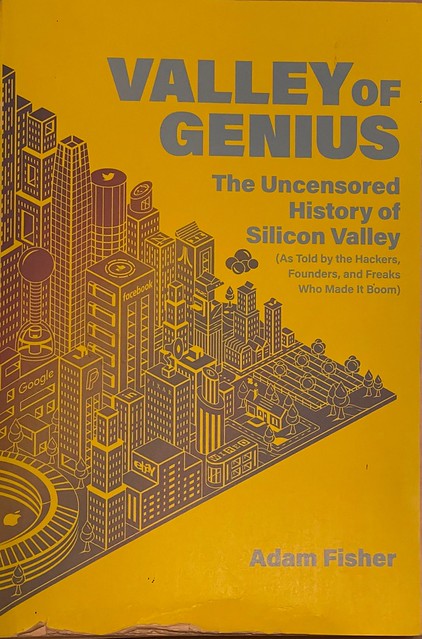
    Valley of Genius by Adam Fisher promises to be ‘the uncensored history of Silicon Valley’ based on stories that founders and programmers told to each other. All of which begs the question how much is myth making and how much is true?
    Valley of Genius
    Valley of Genius front cover

    Getting to the truth

    Having worked for Silicon Valley clients and in-house at Yahoo!; I recognise that the truth doesn’t get out there and the myth making is largely self-serving. There is also a big question about how far the collective memory actually goes back.

    Yahoo! star

    Secondly, the story of Silicon Valley has already been told a number of times, how will Valley of Genius compare to Dealers of Lightning, The Valley of Heart’s Delight, Where Wizards Stay Up Late or Accidental Empires in terms of telling the story of Silicon Valley?

    Finally, there is the challenge of how big tech companies have got so good at controlling their story in the wider world. Whether it was keeping close tabs on journalists like Fred Vogelstein found out while working at Wired magazine, through Frank X Shaw’s reputation for robust rebuttal, funded their own media outlets like Pando Daily and eventually disintermediated the media altogether.

    Adam Fisher

    Adam Fisher grew up in the Bay Area and became a journalist and later editor at Wired. He left there and freelanced for a number of publications, branching out from technology writing to other areas like travel and tourism.

    Style

    The most noticeable thing about Valley of Genius when you get into it is that there is no prose. It is all dialogue. Fisher has cut together segments of interviews to tell a story. Sometimes it feels like people around a table, other times it feels more disjointed.

    The book is described as an oral history and Fisher in his interviews describes the process as being like putting together documentary interviews.

    Fisher went out and interviewed many of the great and the good of Silicon Valley to get this material, however given some of the soundbites were things I had heard before such as Steve Jobs talking about a computer as a ‘bicycle of the mind’; I was not sure if these people like to self reference or if Fisher has interspersed his interviews with archival material. Right at the end of the book, Fisher comes a list of people by chapter and where he had to source secondhand quotes from.

    I’ve read a number of books on Silicon Valley over the years, so had a frame of reference and I had context, so I found Valley of Genius enjoyable to read. But for someone who is coming to the subject with just a cursory knowledge of Silicon Valley, there is benefits to having a guide. Reading the quotes without understanding the context, or having been to Silicon Valley still leaves you outside.

    I honestly don’t know if Fisher would have been a good guide, so him removing his voice from the book maybe less of a loss than we might think. But a new reader to the subject matter would benefit from a guide like Michael S. Malone or the insider snark of Robert X. Cringely (aka Mark Stephens). Fisher’s book Valley of Genius is a book for insiders and future academics who might be looking at the history of Silicon Valley in the future. According to Fisher, he managed to secure the last interview that Bob Taylor ever gave. Bob Taylor played key roles in moving Silicon Valley forward while in managerial positions at NASA, ARPA and XEROX PARC. In those interview quotes are more granular aspects of things, like Nolan Bushnell having a champagne party on the grass outside the offices of a recently bankrupt competitor, or that the video card to power the monitor used in Doug Engelbart measured about 3 foot by 4 foot in size.

    It’s also a very one dimensional view of Silicon Valley. It largely misses out hardware and hard innovation; which is problematic for a technology hub that is competing against China and India for that matter. There is no 3Com, Cisco or Juniper Networks. The hardware story is very much lacking, there is no Intel, AMD or Nvidia, Sun Microsystems or SGI. It is largely a consumer technology vision that writes out businesses like Oracle and Salesforce together with the characters that lead them.

    Plot line

    Valley of Genius ignores a good deal of early Silicon Valley, such as the the pre-war nature of Stanford, Varian, Bill Hewlett and David Packard’s garage start-up, Shockley Labs, the treacherous eight, defence contracting and the missile age.

    Mother of all demos

    Instead Valley of Genius history starts at 1968, when Dough Engelbart of Stanford Research Institute provides the Mother of all Demos to a mix of academics, government people from the likes of the department of defense and technologists.

    Engelbart talks about his developments in 1986

    He the talked about his career on the Google campus in 2007.

    Atari

    The story moves on to Atari and Nolan Bushnell. Bushnell was responsible for popularising computer games and arcade consoles. Bushnell was a bridge between the counter culture and Silicon Valley hustle. A few chapters later Valley of Genius also covers the acquisition and eventual (first) failure of Atari.

    Here’s Bushnell being interviewed for the 50th anniversary of Atari by IGN.

    Bushnell did a Google Talk a number of years ago as well.

    Xerox PARC

    PARC (Palo Alto Research Center) was a west coast R&D facility put together by Xerox to understand what the future of work would look like. They had already realised that it would be computerised. From PARC came modern computers, local area networks, file servers, laser printers and productivity software.

    Apple

    In separate chapters Valley of Genius covers Steve Jobs and Steve Wozniak’s commercialisation of phone hacking tools, and the evolution of the Apple computer line up from the Apple II to the Macintosh.

    Retailer High Technology did the first adverts featuring the Apple II computer

    Which was a far more budget affair than Apple’s own launch of the Machintosh.

    The book goes on to cover the return of CEO Steve Jobs and the rejuvenation of Apple as a business including the iPod, iPhone and iPad through to the death of Jobs.

    The hacker ethic, or hacker culture

    The hacker ethic or culture, a digital equivalent of the person who tinkers away with things in a shed or garage has their own section. The section is atemporal in nature, which I can understand to a certain extent. Steve Wozniak came out of hacker culture, as have many software developers over time.

    Fisher focuses on what hacker culture is, rather than what it means (both good and bad). I would recommend Steven Levy’s Hackers: Heroes of the computer revolution as a companion to this chapter in Valley of Genius. The copy I read years ago was published by Penguin, but O’Reilly have re-published it as the book this is part of myth-making and cultural norming in software development teams.

    The WeLL

    The WeLL was the proto-online community that is still going and features first generation digerati such as journalist Wendy Grossman, the founders of Wired magazine and cyberpunk author Bruce Sterling.

    Stewart Brand talked about the founding of The WeLL during a Google hosted talk

    The WeLL never scaled in the same way that we think about social networks now but it has quality discussions and is much kinder than Twitter or Reddit.

    VPL

    VPL was a failed start-up in the mid-1990s that set much of the expectations and tempo on VR to this day. You will most likely know it from the VR suit featured in The Lawnmower Man movie. I covered it in more depth in my metaverse discussion paper.

    General Magic

    Take a series of burnt out Apple employees and have them invent a predecessor of the net appliance or smartphone. That was General Magic and it was a glorious failure. Sarah Kerruish’s documentary on General Magic tells the story much better.

    Wired magazine

    Wired magazine gets its own chapter. it represented a way of melding culture and technology. I had read Wired before I had used the web, but it gave me a good idea of what to expect. But I don’t know if it is more important than ZDnet or other technology publishing houses. Valley of Genius goes on to celebrate Wired’s online endeavours including HotWired, Suck – a sarcastic version of Wired and Webmonkey – which taught a lot of people web development skills and probably doesn’t get the love it deserves in Valley of Genius. Mondo 2000, a rival to Wired in terms of setting the cultural zeitgeist for technologists also gets a chapter.

    Pixar

    Pixar as a Silicon Valley story is an accident due to two things

    • George Lucas’ Industrial Light & Magic being based in North California rather than in Los Angeles
    • Steve Jobs looking for a project post-Apple

    But it didn’t necessarily move Silicon Valley forward.

    Netscape

    The jump to Netscape as the first commercial browser makes sense. AOL, AT&T True Experience, CompuServe and Prodigy services were all driven by businesses outside the traditional Silicon Valley space.

    Bob Cringely, from what I guess was PBS’ Triumph of The Nerds

    At the time Netscape seemed as much about the crazy public valuation of the business which was emblematic of the dot com boom, as it was about the software that would kick off the open web. These kind of valuations re-emerged with businesses like Uber and WeWork.

    eBay

    eBay was the standout e-commerce play for Silicon Valley. Amazon was a Seattle company and so was an outsider in a similar way that Microsoft always had been. eBay was also founded by an ex-General Magic employee and so was part of Silicon Valley’s version of ‘Rock family trees‘. We see this even now with the ‘PayPal mafia’.

    Google

    Google changed the web experience that Silicon Valley had pioneered via Yahoo! and Excite. Brin and Page became a key point of focus in Valley of Genius. However, this ignores the complexity both around search and the development of foundational web technologies that other companies produced. If you are interested about the nature and history of Google, Steven Levy’s In The Plex is probably a better option to read.

    Google’s move to pay per click advertising gets its own chapter that greatly reduces the complexity of the real story.

    Napster

    Napster was the poster child of market value destruction and disruption that predated Uber and its ilk.

    Dot bomb

    The dot com boom can be charted from the last quarter of 1995 and reached its nadir in the last quarter of 2002.

    Eric Steiner tells his tale as the CEO of Inktomi through the dot com boom and bust

    Valley of Genius covers it in terms of its sociological impact on the Bay Area, as much as its economic impact. The reality is more complex, even the dot.com label attached to it is a misnomer. It encompassed telecoms, networking hardware, datacenters and more in terms of its impact rather than just e-businesses.

    Facebook

    While Facebook was an east coast invention, the movement of the company and its CEO Mark Zuckerberg west saw a cultural change in Silicon Valley that took it down a much darker patch. By comparison Twitter in its start-up phase looked more like Atari in terms of its counterculture influence.

    Future gazing

    At the end of the book there is a section on future gazing, which became what made Silicon Valley great. The business model was prioritised over innovation. Veteran journalist John Markoff even talked about how Salesforce had moved to a ‘vertical campus’ model with Salesforce tower. Which is how every other business in places like Singapore, Hong Kong and even Wall Street work anyway.

    There was a singular lack of reflection on challenges ahead or areas of introspection by the people telling these stories. If anything, that was what concerned me the most about the book. Innovation is at a technological, scientific and socio-cultural cross-roads and the inhabitants of the Valley of Genius apparently doesn’t have a clue. More on the book here. You can find more of my book reviews here.

    Extra content – Valley of Genius promotional tour interviews

    Panel hosted by Adam Fisher to promote the Valley of Genius book

    Leo LePort interviews Fisher on Valley of Genius at the time of its launch.

  • Subprime attention crisis

    Subprime attention crisis is a short book, or a long essay depending on the way you want to look at it. It was written by Tim Hwang.

    Sub Prime Attention Crisis

    About Tim Hwang

    Hwang is a lawyer working for email newsletter platform Substack. Prior to this he worked in a US think tank attached to Georgetown University: Center for Security and Emerging Technology and in public policy at Google focused on machine learning. So he brings a deep set of knowledge to writing Subprime attention crisis. One also has to bear in mind that his current employee Substack is based on the online media model moving from online advertising driven to subscription driven.

    Timing is everything

    I read this book over a couple of days at the beginning of this month. By this time, Meta and Alphabet has published quarterly results that were below what investors expected with falling sales. Add into the mix that the problems that Twitter and Snap have had (which are are bigger issues than just down to the dynamics of the online advertising market), all of which makes this book feel timely.

    On the other hand, one could also argue that much of the crisis had already landed. Ad tech businesses like Rubicon Project have either gone under or merged with their peers creating a massive amount of consolidation. The latest wave of consolidation happened in 2020 – 2021.

    Meta-specific issues

    Even with Meta and Alphabet there are business specific issues. Meta has struggled to compete effectively with TikTok. The poisonous nature of debates on Facebook, together with an aging audience on the platform hasn’t helped. In fact it’s a wonder that the context collapse that the platform has suffered from for at least the past six years hadn’t dragged it down yet. WhatsApp has helped enrich Facebook data and provided a channel for business services. At the time Facebook bought the business partly because Zuckerberg needed a brain trust for the future. The brain trust is gone and Zuckerberg’s dive into the Metaverse looks very similar to Apple’s peak John Sculley moment with the Knowledge Navigator concept. You can see glimpses of the Knowledge Navigator in the smartphone, the iPad, the now abandoned WikiReader product or the use of contextual information and national language processing like Siri. Apple didn’t waste the kind of money that Meta has spent chasing an illusory vision of the future.

    Alphabet-specific issues

    I was surprised that Alphabet growth had lasted this long based on the following considerations:

    With mobile, Google also pivoted a different type of search from product search to where is my nearest coffee shop with free wifi and has managed to sell search ads against them. This meant that Amazon and eBay managed to capture a lot of product searches, with consumers only hitting up Google afterwards and Amazon’s advertising has been eating Google’s lunch. Secondly a lot of the high street and neighbourhood shops have been eaten alive by food delivery services and this was then exasperated by the COVID which has changed at least some people’s consumer behaviour

    Historically, Google has been too focused on looking for multi-billion dollar opportunities which haven’t panned out and closed down smaller services that were making money and bringing in attention. In essence, over the years they have thought Google Reader, the Google Search Appliance, Google Health, Boston Dynamics and several other projects were the big payday. They weren’t, but they were respectable business opportunities, just too small for Google to want to pursue. In its wake Google had destroyed entire sectors, or turned them into cottage industries such as enterprise search and knowledge management, RSS newsreaders autonomous robots

    Web search in general has become less effective at doing deep research for consumer and B2B needs – no more support for boolean operators is a case in point. This has had some tech forward netizens wondering if the likes of Reddit fulfils the vision of knowledge search in place of Google and Alphabet being concerned about young people using TikTok as their local search box instead

    “something like almost 40% of young people when they’re looking for a place for lunch, they don’t go to Google Maps or Search, they go to TikTok or Instagram.”

    Google internal report quoted by Business Insider

    YouTube seems to struggle getting brand building advertising dollars in the face of TikTok, Instagram and this explains why you saw a decline in sales over 2 percent. Instead you see a lot of D2C product ads a la day trading and drop shipping courses advertised. Part of this might be down to the product. YouTube has been screwing over creators and creators have made it clear that they’re not happy. You don’t need to go to YouTube if you get the directors cut of your favourite creators content on Patreon or Curiosity Stream. Censorship of political analysis content around China or Ukraine seems to be particularly bad. 

    Back to Subprime attention crisis

    Hwang in Subprime attention crisis points out many of the things that agency employees and owners have known for years:

    • Online advertising effectiveness has declined compared to its performance 25 years ago
    • Audiences don’t see a lot of the ads that are displayed. Different reports will give you different numbers on this
    • Online advertising is destroying the very media industry that its content is shown on
    • Online advertising fraud is a big problem
    • Online advertising business practices are an even bigger problem with up to 70 percent of of online programmatic advertising spend going to advertising technology intermediaries such as The Rubicon Project (now Magnite) and Xaxis
    • This has allowed businesses like Procter & Gamble and adidas to reduce advertising spend at no loss in effectiveness. In the case of P&G Subprime attention crisis highlights how they cut $200 million in online advertising spend, moved that spend on to offline media like radio and print AND managed to increase their reach by 10 percent.

    More on adidas via its inhouse head of media Simon Peel

    One of the most notable things for me was being introduced to the work of Australian based academic Nico Neumann who has done some great research on online advertising effectiveness related areas including Frontiers: How Effective Is Third-Party Consumer Profiling? Evidence from Field Studies.

    So nothing surprising for insiders, but….

    Hwang marshals his facts well. Which is what you would expect from a lawyer. He uses analogous examples from the US financial services sector including the 2008 financial crisis. The book itself is 141 pages in length and there is a substantial section detailing his sources. Subprime attention crisis is based exclusively on desk research.

    More on the book here.

  • Good To Great by Jim Collins

    Jim Collins

    Jim Collins, the author of Good To Great has been researching and writing about what makes companies successful since 1988, though there are points made about this and the similarity of the work done by Tom Peters at McKinsey. Peters eventually turned the outputs of that research into the book In Search of Excellence.

    From this research Collins has written a series of books:

    Good to Great was Collins’ sophomore book published in 2001. I was curious to see how it stands up in the 20 years since publication.

    What’s the book like?

    Amsterdam

    Collins has written a surprisingly accessible book that at the same time demonstrates an academic rigour to the underlying research. A good chunk of the book is an epilogue, frequently asked questions and referenceable materials at the back.

    Each chapter is comes with a summary page and Collins makes good use of visuals to convey his ideas.

    Synopsis

    Collins bases Good to Great around seven ideas.

    • ‘Level 5’ leadership. Collins had a management maturity capability model, the top level on ‘level 5’ was a leader who left their ego at the door with personal humility but professional will. They tend to be work horse rather than race horses. I found this particularly interesting as research that my first agency used to tout showed how a CEO’s visibility or fame had a positive correlation with rising share price, indicating that investors are probably buying on the wrong signals
    • Getting the right people on the bus. The right people comes before vision, strategy, tactics, structure. ‘Who’ before ‘what’. Rigor but not ruthlessness drives people decisions. All of this was based around three principles: 1/ If in doubt, don’t hire. Instead keep searching. 2/ Act when a people change is needed. 3/ Put the best people on the best opportunities. The right people thrive in a culture of vigorous debate in search of the best answers and then stand united behind the collective decisions, regardless of political or personal interests. The right people are your most important asset. You need self motivating people rather than having to work to motivate them
    • The Stockdale Paradox. Retain faith that you will succeed in the end. Regardless of the difficulties. And at the same time confront the most brutal facts of your current reality. Whatever they might be. An honest determined effort is required to find the truth of a situation. 1/ Leading with questions, not answers. 2/ Engage in a dialogue and debate, not coercion. 3/ Conduct autopsies, not blame. 4/ Build ‘red flag’ mechanisms that turn information into something that cannot be ignored. Dealing with problems head on. Leadership doesn’t begin with vision, it starts with confronting facts head on and dealing with their implications
    • The ‘hedgehog concept’. Focus at the interception point between: 1/ What you are deeply passionate about. 2/ What you can be the best in the world at. 3/ What drives your economic engine. It is an iterative process. This becomes the one big thing that you focus on.
    • A culture of self-discipline. Great results over the long term depends on a disciplined culture. It requires people who adhere to a consistent system, but also gives freedom and responsibility within the framework of the system. Discipline means focus, ignoring once in a lifetime opportunities that dont fit within the business focus. Stop doing lists are as important than to do lists. This reminds me of why Apple never put an FM radio in an iPod or iPhone.
    • Technology as accelerator. Technology isn’t a fad that they follow, but apply carefully selected technologies that meat their focus. A classic example of getting this wrong is the way Micro Focus pivoted to cryptocurrency and ended up being bought by rival Open Text. Instead the attitude to technology is down to thoughtfulness and creativity. Contrary to every marketing campaign I did during my first decade in agency life, technology by itself is never a primary cause of greatness (or decline).
    • Good practices are cumulative and compounded in nature. Collins talks about the flywheel effect, the momentum energy required to get it moving requires consistent pressure, but once it gets moving subsequent pressure means that it moves the flywheel at a much faster rate

    Where Good To Great didn’t age well

    The example of Wells Fargo standing out as an exemplar jarred with me. Wells Fargo is cited as a prime example of a great company, but there are examples of a number of cracks in its culture over years

    • Allegations of higher costs charged to African-American and Hispanic borrowers on sub-prime loans which resulted in fines and damages paid totalling 175 million dollars
    • Failure to monitor money laundering
    • Price gouging on overdraft fees
    • National mortgage settlement, the second largest civil settlement in U.S. history
    • Race discrimination in hiring practices

    Good to Great limitations

    Good to Great focuses on American companies, there doesn’t seem to be a consideration of how national culture may have an impact on the firm. Where does China’s wolf culture or Samsung’s punishing culture fit in the kind of model that Collin’s proposes in his book? I don’t know the answer but its a topic worth exploring in a more global business environment. I think that its particularly interesting because Collins’ work has been widely read by Chinese business people, yet their ‘great companies’ look very different to the corporates that Collins cites as good to great in nature.

    In conclusion

    Collins has created useful management book for departments as well as large corporates, which explains why it has been published in so many languages including Spanish and Chinese. What is less apparent in Chinese corporate culture is how influential the book has really been.

    You can find my updated list of professional reading materials here and further book reviews here. Lastly, more on Good to Great here.

  • The Visual MBA

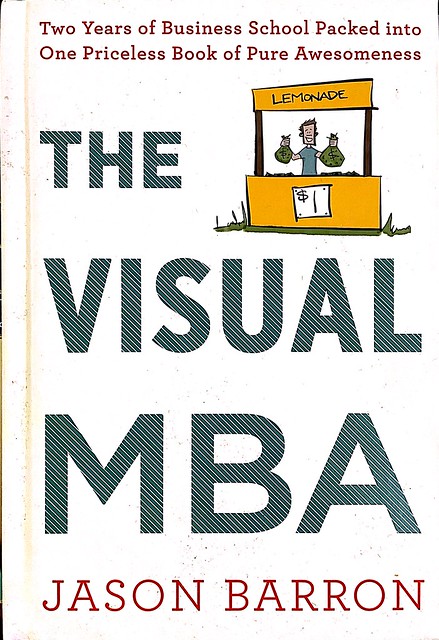
    Jason Barron’s book The Visual MBA looks to distill down business principles into more easily understandable formats. The Visual MBA has been translated into a number of European languages since it was published in 2019, which is a good indicator of the book’s utility. So I thought I would take the time to review The Visual MBA and see how I got on with it and whether it lives up to its premise.

    The Visual MBA

    Areas covered in The Visual MBA

    The content of The Visual MBA is broken down into a number of areas including:

    • Leadership
    • Corporate financial reporting
    • Entrepreneurship (management and financial focus)
    • Management accounting
    • Business finance
    • Marketing
    • Operations management
    • HR
    • Strategy
    • Ethics
    • Decision making
    • Startups

    The book itself is a robust hardback book that would be fine in a daypack lugged around campus. As with any book there are things that could be put in and taken away. My impression of the content is that would be useful to someone studying business at A’level or in the first year of an undergraduate degree. I personally found the marketing section frustrating. Part of the reason for this is that the depth of the subject was barely scratched. Readers were not prompted to even ask the right kind of questions.

    There was nothing that would spur you to read more and read widely. I suspect that this would be the case with the other areas covered by the book as well. It creates the false confidence that would appeal to a surface player. I think that is dangerous for readers and the businesses that they work for.

    Do I think the premise of the book works?

    The book neatly summarises many of the key concepts that would be taught in a general business course and it explains the points in a simple manner. For instance the idea of balance sheets reminded me of the first semester in the first year of my marketing degree in terms of its explanations.

    Where I am less sure of the book’s benefits was whether the illustrations would make me retain any better the content of the book? I will ignore the fact that for some pages the drawings weren’t illustrated but instead representations of the headlines in a hand drawn typography. I might the book beneficial if they were my diagrams that I was sketching in my notes. But I don’t think they have the same effect on a reader of the book.

    In summary I would recommend that one buys the book as a simple guide to business studies or commerce rather than the visual aide memoire that the book seems to promise. If this sounds of interest to you you can get more information here.

  • You Are Here by Phillips & Milner

    This is a book review of You Are Here which provides a critique on the current political media landscape from a predominantly US perspective. I decided to read the book given that it was endorsed by online media researcher and author danah boyd. danah is most famous for her long time researching the online lives of young people. I first came across her when she worked briefly at Yahoo! Research.

    Navigating polarised speech, conspiracy theories and media landscape

    You Are Here is written by two American academics: Whitney Phillips and Ryan M Milner. In the book they try to make sense of the current media landscape and what they consider to be the likely causes.

    You are here

    Ecology as metaphor

    You Are Here uses the metaphor of ecology to discuss a polluted landscape poisoning society. This has two effects:

    • It taps into the deep concerns of their readers who have a lot of anxiety around areas like climate change
    • It encourages system thinking in people who are otherwise not system thinkers

    The downside is that it might convey the kind of desperation and hopelessness that we see around climate change also affect the media landscape creating a kind of dark ennui among the readers.

    Conspiracy theories

    Phillips and Milner focus on conspiracy theories going back the satanist concerns of the 1980s and 1990s. While conspiracy theories are important and memetic in nature, there is a risk that focusing on them misses a wider truth. Why do people feel the way they do? Brexit research showed us that a good deal of concern was about the rate of change and being economically left behind. The role of class and the isolation of working class voices and issues in political discourse and the media left the door open for conspiracy theories.

    Strengths and weaknesses

    You Are Here does a good job at summarising much of the current media theory thinking about how platforms alter our collective perceptions.

    You Are Here describes itself as a field guide. A field guide is a book designed to help readers identify things or phenomena rather than offering solutions per se. The reality is that for most readers, their exposure to the content discussed in the book through the proverbial rear view mirror of coverage on MSNBC News, The New York Times or The Atlantic or conversations with friends and family members who live outside the major cities. There is an assumption that the interested reader is unaware of the current media landscape. In this respect the book is likely to raise anxiety, entrench beliefs and focus the reader on regulation as the sole solution to the current media landscape. I don’t think that this will necessarily move things forward. It will reinforce progressive readers own biases. I recognise and identify with Phillips and Milner’s world view, which is similar to my own – but I have some self awareness of my own viewpoint in a sea of opinions.

    Platforms

    A decade ago I worked with Amy Gershkoff. Amy had previously been involved in the media planning and analytics for the campaign to re-elect President Obama. At the time, the narrative being communicated was that media and social media platforms through the judicious use of data and optimising for algorithms offered the opportunity to help Obama to be re-elected.

    The reality of these things are somewhat different. Programmatic media is often correctly targeting half the time. But when it gets it right, it can be creepy.

    Amy took this story to large corporates in Hong Kong and China, which was where I was working at the time. The irony of ‘the power of modern political campaigning online’ being used as an example of omni-channel marketing for Chinese companies wasn’t lost on me. Phillips and Milner’s stance misses this wider picture.

    The Obama campaign built on pioneering work that has been done by the like of Joe Trippi for Howard Dean when he ran for consideration as the future Democrat presidential candidate eight years earlier.

    The point is that there is a case to be made paraphrasing Goldie Lookin’ Chain ‘Platforms doesn’t poison democracy, people do.’

    Conclusion

    You Are Here tries to articulate a route for individuals to navigate the media environment, rather than building a groundswell to try and change it for the better. I can’t help but feel that there’s an opportunity having been lost and the polarisation will continue.