ChatGPT
The buzz in part of our office about Midjourney has subsided to be replaced by buzz about ChatGPT, rather than Christmas. ChatGPT is is a software application used to conduct an on-line chat conversation via text. ChatGPT was considered to be a superior example of a chatbot down to the power of machine learning used in creating the content.
I was curious about how good ChatGPT actually was given the following commentary from The Verge:
The primary problem is that while the answers which ChatGPT produces have a high rate of being incorrect, they typically look like they might be good and the answers are very easy to produce
Vincent, J. (2 December, 2022) AI-generated answers temporarily banned on coding Q&A site Stack Overflow | The Verge
The Verge article was interesting. Most of the places where chatbots might be needed: providing customer services, regulated industries like finance would suffer from confident, but incorrect answers being provided to customers.
Secondly, media outlets decided that ChatGPT was a potential Google challenger, with outlets like CNBC comparing the two and equity analysts at Morgan Stanley feeling the need to come out and say that ChatGPT was not likely to replace Google.
Google’s innovators dilemma
What became quickly apparent Google’s narrative about being an innovator full stop, has been threatened by ChatGPT. Google as an incumbent is now stymied by Clayton Christiansen’s Innovator’s Dilemma. Google is no longer cool, its conversation related products are seen to be behind the curve and the company is seen as being too big to out-innovate itself easily.
So what’s ChatGPT like to use?
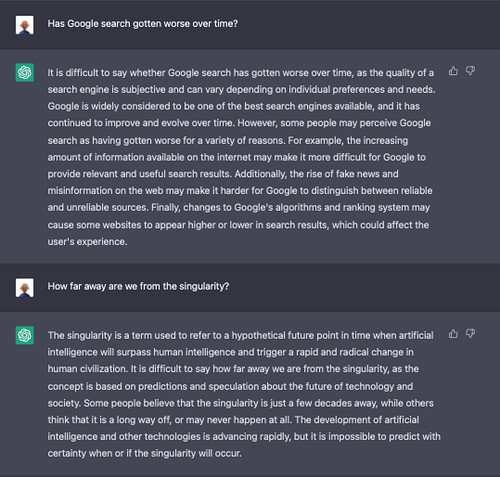
I have shared a picture of some of the better responses I had from the service. I started off with a certain amount of ambition. I asked it about who it felt might win the current war in Ukraine. I found that the training set of data used to power it was finished in 2021. This was obviously done to filter out the worst of the internet from the content, getting around rather than solving problems that previous chatbots have suffered from like Microsoft’s Tay project.
Eventually I managed to get on to safer ground for ChatGPT. It answered questions about what an AI winter was, whether fuzzy logic is a form of artificial intelligence (it is), whether Baye’s Theorem was a form of AI (it isn’t per se, but it is employed to solve some AI problems there similar to the kind of uncertainty challenges fuzzy logic solves.
ChatGPT said that AI (like Bayes Theorem) could be used to provide a solution to buffer bloat – which massively increases the latency on data networks.
I found out quantum computers could make an optimised AI more power efficient and the business expert systems popularised in large companies during the 1980s and 1990s were analogous to modern day AI systems.
It reminded me a lot of content I had read on Summly, the mobile news app that mashed up an AI service API with news sources to summarise articles. This start-up was bought by Yahoo! a decade ago.
In this respect, I do wonder whether ChatGPT is truly the quantum leap forward that many seem to think, or is it merely a reminder of how well understood technology can be applied in different ways?
China
Volkswagen’s Skoda considers withdrawing from China – media report | Reuters – Czech carmaker Skoda Auto, part of Volkswagen, is considering withdrawing from China and will make a final decision next year. The re-orientation towards India is interesting
How China aims to avoid the curse of increased longevity & ill health – Financial Times – Partner Content by Ping An Insurance – Ping An Insurance has a health management model or concierge service as they like to position it
Learning from the Soviet Collapse – by Jordan Schneider – China’s Marxist Leninist version of Andy Grove’s book Only The Paranoid Survive – all of which implies at weakness at the heart of the CCP; its own members…
Defending democracy in an era of state threats – GOV.UK
Consumer behaviour
Gen Z: progressive, illiberal or both?
Culture
Why we’re doing this – Flickr Foundation – interesting on the future of Flickr Commons and good to see George Oates involved
Economics
Can India build a military strong enough to deter China? | Financial Times – I think that this is down to the lead China has in manufacturing capability and innovation as much as anything else. There is a substantial risk that India could lose many of its northern provinces in theory. In theory being the operative phrase here. Ukraine has show what’s possible with people fighting for their homes. It makes more sense for India to think about assymmetric and grey zone tactics at scale to bleed China’s financial and human lifeblood. From hacking well in advance of a conflict, to militias trained and equipped for guerrilla actions allowing for attack in depth once China crosses the threshold.
China boosts military aid to Africa as concerns over Russia grow – Nikkei Asia – China has kept its forces from direct engagement in crises in Africa as part of its noninterference policy, it has also taken an increasingly high profile in United Nations peacekeeping missions. It has sent more than 1,000 troops, police and specialists to oil-rich South Sudan, for example. “When Chinese interests were threatened by insurgencies in Nigeria, China issued a statement, as it still lacks the military commitment. This can, however, change in the future,” Ali said. Experts say China is more focused on economic and national security interests than on peacebuilding. Beijing prefers strategies centered on development that help to alleviate poverty and provide stable governance, but do not necessarily advance protection of individual rights and free markets. But this growth-first attitude may be counterproductive over the long term. In the Democratic Republic of Congo, China has a very close relationship with the government, but attacks in the resource-rich east of the country by a number of rebel groups pose threats to its mining interests. “Insurgencies happen as the product of social exclusion,” Nte said. “There must be a stable political climate to address economic degradation caused by the wrong policies.”
UK economy rebounds by more than expected in October | Financial Times – the second largest contributor to growth in October was performance of the health sector in administration of vaccine boosters and flu shots, the biggest sector was construction. But construction has started to slow since then with sites halting work in November
Globalization is Dead and No One is Listening – by Kevin Xu
How Putin’s technocrats saved the economy to fight a war they opposed | Financial Times – tough moral questions to be asked. However, Central Bank governor Nabiullina’s moral calculus reminds me a good deal of convicted German war criminal Albert Speer, in particular the “Speer Myth”: the perception of him as an apolitical technocrat responsible for revolutionising the German war machine. The close alliance with Iran should allow both countries to pool expertise in sanctions busting.
Meanwhile air travel is going great guns according to airlines like Lufthansa who are bringing back their Airbus A380 jumbo jet airliners.
Finance
Microsoft to take 4% stake in London Stock Exchange Group | Financial Times – interesting series of cloud computing deals happening that include an equity purchase
Health
How docs deal with tricky situations with patients or billing | Fierce Healthcare
Hong Kong
Hong Kong media mogul Jimmy Lai’s sentence casts chill over relaunch, analysts say — Radio Free Asia – “If you can’t say anything anyway, then you might as well locate [your office] in mainland China,” Chow said. “Using Hong Kong as a jumping-off point to the mainland is a waste of money, because rents are much more expensive than in mainland China.” – there is also the tax aspect (expats pay much more tax in Mainland China) and a transferrable currency, but otherwise the point is pretty valid
Hong Kong security chief accuses Google of ‘double standards’ for refusing to correct national anthem search results | South China Morning Post – Hong Kong upset that Google knows the national anthem of Hong Kong is ‘Glory to Hong Kong’ – I wonder how they will use the National Security Law in this fight?
Ideas
Techno-optimism for 2023 – by Noah Smith – Noahpinion
The great disruption has only just begun | Financial Times
A Vibe Shift Is Coming. Will Any of Us Survive It? – In the culture, sometimes things change, and a once-dominant social wavelength starts to feel dated. Monahan, who is 35, breaks down the three vibe shifts he has survived and observed: Hipster/Indie Music (ca. 2003–9), or peak Arcade Fire, Bloc Party, high-waisted Cheap Mondays, Williamsburg, bespoke-cocktail bars; Post-Internet/Techno Revival (ca. 2010–16), or the Blood Orange era, normcore, dressing like The Matrix, Kinfolk the club, not Kinfolk the magazine; and Hypebeast/Woke (ca. 2016–20), or Drake at his Drakest, the Nike SNKRS app, sneaker flipping, virtue signaling, Donald Trump, protests not brunch
Innovation
Tracking How the Event Camera Is Evolving – EE Times
IBM Reveals Its 433 Qubit Quantum Computer – EE Times
Innovative ASIC CPU Drives Record-Setting Server Performance – EE Times
The global microchip race: Europe’s bid to catch up | Financial Times
Robots set their sights on a new job: sewing blue jeans | Reuters – the economics of automation are very interesting. In markets with poor productivity i.e. the UK , people are replacing automation in warehouses and the car wash
IBM partners with Japan’s Rapidus to make advanced chips as US recruits allies to its cause in China tech war | South China Morning Post – 2nm node process
Canon prepares to ramp nano-imprint lithography | EE Times
Tracking How the Event Camera Is Evolving – EE Times
Ireland
Do you recognise these iconic Irish Christmas ads? or the effect of nostalgia on Irish consumers perceptions of advertising campaigns
Japan
Japan scraps pacifist postwar defence strategy to counter China threat | Financial Times – this is much needed, but will be huge in terms of Japanese politics and how the country sees itself
Legal
China preps $143 billion chip support, goes to WTO | EE Times
Luxury
5 Facts About Chanel Métiers d’Art Show in Dakar | Hypebae – apparently Chanel managed to amass an armada of Toyota Land Cruisers to put all this on.
Luxury Watch Thefts of Rolex, Patek and Other Models Are on the Rise – Robb Report – which is why you have some UK watch collectors on YouTube talk about the ‘London watch check’ and rather than showing their timepiece have a bare wrist instead
Luxury Daily: One-second wonder: Mr. Bags x Qeelin sells out immediately – I will never get how the HSN / QVC type format works so well in Chinese luxury sector
You’ll own nothing (besides luxury goods) and be happy | Financial Times
Online
Is Snapchat+ still being subscribed by users? / Digital Information World
Amazon’s heroic phase is over | Amazon Chronicles – My first theory is that capitalism doesn’t stop evolving. The evolution of the microprocessor, digital computing, the internet, the personal computer, the World Wide Web, and the tech giants that have emerged in their wake are all transforming capitalism as we experience it and the culture produced by it in ways we don’t even fully understand. These are the biggest companies in the world and the ones with the greatest impact on how we think, work, shop, and communicate. You can’t understand capitalism in the twenty-first century without understanding how technology is changing it. I think this theory is pretty uncontroversial. It’s certainly not new. My second theory is that the arc of capitalism traced by Marx and Lukács and others writing in their tradition can also be retraced on a smaller scale. Like those early modern bourgeoisie, big tech has moved from its initial chaotic and subterranean strivings, to a heroic universalist phase where it championed political and economic liberation. Now these companies are consolidating their dominance by reducing or eliminating their workforce, shifting away from consumer goods, and brokering compromises with state power.
Taiwan considers extending TikTok ban to private sector — Radio Free Asia
U.S. lawmakers unveil bipartisan bid to ban China’s TikTok | Reuters – first Taiwan, now the US…
The METAmorphosis of behavioural economics and fast data. | Human Digital
Security
Recruited for Navy SEALs, many sailors wind up scraping paint | The Japan Times – is this generation snow flake, or is there something broken on SEAL unit culture? What’s not talked about in the article is unit fit and mental resilience
Dutch chip equipment maker ASML’s CEO questions U.S. export rules on China -newspaper | Reuters
Fall of the house of Sergei Leontiev | Financial Times
This won’t help consumers trust in politicians, but the strong legal reaction might