Category: technology | 技術 | 기술 | テクノロジー

It’s hard to explain to someone who didn’t live through it how transformation technology has been. When I was a child a computer was something mysterious. My Dad has managed to work his way up from the shop floor of the shipyard where he worked and into the planning office.

One evening he broad home some computer paper. I was fascinated by the the way the paper hinged on perforations and had tear off side edges that allowed it to be pulled through the printer with plastic sprockets connecting through holes in the paper.

My Dad used to compile and print off work orders using an ICL mainframe computer that was timeshared by all the shipyards that were part of British Shipbuilders.

I used the paper for years for notes and my childhood drawings. It didn’t make me a computer whiz. I never had a computer when I was at school. My school didn’t have a computer lab. I got to use Windows machines a few times in a regional computer labs. I still use what I learned in Excel spreadsheets now.

My experience with computers started with work and eventually bought my own secondhand Mac. Cut and paste completely changed the way I wrote. I got to use internal email working for Corning and internet connectivity when I went to university. One of my friends had a CompuServe account and I was there when he first met his Mexican wife on an online chatroom, years before Tinder.

Leaving college I set up a Yahoo! email address. I only needed to check my email address once a week, which was fortunate as internet access was expensive. I used to go to Liverpool’s cyber cafe with a friend every Saturday and showed him how to use the internet. I would bring any messages that I needed to send pre-written on a floppy disk that also held my CV.

That is a world away from the technology we enjoy now, where we are enveloped by smartphones and constant connectivity. In some ways the rate of change feels as if it has slowed down compared to the last few decades.

  • Sony Trinitron

    It is hard for anyone who can’t remember back to the original PlayStation, but back in the 1980s and the 1990s Sony was a technology company that held the kind of stature that Apple currently holds in consumer minds. Trinitron had the kind of gravitas that Apple’s iPhone or Samsung’s Galaxy have now.

    In fact, Sony used to do a fair bit of industrial and product design for Apple. The initial Apple PowerBook range was designed by Sony and the 3 1/2 floppy disk that was the hallmark of the original Mac was down to Sony engineers who collaborated with the Apple team to get the product ready in time. Steve Jobs self-imposed uniform of black mock-turtleneck jumpers and Levi 501s was inspired by a conversation he had with Akio Morita about the use of corporate uniforms inside Sony Japan which created corporate cohesion. (Sony had implemented these, because workers in post-war Japan struggled to afford clothes). Jobs cited  Sony, alongside Cuisinart and Braun as companies that he would like to emulate in terms of product design.

    Part of Sony’s pre-eminent position was down to their amazing electronic, electrical and mechanical engineering chops combined with great product design and an attention to detail which churned out a succession of small high-performance products including high-end personal tape cassette players (the Walkman), personal compact disc players (the Discman) and camcorders (Video8 and Hi-8).

    Often consumers couldn’t afford the high-end designs so the mid-and-low range products that they bought had the Sony quality and design ‘halo’ around these products.

    The second thing that supported Sony was the high quality of their televisions. This was due partly to the industrial design that Sony perfected – particularly in their portable television sets.
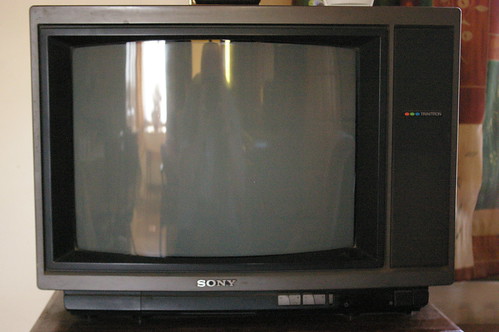
    Sony Trinitron TV
    The deal closer was Sony’s display technology called Trinitron.
    Trinitron logo
    Trinitron signified the technology that Sony had inside its screen, and the logo became a mark of quality. The story of Trinitron goes back the mid-1960s, Sony had bet the farm on a great display technology called Chromatron which it had licenced from a small American company. The problem with Chromatron was that it was really hard to make the displays commercially, Sony was getting about three good displays for every 1,000 they made on their production line. The televisions that the displays went into cost twice as much to make as Sony could sell them for. By 1966, Sony was facing financial ruin.

    So they took a look around at the other technologies pioneered by the likes of GE and RCA to try and work out how they could come up with a unique patentable product. In double quick time, Sony came up with a display with an electron gun at the back of the cathode ray tube with three electrodes (for the red, green and blue composite colours), permanent magnets to focus the electron stream and an aperture grill made up of tiny wires hung vertically connected by one or two tungsten stabilising wire going horizontally across them.

    This gave Trinitron displays a bright, high contrast, high-colour display with no gaps between the colour phosphor dots on the screen. I still use a Trinitron set to watch DVDs because it provides a superior colour and contrast to more modern LCD screens. Modern LCDs have to use a lot of power; up to 1,000 watts to try and match the contrast of the Trinitron set. In 1996 Sony’s patents ran out and technological change with copycat designs from Mitsubishi and ViewSonic; followed by LCD displays eroded Sony’s advantage in the market. Prior to bowing out of the market Sony made its WEGA sets which feature the best consumer Trinitron screens to date – and can be picked up on eBay for a song. In 2008, Sony stopped selling Trinitron televisions in the developed word (though WEGA sets continued to be sold in China).

    It still has a production line in Singapore making Trinitron displays for professional use, in particular video monitors. Sony’s television business is now bleeding cash as it no longer has a best-of-breed display technology advantage and so consumers will no longer pay a premium price because it’s a Sony. A Sony BRAVIA LCD television is a Sharp or Samsung panel display with Sony electronics and packaging.

    Efforts to commercialise OLED displays have so far proven to be unsuccessful so far; though Sony does offer a Trimaster branded version of these for high-end video monitoring. Presumably the Trimaster brand is allusion to the gold standard that Trinitron provided. More Sony related content here.
  • Tape pack

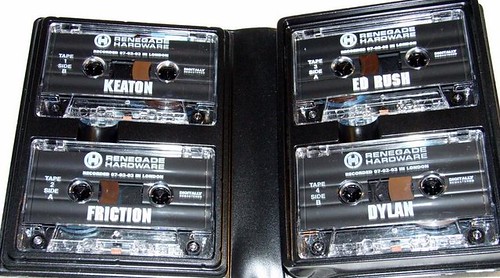
    Back in the day many computer games, audio books and language course used to come in a book sized moulded plastic sleeve lined with four or six cassette tapes called a tape pack. There would be a sleeve that would take a cover on the outside like a DVD film case (or a VHS film case before it). The boxes were pretty flimsy but they did better than the brittle plastic that went into cassette and CD album ‘jewel cases’.
    tape pack
    From the early 1990s through to the early noughties the tape pack took on a new cultural significance.

    Organisers of nightclub events quickly realised that consumers who couldn’t afford to attend every event could still be sold the evenings sound track on a series of tapes. Also people who had been often wanted to relive the night listening to the tapes on their Walkman, at home on the stereo, or as was usually the case on the car stereo. In the same way that I bought records by certain artists, remixers and record labels; club goers would by tape packs by their favourite DJs; given that a big name could play four sets on a Saturday night, they maybe chasing down £60 of tapes for that week.

    The boxes acted as a bill board for the club with flyer art on the front that parodied famous brands, were surreal or had fantastic themes with boasts of five or eight kilo-watt audio systems by TurboSound alongside details of the number of smoke machines and lasers in the club.

    DAT machines started appearing in the DJ booth. Even a wine bar that I played garage sets in on a Wednesday night had a HHb professional DAT recorder (that would have been at home in a recording studio as a tape machine for mastering albums) underneath the counter of the DJ booth.

    Tape packs were big money for club promoters and the independent record shops that supported the dance music scene at the time. tape packs jostled for shelf space behind the counter with racks of records. I am partly convinced that the C-90 cassette format was responsible for DJ’s working 90-minute slots at a club.  The tape pack started a long slow decline. The writing was on the wall with the rise of the super-club who looked to have a record label, alongside their fashion brand and club nights. DMC had shown the way with Mixmag Live – the first legal mix series.

    With the notable exception of the Ministry of Sound; the focus moved from the club franchise to the DJ; and DJ’s got their own production record deals with the dance imprints of major labels.

    Secondly, since recording a CD at first meant going into a studio, big name DJs used technologies like Digidesign’s Sound Tools and Pro Tools audio editing and production software to clean up their mixes, mould them and sound a lot better than they really were. These mixes has more in common with studio megamixes like Mirage’s Jack Mix series or and edit mixes a la Chris ‘Steinski’ Stein and Danny Krivits than DJing; but their superior flawless quality was more popular with consumers.

    The reason why this decline was slow was partly due to market forces; whilst the Discman replaced the Walkman as the personal stereo of choice; CD production took a long time to come down in costs to tape duplication and in-car audio still had a large installed base of cassette head units.

    In addition, early car CD units jumped and skipped tracks with every bump in the road and the cartridge units that held the CDs often scratched them. Fragmentation of dance music into different genres (and socio-economic classes of audiences if we’re honest about it) and in particular the reliance of happy hardcore and drum & bass relying on borrowing and shared sounds meant that tape packs lasted longest supporting these genres of music.

    Now these recordings are remastered by consumers into digital formats and shared or sold online. More culture related content can be found here.

  • Privacy policies + more news

    Google privacy policies

    Official Google Blog: Updating our privacy policies and terms of service – a confluence of events are affecting Google’s privacy policies. The fact that Google has over 70 different privacy policies implies a whole range of issues with version control and updating. Secondly there is the regulatory pressure to simplify privacy policies so that consumers can understand them if they read them. The consolidation of privacy policies also foreshadows a consolidation of services as well.

    Economics

    How China’s Boom Caused the Financial Crisis – By Heleen Mees | Foreign Policy – title is misleading as it was a factor, but needs more nuance. Low interest rates and the decline of middle class income led to a need for refinancing. Blaming China is simplistic – it was China, not the U.S. economy, that prospered on Americans’ spending binge. The world’s most populous country grew at double-digit rates for much of the 2000s. And while the U.S. savings rate hovered around 15 percent of GDP, China’s savings rate increased from 38 percent in 2000 to 54 percent in 2006. China’s savings are heavily skewed toward risk-free assets, perhaps because the Chinese are culturally more risk-averse, but also because the country’s financial markets are still underdeveloped and not fully liberalized. The large buildup of savings in China and other emerging economies (mostly oil exporters) depressed interest rates worldwide from 2004 on, as too much money was chasing U.S. Treasury bonds and other supposedly risk-free securities, driving up the price of bonds and driving down interest rates. Thus, by the time the Fed started to worry about rising inflation by mid-2004, leading the Fed to try to put the brakes on the economy, it was already too late

    Finance

    Saudi equities: a lifting of the veil? | FT.com – opens up market to direct institutional investment

    Innovation

    Fujitsu mobile phones boost diabetic support services ‹ Japan Today

    Japan

    Japan losing its manufacturing edge to South Korea ‹ Japan Today – lacks conviction so isn’t taking the risks that Korea will

    Korea

    Unpacking the Fourth Quarter Numbers at Samsung Electronics – WSJ – issues with profit margins abound

    Luxury

    Louis Vuitton Sets A New Standard In Federal Trademark And Copyright Law : Fashion Apparel Law Blog

    Media

    Copyright Industry Calls For Broad Search Engine Censorship | TorrentFreak

    Online

    I, Cringely » Absence makes the heart grow fonder and other weird thoughts – on SOPA protests

    Why the feds smashed Megaupload – interesting timing around SOPA | PIPA protests and the MegaUpload versus Universal Music dispute over the MegaUpload advert

    Retailing

    London department stores become the ‘Great Mall of China’|WantChinaTimes.com – each Chinese shopper on average spent 2,520 pounds (US$4,000) in Harrods

    Technology

    ARM’s stiff upper lip trembles at Chipzilla’s Medfield | ExtremeTech

  • The future is divergence

    The future of divergence has been bubbling along for a while. I was chatting to my friend Ian over lunch putting the technological world to right over the hour or so that we had. That coalesced some of the ideas that I have been thinking about for a while and posted about in fragments on this blog at different times and has coalesced in this post: the future is divergence.

    So what about the future is divergence?

    I’d like to think of it as an executive summary for the attention deficit disorder generation who have been brought up on MTV, online instant gratification and the shallow intellectual depths of strategy by PowerPoint presentation.  I guess if I was going for accuracy rather than a snappy headline it would be something like: the future of consumer electronics is likely to be context-dependent divergence rather than the convergence strategies that they have pursued: mostly unsuccessfully.

    Why?

    First of all let’s think about convergence the way it is manifested currently. For the past decade and a half we’ve seen the internet pervade more aspects of everyday life. It is handy to have the same network protocols being used connecting everything together, its what happens when they are connected is what matters.

    If we look at different devices we can see a an evolution of products until one fires the imagination and things kick off. For instance mobile email went through a number of iterations before coming a ubiquitous consumer product. Mobile email started in the mid-1980s with the Ericsson Mobitex network which allowed for two-way paging across a reliable narrowband digital data network. it is still used for breakdown services in the UK and by emergency services in North America. Research In Motion (RIM) made its first BlackBerry handset for the Mobitex network in the late-1990s

    It took another two decades for mobile email to become ubiquitous. I have been using mobile email since 2002, firstly on a Nokia 6600 and currently on an  Apple iPhone. But what has happened is that I have two mobile devices. My phone which is a Samsung feature phone which does my calls and has a week long battery life and my iPhone which handles,  text stuff like email, my calendar and address book. My usage hasn’t converged into one device as the iPhone’s battery life and call quality isn’t good enough.

    Mobile email hasn’t made me give up my desktop email either, I prefer to do long form emails on my laptop at home simply because the writing experience on the iPhone is inferior. Instead of convergence this is an exhibit of divergent devices based on user context.

    I suspect that the phone as a phone factor maybe around for a good while yet; particularly when you look at the utility that people find with Apple’s Siri service or the Vertu concierge service; both of which are often simpler to use than an application or firing up a web browser.

    This divergence of context is one of the reasons why I am skeptical about so-called smart televisions. Our homes are filled with screens that delivers content. The mobile phone is most often used in the home within reach of a wired telephone. Tablets are often used to access the internet whilst watching television. There is a reason why this works currently. I can pick up or put down the internet and have an immersive experience on the television screen; the consumer electronics manufacturers hope that I will soon enjoy this not just in high definition but with 4K (the same standard as many digital cinema set-ups).So why would I want this screen with modules telling me about the latest happenings on Facebook or Twitter a la Pop-up Video? It makes absolutely no sense, yet this is the vision that consumer electronics companies and Google want you to buy into.

    Granted in certain circumstances information presentation of this type can be useful; in particular news television a la CNBC, Bloomberg TV and CNN; but most TVs are more likely to be sold on entertainment and sports.

    The thing was consumer electronics manufacturers like Sony had divergence and frittered it away. The Walkman, Discman, Trinitron televisions, Dream Machine alarm clocks, the ES range of hi-fi separates – all were divergent devices based on user context. Digital didn’t change that, it changed the connectedness of devices and convenience of receiving media. Strategists at the major Japanese electronics manufacturers got blinded by the technology rather than how consumers use products – even Steve Jobs got it wrong on occasion. More on Sony here.

  • CES 2012 trends

    Early January means CES 2012 in the tech calendar as the media gives its full attention to the consumer electronics sector. With some 2,600 exhibitors there was a lot of news coming out of the event. But I was more interested in some of the more macro trends that you could see from the coverage and hear from friends that attended the event. Here’s my three big things:

    Size zero design

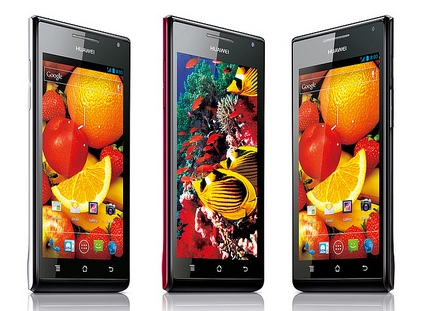
    Size zero design – Motorola was responsible for move towards size zero design with its original SLVR and RAZR feature phone designs and Apple has turned it into a must-have design feature across both smartphones and computers. It was only natural that up and coming young Turks like Huawei with their Ascend P1 smartphone should attempt to demonstrate their technical prowess and superiority with the current thinnest phone.
    Huawei-Ascend P1-smartphones
    I also found it interesting that Fast Company wrote an article pointing out the design rabbit hole that size zero design is for device manufacturers and consumers. Pretty good, and only almost two years after this blog (^.^)

    Austerity designs

    Austerity designs – a general observation from a couple of the people I knew had gone to CES 2012 was that manufacturers generally had a lower average ticket price on the items that they were displaying. In the past manufacturers would bring different ranges into different markets, for instance Sony would bring higher end hi-fi products into France and Germany that they wouldn’t bring into the UK. There was less aspirationly priced items than in previous years, probably as manufacturers look to deal with the current economic climate. CES products are not only about drumming sales for the coming year, but also setting the tone for a next few years ahead. This pricing strategy indicates that many of the manufacturers probably aren’t expecting a huge economic bounce back in the West.

    Smart everything

    Smart everything – one of the things that struck me about CES 2012 is the way that technology was been shoehorned into every facet of life  from the car, to the wall thermostat and the wall plug. The only thing is I am not convinced that the electronics will last as long as the useful life of the car or the electro-mechanical Honeywell wall thermostat that would have been used previously. This phenomenon has become its own meme: the internet of (shit) things. Secondly do you really want your home heating or your car dashboard to need rebooting every so often so that it keeps working? I have even heard of the volume disappearing on Sony TVs until they they were updated