Category: technology | 技術 | 기술 | テクノロジー

It’s hard to explain to someone who didn’t live through it how transformation technology has been. When I was a child a computer was something mysterious. My Dad has managed to work his way up from the shop floor of the shipyard where he worked and into the planning office.

One evening he broad home some computer paper. I was fascinated by the the way the paper hinged on perforations and had tear off side edges that allowed it to be pulled through the printer with plastic sprockets connecting through holes in the paper.

My Dad used to compile and print off work orders using an ICL mainframe computer that was timeshared by all the shipyards that were part of British Shipbuilders.

I used the paper for years for notes and my childhood drawings. It didn’t make me a computer whiz. I never had a computer when I was at school. My school didn’t have a computer lab. I got to use Windows machines a few times in a regional computer labs. I still use what I learned in Excel spreadsheets now.

My experience with computers started with work and eventually bought my own secondhand Mac. Cut and paste completely changed the way I wrote. I got to use internal email working for Corning and internet connectivity when I went to university. One of my friends had a CompuServe account and I was there when he first met his Mexican wife on an online chatroom, years before Tinder.

Leaving college I set up a Yahoo! email address. I only needed to check my email address once a week, which was fortunate as internet access was expensive. I used to go to Liverpool’s cyber cafe with a friend every Saturday and showed him how to use the internet. I would bring any messages that I needed to send pre-written on a floppy disk that also held my CV.

That is a world away from the technology we enjoy now, where we are enveloped by smartphones and constant connectivity. In some ways the rate of change feels as if it has slowed down compared to the last few decades.

  • Gucci + more news

    Gucci

    Shenzhen sweatshop allegations force Gucci to act – FT.com – PR nightmare and management FAIL for Gucci. The Gucci story is unusual in that it affects service workers. Luxury in Asia requires a certain servility of service that I find uncomfortable and the Gucci story of long oppressive days for retail staff sounds emblematic of it. That its happening in the Gucci Shenzhen store doesn’t surprise me at all

    China

    China Favors Direct Investment to Create ‘New Blood’ in Europe – WSJ

    Maersk builds LatAm “reefer” factory | FT.com – because the cost of production is growing faster in China than Latin America

    Consumer behaviour

    What Wealthy Women Really Want – WSJ

    For Their Children, Many E-Book Fans Insist on Paper – NYTimes.com – the tactile arguments for toddlers are the same reason why I prefer print books

    Culture

    Alan Moore – meet the man behind the protest mask | The Observer – it was a nice literary tail for the Guardian to loop back with Alan Moore

    Paris Review – The Art of Fiction No. 211, William Gibson – interview with the cyber punk don

    Economics

    Housing prices fall in Chinese cities – FT.com – property developers and small businesses have been suffering

    Brussels warns on risk of UK double-dip – FT.com – UK economy stagnating and government’s deficit reduction strategy isn’t working according to a European Commission report – a deep and prolonged recession complemented by continued market turmoil cannot be excluded

    The way (not) to rein in the yen – FT.com A more aggressive quantitative easing programme, targeting 10-year government bonds instead of shorter maturities, would contribute more decisively to ease the pressure on the exchange rate. More importantly, it would also stimulate the largely stagnant domestic economy (paywall)

    The Long Haul to Capitalizing on Web Trends – Digits – WSJAccording to comScore Inc., almost 62% of the ads shown on Facebook in the July through September quarter came from advertisers that are not among the top 1000 digital advertisers in the U.S.; on Yahoo Inc., just 23% come from such small advertisers. These sorts of Facebook advertisers range from nail salons marketing to people who live a particular town, to recruiters targeting employees at a specific company – going down the long tail due to targeting ability, not great on context like Google local search though

    Ideas

    Information: Be careful what you signal | The Economist

    Possibility Is Thrust of 100-Year Starship Study – NYTimes.comin 10,000 years, the speed of humans has jumped by a factor of about 10,000, from a stroll (2.6 m.p.h.) to the Apollo astronauts’ return from the Moon (26,000 m.p.h.). Reaching the nearest stars in reasonable time — decades, not centuries — would require a velocity jump of another factor of 10,000

    Innovation

    Marubeni Launches 3D Printing Service — Tech-On! – interesting that it is aimed at making precision resin dies etc

    Japan

    Japan’s #1 Mascots: Kumamon, Bary-san, and Nishiko-kun | Japan Probe – Japan seems to have mascots for everything, kind of cool actually

    Japan Today | Toshiba to close three semiconductor plants

    Korea

    South Korea’s economy: What do you do when you reach the top? | The Economist – interesting economic profile on Korea

    Luxury

    Von Furstenberg to Chinese Women: Stop Chasing Men – WSJ

    The rise of quiet luxury: Understated chic that is very, very expensive. – Slate Magazine

    China’s Menswear Market (Quietly) Booming « Jing Daily

    Luxury’s anti-social (media) brigade | FT.com – variable adoption

    Brussels finally recognises luxury | FT.com

    Luxury Second-Hand Shops Spreading Like Wildfire In China | Jing Daily

    The moral of Dior’s numbers | FT.com – Galliano story didn’t affect Dior sales

    Media

    Secret documents reveal the flimsy case for Ofcom to give into BBC’s public TV DRM demands – Boing Boing

    Technology

    HP CEO: Apple will become market leader in personal computers | MacNews

    Wireless

    Nokia’s Microsoft Phones May Not Get Traction, Analyst Says – NYTimes.com – no USP, apart from a bucketload of advertising
  • Video futures

    Peter Jackson has been shooting a really interesting video diary for the forthcoming Hobbit two-part film. Whilst all the Tolkien geeks are pouring over it salivating at what they are going to spend their next ten year’s disposable income on, I was curious to know what it was likely to tell us about the future of video. Jackson heads up Weta Workshop and Weta Digital, constantly innovating in video production. Below is the first entry, it is worthwhile working through all of them

    • Technology still hasn’t addressed the need to shoot 3D in an elegant way. Much of this is down to the fact that the economics and scale that has driven semiconductor innovation hasn’t been replicated in other aspects of technology such as camera optics, so they use Heath Robinson-esque mirrored set ups to get around the interocular (replicate the distance between your eyes) distance issue
    • The amount of dedicated cameras that Jackson is having to use suggests that 3D product isn’t likely to come down in cost anytime soon; so we are still likely to have shoddy post-production versions plied on cinema audiences for a good while yet. I could see the demand for 3D dying out, at least until VR starts to make a serious impact on lean back experiences.
    • Higher frame rates make a difference. I hadn’t realised that the human eye can distinguish at up to the equivalent of 60 frames per second. Shooting at this speed makes imagery more believable. So we are more likely to go to 60fps 4K video than 24fps at 8K resolution.
    • Digital doesn’t mean perfect reproduction. If you’ve listened to an iPod versus a decent CD player; or a decent CD player versus a decent record player – it would be easy to understand this point; despite the historic branding as digital having a higher fidelity to the original. However it was still interesting to hear how the high quality digital cameras de-saturate the video and the make-up artists and set designers have to work hard to compensate for the colour loss on screen

    More related content, alongside other aspects of technology can be found here.

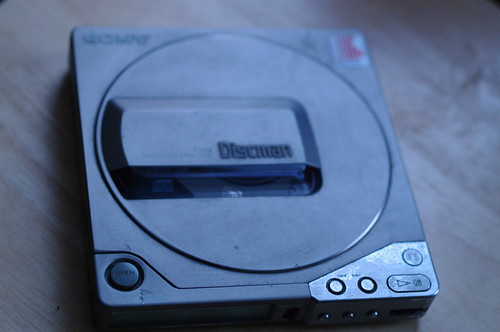
  • Sony Discman D-250

    When you think about the likes of the Sony Discman D-250 you need to realise what it was like growing up in the 1980s. It meant that personal music on the move was a ghetto-blaster perched on your shoulder annoying the neighbourhood or a Sony Walkman personal stereo. I was really fortunate in that I had a half decent Walkman WM-24 which whilst bulky gave half decent sound. It was more expensive looking than it actually was but the Dolby noise reduction made a big difference. This eventually died on me and I ended up with a more modern, but poorer quality Walkman WM-36.

    But a CD player was what you really wanted, for decent sound.
    Sony D-250 Discman
    I poured over the Sony catalogues working out which one I wanted (the Sony D-Z555) versus the best that I could afford (the Sony D-250). The Sony D-250 Discman was in Sony’s premium Discman range, featuring a pressed metal chassis and a NiCD rechargeable battery the size of a packet of Dentyne gum. Eventually the battery dying and my not being able to buy a replacement battery would see it do hi-fi duty. Portable music would have me use a Sony DCS901 Sports Discman. This also played CD-Rs full of MP3 files – it was my pre-iPod and had a battery life of almost 40 hours, but more of that another time.

    The Discman D-250 came with line-out connection for a hi-fi and you could attach a wired remote control. It could be programmed to random play, play tracks in a specific order and access CD ‘index marks’. These index marks put you to predefined points in a specific recording and at the time were only used in some classical recordings. As a standard it wasn’t widely supported but would have leant itself well to the mix CDs that started to come along a few years later from Mixmag Live.

    The CD has served me well as a player for my hi-fi system because of its rugged mechanicals and decent electronics long after I started using an iPod for portable music and its more sophisticated brother the D-Z555 is highly prized by hi-fi enthusiasts for the same reason, particularly as it featured a digital output as well.

  • Think Outside Stowaway

    I first got hold of a Think Outside Stowaway portable keyboard at the start of my agency career. It was 2000, the over-enthusiasm for internet-based businesses, alternative telecoms providers and Linux eco-system businesses was in full-swing and I was building my agency career helping further fuel the economic bubble.

    Broadband wasn’t a word in common parlance, streaming video windows were about the size of a postage stamp; that didn’t stop sites like UK business technology site Silicon.com from trying to develop and promote video content for the web.

    We weren’t living in the real-time always-on world of now. At this time wi-fi devices were online starting to be launched on to the market and was some way from adoption. Wireless meant using IrDA infra-red connections between devices (like a TV remote control having a long conversation) and wireless data meant the then new digital mobile phone networks with SMS and patchy voice services.

    You could could get some Nokia and Ericsson phones to talk to other devices to connect to the internet but it wasn’t cheap. The only people I knew who used it were news photographers getting pictures over to picture desks at photo agencies and newspapers.

    My biggest client at the time was Palm who were spun out of 3Com with Carl Yankowski at the head of the company and Bill Maggs as CTO.

    I had gone out and bought a Palm Vx PDA three weeks before being put on the account (where I would have got one for free).  The Vx became my primary computing device, as I was away from home much of them working in the office, at client meetings or traveling. I started to write on it, but the stylus would only get you so far.

    I had looked at devices like the AlphaSmart 3000, which was cheap, ran on three AA batteries for weeks at a time, and could transfer text via USB. It had proper keys with decent travel on them and was sturdily made, but it had a similar footprint to a modern-day 13-inch MacBook Pro.

    I eventually ordered a Think Outside Stowaway portable keyboard from Amazon in the US. The keyboard used the Palm Vx as its ‘computer’ and and PDA became a compact word processor that would fit into two jacket pockets and was more productive than even the current iPad.

    I managed to draft emails to colleagues, positioning documents, media tour briefing documents and press releases on it. You could type away quite happily on the train or an airplane, which I frequently did when I went back home to see the parents.

    How on earth did a they get the Think Outside Stowaway keyboard to fit in a jacket pocket?

    This came down to a bit of product design genius by a Silicon Valley-based start-up called Think Outside Inc. who came up with a Jacob’s Ladder-type keyboard design which gave you 19mm keys and then folded into four sections – connected together with a flat ribbon cable. The pieces were locked together by sliding in two handles (the red bits in the picture above) to provide a stable flat keyboard. The design was so successful that Palm sold their own-branded version to be sold to people like me and Targus-branded versions did a similar thing for Handspring, Compaq and HP PDAs. But none of them had the elegant design solution collapsing the keyboard like the Think Outside Stowaway unit.

    A flip-up connector plugged into the serial port of the device and held the screen at an optimum position for viewing. Later versions of the keyboard used Bluetooth wireless connectivity, unfortunately the electronics were less tolerant of being folded up so the keyboards became less elegant and bulkier. Eventually Think Outside was acquired by cellphone charger company Mobility Electronics (iGo) and eventually touch devices pretty much killed the mainstream demand for a portable keyboard all together.

    You can still get keyboards that embody the ideas of the Think Outside Stowaway. Unfortunately, they aren’t any more compact or robust than their predecessor. Which is a shame given the prevalence of iPhone users is many businesses. More throwback gadget related content here.

  • iPhone 4S

    I read through the Apple press materials following the iPhone 4S and iCloud services launch the other day. There was a lot of disappointment out there when the phone revealed wasn’t a massive step-change forward which is probably massively unfair for example Carnegie Mellon University professor or computer science David Farber posted the following message on his Interesting People mailing list:

    After yesterday’s announcement by apple I decided to   explore changing phones and/or carriers. I am specifically interested in the most advanced smartphone with “4G” capability.

    Any suggestions?

    Having done my own research, I ended up coming away with questions rather than forming opinions.

    Firstly, iCloud; I read and saw nothing that altered my initial perceptions and concerns when I wrote about the service back in June. So rather than repeating myself it is easier to link out to my earlier post.

    As for the iPhone 4S itself; the updates to the device compared to the iPhone 4, felt as much about feature catch-up as about innovation. The improved camera matched features in top of the line Nokia and Samsung phones. The much-lauded speech recognition application Siri was as much about matching the voice activated features in Android software.

    Unlike many online who were looking for a new thinner form factor, I was glad that the new phone kept the iPhone 4 size as there is already an unhealthy focus on size zero design at the expense of battery life, product performance  and ergonomic design.

    When Steve Jobs talked about the transition to Intel processors for the Macintosh product range, the rationale was mostly around a new focus on processors moving from computing power to computing power per Watt. I’d like to know what effect that Apple’s new electronics design for the iPhone 4S has on power consumption and battery life. Does the faster video transitions come at the expense of usability due to declining battery life?

    Only time will tell if the aerial changes and new electronics have improved the iPhone performance in areas such as call quality and dropped calls. After the initial rush to buy from completists and early adopters the word-of-mouth around these issues are going to be important for iPhone sales. More information about the iPhone.