Category: technology | 技術 | 기술 | テクノロジー

It’s hard to explain to someone who didn’t live through it how transformation technology has been. When I was a child a computer was something mysterious. My Dad has managed to work his way up from the shop floor of the shipyard where he worked and into the planning office.

One evening he broad home some computer paper. I was fascinated by the the way the paper hinged on perforations and had tear off side edges that allowed it to be pulled through the printer with plastic sprockets connecting through holes in the paper.

My Dad used to compile and print off work orders using an ICL mainframe computer that was timeshared by all the shipyards that were part of British Shipbuilders.

I used the paper for years for notes and my childhood drawings. It didn’t make me a computer whiz. I never had a computer when I was at school. My school didn’t have a computer lab. I got to use Windows machines a few times in a regional computer labs. I still use what I learned in Excel spreadsheets now.

My experience with computers started with work and eventually bought my own secondhand Mac. Cut and paste completely changed the way I wrote. I got to use internal email working for Corning and internet connectivity when I went to university. One of my friends had a CompuServe account and I was there when he first met his Mexican wife on an online chatroom, years before Tinder.

Leaving college I set up a Yahoo! email address. I only needed to check my email address once a week, which was fortunate as internet access was expensive. I used to go to Liverpool’s cyber cafe with a friend every Saturday and showed him how to use the internet. I would bring any messages that I needed to send pre-written on a floppy disk that also held my CV.

That is a world away from the technology we enjoy now, where we are enveloped by smartphones and constant connectivity. In some ways the rate of change feels as if it has slowed down compared to the last few decades.

  • Palm | HP portable devices

    I decided to jot down some thoughts on the demise of the Palm | HP portable devices business. I am not going to say whether it was the right or wrong thing to do mainly because other people have been doing that already.

    HP and the mobile device

    HP was arguably the original modern mobile computing device manufacturer, coming out with the HP-35 scientific calculator back in 1972. The company had a long history of being a pioneer in mobile computing; so the move away from mobile devices is actually putting an ending to a long line of devices.

    Compaq had a set of handheld computers in the mid-1990s called Aero. These ran DOS and Windows 3.1, being the predecessors of devices like the ASUS eeePC netbook.

    HP developed a number of PDA devices in the early and mid-1990s including the 95LX, 200LX, 100LX and the OmniGo 700LX which allowed a Nokia 2110 to piggyback on the PDA with a specially molded section on the back of the case.

    The Jornada series of devices was a range of Microsoft Windows-powered PDAs were launched in 1998 and had a number of achievements including the first Windows Pocket PC colour touchscreen device and a UK-only GSM smartphone. The Jornada brand was phased out following the merger with Compaq.

    The iPAQ succeeded Compaq’s Aero line in 2000 and the HP Jornada line after Compaq had been acquired. The last iteration of the iPAQ range was in 2010.

    The Palm range of devices were first launched in 1996, the operating system was tweaked and prodded over the next decade to power various different devices including the iconic Palm III, V and Treo range of smartphones. Ultimately it eventually came up with the webOS after repeatedly fumbling its future.

    This is a long and rich history of engineering innovation for which the Touchpad and Pre don’t stake up as worthy successors.

    Things I never got when the Palm acquisition was first announced

    I wrote up some bullet points of things that I didn’t fully understand when HP originally announced the Palm acquisition:

    • Is HP overpaying for the company? There isn’t that many people interested in Palm and analysts had set a target share price of zero. Is this price as much about emotion as assets?
    • Why is the Palm WebOS going to live up to HP’s faith in it?
    • Much was made of Palm’s cloud services technology in the webcast, but how many extra servers or services will it actually sell for HP?
    • SKUs. I was alarmed at the amount of proposed device variants HP was envisaging in the future on the call with possible support in differing form-factors for Microsoft Windows, Windows Phone, Android and WebOS in personal devices

    With the benefit of hindsight:

    • Unless HP manages to parlay Palm’s intellectual property assets into a patent war chest either through an auction or successful legal action, it is unlikely to make its money back on the Palm acquisition and its Palm | HP portable devices. There isn’t likely to be licensing revenues from other manufacturers that would make up Palm acquisition. Whilst, the current uncertainty around Android may make manufacturers open to looking at an alternative operating system; but why take on webOS when both Palm and HP couldn’t make it work properly? It’s not like both these brands didn’t have a good reputation and heritage in building mobile computing devices, also in order to license the operating system HP would have to maintain and continue to develop it. What would that road-map look like and why would HP continue to develop consumer-facing software given its renewed focus on the enterprise
    • I never did find out how webOS was going to live up to HP’s leap of faith in the operating system because it evidently didn’t pan out, hence HP withdrawing it’s Touchpad and Pre devices

    The value of the Touchpad and its implications for the webOS

    Many of the eulogies for the Touchpad and the Pre point out that webOS was good software held back by Palm | HP portable devices hardware chops. This was the same criticism leveled at the original Palm Pre; so it begs the question why didn’t new owner HP try and deal with the performance issues second time around? I suspect that the leadership of Palm knew that the original Pre sucked, which why it was kept out of journalist hands for so much of the launch period.

    Given the resources of a large company like HP, I would have thought that the former Palm engineering team and their new HP would not have wanted to continue making poor performing products; and instead would have looked to draw a line under everything with a superior device.

    Yet when you look at the price that the remaining Touchpad devices are flying off the shelves in the US: 99 USD, this tells you a lot about the perceived value of the product.

    The 99 USD price point is some 220 USD below the tear-down price of the HP Touchpad. The tear-down price is a conservative estimate of the total cost of a Touchpad to HP. Now you can allow for the fact that the product has some discount priced in because HP was withdrawing from the market, but even Nokia isn’t taking that kind of bath with its Symbian handsets.

    So a fair amount of this discount must be due to the device experience provided by the webOS software. The risk versus rewards offered to users by this operating system far outweigh the intrinsic value of the hardware on which it runs. I would have to question why anyone would want to license webOS? You can find more more related content here.

    More Links

    HP | Palm deal thoughts

    HP: What Léo Apotheker’s Decisions Mean | Monday Note

    HP gave up on cool webOS devices but promises webOS PCs and printers | VentureBeat

    HP TouchPad Carries $318 Bill of Materials – Teardowns at iSuppli
  • Funds of funds + more news

    Funds of Funds

    Funds of Funds May Actually Increase Risk, Study Finds – NYTimes.com – this feels counter-intuitive at first, until you realise that funds of funds are a synthetic financial instrument from the prospective of the end investor. Synthetic financial instruments led to problems like the 2008 financial crisis and the Savings and Loans crisis of the 1990s. The reason for the problem of funds of funds for the end investor is that there lots of known unknowns under the hood. It is conceivable that several funds make a similar wrong headed bet and get stung by it. Without directing the funds, how do you maintain continued diversity of investment and strategies to ensure the bet hedging. Lastly funds are less liquid assets in the grand scheme of things with limitations on when and how much you can withdraw. I wonder if a similar study has been done around thematic ETFs as well?

    Beauty

    At Makeup Alley, Advice From Online Peers – NYTimes.com – how user reviews are demolishing beauty treatment company claims and promoting other products that previously didn’t claim benefits

    Economics

    Wealthy Investors Grow Pessimistic About Economy – WSJ – US economy, due to government debt and economic growth

    Japan records surprise trade surplus – FT.com – rescheduling manufacturing work around power fluctuations

    Ethics

    danah boyd | apophenia » “Real Names” Policies Are an Abuse of Power

    A Billion Dollars Isn’t Cool. You Know What’s Cool? Basic Human Decency | TechCrunch – social norming around the social web

    Ideas

    Could Quantum Computing Kill Copyright? | TorrentFreak

    Korea

    Five Lessons From Samsung’s Second Quarter Results – WSJ – interesting that Samsung is husbanding its cash by reducing shareholder returns

    Luxury

    Second-Tier Spotlight: “Rich Second Generation” Fueling Ningbo Luxury Market « Jing Daily : The Business of Luxury and Culture in China – interesting divergence in consumer preferences

    Media

    To Spread Your Brand On Facebook, Don’t Target Your Fans–Target Their Friends | Fast Company – propagation planning

    More British papers dragged into hacking row ‹ Japan Today – not surprising, the practice may have started at the News of The World but could have been taken around the papers as journalists and editors move on to new roles

    Murdoch Selects Advisers Carefully – WSJ.com – it makes sense he needs a ‘clean’ team that can stay together through this

    Online

    danah boyd | apophenia » Designing for Social Norms (or How Not to Create Angry Mobs)

    With the Bing Search Engine, Microsoft Plays the Underdog – NYTimes.com – I am not seeing a cohesive vision to change search from Microsoft; this looks like the ‘we are innovative’ foot-stamping PR wrapped in a storytelling methodology that comes out of Microsoft corporate PR. I think that the social search stuff at Google and Facebook is of more interest. Bing needs to come out of the box with something 10 times better to get people to move in significant numbers. Qi Lu didn’t manage it at Yahoo!, what makes them think he can manage it at Microsoft?

    A Bomb in Oslo? What Google Lost by Ending Real-Time Search – The Atlantic – Google News just wasn’t as fast, it needs Realtime

    Official Google Blog: More wood behind fewer arrows – interesting change, more focus on fully formed products?

    Security

    Majority of South Koreans’ data exposed | FT.com – the interesting bit is the data wipe of PCs used in the attack to hide fingerprints

    Technology

    Data Centers Using Less Power Than Forecast, Report Says – NYTimes.com – green technology and virtualisation kicks in

    The Key Subtle Notes From Apple’s Earnings Call | TechCrunch – exclusives are doled out on the conference call without hype

    Wireless

    Apple Passes Nokia and Holds Off Samsung to Become World’s Top Smartphone Vendor [Updated] – Mac Rumors – Android is Toyota and Apple is Mercedes & Porsche

  • Facial recognition – ethics

    Former CEO Eric Schmidt made a big deal of facial recognition databases being the one technology that Google wouldn’t deploying as it is an ethical and privacy set too far. Face recognition is currently used in law enforcement situations from policing football matches to anti-terrorism detection and surveillance amongst crowds. Google does use a certain amount of face recognition technology in its Picasa photo-sharing application and has some patents on using facial recognition in a social network.

    Developments in face recognition technology are apparently taking place at a rapidly increasing pace according Schmidt, which means that even if Google doesn’t roll something out, others will, Facebook being the likely favourite.

    With geotagged images and video taken by smartphones, turning the world into a constantly surveiled system. There would be no privacy and few hiding places left. The idea of moving to a new town or city and reinventing yourself which young people do when they go to college or go and get their first job would fall at the first hurdle as your old life would be seamlessly sewn together to your new one online.

    The risk goes up considerably when you have battered spouses who have ran away or are looking escape a stalker.

    Google’s disinterest in face recognition could be seen as being more about dodging anti-trust regulations, particularly if this technology was merged with search. However once someone does it, Google will to be a reluctant but fast follower if it is to continue to compete in the online space, which probably explains why they bought PittPatt the other day and recently patented the use of facial recognition technology to pick famous people out of pictures (presumably to improve image search relevance). More related content can be found here.

    More information online

    One Counter To Schmidt’s Facial Recognition Claim | Stowe Boyd

    Google Acquires Facial Recognition Software Company PittPatt | Techcrunch

    Google warns against facial recognition database | The Telegraph

    Google Thinks Facial Recognition Is Very, Very Bad. Except Maybe For Famous People | Gizmodo

    Google debates face recognition technology | FT.com

  • Idea Man by Paul Allen

    Self-described ‘Idea Man‘ Paul Allen was the technical foil to Bill Gates’ when he founded Microsoft. Much of the Microsoft story is the story of Bill Gates – partly due to the way the company’s PR machine built Gates up as a software superman. The wheels came off the wagon with the Judge Jackson trial video testimonial. Allen dropped out of the story despite being instrumental in many of the key early products; instead he became known as a local billionaire who liked to jam with rock star friends and owned some local sports teams. Now he is trying to reinsert himself carefully in Microsoft’s story with Idea Man.

    Gates is now re-inventing himself has a modern-day Rockerfeller through charitable donations, trying to redefine his place in history as a convicted monopolist. With this change, Allen becomes even less significant. A cynical person may describe this book as Paul Allen’s attempt to write himself back into history, but without the Gates stigma. This view was reinforced by the books launch occurring round about the same time that Allen took legal action against many of the most successful technology companies for alleged patent violations.

    A student of Microsoft’s history would recognised the flawed human portrait of Bill Gates who is portrayed  as argumentative, ruthless, driven determined and petty. So in many respects Allen doesn’t add much to the Gates canon; Allen acts as an apologist for Gates in many respects being exceptionally tolerant of his faults; a co-founder equivalent of Stockholm Syndrome. Ballmer comes across as being a more decent human being, yet Allen’s accurate but unnecessary visceration of Microsoft’s performance feels as if it is aimed more towards liquidating Ballmer’s historic legacy.

    What I didn’t get from the book was the sense of Allen the person, what is he really like? What drives him? What are his demons? In this respect, Allen is absent from his own memoirs and the book comes across as two-dimensional because of it.

    There are sections on his relationships with famous musicians and sportstars, but it didn’t mean that much to me so I can’t comment beyond saying  that I didn’t find it that engaging.

    If you are going to read any book that touches on Microsoft and the PC era; I would instead recommend Robert X. Cringely’s Accidental Empires or Jennifer Edstrom (daughter of Waggener Edstrom’s Pam Edstrom) and Martin Eller’s Barbarians Led By Bill Gates.

  • iCloud thoughts

    On June 6, Apple announced a number of products at a keynote speech to kick off its worldwide developer conference. Mac OS X Lion and iOS 5 were widely anticipated; but the one that got the most attention was a service called iCloud.

    This service has received a fair bit of coverage and its worthwhile reflecting upon, some of this reflection has to do with all the things that we don’t currently know. I am not  going to focus on the iTunes Connect product that gives you a selection of your music across devices as other people have done that much better than I could.

    First of all a bit of a history lesson

    Apple has actually selling online services since about 1985, so Apple’s history with online services is almost as old as The WELL. AppleLink was an online service set up originally to connect Apple employees and dealers, it had a client software application for both Mac and the later models of the Apple II. It provided assess to remote server folders (kind of like FTP, iDisk, Box.net or Dropbox), bulletin boards for discussion and system-wide email (though interoperability with other email systems came in later).

    This system was a way that Apple distributed systems updates and drivers to dealers (you have to remember that at that time operating systems and the associated software that went along with them took up much less memory than they do today). This was all hosted on time-shared mainframes and connected by a global data network by GE Information Services. GE charged too much for the service and didn’t reflect the technological changes coming down the pipe that made these services cheaper to operate. So Apple eventually worked with Quantum Computer Services (now known as Aol) to develop a version of AppleLink suitable for consumers.

    The first email from space was sent on an Apple Portable via an AppleLink account from the Atlantis space shuttle to the Johnson Space Center in 1991. Back in 1988, AppleLink was also the host for a multi-channel story that played out with weekly episodes and included user identities woven into its plot. The storytelling used chat rooms and email was well as a more traditional narrative format echoing Matt Beaumont’s novel e by about 12 years.

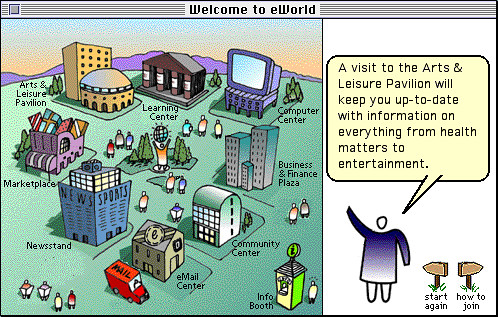
    After a while, Apple, had a falling out with GE Information Services and consolidated their own service renamed eWorld and had it run by AOL.
    eWorld main screen
    Eventually eWorld was closed down as Apple realised that it couldn’t compete with AOL and they had bigger things to worry about as Apple was on the downward trajectory that would result in the return of Steve Jobs. By 1997 both AppleLink and eWorld had been closed down. The content eventually ended up on the Apple website under sub-domains like developer.apple.com and support.apple.com.

    In 2000, Apple came back with iTools which included the .mac email accounts, simple web publishing and iDisk. The email account allowed you to have IMAP4 which was rare at the time and iDisk was based on WebDAV standard to syncing. There were other services including web publishing and iCards: an electronic greeting cards service (prior to Facebook were a low impact way to exchange greetings, with a HTML card sent via email. One of the most prominent providers bluemountain.com was bought in a deal apparently worth 780 million dollars by then internet giant Excite@Home).  By 2002, Apple started charging for these services and briefly threw in a subscription to Virex.

    The service got a rebrand as MobileMe to take account of Apple’s expanded computing portfolio to take in the iOS-powered series of devices. Newcomers got a .me.com email address rather than the .mac.com email address. I myself have been signed up to these services through their evolutions for the past ten years or so, so still have a .mac.com ID.

    iCloud is a development repackaging of these offerings; an evolution rather than an innovation, it also means that Apple’s claim in the sub header of its press release that the service: Free Cloud Services Beyond Anything Offered to Date – are economical with the truth. There is also a question in my mind, for reasons I’ll outline below, about whether this next evolution is positive for end users.

    Device philosophy

    One of the things that stuck out to me when I was listening to Steve Jobs introduce iCloud, he described the Mac as ‘just another device’. On one level it makes sense; as the Mac is one of three sets of computing devices that Apple now sells: the Mac, the iPad and the iPod Touch / iPhone.

    • The second thing that marks it out, is a trust that as Sun Microsystems used to say ‘the network is the computer’.
    • Finally there is the question of primacy. Which device is the ultimate arbiter of the correct data?

    The flawed ‘net

    iCloud is based on the assumption that good quality data connectivity is ubiquitous, this is complete fiction for many people. I live in central London, apparently a world city, a hive of connectivity. Wi-fi that I can access safely is only available in certain coffee shops, and the mobile networks are full of holes like Swiss cheese. I am with Vodafone that seems to be better than most, but the only way to have a near-continuous reception is to roam on a foreign SIM; which is outrageously expensive. This situation isn’t . In the UK, the broadband infrastructure simply isn’t available to support existing streaming video services. I live in Central London within the proverbial stones throw from Silicon Roundabout and get barely 3MBs download and 400KBs upload from my ADSL connection. I live 500 metres from my local exchange.

    Data integrity

    One area I am not convinced that Apple will get right with the iCloud is keeping the integrity of address and calendar data intact. If one device doesn’t have primacy there is no control mechanism. It is easy to accidentally alter a record on an iPhone and that could then ripple through the iCloud to all associated devices based on it being the most recent edit. There is no information on how it will handle duplicate entries and failed syncs. Lots of unanswered yet critical questions.

    Household enterprise systems

    My set-up on MobileMe is relatively simple, I have one iTunes account, one address book, one calendar, one set of bookmarks and system preferences. These are synced across two devices (the MacBook Pro that I am writing this post on, and my iPhone). But increasingly, Apple’s eco-system is found at the centre of family’s IT systems. The analogy of the household CEO is often used to describe the housewife as homemaker.

    The family’s IT system needs to look more like the kind of enterprise technology that a CEO would expect. With massive data storage and policy-based systems designed to keep the right data with the right owners. I haven’t seen any evidence that iCloud would do this which is likely to result in lots of poisoned address books and music collections.

    It just works?

    One of Apple’s key selling points since Steve Jobs returned to Apple was that the company’s products just work. This is why the synergy between hardware and software is so important. When you took one of the original iMacs out of the box, you plugged in the keyboard, the modem cable into the telephone socket, the power socket and turned it one; you were ready to start computing.
    Museum of Information
    It promised elegant simple technological choices to early adopters and the late majority alike and is why products like the iPod, the iPad and the iPhone have become commonplace in many developed marketplaces disrupting incumbent players like Creative and Nokia. The complexity and challenges that the iCloud system needs to overcome could undue this unique selling proposition and tear Apple’s market-making leadership position apart.

    Open standards to Apple standards

    One of the things that has helped Apple to do well has been its adherence to open standards: the iMac benefited from being a USB pioneer. Mac laptops became popular with photographers because of FireWire. The Safari web browser and WebKit build upon W3C standards compliance and it is hard to remember now, but the first iPhone used HTML5 web applications for external developers – something that many people lost sight of.

    Apple’s online services were similar. The email service was based on IMAP4 allowing for easy synchronisation and iDisk works on WebDAV. However in the Apple press release announcing iCloud there is no information on what it supports any standards, but it does talk about iCloud storage APIs. And Apple did promise to make thse APIs available to developers. I am concerned that my social graph may be locked into a storage equivalent of the Hotel California; which is especially dangerous when you think at the amount of iterations and service closures that Apple has exhibited in the online space.

    More online related content can be found here.

    More reading

    Apple Introduces iCloud – Free Cloud Services Beyond Anything Offered to Date

    What the iCloud will cause to happen next | FT.com

    Apple details iCloud’s digital storage and syncing, free 5GB of storage

    Fourth time’s a charm? Why Apple has trouble with cloud computing

    Cloud Poll: Does iCloud Actually Have Anything to Do with Cloud Computing? | ReadWriteWeb