Category: technology | 技術 | 기술 | テクノロジー

It’s hard to explain to someone who didn’t live through it how transformation technology has been. When I was a child a computer was something mysterious. My Dad has managed to work his way up from the shop floor of the shipyard where he worked and into the planning office.

One evening he broad home some computer paper. I was fascinated by the the way the paper hinged on perforations and had tear off side edges that allowed it to be pulled through the printer with plastic sprockets connecting through holes in the paper.

My Dad used to compile and print off work orders using an ICL mainframe computer that was timeshared by all the shipyards that were part of British Shipbuilders.

I used the paper for years for notes and my childhood drawings. It didn’t make me a computer whiz. I never had a computer when I was at school. My school didn’t have a computer lab. I got to use Windows machines a few times in a regional computer labs. I still use what I learned in Excel spreadsheets now.

My experience with computers started with work and eventually bought my own secondhand Mac. Cut and paste completely changed the way I wrote. I got to use internal email working for Corning and internet connectivity when I went to university. One of my friends had a CompuServe account and I was there when he first met his Mexican wife on an online chatroom, years before Tinder.

Leaving college I set up a Yahoo! email address. I only needed to check my email address once a week, which was fortunate as internet access was expensive. I used to go to Liverpool’s cyber cafe with a friend every Saturday and showed him how to use the internet. I would bring any messages that I needed to send pre-written on a floppy disk that also held my CV.

That is a world away from the technology we enjoy now, where we are enveloped by smartphones and constant connectivity. In some ways the rate of change feels as if it has slowed down compared to the last few decades.

  • Closing the innovation gap – Judy Estrin

    Closing The Innovation Gap is a rare breed of book. It looks with a clear eye at the subject of innovation and Silicon Valley.

    Innovation is an overused word, companies like to have it associated with their brand, products and services as it affects both the share price: covering management sins and providing investors with a veneer of hope for future growth. In a previous life, I worked at a firm where we used to talk about doing ‘innovation communications’. Where the theory went, we helped innovative companies communicate the fact that they were innovative.

    All this pre-supposed that we had a clear definition of what innovation was. From my time there, there seemed to be an assumption that all IT and biomedical related businesses were essentially innovative (unless they competed against our existing client base).

    Whereas a food business that borrowed the ‘virtual fab’ model from chipmakers in the semiconductor industry to take on big guns like Proctor & Gamble or PepsiCo wasn’t. I guess the bottom line I am trying to get across is that innovation is critically important, yet tragically misunderstood by many people.

    Judy Estrin has a genuine pedigree in innovation coming from a family of innovators. Her father worked with John von Neumann (the father of modern digital computing) at the Institute of Advanced Studies in Princeton and her mother was a professor at the computer science department of UCLA.  Judy has a Silicon Valley pedigree having had senior roles or been a board member at: Sun Microsystem (who build servers on which banks, telecoms providers and many dot.coms depended – now part of Oracle), Cisco (who pretty much are the internet infrastructure) and FedEx.

    The book addresses the challenge of innovation that we currently have.

    I have had a gut feeling about the decline in pace of innovation over the past decade or so. In a lot of respects improvements in computing have lost their sparkle, they longer feel like a leap forward, but more of the same.

    When I think about the dot com period there were meaningful improvements in telecoms hardware, web technology, software and business processes – not all of them where financially successful but things felt as if they moved forward.

    If I think about web 2.0 – the biggest single improvement was more of a software engineering improvement with a deliberate focus by the likes of 37signals and the original flickr team on avoiding feature bloat at the expense of usability.

    Facebook is an evolution from the likes of The WELL, Friendster, Friends Reunited and MySpace – rather than a true innovation.

    The iPhone whilst beautifully crafted in terms of software and hardware, increasingly reminds me of my long departed Palm Vx PDA – but with a shitty battery life.

    In Closing the innovation gap, I found the book to fall into three distinct sections:

    • Charting the origins and progress of what I will call ‘innovation entropy’ in the west. This talks about how the cold war was entwined with the rise and stall of innovative research that helped in creation of technology that we take for granted today: keyhole surgery, the internet, modern computers, cellular phones and CCDs (coupled-charged device which go into digital cameras.)
    • The economic and cultural effects of ‘innovation entropy’. In this respect Estrin echoes the work of Will Hutton’s The state we’re in published in 1996 which I read in college. Like Hutton, Estrin is a critic of short-termism in business, the financial markets, academia and government spending. Some of this short-termism was unintentional as the law of unintended consequences kicked in due to changes in regulations that were designed to encourage innovation. A secondary factor that Estrin points out is a corresponding lack of appetite for risk – or the rise of risk management which has helped cripple long-term research which begat big innovation
    • How to address ‘innovation entropy’. In Closing The Innovation Gap Estrin maps out the areas where educators, government, financiers and businesses need to change and collaborate on. This collaboration requires root-and-branch change

    Estrin’s book is powerful as she pulls together a coherent story which makes it easy to read. As a prominent person within Silicon Valley she gains access to many people who are at the head of organisations driving innovation at the present time. More related content here.

  • Kin logo

    Whilst I won’t be dashing out and getting myself one of the Microsoft | Sharp Kin phones. I did like the Kin logo. The logo seems to be completely unrelated to the devices. It’s an atemporal brand design it would be easy to produce on screen, as an app icon or in print and also looks as if it draws heavily on Asian influence. 

    You wouldn’t need to be able to read the characters to at least recognise the brand. With that in mind it would work in markets around the world. 

    All of that is makes for a really challenging design brief and the work done on the Kin logo is very impressive. 

    I’d go as far as to say that the Kin brand and products are unworthy of the Kin logo design 

    Microsoft Kin logo

    There is a noticeable stylistic similarity to the S|Double Studio logo from Shawn Stussy’s new clothing label.

    s|double

    And the S|Double logo reminds me of Asian seal designs used to sign documents and mark the ownership of artworks. 

    seal

    This is roughly what my given name would look like on a seal or chop in Chinese characters. 

    There is also a resemblance to Chinese design motifs in Chinese new year and wedding decorations. The one that immediately comes to mind for me is the double happiness character set that is incorporated into designs. 

    Such motifs are used in a repeated pattern across fabric weave, interior design prints and carvings. There is a certain irony in that the Kin logo: one of the most modern of graphic design assignments going back designs and principles that are millennia old. 

    I am curious to know if the Kin logo harking back to those designs was intentional, based on design research, or if it was happenstance. Both are probable likelihoods for this project. 

  • Data that matters

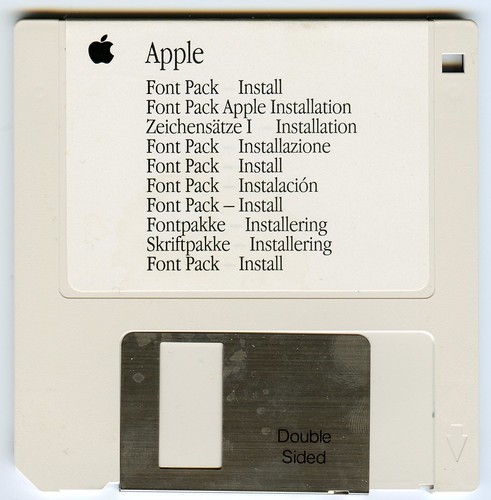
    Data that matters has impermanence – One thing that springs up periodically is how older electronic data becomes harder to access.

    Apple font pack disk from the mid 90s

    Whether its floppy disks that are no longer readable or optical disks which have become corroded through chemical reaction over time electronic data is generally impermanent.

    I lost a substantial amount of the posts on this blog two years ago when the server I used over at Yahoo! Small Business hosting went into meltdown 90 per cent of my blogging output between December 2006 and January 2008 disappeared. I managed to recover 10 per cent of the content from the Google cache of my blog.

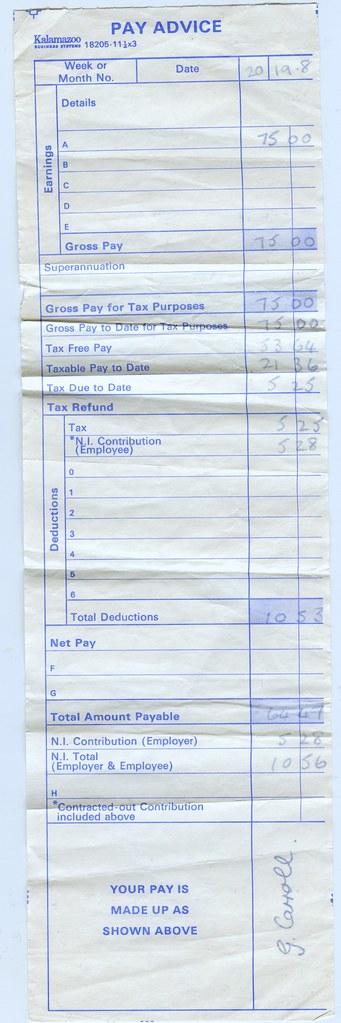
    However it isn’t only digital artifacts that are at risk. I was going through bags of old papers and found my old P60s some of which could no longer be read since they were printed on thermal paper and my first payslip which was barely readable.

    my first proper pay slip

    This was from my first full-time job cleaning and repairing equipment that was rented out to building contractors including lawn mowers, concrete mixers and Makita power drills.

    You can also see paper go yellow from the acid used in its manufacture as well as fade from the carbon paper print.

    I had obviously put it away to keep it for posterity, but I decided to keep it in the cloud as I figure that it might last longer that way now. Though your guess is as good as mine. The thermal paper and Flickr’s business model are both tough things to fathom how robust they will be.

    The problem with this is often the data we don’t want to keep stays like embarrassing pictures on Facebook or a drunken rant on a Usenet forum, whereas the stuff we want to keep too often fades away. So how do we get better at looking after electronic data that matters? More online and internet related posts here.

  • Palm troubles

    First of all some disclosure: I worked on the Palm account at my agency some ten years ago now and got to work with some of the smartest people in mobile device technology, notably the company’s chief competitive officer Michael Mace as an occasional media spokesperson back when his pictures had him with a Magnum PI-style moustache.

    At the time I worked on the account the company was riding high on the PDA boom, but the seeds of its current problems were sown back then.

    Even after working on the Palm account, I was a Palm customer. I had a Palm Vx which I used to death (quite literally) and spent a fortune on accessories including a Rhinoskin titanium slider hard case and a ThinkOutside portable keyboard. After that  I had a number of other Palm devices: a m515, a Tungsten3, a Treo 600 and a Treo 650.

    The last device left such a bad taste in my mouth because of an address book full of duplicates and corrupted data that I migrated to Nokia E-series devices, which provided a superior experience to the Treo 650 despite serious software stability issues.

    The company has been buffeted by critics over the years, many of them well-meaning.

    With the arrival of Jon Rubenstein to give it flare and product smarts and a matching injection of new money into the company, there was every chance that Palm could reinvent itself.

    Unfortunately it didn’t, and the company is now reaping the fruits of mediocre labours.

    To be honest the signs where there that the new product line wasn’t great and I wasn’t surprised:

    The communications-related signs are particularly damning as they indicate that at least some insiders at the company may have realised that the product despite the hoopla was not ready for primetime.

    Palm Pre

    The second good sign of a bad device is when after a decent amount of time virtually no one that you know owns one. I only know one person: the fashion-forward Rise co-founder Paul Allen; however on this occasion the Palm Pre has turned out not to be a fashion classic and more like a gadget equivalent of MC Hammer’s parachute pants.

    Interestingly, in his letter to Palm employees, Rubenstein puts much of the weight of corrective action on working short-term tactics with carrier partners to create demand push with no clue about what execution improvements in terms of product redesigns and quality improvements (if any) would be coming to shore up a poor customer experience. More gadget related content can be found here.

  • Internet experience in China

    If you are like me you probably have some favourite platforms that you find useful for your online life. This is a list of what I found worked and didn’t work from my internet experience in China. I thought that it would be handy to know, so that if you were visiting you could put surrogate services in place to continue your online life.

    Works well

    • Flickr – both Uploadr and the site work just as well as they work at home
    • Delicious – again just works as well as you would expect it to at home
    • Google – seemed to work fine, though this may change because they haven’t been the best corporate citizen in China recently. Interestingly, typing Google.com took me directly through to the US site rather than their usual trick of geo-targeting and loading up their local country portal instead – which is a source of mild irritation when I am travelling
    • Google Analytics – dashboard worked as promised
    • Feedburner – worked as good as usual. The 120-odd drop in subscribers on the day I arrived in China I put down to my content being uninteresting as it picked right up again the following day
    • Pretty much all the major IM platforms worked well: I use Skype, Yahoo! messaging, AOL Instant Messenger, GTalk
    • LinkedIn – worked fine
    • Last.fm – worked just as well as it does back home. I scrobbled and listened to music from Shenzhen
    • Web radio – I logged on to RTE to keep up with the latest news and current affairs closer to home with no problem at all

    Patchy performance

    • Foursquare – whilst I could select Hong Kong as a city, it found it often difficult to register with a place as it struggled to match location with ‘geo-coding’. A bit disappointing to be honest with you. I did use it successfully in Shenzhen where I found free wi-fi. Your mileage may vary

    Didn’t work

    • Twitter – I found myself using instant messenger much more, to compensate for the way that I use Twitter as a communications tool. I use a multi-platform instant messaging client called Adium and had no problem with Yahoo! Instant Messenger, GTalk, Skype, .mac | MobileMe messaging, AOL Instant messenger out here so workarounds for communication are really easy
    • Friendfeed – to be honest I only looked at this because I thought I may be able to catch up on a few Twitter feeds
    • Facebook doesn’t work, but my account is a zombie account anyway with content being fed in from other places like Twitter
    • Bloglines – I would recommend downloading an RSS newsreader client and importing your OPML file to temporarily replace using Bloglines. I missed my RSS reader far more than the more banal communications of Twitter

    Internet experience in China: performance

    Generally sites can be a little slow and occasionally you need to use the refresh button. Traffic gets very slow indeed on Sunday evenings.

    The Chinese are enthusiastic adopters of the ‘net and families often log-on to watch a film or TV programming on a Sunday evening – during this time, website load times noticeably increased and I found video Skype calls worse than useless. So let’s hope that BBC iPlayer doesn’t get too popular in the UK, otherwise reality TV shows may cause the ‘net to grind to a halt. More China related content here.