It’s hard to explain to someone who didn’t live through it how transformation technology has been. When I was a child a computer was something mysterious. My Dad has managed to work his way up from the shop floor of the shipyard where he worked and into the planning office.
One evening he broad home some computer paper. I was fascinated by the the way the paper hinged on perforations and had tear off side edges that allowed it to be pulled through the printer with plastic sprockets connecting through holes in the paper.
My Dad used to compile and print off work orders using an ICL mainframe computer that was timeshared by all the shipyards that were part of British Shipbuilders.
I used the paper for years for notes and my childhood drawings. It didn’t make me a computer whiz. I never had a computer when I was at school. My school didn’t have a computer lab. I got to use Windows machines a few times in a regional computer labs. I still use what I learned in Excel spreadsheets now.
My experience with computers started with work and eventually bought my own secondhand Mac. Cut and paste completely changed the way I wrote. I got to use internal email working for Corning and internet connectivity when I went to university. One of my friends had a CompuServe account and I was there when he first met his Mexican wife on an online chatroom, years before Tinder.
Leaving college I set up a Yahoo! email address. I only needed to check my email address once a week, which was fortunate as internet access was expensive. I used to go to Liverpool’s cyber cafe with a friend every Saturday and showed him how to use the internet. I would bring any messages that I needed to send pre-written on a floppy disk that also held my CV.
That is a world away from the technology we enjoy now, where we are enveloped by smartphones and constant connectivity. In some ways the rate of change feels as if it has slowed down compared to the last few decades.
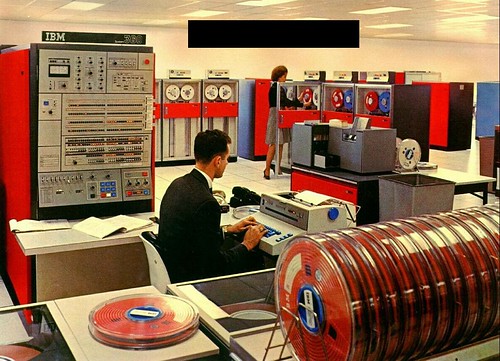
Last week Fred Brooks died. Brooks was famous in technology circles who designed the IBM OS/360 operating software for the IBM System 360 series of mainframe computers. Some 50 years later, the computers that perform the equivalent tasks to the mainframe still ensure that they can run OS/360 application compatible code.
The reason for this was that Fred Brooks did his job really well for mission critical business processes.
OS/360
OS/360 was remarkable. At the time IBM was the leading edge in computers. The 360 system was a major leap forward. It was able to support a wide array of applications, and it was one of the first operating systems to require direct-access storage devices – like a modern computer.
The first release of OS/360 had about a million lines of code, much larger than any previous IBM operating system, and eventually grew to over 10 million lines of code. By comparison the latest version of macOS contains about 85 million lines of code and Google’s technology stack contains about 2 billion lines. But the IBM team that Fred Brooks worked with were doing this about 60 years ago, with all the limitations that that would have entailed.
OS/360 is now in the public domain and its code is often poured over by computer science students looking to learn lessons from the past. That alone would have made Fred Brooks achievement live on today.
Mythical Man-Month
The journey to build OS/360 was to turn out as important as the software itself. Fred Brooks wrote a book based on his experiences and what he had witnessed during the development process. This was encapsulated in a book called The Mythical Man-Month: Essays on Software Engineering. You might not have heard of the book, but Fred Brooks offered insight for anyone managing complex projects. If you’ve experienced Agile and Scrum methodologies in work, you’ve experienced ideas that try and address the challenge that Brooks realised. Large programming projects suffer management problems different from small ones due to the division of labor; that the conceptual integrity of the product is therefore critical; and that it is difficult but possible to achieve this unity.
The ideas within the Mythical Man-Month go beyond software engineering. We use his thinking in most of the advertising agencies that I have worked in.
Polaris
You can see Fred Brooks Mythical Man-Month principle turn up in all kinds of unusual places. My Dad worked on the UK’s Polaris ‘Resolution class’ submarine programme through the 1960s. Advertisements went into the newspapers of Ireland and former Commonwealth countries looking for time-served skilled tradesmen. My Dad worked alongside other Irishmen, people from Hong Kong and at least one Sikh man.
The shipyard was paid by the Royal Navy on a cost plus basis, which meant that the yard was incentivised to have as many people working on the ship as possible, working as much overtime as they liked. The result meant that in a cramped space, there was a lot of people sitting around as they couldn’t physically work alongside other tradesmen.
Which is why some authors have alleged that workers described these submarines as ‘gravy boats’; my Dad hadn’t hear of this term but doesn’t mean that some didn’t use it.
With regards the conceptual integrity of the product; in a time before CAD systems, errors worked their way into working drawings over time.
Frederick Brooks, the famed computer architect who discovered the software tar pit and designed OS/360, died Thursday. He also debunked the concept of the Mythical Man-Month in his book, writing: “Adding manpower to software project that is behind schedule delays it even longer.”
OOPS is Meta’s online operations support system. OOPS provides access to user accounts like a sys admin on a company IT network. If you’re a Meta employee, friends or family you can get hold of a concierge service to solve account related problems. It isn’t available to outsiders.
It seems that OOPS has been used to reassign or disable accounts for profit and access wasn’t as controlled as it should be.
The Meta OOPS scandal made me wonder if OnlyFans performer Kitty Lixo had actually been gaslit about her account by Meta employees, rather than being helped out in return for sex. Lixo has gone from having an Instagram account with 199,000 followers to two smaller accounts with under 20,000 followers combined at the time of writing.
“We met up and I f**ked a couple of them and I was able to get my account back two-three times,” Kitty Lixo said, recommending others with locked accounts to continue reaching out to the platform for eventual ban reversal.
OnlyFans Star Says She Slept With Meta Employees to Get Instagram Unbanned by Nick Mordowanec (May 20, 2022) Newsweek
Subscription Pricing Coming to Features Your Car Already Has – a $25-per-month charge for advanced cruise control or $10 to access heated seats? What if those charges continued long after your car was paid off? …As vehicles become increasingly connected to the internet, car companies aim to rake in billions by having customers pay monthly or annual subscriptions to access certain features. Not content with the relatively low-margin business of building and selling cars, automakers are eager to pull down Silicon Valley-style profits. For automakers, the advantage of this model is clear. …Not only do they get a stream of recurring revenue for years after an initial purchase, they can hope to maintain a longer-term relationship with the customer and build brand loyalty, said Kristin Kolodge, vice president and head of auto benchmarking and mobility development at J.D. Power. – I suspect that this will only work if every car was on a lease agreement and if that’s the case then there are lots of negative impact from old cars that need to be written off that outweigh this business model. Secondly, there is an expectation that all of the vehicle will conform to Moore’s Law.
What about the layoffs at Meta and Twitter? Elon is crazy! WTF??? | I, Cringely – I first arrived in Silicon Valley in 1977 — 45 years ago. I was 24 years old and had accepted a Stanford fellowship paying $2,575 for the academic year. My on-campus apartment rent was $175 per month and a year later I’d buy my first Palo Alto house for $57,000 (sold 21 years later for $990,000). It was an exciting time to be living and working in Silicon Valley. And it still is. We’re right now in a period of economic confusion and reflection when many of the loudest voices have little to no sense of history. Well my old brain is crammed with history and I’m here to tell you that the current situation — despite the news coverage — is no big deal. This, too, shall pass – vintage Bob Cringely
Kiwix on the App Store – this is available on Mac and iOS app stories. It allows you to view an offline version of Wikipedia, Project Gutenberg and Khan Academy modules. Ideal for when you’re unplugged.
The idea of the disruption crisis came from a series of conversations that I have been having in recent times and recent online news.
TechCrunch Disrupt NY 2012 Day Two – May 23, 2012 (Photo: Devin Coldewey)
What is the disruption crisis?
The rise of big tech such as Meta, Twitter, Google, Amazon, Bytedance, Alibaba and Tencent drove a wave of digital disruption over the past quarter century. Now the disruptors are being disrupted themselves and I think that they may precipitate a disruption crisis.
Continuing to look to these digital disruptors is the equivalent of Jimmy Swaggart or Jim Bakker being held up as an exemplar of a good husband and faithful spouse.
Mass lay-offs
Others have talked about the layoffs in more depth, so I have included a video explanation.
I started my agency career during the dot com bubble. We had going for growth at all costs. They talked about trying to move at ‘internet speed’. This was down to the go for growth funding model that drove start-ups through their angel and VC funding rounds and beyond. Common sense was often set aside. if this sounds 180 degrees away from the lean start-up model you’re not wrong.
…Amazon made big bets on long plays, willing to sacrifice immediate profitability to boost its overall position in blue ocean markets. When Amazon’s had to play catch-up, it largely hasn’t worked: the Kindle Phone is maybe the most high-profile mistake/missed opportunity, just to name one. It’s hard to deny that this loss-leader approach has been key to Amazon’s success, although it often made the company a mystery to Wall Street. This would signify a huge shift, totally aside from the 3% of employees who will likely leave the company.
Hacking away at the Devices and R&D divisions is the most perplexing to me. These are the sources of Amazon’s most signature successes, with the Kindle, Alexa/Echo, and Fire TV. They’re what hook customers when they’re still kids, and that customers above all associate with the company, even as they help ensure loyalty and drive their share of media purchases and retail revenue. The Kindle, like the Echo and the Fire Stick, was always supposed to be a loss leader: you sell the razor at close to cost and make your money back selling the blades. How many books has Amazon sold because of the Kindle? How many Prime subscriptions? How many impulse purchases do people make on their Echos and Fires?
Tim Carmody, Loss Leaders. (Issue #50) Amazon Chronicles
Consultants have taken the idea of transformative technology and scrappy startup methodologies to try and reinvent business, or facilitate digital disruption. The problem is that the examples they use as exemplars are failing, casting doubt on their doctrine and fuelling a disruption crisis in boardrooms and the consultants that advise them.
Unilever – a cautionary tale
For instance, I contracted at Unilever. I worked rolling out digital brand assets for their Family Brands product line. This was a line of margarines, due to organic growth it has different names in different markets:
Blue Band
Country Crock
Flora
Fruit d’Or
Margarina Primavera
Plantta
Rama
While I was doing this work, I worked closely with the Becel functional foods and Bertorelli brands. Family Brands was being put into a separate business to develop a ‘startup mentality’. The thing was Family Brands hadn’t been a startup for decades. In fact, it hadn’t been a startup since the 1870s when Antoon Jurgens branched out from trading in butter and started to manufacture margarine. His company merged with rivals Van den Bergh’s, Centra, and Schicht’s to form Margarine Unie (Margarine Union) in 1927, by which time it had a dominant position in margarine manufacturing.
Three years later, Margarine Unie merges with Lever Brothers Limited to create Unilever and the rest was history.
Margarine as a substitute good
Margarine historically was a substitute product for butter. My parents (both of whom came from farming families in Ireland) used to talk about how poor children in the towns would have eaten margarine rather than butter. As a child, we might use margarine to bake a cake, but if we wanted the cake to keep a while my Granny or my Mam would only use salted butter. Despite butter (which we kept in the fridge) being so hard that it might break up the surface of the bread, we used it on our sandwiches, toast or to fry with. Margarine just wasn’t the done thing.
One of the most damning things that my Granny once said about a friend of hers was:
She uses margarine to make the ham sandwiches when you’re invited around for a cup of tea.
One of the first courses that I had at university was in economics, where they used margarine as an exemplar for a substitute good.
Healthier option
Margarine started to be considered a healthier option due to concerns about heart disease and cholesterol. Much of this was down to Flora, invented in 1964, which contained polyunsaturated fats derived from sunflower oil. At the same time wholemeal bread started to become preferable due to the requirement for fibre in the diet.
Yellow fats category decline
However Although 21st century sales declined as many consumers switched to butter. This was down to changes in consumers wanting a more natural product and heart health improvising. In the five years leading to 2014, sales of margarine fell 6%, while sales of butter rose 7%.
It was in this atmosphere that the startup narrative was fired up for Family Brands.
The other shoe dropped when Unilever narrowly managed to fight a hostile bid from 3G Capital a couple of years after I was there. Paul Polman got rid of business lower margin businesses as an attempt to increase earnings. These were still great businesses which is why KKR were happy to take the business off Unilever’s hands.
Unilever didn’t spin out a startup. It wasn’t disruptive thinking, it was an act of desperation to fend off takeovers or possible greenmailing. The problem with with this is Unilever now has a lot less buying power on global supplies of oils and fats needed for its ice cream, mayonnaise, food additives and personal care businesses – which was the rationale for forming Unilever in the first place.
Foundational technologies in crisis bringing crisis
Foundational technologies were cited as new elements that would cause digital disruption. The fall of these technologies and the companies that have championed them have fuelled this disruption crisis.
Cloud services
Microsoft and Amazon both saw declining sales in SaaS and related services, as businesses has less employees and needed less seats. Amazon has been cutting deep in its R&D function and devices. This means that Alexa for the hospitality industry and health sectors are likely to be borrowed time.
Web 3.0 (blockchain, NFTs, cryptocurrency)
Here’s what my friend Nigel Scott had to say about FTX on LinkedIn:
There has been a lot of commentary over the weekend on the #ftx #cryptocurrency #exchange collapse
A lot of words have been typed and spoken but in the end I think the numbers probably sum it up best
Back in 2018 there was an estimated 200 Crypto Exchanges scattered around the globe
Over the past 3 years an estimated 200 Crypto Exchanges have either collapsed or disappeared
This rate of attrition is nothing new. Back in 2014 – after the Mt Gox event – it was estimated 45% of all #Crypto Exchanges had either collapsed or disappeared
The harsh truth is the risk of failure has always been central, rather than peripheral, to the Crypto Exchange model
Today there are almost 600 Crypto Exchanges open for business
The only question that needs to be asked is what fraction of them will still be in business in 2023, 2024, 2025 and beyond?
and, more importantly, what is the probability of picking a survivor, never mind a winner, in such a volatile environment?
Which is to say, contrary to most of the commentary I have read over the weekend, the #ftxcrash isn’t the exception, it’s the rule – what makes it exceptional is the scale, not the probability of the failure
Blast radius
One edition of the Axios Login newsletter used the headline ‘blast radius‘ describe the impact that FTX and other crypto economy problems were having on the wider Web 3.0 ecosystem of decentralised services. Creating a disruption crisis.
Less than four years before disruptive technologies had become mainstream when IBM brought a ‘better way’ of managing supply chain for Walmart by putting their heads of lettuce on the blockchain. Just writing that last sentence made me like my IQ number was dropping; but just four years ago, this was a point of validation…
Metaverse
Prior to Meta’s recent financial results and job cuts you had the likes of McKinsey cheerleading for the metaverse.
With its potential to generate up to $5 trillion in value by 2030, the metaverse is too big for companies to ignore.
To give you an idea of how far we are from the much vaunted metaverse, have a look at my discussion paper.
Social media marketing
Alphabet has seen a decline in YouTube advertising and search advertising is down by about a fifth in October. Twitter is heading towards bankruptcy as brands stopped advertising on the platform. Meta has also shown a decline in advertising revenue. Snap is doing much worse. TikTok seems to be the outlier.
Accenture and the disruption crisis
A quick search of Accenture and disruption yields about 628,000 results. Accenture has latched itself onto disruption in the same way that IBM glommed on to e-business during the first dot com bomb, Sun Microsystems became the ‘dot in dot com’ and the whole of the entire enterprise IT industry latched on to the millennium bug.
Better than ‘the dot in dot com’
Some bright minds at Accenture came up with a concept that was ownable, not time-bounded like ‘e-business’ or ‘the dot in dot com’ – you’re kind of done when everyone has a website that can do transactions of some sort.
Sun Microsystems advert circa 2000
Accenture welded itself to disruption with the Disruptibility Index which looks at how disruption affects different vertical markets.
Dark thoughts
Disruption tapped into deep negative behavioural emotions. Fear, uncertainty and doubt. As tech executive Andy Grove had constantly repeated ‘Only the Paranoid Survive‘. Disruption didn’t necessarily promise a thriving business due to sustained competitive advantage, like earlier generations of technology companies and consultancies. Instead it promised, merely survival in a globalised hostile world, with constant waves of disruption coming at the c-suite. This is the business equivalent of Adam Curtis’ video essay Oh Dearism.
This gives your internal champions on the client side a bit more political space if their digital transformation projects doesn’t hit all the goals that we would like it to hit.
Of course all of this could come off the wheels if a great disruption crisis hit, wouldn’t it?
The disruption crisis doesn’t just toll for Accenture
It would be remiss of me to just single out Accenture. They have been part of a much bigger movement across professional services, finance, the technology sector and academia. Here are some of the people across academia have had a similar idea to Accenture; they’ve written books like these over the past 10 years or so:
It has been the fodder of countless conferences around the world. For example here’s a representative of Euromonitor International speaking at a conference of the International Homeware Association (IHA) on digital disruption.
I am not putting this in here to make fun of the IHA – it is the professional association of a market worth 80 billion dollars a year globally and deserves our respect. Globalisation has centralised a lot of homeware production in the Far East due to globalisation over the past quarter of a century; but it still plays a central, if less visible part in our lives today.
Instead I am using the IHA as an exemplar of how digital disruption has pervaded all parts of the economy as a central organising principle in modern business thinking.
In 2020 Forbes magazine described Yeezy’s rise as “one of the great retail stories of the century”. Yeezy influenced and inspired a multitude of other fashion brands. Kanye West and the Yeezy brand has been a phenomenal power in street wear. West collaborated with BAPE early on his career and Yeezy took off with the famous Nike collaboration output: Air Yeezy sneakers. Adidas reached out to West, after
Adidas has a plan to sell Yeezy sneakers without Ye – Because the company owns the designs it made with Ye, it can—and it probably will—sell the shoes, chief financial officer (and interim CEO until Dec. 31) Harm Ohlmeyer said on the company’s Nov. 9 earnings call. – They can’t use the Yeezy name though. Given that Yeezy is responsible for up to 40 percent of adidas properties according to some sources, this could end up being the best of both worlds for adidas. Kanye West was unhappy for a long time with the adidas deal, so unlikely to complain, and he may yet be able to use the Yeezy brand with another sneaker maker, for instance in China.
Opinion | How China Lost America – The New York Times – interesting piece by Thomas Friedman – the big take out for me is that China thinkers don’t realise that Xi Jinping doesn’t care due to his Marxist dialectic world view. Read also: The Return of Red China: Xi Jinping Brings Back Marxism – China is now breaking from decades of political, economic, and foreign-policy pragmatism and accommodationism. Xi’s China is assertive. He is less subtle than his predecessors, and his ideological blueprint for the future is now hiding in plain sight. The question for all is whether his plans will prevail or generate their own political antibodies, both at home and abroad, that begin to actively resist Xi’s vision for China and the world. But then again, as a practicing Marxist dialectician, Xi Jinping is probably already anticipating that response—and preparing whatever countermeasures may then be warranted – Kevin Rudd on China
Consumer behaviour
PR emails: I said yes to every single one for a day. Oof. | Slate – Could it be possible that the publicists are on to something? Is the daily flood of hopeless pitches actually a secret window into American ingenuity, optimism, and desperation—not to mention a very interesting line of scientifically tested sex toys?
Really interesting commentary on how Adidas designed the mesh used in the 4DFWD running shoe that provides a similar energy transfer to the carbon fibre shank in Nike Air Zoom Alphafly NEXT% shoes that completely changed long distance running
Great video on how additive manufacturing’s unique properties can result in innovation. This heat exchange was printed from laser sintered aluminium alloy powder. The weight savings and increased thermal efficiency figures claimed are very impressive. The problem is using this technology at scale, or will it be niche like carbon fibre fabrication is now?
Some machines combine CNC milling machines with additive manufacturing capability, this hybrid expertise makes a lot of sense.
The US used shell companies during the Cold War to secure titanium from Russia. Now it seems that Russia has done similar things with electronics components for its smart weapons obtained from US manufacturers.
Carl Schmitt was a German jurist, legal theorist and political theorist. The common narrative around him is that he came up with the legal principles that justified most of Nazi Germany’s greatest excesses. His work has also been used to justify the Xi-era legal system in China with legal thinking leaning heavily on the work that Carl Schmitt did. But there is more to the Schmitt story than that.
Conservative state theory
While the current Communist Party of China thinkers see Schmitt as a like mind, the German legal system and Schmitt’s legal system would have appealed to China from the founding of modern China with the monarchy being deposed, through warlord era though to the leadership of the Kuomintang. Germany had consolidated into a modern nation and built an empire in a relatively short space of time thanks to its legal system and a conservative state theory.
Cautionary tale of the Weimar Republic
Post World War One, the Weimar Republic put checks and balances on the government through the courts, which was seen as a negative given the relative performance of the country. Into this political change came Carl Schmitt. Ryan Mitchell does a good job at bringing Carl Schmitt’s story to life and talk through his relevance to China through the years.
Moving forward to Xi-era China, the Weimar Republic that Carl Schmitt lived in looks like a living nightmare in the the same way that German Empire looked like an exemplar. Secondly, socialism didn’t provide an appropriate legal system for Communist China, so they adapted the German system that the Kuomintang had used previously with Chinese socialist characteristics that Hitler would have approved of.
Carl Schmitt comes across as a more complex figure than he has been recently portrayed.
Consumer behaviour
How to make friends as an adult | The Face – really interesting that The Face felt that they had to write this article. I made some of my long term friends in London during my late 20s and early 30s. Many of the readers will also have friends from college or university as well. It implies that they aren’t socialising at house parties, going to concerts, club nights or bars. Work also seems to be a spartan supply of friendships.
HSBC strains reach breaking point | Financial Times – Last week, a row between HSBC and its largest shareholder, Chinese insurance group Ping An, spilled into the public arena after Michael Huang, chair of the insurer’s asset management unit, told the Financial Times the bank should break itself up and be “far more aggressive” in its cost-cutting. The extraordinary dust-up, brewing in private for several years, according to people close to the bank, first came to light in the spring when it emerged that Ping An had told HSBC management they should pursue a break-up. HSBC has largely sat on its hands in the interim, fuelling growing frustration at Ping An. “The global finance model that once dominated and shaped the global financial industry in the last century is no longer competitive,” Huang told the Financial Times. “Just divesting a few small markets or businesses” would not be enough to address the challenges. He urged the bank to “adopt an open attitude by studying the relevant suggestions carefully and prudently [ . . .] rather than attempting to simply bypass and reject them”. Ouch
Ireland
‘There’s not many left now’: census shines spotlight on Britain’s dwindling Irish community | Immigration and asylum | The Guardian – The Irish came in waves that started in the 19th century and continued through the Great Depression, the post-war boom, the swinging 60s, the Thatcher era and into the 21st century, one of the great migrations. Many were unskilled labourers, or navvies; others were plumbers, teachers, nurses, dentists, writers and entertainers. Some became famous – Oscar Wilde, Fiona Shaw, Graham Norton – or had children who became famous – Shane MacGowan, Morrissey, Piers Morgan. However, last week brought confirmation that the Irish community, for so long Britain’s biggest source of immigration, is withering. Census figures showed the number of Irish-born people living in England and Wales last year numbered 324,670, a fall of 80,000, or 20%, from a decade ago, when they numbered 407,357. The UK’s Office for National Statistics says this is a long-term trend that started in 1961, when the Irish-born population peaked at 683,000, more than double the current number. Once the biggest group of those born outside the UK, the Irish are now fifth behind India, Poland, Pakistan and Romania
The relationship between word count and engagement | Chartbeat Blog – Our analysis shows that up to almost 4,000 words, the longer article, the more engaging it will be. If your articles are falling short of the benchmarks we’ve shared, a real-time optimization tool like our Heads Up Display can show you how far readers are scrolling and give you an opportunity to make changes at the point of exit. Beyond 4,000 words, variability in engaged time grows, but that doesn’t mean there’s a ceiling. As we see with our year-end list of the most engaging stories, unique topics can require more depth than daily reporting. This doesn’t mean you should shy away from covering them. It just means you’ll need to devote more attention to optimizing these pages for engaged time.
Airbnb Says Its Focus on Brand Marketing Instead of Search Is Working – WSJ – Airbnb Inc. said its strategy of slashing advertising spending, investing in brand marketing and lessening its reliance on search-engine marketing is continuing to pay off. Its marketing spending is now low enough that it doesn’t anticipate drastic reductions even if economic headwinds worsen next year, it said.– some really interesting feedback that implies Google has lost its position as the front door of the web despite dominance in both mobile and desktop browsers
Apple’s hope for record quarterly sales damped by Zhengzhou restrictions – Apple continues to see strong demand for iPhone 14 Pro and iPhone 14 Pro Max models, and expects lower iPhone 14 Pro and iPhone 14 Pro Max shipments than previously anticipated, adding that customers will experience longer wait times to receive their new products. Apple said it is working closely with our supplier to return to normal production levels while ensuring the health and safety of every worker. According to Barclays’ research notes, the COVID outbreak in Foxconn’s Zhengzhou plant, which accounts for 70% of worldwide iPhone production, is estimated to affect the output of 10-12 million iPhone Pro models for the fourth quarter of 2022. Meanwhile, Deutsche Bank Securities said in a research note that according to Apple’s 10-K document filed on October 28, the company had manufacturing purchase obligations of US$71.1 billion for the third quarter, up 65% annually and 30% quarterly – a sign leading Deutsche Bank Securities to believe that Apple forecasts better iPhone growth than last year. Manufacturing purchase obligations represent non-cancelable purchase orders of components ahead of unit sales and typically covers periods up to 150 days