How does the UK rank as a knowledge economy? – Soft Machines – The big story is the huge rise of China, and in this context, inevitable that the rest of the world’s share of the advanced economy has fallen. But the UK’s fall is larger than competitors (-46%, cf -19% for the USA and -13% for rest of EU) – the definition of knowledge economy used in the research doesn’t play to the UK’s strengths in areas like financial services, education, legal services, accounting services and advertising. But there is no denying the overall pattern, that the UK failed to make the knowledge economy work for it in the same way that China, the US or the EU have managed to do over the last decade
Cultural institutions in crisis | Financial Times – Financial losses from Covid-19 are not the only challenges museums face. Well before the pandemic, environmental and social activists were holding western institutions vigorously to account. Museums were already struggling with issues of diversity — both in staffing and, more importantly, in representation in their collections — the status of objects in those collections and calls for restitution. The situation is further complicated by criticism of many traditional sources of philanthropic funding and ongoing concern for the environment. The Black Lives Matter movement and other world events put a renewed spotlight on racism, illuminating the “white gaze” of western institutions. Even as museums scrambled to promise that change was afoot, they found themselves ensnared in further criticism. “Did our lives matter when you STOLE ALL OUR THINGS?” retorted writer Stephanie Yeboah when Hartwig Fischer, director of the British Museum, tweeted solidarity for Black Lives Matter (paywall)
As Understanding of Russian Hacking Grows, So Does Alarm – The New York Times – By staging their attacks from servers inside the United States, in some cases using computers in the same town or city as their victims, according to FireEye, the Russians took advantage of limits on the National Security Agency’s authority. Congress has not given the agency or homeland security any authority to enter or defend private sector networks. It was on these networks that S.V.R. operatives were less careful, leaving clues about their intrusions that FireEye was ultimately able to find. By inserting themselves into the SolarWinds’ Orion update and using custom tools, they also avoided tripping the alarms of the “Einstein” detection system that homeland security deployed across government agencies to catch known malware, and the so-called C.D.M. program that was explicitly devised to alert agencies to suspicious activity (paywall)
Why 2021 will be a bumper year for M&A | Vogue Business – the big three trends for M&A in 2021: conglomerates looking for an opportunity to consolidate, luxury brands stepping up vertical integration by investing in distressed parts of their supply chain, and a focus on investment in digital expertise and the APAC region. – more luxury related content here.
Cheddar put together an interesting study into popular Christmas songs. I really like that Cheddar put their sources including The Wall Street Journal and other news sources. I’d love to see more people do this on YouTube videos. The start of popular Christmas songs took off with recording music and the move away from religious music to a more secular family festival celebrated in America.
As the clock ticked down to Brexit finally happening, I watched the late Darcus Howe’s three part series White Tribe using the All4 service. Looking back two decades, you could see effects of the Thatcher administration which accelerated the decline of the British industrial heartland without thinking about what came next beyond shopping malls, loft apartments and garden festivals. The schism in society that fuelled Brexit was readily apparent. The void of what being English meant, was again apparent during the head-scratching paean to the NHS that was the London Olympics opening ceremony. What I thought was most remarkable is that White Tribe is very consistent with what I saw in John Harris’ series for the Guardian Anywhere but Westminster. All of it in retrospectYou can watch the full series of White Tribehere.
In common with other organisations from design agencies to the Irish government’s department of foreign affairs; Japanese airline ANA celebrated Christmas with a content focus this year DO: Bring Japanese Christmas Home ‘Tis the season… – ANA. The content is unusual as it focuses on secular Japanese Christmas traditions including Christmas songs. More Japan related content here.
How “God Makes God” is a 1993 CD ROM about probability, game theory, genetic algorithms, and evolutionary strategies | Boing Boing – I remember having my mind blown by this CD ROM at college. It reminded me of Jostein Gaarder’s book Sophie’s World in terms of its approach to making philosophy entertaining and accessible. I remember reading Sophie’s World around the same time as having played How God Makes God. There was something about HyperCard and the CD ROM authoring tools that followed. Amidst all the brochureware there were creators who drove extraordinary media projects, most notably for me was the game Myst, which I don’t think has been bettered. I suspect part of it was the excitement of new ‘hyper-media’, the limitations of the tools (though 640MB storage at the time seemed vast when I was using an Apple PowerBook 165 with 4MB of RAM and an 80MB hard drive at the time) and the media economics of the time. CD-ROM authoring tools were becoming more sophisticated. CD manufacturing plants were proliferating, lowering the cost per CD ROM disk and CD recordable drives were relatively affordable in the price range of $10,000 – $20,000. Still eye wateringly expensive, but this was a vast improvement from just two years before and allowed for better prototyping, small production runs and testing across devices.
Instacart Is a Parasite and a Sham | The New Republic – The gig economy company, like many of its peers, has seen business skyrocket during the pandemic—while exploiting workers and even failing to turn a profit. That last bit reminds me a lot of the first generation dot com companies who tried to break through the wall of economics and succeed by moving at internet speed. This time they seem to have supplemented the usual ‘throw money at it’ approach with a lack of morality
Regulators tell Jack Ma’s Ant Group to rectify five problems – the five areas included: Ant’s inadequate governance; regulatory negligence; unlawful profit-seeking; monopolistic practices and; infringement of consumer rights, said China’s central bank vice governor Pan Gongsheng.
China orders Ant Group to rein in unfettered expansion as regulators put up fences around financial risks | South China Morning Post – Ant must return to its origins in online payments and prohibit irregular competition, protect customers’ privacy in operating its personal credit rating business, establish a financial holding company to manage its businesses, rectify any irregularities in its insurance, wealth management and credit businesses, and run its asset-backed securities business in accordance with regulations, the People’s Bank of China’s deputy governor Pan Gongsheng said in a statement on Sunday.
Luxury
From TikTok to Depop: Fashion’s new trend funnel | Vogue Business – trends like leather, feathers, neutrals or hot pinks, were relatively easy to follow: the trend funnel moved from runway to rack, with some help from popular culture along the way. This year, Gen Z users on TikTok and Depop jumpstarted a new trend funnel, quickly giving rise to aesthetics like “cottagecore” and “dark academia”, influencing young shoppers’s purchases. “If one of your favourite [TikTok] creators changes their aesthetic due to a particular trend, a whole style can be born out of it,” says Yazmin How, TikTok’s content lead. “The fashion industry is no longer the only voice directing the new season’s trends. People are tapping into TikTok to see what emerging styles are ‘in’ and what previously popular trends are coming back around.” TikTok trends manifest into purchases on Depop, where 90 per cent of users are Gen Z. In step with the rise of the cottagecore trend on TikTok, search for the term on Depop rose 900 per cent between March to August, when it reached its peak. Greater connectivity and increased time at home has boosted the amount of these consumer-led movements, and brands whose aesthetics fit the trends are benefiting, like LoveShackFancy, who specialises in the prairie dresses and gingham blouses associated with cottagecore’s countryside aesthetic – reminds me a bit of the Harajuku trends from the past 30 years. Culture and the trends that come out of it, are now massively parallel in nature
Why Bella Poarch’s “M to the B” video was the top TikTok of 2020 – Vox – TikTok automates the mix of all these topics, going farther than any other platform to mimic the human editor.” At the same time, he says, it’s also “an eternal channel flip, and the flip is the point: there is no settled point of interes t to land on. Nothing is meant to sustain your attention.” The result, he argues, is what essentially amounts to “soft censorship,” or a feed that becomes as “glossy, appealing, and homogenous as possible rather than the truest reflection of either reality or a user’s desires.” How did a perfectly average competitive dancer become the No. 1 internet celebrity in the world? Why did half a billion people watch Poarch’s face bob up and down? Because these two women are the logical endpoint of the world’s most powerful entertainment algorithm: young people centering their conventional attractiveness in easily repeatable formats
Retailing
Amazon and the Rise of the Retail “Sniffer” Algorithm | The Fashion Law – the “sniffer algorithm” – or better yet, “one or more” sniffer algorithms that not only sniff out topics that a speaker is potentially interested in but that also “attempt to identify trigger words in the voice content, which can indicate a level of interest of the user.” For example, as Amazon’s patent application states, “A keyword that is repeated multiple times in a conversation might be given assigned a higher priority than other keywords, tagged with a priority tag.” At the same time, “a keyword following a ‘strong’ trigger word, such as ‘love’ might be given a higher priority or weighting than for an intermediate trigger word such as ‘purchased.’” – when does assistance become creepy?
Insecure wheels: Police turn to car data to destroy suspects’ alibis | NBC News – investigators have realized that automobiles — particularly newer models — can be treasure troves of digital evidence. Their onboard computers generate and store data that can be used to reconstruct where a vehicle has been and what its passengers were doing. They reveal everything from location, speed and acceleration to when doors were opened and closed, whether texts and calls were made while the cellphone was plugged into the infotainment system, as well as voice commands and web histories. But that boon for forensic investigators creates fear for privacy activists, who warn that the lack of information security baked into vehicles’ computers poses a risk to consumers and who call for safeguards to be put in place
Web of no web
Tencent backs Chinese healthcare portal DXY in $500M round | TechCrunch – China has done a lot of work to move towards telemedicine and technology augmented health. Tencent’s WeChat was used by local governments for their COVID certificates, tracking and tracing applications. More Tencent related content here.
I moved to an Apple iPhone 12 Pro Max from an Apple iPhone 11 Pro Max. That’s an important factor to bear in mind when one sees phone comparisons. Secondly, I don’t earn my living doing phone reviews, so my reactions are likely to be less dramatic than a professional phone reviewer. Instead, I am trying to reflect a view of what its like to live with the device.
Smartphones overall
You would have to look pretty hard to find a dreadful premium or mid-range smartphone nowadays. Some of the lower end Motorolas are sluggish performers, have the build quality of an early Samsung Galaxy and a mic that cuts in and out. But for the average iPhone user, a phone that is five years old is still a cracking phone, that could go another few years with a replacement battery.
The cameras are more than adequate for snapshots or document scanning, but no amount of software will make up for the quality of the lens in a smartphone versus a semi-professional photographers camera. And for most people, that’s enough. Performance has reduced to incremental improvements in real world performance. And in this respect smartphones mirror personal computers; as the huge perceived performance gains of the early computers flattened out.
I no longer need a Mophie Juice Pack case to make the iPhone last through a work day like I did with the iPhone 3GS. Although for long trips away from my desk, I still a power pack and a cable in my bag. This is as much about having the reassurance of knowing that I can run down my battery with lots of Maps usage if I have to, rather than a real need. Increased battery life is partly a function of screen size. The larger the screen, the larger the battery. Device screen sizes have grown over the years. Secondly, chip design and system software have focused on power consumption as part of a decade plus long focus on computing power per watt.
I still miss the keyboard and form-factor of my old Nokia E90; despite its flaky Symbian software. But I no longer miss its superior battery life, or the ability to remove the battery and replace it with fully charged spare.
Out of the box
All of the iPhone 12 models come in smaller packaging than previous devices. The primary reason for this is Apple no longer supplies a USB charger. The excuse that Apple provided was that it was environmentally friendly. The problem with this is there are some awfully unsafe USB chargers available online as an alternative. The second thing that was missing from the box was a set of Apple wired earbuds. Again this was put down to being environmentally friendly by Apple. Though you could also come to two less flattering conclusions:
Apple is converting an insignificant amount of Android users, but only converting existing Apple iPhone customers. So headphones with a Lightning connector wasn’t needed and Apple could save on costs
I can understand why Chinese netizens considered both moves to Apple shortchanging customers. I agree with them.
China
It is also interesting to note that all the main live-streaming platforms in China simultaneously decided to cancel live-streaming of the iPhone 12 series launch.
Of course the Chinese government / Communist Party of China had nothing to do in coordinating this – honest….
Handset design
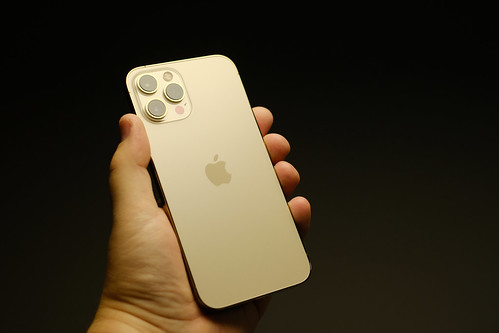
When you take the iPhone 12 Pro Max handset out of the box, you immediately notice its size and weight. It has steep stainless steel sides like an iPhone 4 on steroids.
iPhone 12 Pro Max view from the back of the phone
Usually the heft of a premium phone feels reassuring. But at first, holding the phone was a dissonant experience. There were a few reasons for this:
The change in design language from smooth round edges on handsets from the iPhone 6 onwards, to a flat edge of the iPhone 4 and 5.
It was the first time that an iPhone model has become thicker than the previous generation of iPhone.
The change in design with its thicker flat sides has little difference in putting on a protective case, but removing the case is noticeably harder.
After three days or so usage, the iPhone 12 felt perfectly normal as I got used to it.
Camera
As I said at the outset to this post, this like other modern premium smartphones, are good at taking snapshots. The main difference between my iPhone 11 Max Pro and iPhone 12 Max Pro was a slight increase in optical magnification. The rest of the mild photographic improvements were available in the iOS 14 software for both new and older iPhones.
Networking
The big selling point for Apple on the iPhone 12 Pro Max is its ability use 5G networks. The problem is that for consumers 5G doesn’t have a compelling killer application at the moment.
In that respect, it reminds me a lot of my time working with Cap Gemini as a client when video calling and Quibi like sports and entertainment clips were thought to be the killer app for 3G.
The reality is that it took wi-fi and 4G made video to make calls work, even then the product isn’t perfect. Shorter sellable video content is still looking for a market. 5G does have industrial niche market opportunities. Secondly, 5G network rollout means that there will be probably three generations of future iPhones before the 5G wireless function becomes useful. I still live in a neighbourhood in central London where I often lose 4G coverage. 5G will require many more cell sites to provide the same level of coverage.
Cellphone reception seems to be better; I don’t know if this is down to the handset or my carrier building out their infrastructure further during the lockdown.
My house has never had great cellphone reception during my time living here. It backs on to a railway line with overhead electrification and only had windows the side facing away from the railway. Yet I am now seeing two bars of signal in parts of the house where I previously would only have had Wi-Fi or a single bar of 3G.
Conclusion
Unsurprisingly, the iPhone 12 Pro Max is an accomplished handset. It offers good battery life, responsive performance, a great screen, a good camera and is well made. But there is insufficient reason to upgrade if you have an iPhone made in the last three years. You already have a good well made phone. It has a good camera and will run the latest version of iOS.
If your battery no longer holds the charge, the way it once did, Apple offers a service to replace the battery at a very reasonable cost.
Shenzhen/Huawei: the other Bay Area | Financial Times – The impression of military manoeuvres by alternative means was reinforced by Tencent, another Shenzhen resident. It was among big Chinese social and video platforms including iQiyi and Weibo, that simultaneously cancelled the livecast of Apple’s iPhone 12 launch
Hackers threaten to leak plastic surgery pictures – BBC News – this follows on from the hack on Finnish mental health services. Given the link between plastic surgery and self image; black hat hackers have a lot of sustained leverage. More security related posts here.
Regulators tell Jack Ma’s Ant Group to rectify five problems – the five areas included: Ant’s inadequate governance; regulatory negligence; unlawful profit-seeking; monopolistic practices and; infringement of consumer rights, said China’s central bank vice governor Pan Gongsheng. China orders Ant Group to rein in unfettered expansion as regulators put up fences around financial risks | South China Morning Post – Ant must return to its origins in online payments and prohibit irregular competition, protect customers’ privacy in operating its personal credit rating business, establish a financial holding company to manage its businesses, rectify any irregularities in its insurance, wealth management and credit businesses, and run its asset-backed securities business in accordance with regulations, the People’s Bank of China’s deputy governor Pan Gongsheng said in a statement on Sunday.
The OnlyFans revolution – The Face – Selena suggests we “talk about OF in a way that doesn’t glamourise the economics of the operation”. Instead, we need a more “nuanced conversation about the nuts and bolts of what the actual labour looks like. We aren’t seeing the injustices. It’s either focused on our trauma or on the glamorous hyperbolic examples, while most of us are somewhere in the middle.” There are many sides to running an OnlyFans that are less visible, including work that goes into maintaining a profile and the emotional labour involved in keeping up with fans. Historically, sex workers basically act as ad hoc therapists to their clients – it’s said to come with the territory, from escorting to camming to BDSM. And the “girlfriend experience” applies here too. A key part of the site’s success is one-to-one connection – often creators’ bios will explicitly state they talk with all their followers – for the right brands there is an opportunity for influence campaigns