Amazon Restricts How Rival Device Makers Buy Ads on Its Site – WSJ – interesting that his is confirmed by both according to Amazon employees and executives at rival companies and advertising firms. Would rival device makers have an antitrust case? It would be harder for Amazon to argue that it doesn’t have a monopoly position in retail. More on Amazon here.
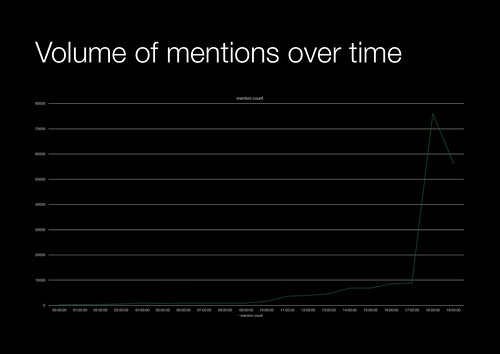
Mark Riston: It’s time for ‘share of search’ to replace ‘share of voice’ – Peckham’s Formula posits that when you launch a brand you should set its advertising budget based on your desired share of market. Specifically, your initial share of voice should be 1.5 times the desired market share you want to achieve by the end of the brand’s second year.
Netflix called out for “Three-Body” author Liu Cixin’s Xinjiang remark — Quartz – Mulan seems to have become a verb in US media in a similar way to ‘it’s all gone Pete Tong’ in late 1980s vernacular English. Although originally ‘gone Pete Tong’ meant that something had gone commercial and mainstream – in effect a sellout, which was a bad thing in the 1990s, when credibility was everything. Netflix might be able to see dramas into China a la the BBC and Sherlock; but I can’t see it being allowed to be a platform. China already has QQVideo iQiyi and PPTV
I first heard of the merge from Sam Altman’s blog. He said that it was a popular topic of conversation in Silicon Valley to guess when (not if) humans and machines will merge. In a meaningful way rather than just a Johnny Mnemonic-style walking data storage unit.
When I heard of this definition of the merge, I immediately thought of the digital series H+.
H+ The Digital Series
H+ told the tale of a technological hack that killed people by disrupting the implants in their heads. Some of the few survivors were out of cellular network reach in the basement of multi-story car park.
He went on to explain that it may not be a hybridisation of humans literally with technology but when humans are surpassed by a rapidly improving (general purpose) AI. The third possibility was a genetically enhanced species surpassing humans in the same way that homo sapiens surpassed the neanderthal.
What’s interesting is that some of the people don’t give ‘the merge’ a name at all. Back during the dot com boom, when Ray Kurzweil published his book Age of Spiritual Machines it was given the name The Singularity.
Part of the resistance to this established term was that The Singularity implies a single point in time. I don’t think Kurzweil meant it in that way. But its been almost 20 years since I read Age of Spiritual Machines, and I suspect most of the debaters have only read about it from a Wikipedia article.
Alton points out that in some ways the merge has been with us for a good while.
The contacts app on our devices and social networks take the place of us remembering telephone numbers. I can remember my parents landline number and the number of the first family doctor that we had. But I wouldn’t be able to tell you my parents current cell phone number; or the number of my current doctor.
On a grander scale; general knowledge and desire to read around has been depreciated by Google and Wikipedia. Our phones, tablets and laptops are not implanted in us, but at least one of them will be seldom out of reach. I learned to touch type and I am now not conscious of how I input the text into this post. It goes from my thought to the screen. Only the noise of the keys gives away illusion of mind control as I stare at the screen. Ironically voice assistance makes me more conscious of ‘the other’ nature of the device.
But it no longer just about memory and our personal connectedness of the devices. Our device control us and suggest what to do and when. Social media platform curation affects how we feel.
As Altman puts it:
We are already in the phase of co-evolution — the AIs affect, effect, and infect us, and then we improve the AI. We build more computing power and run the AI on it, and it figures out how to build even better chips.
This probably cannot be stopped. As we have learned, scientific advancement eventually happens if the laws of physics do not prevent it.
Innovation often spits out the same process in several waves before it works. Before Siri, Alexa and Google home there was Wildfire. Before Wildfire there were various speech recognition technologies including Nuance for call centres, Lernout & Hauspie, Dragon Systems and Kurzweil Computer Systems. The last two were founded in the mid-1970s. SRI International’s AI research started delivering results in the mid 1960s.
AI in its broadest terms has gone through several research booms and busts. The busts have their own name ‘AI winters’. The cadence of progress could easily be far slower than Altman imagines.
One could easily argue that machine learning might run its natural course to technical maturity without much more improvement. Google and other technology companies are basing their work on research done at Canadian universities in the 1980s during an ‘AI winter’ characterised by a lack of basic research funding. Canada continued to support the research when others didn’t.
Silicon Valley companies not engaging in basic research themselves. As Judy Estrin observed in her book Closing The Innovation Gap back in 2008, Silicon Valley no longer engages in ‘hard innovation’. Without that basic research; a general purpose AI envisioned by Kurzweil and Altman maybe out of reach. Which is why Silicon Valley pundits put the merge as somewhere in a 50-year window.
Altman also caveats his prediction based on the laws of physics. Aaron Toponce : The Physics of Brute Force provides an idea of the physical limits imposed by cracking cryptography. It would not be inconceivable that a general purpose AI may hit similar challenges. More on machine learning and innovation here.
LG Launches Hair Growth Helmet to Combat Hair Loss | HYPEBAE – this looks totally legit. NOT. Yes, the FDA has certified other hair growth helmet treatments, but that was to indicate that they wouldn’t harm you or interfere with medications. It doesn’t validate the hair growth helmet actually working. But on the other hand lasers in the helmet….. More beauty category related content here.
Why loneliness fuels populism | Financial Times – depicting loneliness solely in terms of how connected we feel to our friends, neighbours and colleagues risks occluding its other potent forms. Loneliness is political as well as personal, economic as well as social. It is also about feeling disconnected from our fellow citizens and political leaders, and detached from our work and our employer.
“Buy British”: The viability of a nationalist commercial policy | VOX, CEPR Policy Portal – attempts by successive UK governments in the 1970s and early 1980s to initiate such import substitution policies were fraught with economic and legal difficulties. Indeed, accelerating globalisation and the rapid growth of imports in intermediate products for assembly into ‘British’ goods raise significant problems in defining a ‘national’ product – and the growth of tradable services (such as insurance, education and healthcare) presents an even more intractable problem
China has the upper hand in corporate proxy wars with US | Financial Times – Mr Trump gave Mr Xi what he wanted on ZTE — a reprieve in the form of a new US commerce department settlement that allowed it to stay in business — and mistakenly assumed that this concession would smooth over the other matters. China quickly pocketed the ZTE present but continued to withhold approval of the Qualcomm-NXP deal. When the trade talks later started to unravel, Mr Xi let Qualcomm-NXP languish in regulatory limbo, where it eventually died. – Trump gave a concession too early
How a local messaging app defeated WhatsApp in Vietnam – messaging app Zalo has been taking the country by storm for nearly a decade now. Zalo’s got a pretty firm grip on Vietnamese consumers. And now that it’s integrated mobile payment service ZaloPay into its messaging app, there’s plenty of potential for it to expand beyond being just a means of communication.
The landlords are back – The families of China’s pre-Communist elite remain privileged | China | The Economist – The old elite began to suffer almost as soon as the Communist Party won the Chinese civil war in 1949. China’s new rulers quickly set about seizing land from people in the countryside, redistributing it among the landless, confiscating private businesses and executing many rural landlords and people who had worked for the overthrown Nationalist regime
Listen to an unheard Steve Jobs NeXT keynote from 1988 – “But why it matters is that those explorations and that fun were in the end quite significant. It’s always useful to look back and to realize that even though the tech itself might seem quite primitive today, the people were already sophisticated. We know a lot more facts, and we can do more things, but I’m not sure we have gotten that much wiser.”
Frank Herbert was interviewed in 1965 about the origins of Dune. He started researching an article on the control of sand dunes. He makes the fluid mechanics of sand dunes sound fascinating. That was the start point for him creating a science fiction epic. In the interview he covers a wide range of issues including environmentalism, colonialism and philosophy. He also talks about his process of working through is copy as an oral product that happened to be in books.
Herbert is very self aware of his own writing and analytical in his process. He is also critical of people recording, rather than experiencing events. This was fascinating to read some four decades before Instagram culture.
Here is a later talk at UCLA from 1985 with Frank Herbert as a bonus.
Palace the streetwear brand have collaborated with the Happy Mondays for a capsule collection. It’s interesting to see Shaun Ryder and Bez still inspiring and being relevant some 25 years after the peak of their cultural relevance. More streetwear related content here.
https://vimeo.com/457691937
COVID comes to Sesame Street. Oscar The Grouch stars in a mask etiquette. Admittedly this comes with a grouchy reason: that he doesn’t want to see children’s happy smiling faces. Sesame Street hits out of the park again on content.
Sesame Street – wear a mask with Oscar PSA
George Carlin mashed up with Mad Max: Fury Road. It completely changes the feel of the film and is a stinging indictment of human behaviour.
Finally an amazing collection of 1980s TV advertisements and station idents Beta MAX – YouTube. What struck me about this channel was the variety of categories that used television advertising extensively for brand building and activation. Some of the creative would still stand up today and were strikingly similar to work that I did for Unilever.
Hidden Hand is written by two academics. Clive Hamilton is an Australian academic, who is currently professor of public ethics at Charles Sturt University in Canberra. Mareike Ohlberg is a senior fellow in the Asia Programme of the German Marshall Fund. Prior to that she worked for the German think tank; the Mercator Institute of China Studies.
Hidden Hand by Hamilton & Ohlberg (US hardback edition)
Hidden Hand interest piqued
Both of them are seasoned China watchers. China is a popular subject and Hidden Hand would have just gone into my Amazon wishlist but for the 48 Group Club. The 48 Group Club is a British China-orientated association that fosters cultural and social ties. It had threatened legal action over content that they alleged was incorrect or defamatory. My interest in Hidden Hand was piqued.
So What’s it like?
Hamilton and Ohlberg have pulled together an account of China’s relationships with various elites in countries around the world and intergovernmental bodies such as WHO. Having kept an eye on China for over a decade, little of the content was new for me.
What I found was new, was the the way it is woven together in a cohesive pattern of activity in the Hidden Hand. A sustained, pervasive bid for global influence on a scale that most people couldn’t imagine. And those that could imagine would likely be thought of as excessively paranoid.
One thing that immediately comes across is the depth of research that the Hidden Hand contains. The index and bibliography are a big chunk of the book. The facts come thick and fast, but delivered in a dispassionate manner.
The reframe
This book wouldn’t be as well received if it had been published 12 months ago. A split between Wall Street and manufacturing company CEOs, COVID and the steady drip of diplomatic clashes that China has had with western countries have reframed the view for Hidden Hand. Now you have an audience that is more receptive. They are more willing to take an objective, critical analysis of China rather than give them the benefit of the doubt like an errant teenager.
Missing answers
Hidden Hand tries to come up with starting points for answers. Holding elites accountable. Engaging members of the Chinese diaspora. Taking a multilateral stand. All of which are hard to do. There are changes happening to espionage related laws in the UK. The EU is taking a more policy-based approach and Trump administration officials have talked about US CEOs as being unregistered foreign agents. This is a long term battle, something that will go for decades.
The Wall Street CEOs will be hunkering down; hoping to out wait Trump. In Europe and the UK, the root and branch work required to inoculate their countries are not yet underway.
The final missing piece is understanding the first generation Chinese diaspora. In particular the way the communist party has successfully grafted itself into the very centre of what it means to be Chinese. And then thinking carefully about how to decouple that idea. It’s happened already in places like Taiwan (and young Hong Kongers), yet many first generation diaspora and older Chinese Malaysians are wedded to the idea.
I think that would take a lot more research. China must be doing some things right in order to get that level of belief. But there was obviously a problem with the opportunities that China offered. Otherwise why would they come to the West? It must have offered more advantages; how are they opportunities highlighted and put in conflict with the belief in party/ Understanding this will then help the work on protecting the liberal democratic system from infiltration, subversion and exploitation.
An example of that might come from Singapore, which managed to forge a distinct Singaporean identity, whilst still holding the best bits of cultural background. Though there are risks in trying to replicate the Singapore process. More China related content here and more book reviews here.